
Protein waving a PDZ and a RGS domain
a rgs domain and protein technology, applied in the direction of peptide/protein ingredients, depsipeptides, hydrolases, etc., can solve the problems of little knowledge of the specific effect of b ephrin reverse signaling on individual cells, and little functional evidence of the specific significance of combining rgs domains with other domains
Patent Information
- Authority / Receiving Office
- US · United States
- Patent Type
- Patents(United States)
- Current Assignee / Owner
- Publication Date
- 2005-07-19
- Estimated Expiration
- Not applicable · inactive patent
Smart Images
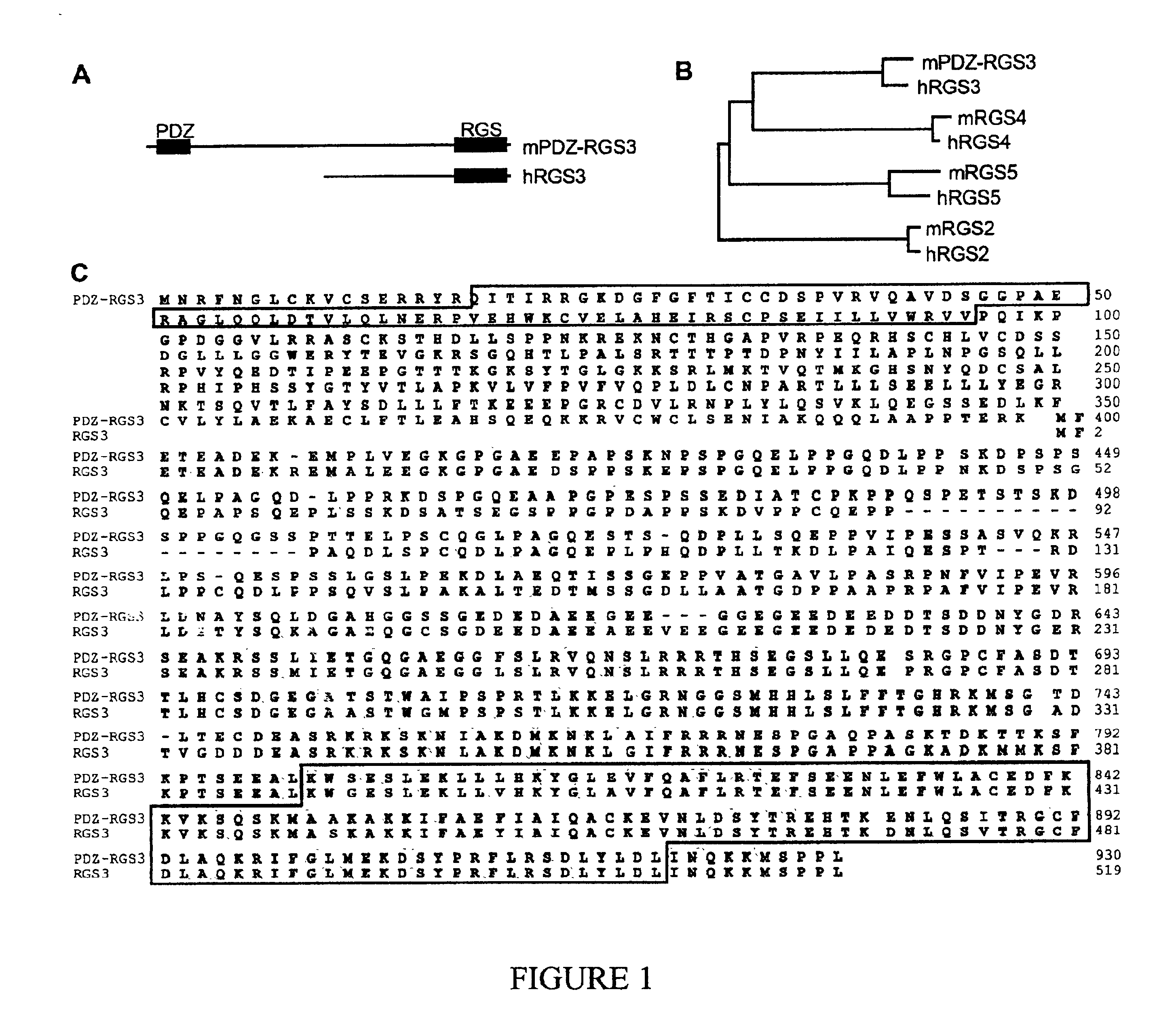
Figure 1 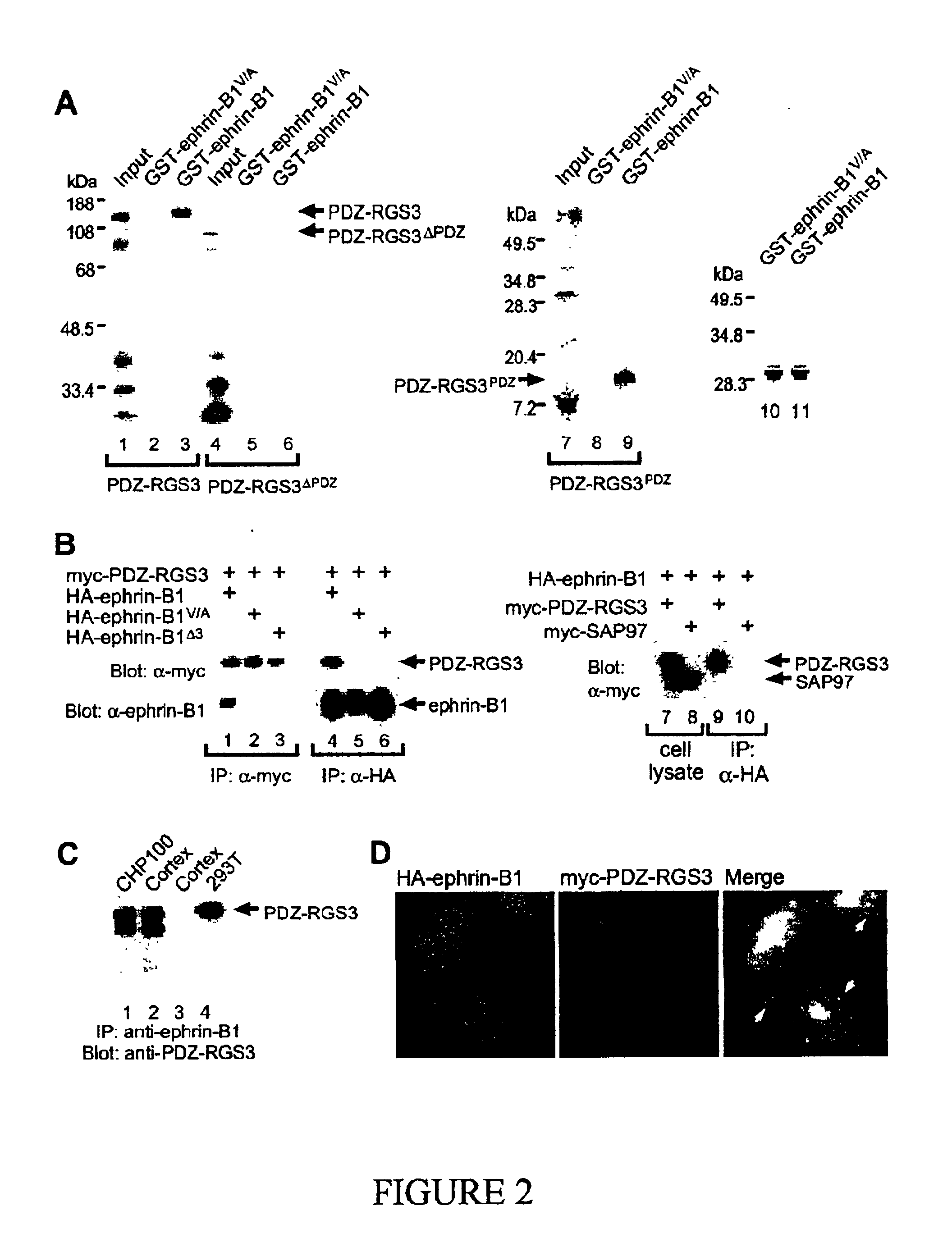
Figure 2 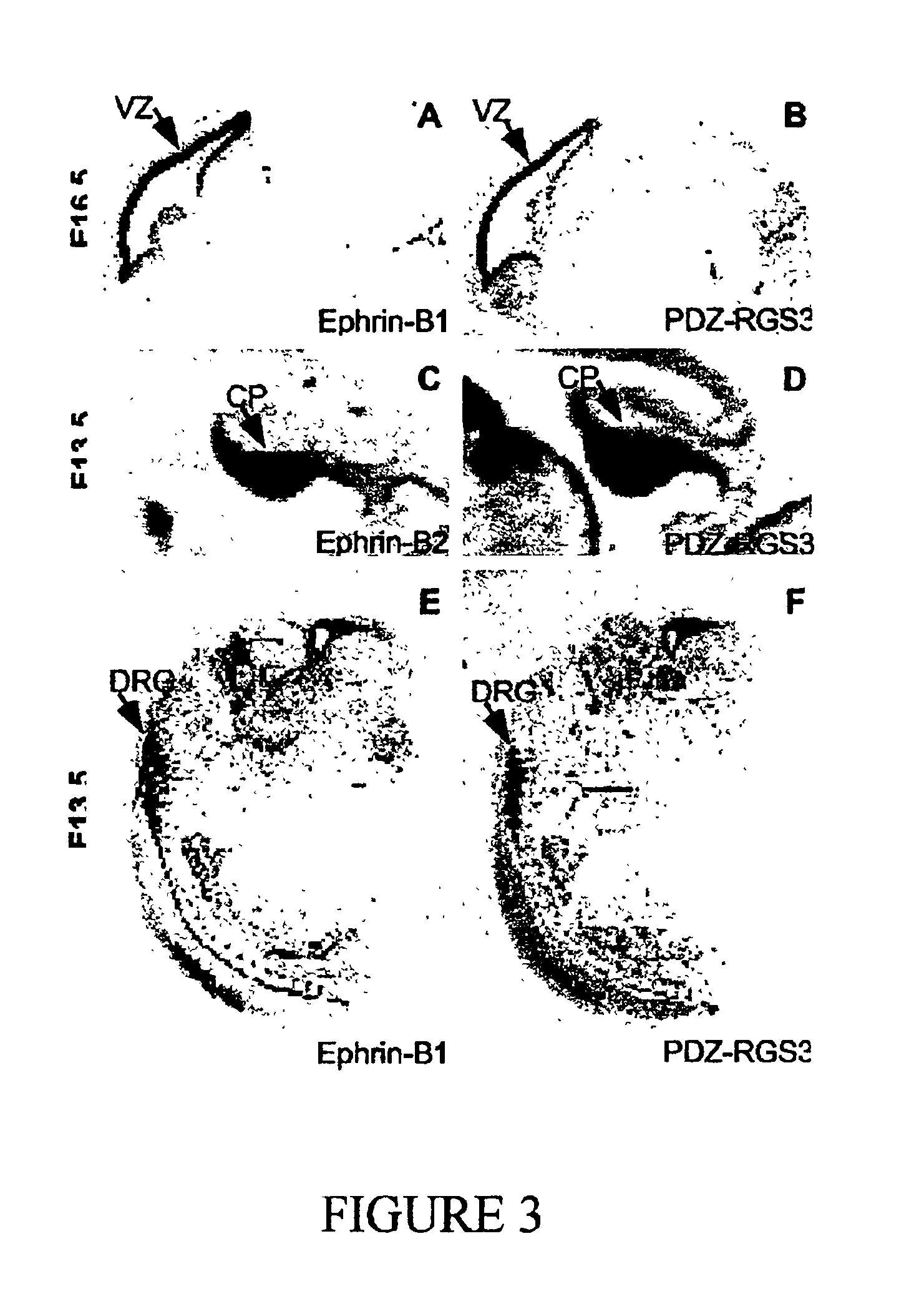
Figure 3
Abstract
Description
CROSS REFERENCE TO RELATED APPLICATION
[0001] This application gains priority from U.S. Provisional Application No. 60 / 280,260, filed Mar. 30, 2001, which is hereby incorporated by reference in its entirety herein.GOVERNMENT FUNDING
[0002] The invention was made in part with government support under grants HD29417 and NS40043 awarded by the National Institutes of Health. The government has certain rights in the invention.TECHNICAL FIELD AND BACKGROUND ART
[0003] The present invention relates to ephrin reverse signaling in vertebrate cells, particularly cerebellar granular cells and leukocytes, the signaling acting through a novel PDZ-RGS protein, to block a heterotrimeric G protein-pathway. This signaling results in inhibition of the chemoattractant effects of a chemokine, in particular, of SDF-1. Methods and compositions for modulation of the pathway provide potential therapeutic agents for inflammation and autoimmune diseases.
[0004] Chemoattractant cytokines or chemokines are a family of...
Examples
example 1
Investigation of Reverse Signaling by B Ephrin
Identification of B Ephrin Binding Proteins
[0090]As a first step to dissect reverse signaling, identification of B ephrin binding proteins was undertaken. Yeast two-hybrid cloning was employed, screening a mouse embryonic cDNA library (Hollenberg, et al., 1995) with the entire cytoplasmic domain of ephrin-B2 as bait. Subsequent studies focused on one of the cDNAs identified, encoding a previously unidentified 930 amino acid protein sequence (FIG. 1). Two motifs were identified in this sequence, a PDZ domain at the N-terminus, and an RGS domain at the C-terminus. The initial screen identified a subfragment containing the PDZ domain, and the rest of the cDNA was then assembled by library screening and polymerase chain reaction (see experimental detail, above). The linkage of PDZ and RGS domains in the same molecule in mouse tissues was confirmed by Northern blot, Western blot and in situ hybridization (experimental procedures and data not ...
example 2
Correlated Expression Patterns in Cerebellar Development and Possible Mechanism for Reverse Signaling
Effect of Soluble EphB Receptor on Isolated Cells and its Role in Neuronal Guidance.
[0101]Identification of PDZ-RGS3, and the demonstration of a role for its RGS domain in the Xenopus assay suggested that one potential mechanism of reverse signaling could be to regulate signaling by a GPCR. If so, B ephrins should be expressed in the same regions as candidate GPCRs. Consequently, the expression of ephrin-B2 and EphB2 in cerebellar granule cells was of particular interest. In mice with gene disruption of SDF-1 or its receptor CXCR4, granule cells migrate prematurely from the external granule cell layer (EGL), indicating SDF-1 normally functions to prevent premature inward migration (Ma et al., 1998; Zou et al., 1998).
[0102]To investigate these ideas further, expression patterns were examined by in situ hybridization. Granule cell migration normally begins around postnatal day 3 (P3) a...
example 3
Effect of PDZ-RGS3 on Leukocyte Migration
Effect of Soluble EphB Recettor on Isolated Cells and its Role in Leukocvte Migration.
[0108]As stated above, identification of PDZ-RGS3, and the demonstration of a role for its RGS domain in the Xenopus assay suggested that one potential mechanism of reverse signaling was to regulate signaling by a GPCR (G protein-coupled receptor). Recently, Wu et al., Nature, 410, 948 (2001), showed that the secreted protein Slit, previously known for its role of repulsion in axon guidance and neuronal migration, also inhibited leukocyte chemotaxis induced by chemotactic factors, i.e. chemokines.
Regulation of Cerebellar Granule Cell Chemoattraction
[0109]To investigate this concept with PDZ-RGS3 protein, a transwell system is assembled wherein the effect of leukocyte migration, in the presence of an appropriate chemokine such as SDF-1 with or without PDZ-RGS3 protein, is monitored.
[0110]To test functionally for an interaction of the GPCR ephrin B and SDF-1, ...