
Lubricating micro-machined devices using fluorosurfactants
Patent Information
- Authority / Receiving Office
- US · United States
- Current Assignee / Owner
- Publication Date
- 2007-11-06
Smart Images
Figure 1 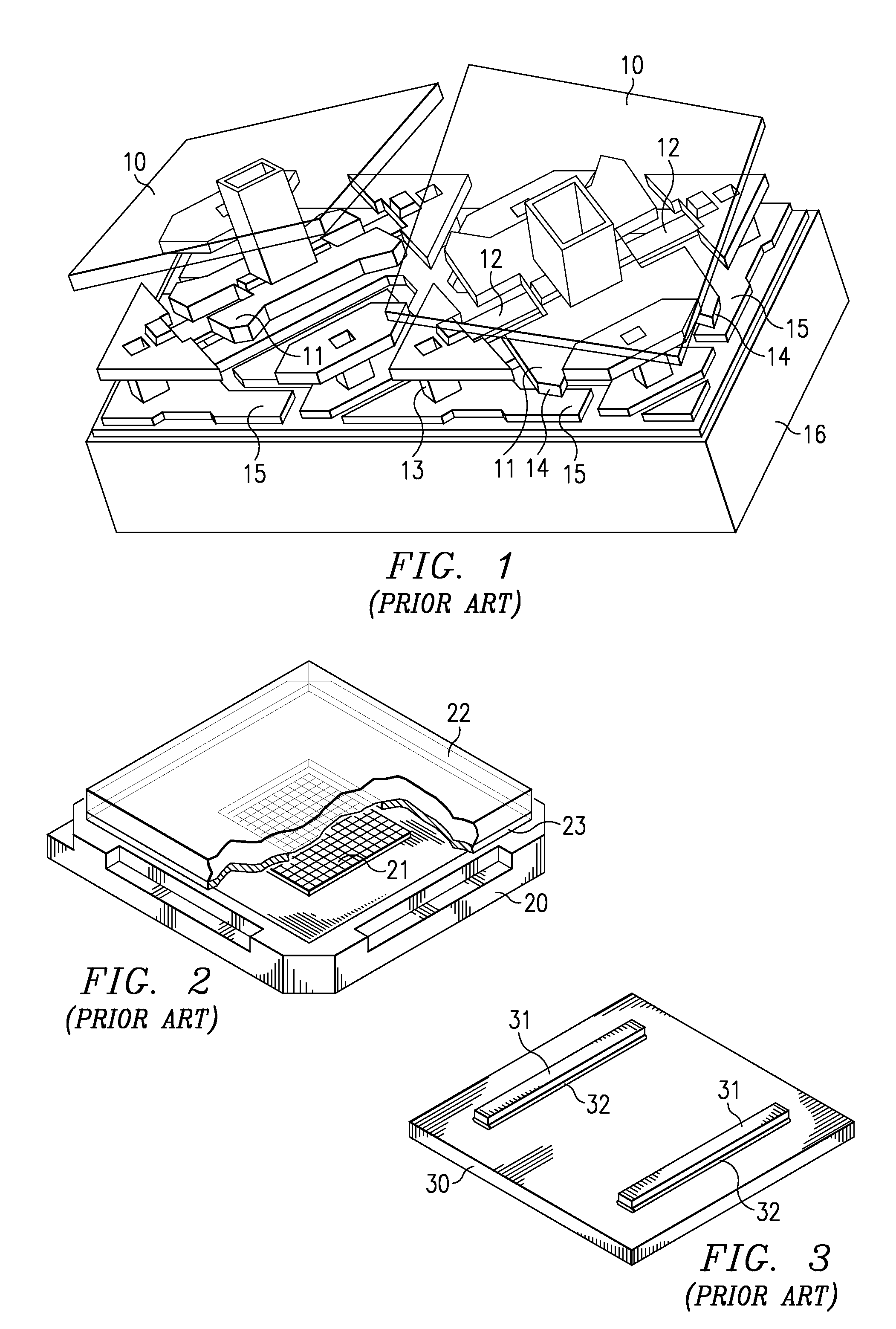
Figure 2 
Figure 3
Abstract
Description
[0001] This application claims priority under 35 USC§ 119(e)(1) of provisional application No. 60 / 301,984 filed Jun. 3, 2001.FIELD OF THE INVENTION
[0002] The present invention relates to micro-electro-mechanical systems (MEMS) devices and particularly to lubricating the surfaces of the moving parts in such devices.BACKGROUND OF THE INVENTION
[0003] Micro-machined or micro-electro-mechanical systems (MEMS) devices, where there is repeated physical contact between moving parts, require lubrication to prevent the onset of stiction (static friction). This stiction can be strong enough to cause the parts to stick irreversibly together, making the devices inoperable.
[0004] For example, in the digital micromirror device (DMD™) of FIG. 1, which is one type of a MEMS device, the mirror / yoke 10 / 11 assemblies rotate on torsion hinges 12 attached to support posts 13 until the yoke tips 14 contact (land on) landing pads 15 located on a lower substrate layer 16. It is this mechanical contact between t...
Examples
Embodiment Construction
[0021]The present invention uses a fluorosurfactant to lubricate the moving parts of a MEMS device. These fluorosurfactants are readily available materials that can be applied to the surfaces of the devices by a nebulization procedure, which is akin to spraying it on but with very small particles of the material. These lubricants, which are non-corrosive and very compatible with the MEMS fabrication process, remain robust over long extended periods of time.
[0022]FIG. 4 is a sketch describing the fluorosurfactant 42 of the present invention. The surfactant 42 contains a hydrophillic 40 (water like) chain or tail attached to a hydrophobic 41 fluorocarbon tail. While the hydrophillic 40 regions are capable of uniting with or taking up water, the hydrophobic fluorocarbon 41 regions do not take up water, but contain non-reactive halo-carbons; i.e., such as carbon, fluorine, and in some cases hydrogen.
[0023]When applied to a MEMS device, the surfactant molecules will display some degree o...