
Segmenting audio signals into auditory events
a technology of audio signals and segments, applied in the field of psychoacoustic processing of audio signals, can solve the problems of computational complexity, specialized techniques for sound separation, and the practicability of auditory scene analysis, and achieve the effect of reducing the number of audio signals
Patent Information
- Authority / Receiving Office
- US · United States
- Patent Type
- Patents(United States)
- Current Assignee / Owner
- Publication Date
- 2010-05-04
- Estimated Expiration
- Not applicable · inactive patent
Smart Images
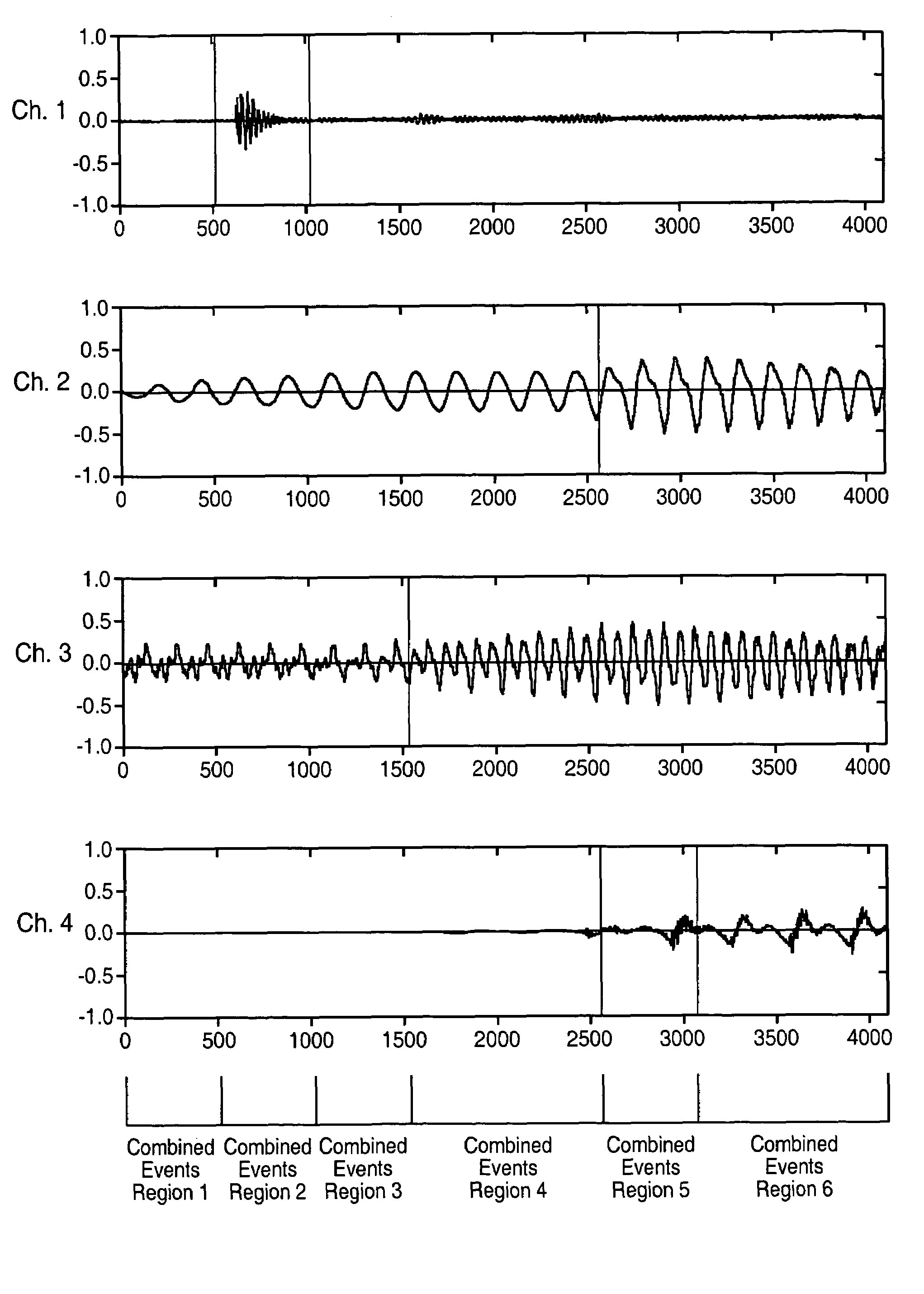
Figure 1 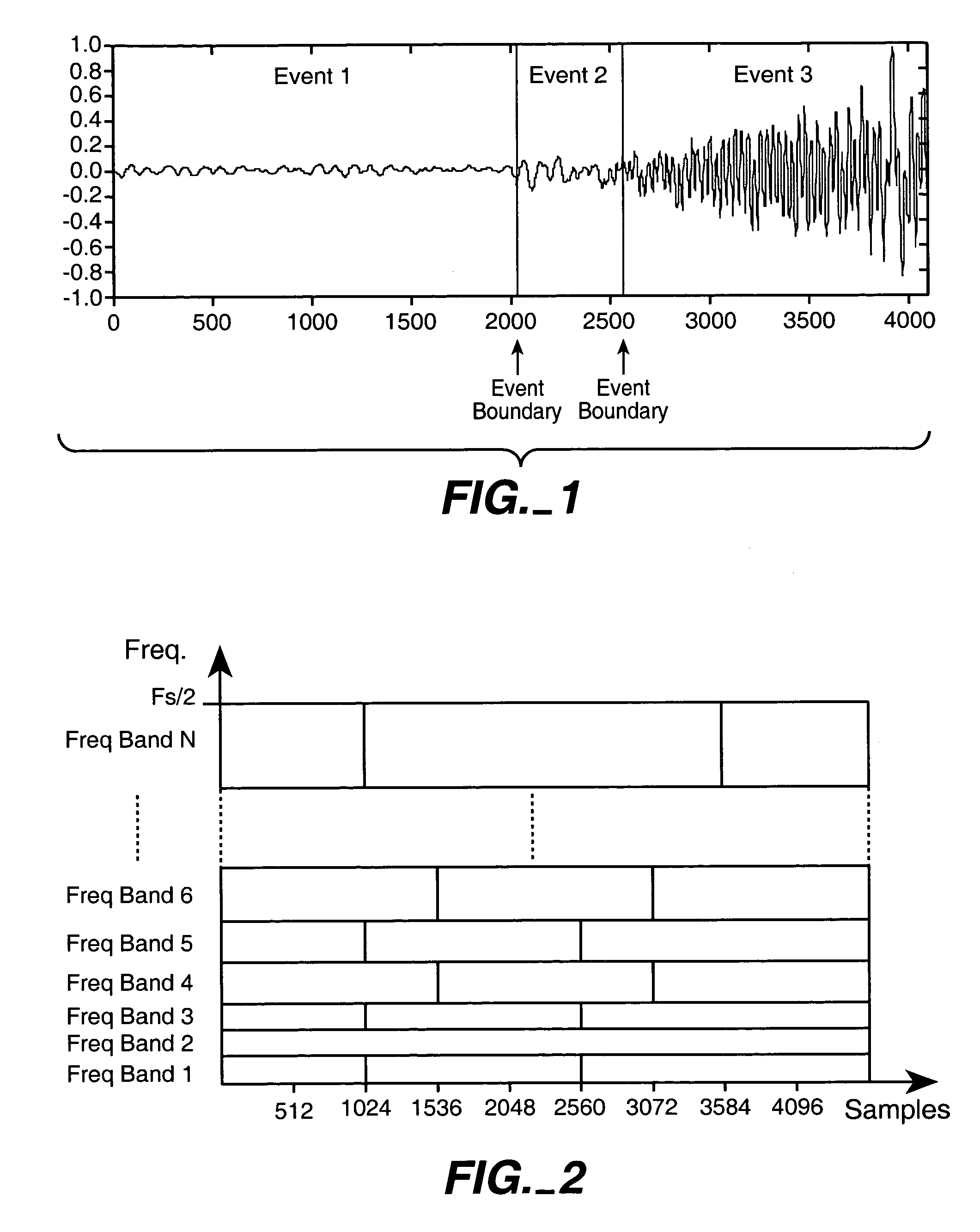
Figure 2 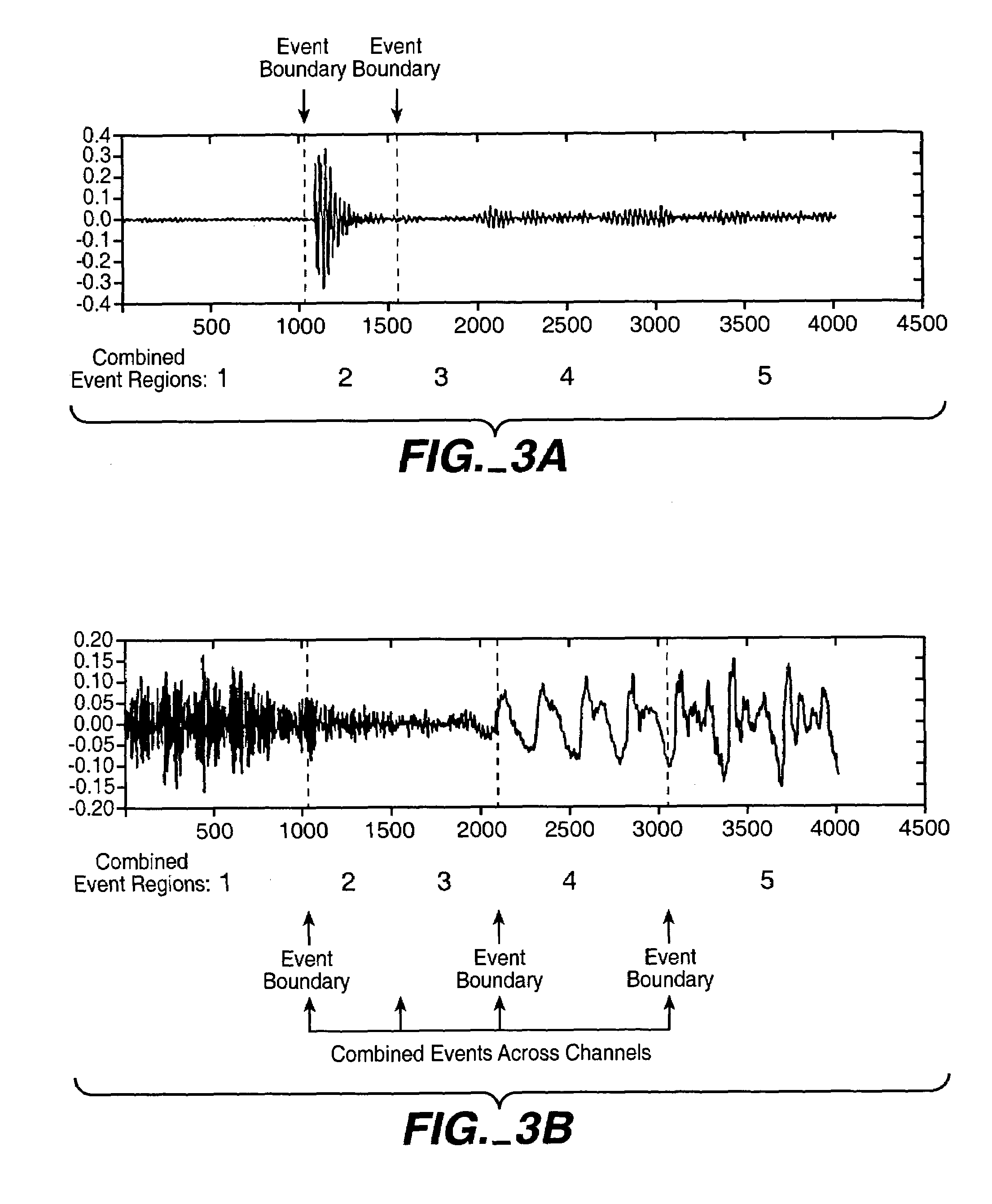
Figure 3
Abstract
Description
CROSS-REFERENCES TO RELATED APPLICATIONS AND PATENTS
[0001] The present application is related to United States Non-Provisional Patent Application Ser. No. 10 / 474,387, entitled “High Quality Time-Scaling and Pitch-Scaling of Audio Signals,” by Brett Graham Crockett, filed Oct. 7, 2003, published as US 2004 / 0122662 on Jun. 24, 2004, The PCT counterpart application was published as WO 02 / 084645 A2 on Oct. 24, 2002.
[0002] The present application is also related to United States Non-Provisional Patent Application Ser. No. 10 / 476,347, entitled “Improving Transient Performance of Low Bit Rate Audio Coding Systems by Reducing Pre-Noise,” by Brett Graham Crockett, filed Oct. 28, 2003, published as US 2004 / 0133423 on Jul. 8, 2004, now U.S. Pat. No. 7,313,519. The PCT counterpart application was published as WO 02 / 093560 on Nov. 21, 2002.
[0003] The present application is also related to United States Non-Provisional Patent Application Ser. No. 10 / 478,397, entitled “Comparing Audio Using Character...
Examples
Embodiment Construction
[0045]In accordance with an embodiment of one aspect of the present invention, auditory scene analysis is composed of three general processing steps as shown in a portion of FIG. 5. The first step 5-1 (“Perform Spectral Analysis”) takes a time-domain audio signal, divides it into blocks and calculates a spectral profile or spectral content for each of the blocks. Spectral analysis transforms the audio signal into the short-term frequency domain. This can be performed using any filterbank, either based on transforms or banks of bandpass filters, and in either linear or warped frequency space (such as the Bark scale or critical band, which better approximate the characteristics of the human ear). With any filterbank there exists a tradeoff between time and frequency. Greater time resolution, and hence shorter time intervals, leads to lower frequency resolution. Greater frequency resolution, and hence narrower subbands, leads to longer time intervals.
[0046]The first step, illustrated c...