
Production method of pure metal/alloy super-micro powder
a production method and super-micro powder technology, applied in the field of pure metal/alloy super-micro powder production method, can solve the problems of complex reaction, increased production cost, and difficult control of reaction, and achieve the effects of reducing production cost, reducing production cost, and reducing production cos
Patent Information
- Authority / Receiving Office
- US · United States
- Patent Type
- Patents(United States)
- Current Assignee / Owner
- Publication Date
- 2010-09-21
- Estimated Expiration
- Not applicable · inactive patent
Smart Images
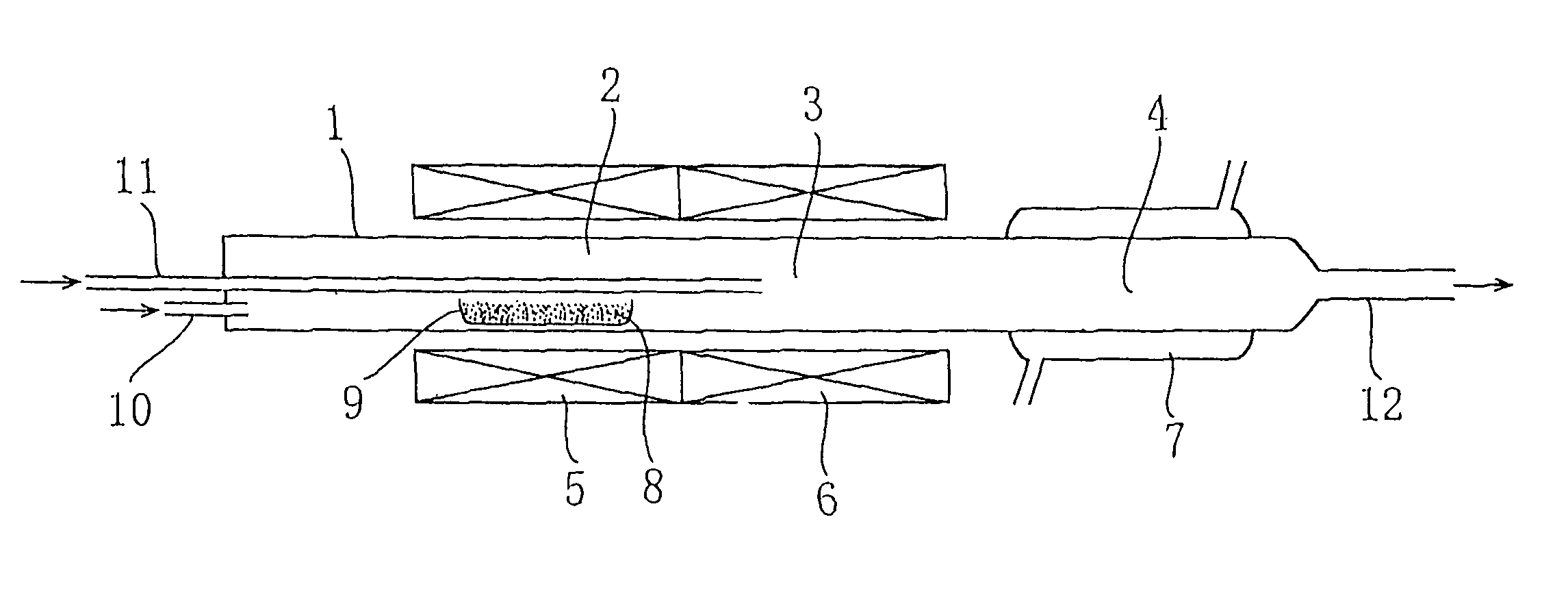
Figure 1 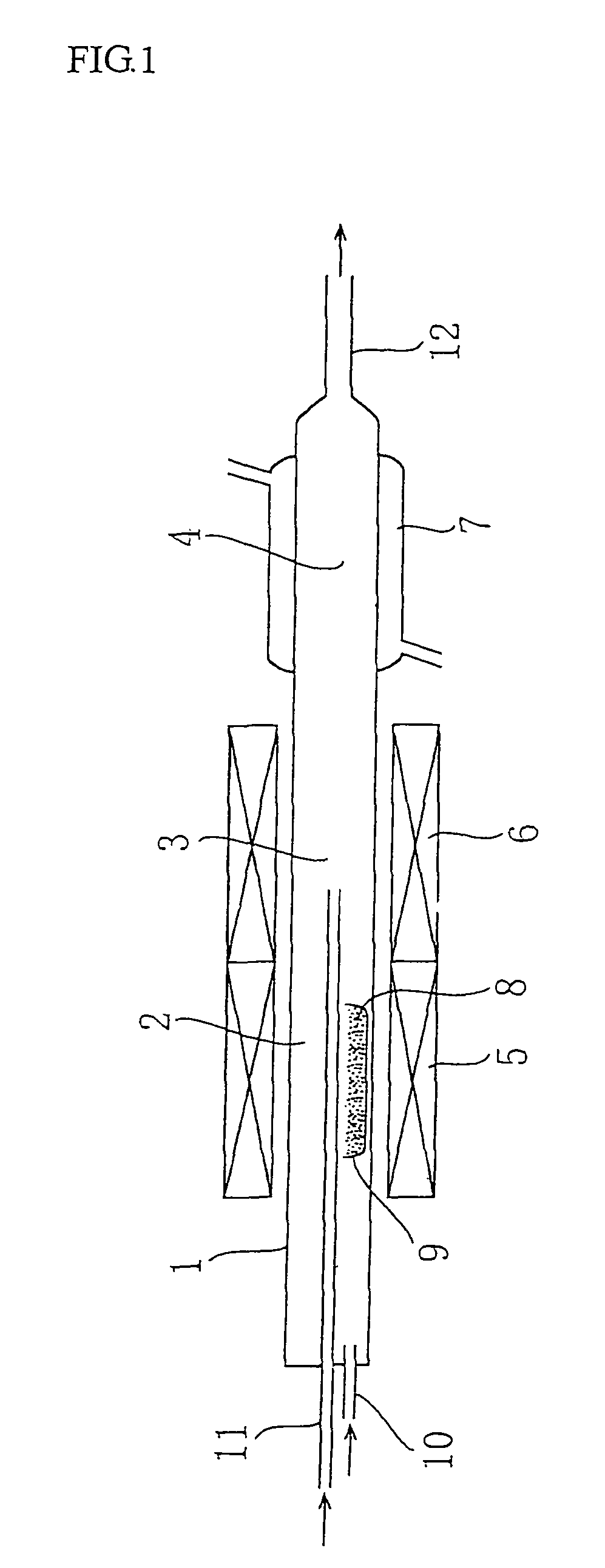
Figure 2 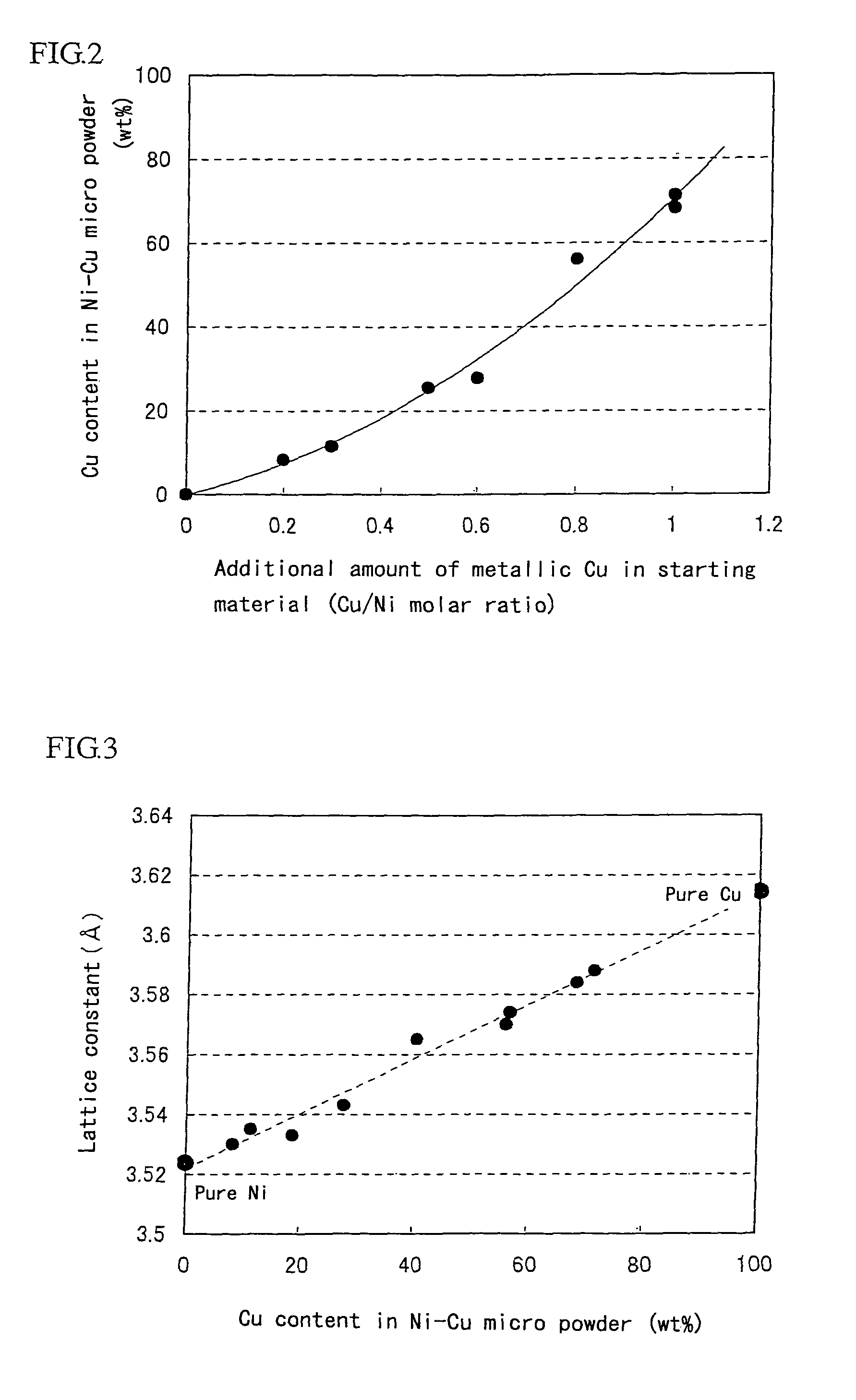
Figure 3
Abstract
Description
TECHNICAL FIELD
[0001] This invention proposes a method of producing pure metal and alloy super-micro powders used in an internal electrode for multilayered ceramic capacitor, an electrode for nickel-hydrogen cell and another electrode or the like.BACKGROUND ART
[0002] A metal powder having an electric conductivity such as Ni, Cu, Ag or the like is used as a material forming an internal electrode for multilayered ceramic capacitor, a porous electrode for nickel-hydrogen secondary cell, a hollow porous electrode for fuel cell, an electrode for other electron parts, or the like. Particularly, metal super-micro powder having a particle size of not more than 0.4 μm is good in the paste nature and is possible to form a fine pattern of a conductor portion or thin the thickness thereof, so that it is rapidly increasing as a demand for the formation of conductors in an electron circuit.
[0003] As a production method of the metal super-micro powder are known an evaporation process in gas, an evapo...
Examples
example 1
[0043]Fe super-micro powder is produced by using a trial apparatus for metal super-micro powder shown in FIG. 1. In the production, ferric chloride as a metal chloride is mixed with metallic iron powder as an elementary metal and the resulting mixture is used as a starting material. A predetermined amount of the starting material is charged into a starting material evaporation vessel, and after an evaporation furnace and a reduction furnace are set to given temperatures, the starting material evaporation vessel is pushed toward an evaporation part of a reactor while flowing carrier gas (Ar gas) and reducing gas (H2 gas), in which vapor of iron chloride generated from the evaporation vessel is transferred to a reducing part with the carrier gas and reduced by the hydrogen gas to produce iron super-micro powder. The production conditions and the results are shown in Table 3. As seen from the results, the invention can be also applied to the production of metal super-micro powder other...
example 2
[0045]Super-micro powder of Ni alloy is produced by using a trial apparatus for metal super-micro powder shown in FIG. 1. In the starting material, nickel chloride (NiCl2) is used as a metal chloride, and powders of metallic Mo, Nb and Co are used as a metal of an alloying component. The production conditions and the analytical results of the resulting powder components are shown in Table 4. As seen from this table, the target metal components (Mo, Nb, Co) are included in the resulting powder, and the content thereof is high as the compounding amount in the starting material (molar ratio) becomes larger. In FIG. 4 are shown the results in case of using metallic Co powder, which shows that the Co content in the super-micro powder is well interrelated to the amount of metallic Co added in the starting material and the control of the composition can be conducted precisely. Also, the resulting powder is subjected to an X-ray diffractometry to measure a lattice constant, whereby the powd...
example 3
[0047]Super-micro powder of Ni—W—Fe three-component alloy is produced by using a trial apparatus for metal super-micro powder shown in FIG. 1. In the starting material, nickel chloride (NiCl2) is used as a metal chloride, and metallic W and Fe powders are used as a metal of alloying component. The production conditions and the analytical results of the resulting powder are shown in Table 5. From the table, it can be seen that the target metal components (W, Fe) are included in the resulting powder. Also, the resulting powder is subjected to an X-ray diffractometry to measure a lattice constant, whereby the powder is confirmed to be alloyed. These results show that the invention can be applied to the production of super-micro powders of not only two-component system but also three-component system.
[0048]
TABLE 5Starting materials chargedAverageA:B:C:Flow amountFlow amountAmount ofAlloyparticleNickelWFeEvaporationReactionof carrierof hydrogenresultingcompositionsize ofchloridepowderpow...