
Method for preparing selenyl-substituted aromatic aldehyde compounds
a technology of aromatic aldehyde and substituted selenyl, which is applied in the field of selenyl can solve the problems of difficult to obtain selenyl-substituted aromatic aldehyde compounds by the above-described conventional methods, and most of these catalystic processes need to be carried out under harsh reaction conditions, so as to achieve easy handling, increase the yield of selenyl-
Patent Information
- Authority / Receiving Office
- US · United States
- Patent Type
- Patents(United States)
- Current Assignee / Owner
- Publication Date
- 2015-09-15
Smart Images
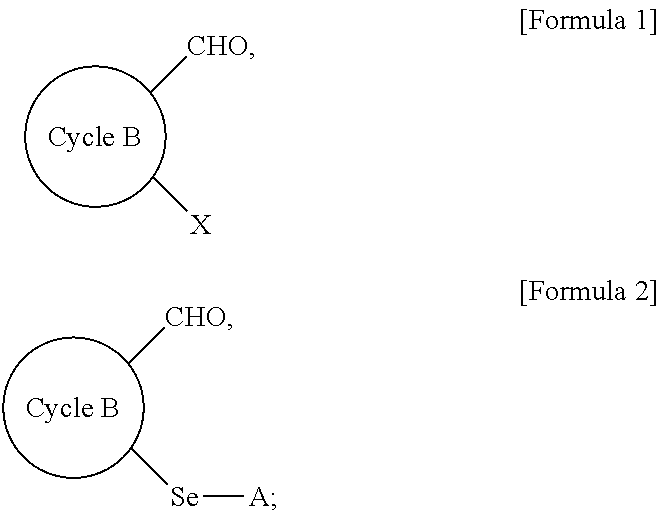
Figure 1 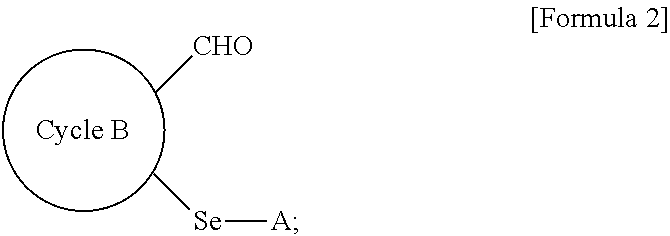
Figure 2 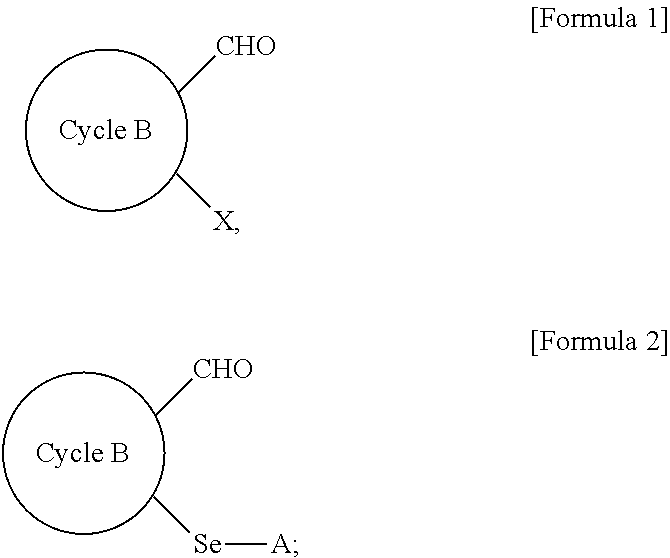
Figure 3
Abstract
Description
FIELD OF THE INVENTION
[0001] The present disclosure relates to a novel method for preparing selenyl-substituted aromatic aldehyde compounds by forming a selenolate nucleophile and performing a nucleophilic substitution reaction between the selenolate nucleophile and an aromatic aldehyde starting material.BACKGROUND OF THE INVENTION
[0002] Recently, Chalcogen chemistry has attracted great attention in the field of organic chemistry. In particular, a biological activity of selenium (Se) has been at the center of attention. Since ebselene(2-phenylbenzisoselenazol-3(2H)-one as a nontoxic glutathione peroxide analogue was synthesized first, considerable efforts have been made to develop stable organic selenium compounds.
[0003] Of the organic selenium compounds, a selenyl-substituted aromatic aldehyde compound can serve as an intermediate for synthesizing benzoselenophenes having various biological activities. The selenyl-substituted aromatic aldehyde compound can be obtained by performing a ...
Examples
experimental example 1
[0097]
[0098]In Experimental Example 1, dimethyldiselenide (DMDS, MeSeSeMe) was used as the diselenide compound, and 5-nitro-2-chloro-benzaldehyde was used as the aromatic aldehyde starting material to prepare 2-methylselenyl-5-nitro-benzaldehyde as shown in the above reaction formula. The other materials, i.e. the solvent, the reducing agent, and the base, were not limited in kind and various kinds thereof were used for the experiment. Differences in % yield of the product caused by such differences in reaction conditions are shown in the following Table 1:
[0099]
TABLE 1ReducingDMDSagentTimeTemp.ProductEntry(eq.)(eq.)Base(eq.)Solvent(h)(° C.)(% yield)11NaBH4 (1)NaOEtEtOH5600(ComparativeExample)22NaBH4 (2)—EtOH24Room3(ComparativetemperatureExample)(RT)32NaBH4 (2)—DMF24RT5(ComparativeExample)41NaBH4 (1)—THF6600(ComparativeExample)51—K2CO3DMF14 0—(Comparative(2.5)Example)61DTT (1)NaOEt (2)EtOH4RT85(Example)71DTT (2)NaOEt (2)DMF1RT85(Example)81.2DTT (1)K2CO3DMF1RT85(Example)(2.5)91.2DTT ...
experimental example 2
[0103]
[0104]In Experimental Example 2, dimethyldiselenide (DMDS, MeSeSeMe) was used as the diselenide compound, and 4,5-methylenedioxy-2-bromo-benzaldehyde was used as the aromatic aldehyde starting material to prepare 4,5-methylenedioxy-2-methylselanyl-benzaldehyde as shown in the above reaction formula. The other materials, i.e. the solvent, the reducing agent, and the base, were not limited in kind and various kinds thereof were used for the experiment. Differences in % yield of the product caused by such differences in reaction conditions are shown in the following Table 2:
[0105]
TABLE 2EntryReducingBaseDMDSTimeTemperatureProduct(Example)agent(eq.)(eq.)Solvent(eq.)(h)(° C.)(% yield)1DTT (1)NaOEtEtOH124RT—(2)2DTT (1)NaOEtDMF124RT—(2)3DTT (1)NaOEtDMF12460—(2)4DTT (1)DBU (2)DMF11RT805DTT (1)DBUDMF1.21RT82(2.5)6N-DBUDMF1.53RT56acetylcysteine(2.5)(2)71,4-DBUDMF1.53RT60butanedithiol(2.5)(2)
[0106]As can be seen from Table 2, for Entry 1 to Entry 3, dithiothreitol (DTT) was used as the r...
experimental example 3
[0110]In Experimental Example 3, dithiothreitol (DTT) was used as the reducing agent and dimethylformaldehyde (DMF) was used as the solvent to prepare a selenyl-substituted aromatic aldehyde compound. The diselenide compound as represented by general formula A-Se—Se-A, the aromatic aldehyde starting material, and the base were not limited in kind and various kinds thereof were used for the experiment.
[0111]To be specific, as the diselenide compound, dimethyldiselenide having a methyl group (Me) as the functional group A, diphenyldiselenide having a phenyl group (Ph) as the functional group A, or dibenzyldiselenide having a benzyl group (Bn) as the functional group A was used. As the aromatic aldehyde starting material, various aromatic aldehyde materials having an electron donating substituent or an electron withdrawing substituent were used. Formulas thereof are provided in the following Table 3. Further, as the base, K2CO3 as a weak base or DBU as a strong base was used. In all ca...