

Analyzing OLED vs MicroLED for Enhanced Color Accuracy
OCT 24, 20259 MIN READ
Generate Your Research Report Instantly with AI Agent
PatSnap Eureka helps you evaluate technical feasibility & market potential.
Display Technology Evolution and Objectives
Display technology has undergone remarkable evolution since the introduction of cathode ray tubes (CRTs) in the early 20th century. The progression from CRTs to liquid crystal displays (LCDs) marked the first significant shift toward flatter, more energy-efficient screens. This transition was followed by the development of plasma display panels, which offered improved contrast ratios and viewing angles but struggled with power consumption and screen burn-in issues.
The introduction of Organic Light-Emitting Diode (OLED) technology in the early 2000s represented a revolutionary advancement in display technology. Unlike LCDs that require backlighting, OLED pixels emit their own light when electrical current passes through organic compounds, enabling true blacks, superior contrast ratios, and thinner form factors. This self-emissive property has made OLED displays particularly valuable for applications requiring high color accuracy and dynamic range.
More recently, MicroLED has emerged as a promising next-generation display technology. Developed initially for large-format displays, MicroLED utilizes microscopic inorganic LED arrays that, like OLEDs, are self-emissive. However, MicroLED offers several potential advantages over OLED, including higher brightness, longer lifespan, and improved energy efficiency, while maintaining comparable color accuracy capabilities.
The technical evolution of these display technologies has been driven by increasing demands for higher resolution, better color reproduction, reduced power consumption, and enhanced form factors across various applications including smartphones, televisions, and professional monitors. Color accuracy, in particular, has become a critical performance metric as content creation and consumption standards have risen across industries.
The primary objective in comparing OLED and MicroLED technologies for enhanced color accuracy is to determine which technology can better meet the growing demands of professional and consumer markets that require precise color reproduction. This includes evaluating each technology's ability to accurately represent color spaces such as sRGB, Adobe RGB, DCI-P3, and Rec. 2020, as well as their capacity for high dynamic range (HDR) content.
Additional technical objectives include assessing color stability over time, color consistency across viewing angles, and color performance under varying ambient lighting conditions. For professional applications in fields such as graphic design, video production, and medical imaging, the ability to maintain calibrated color accuracy over extended periods is particularly crucial.
The ultimate goal of this technical research is to provide a comprehensive understanding of how OLED and MicroLED technologies compare in terms of color accuracy capabilities, identifying their respective strengths and limitations to guide future development efforts and application-specific implementations. This analysis will inform strategic decisions regarding which technology to prioritize for different market segments and use cases where color fidelity is paramount.
The introduction of Organic Light-Emitting Diode (OLED) technology in the early 2000s represented a revolutionary advancement in display technology. Unlike LCDs that require backlighting, OLED pixels emit their own light when electrical current passes through organic compounds, enabling true blacks, superior contrast ratios, and thinner form factors. This self-emissive property has made OLED displays particularly valuable for applications requiring high color accuracy and dynamic range.
More recently, MicroLED has emerged as a promising next-generation display technology. Developed initially for large-format displays, MicroLED utilizes microscopic inorganic LED arrays that, like OLEDs, are self-emissive. However, MicroLED offers several potential advantages over OLED, including higher brightness, longer lifespan, and improved energy efficiency, while maintaining comparable color accuracy capabilities.
The technical evolution of these display technologies has been driven by increasing demands for higher resolution, better color reproduction, reduced power consumption, and enhanced form factors across various applications including smartphones, televisions, and professional monitors. Color accuracy, in particular, has become a critical performance metric as content creation and consumption standards have risen across industries.
The primary objective in comparing OLED and MicroLED technologies for enhanced color accuracy is to determine which technology can better meet the growing demands of professional and consumer markets that require precise color reproduction. This includes evaluating each technology's ability to accurately represent color spaces such as sRGB, Adobe RGB, DCI-P3, and Rec. 2020, as well as their capacity for high dynamic range (HDR) content.
Additional technical objectives include assessing color stability over time, color consistency across viewing angles, and color performance under varying ambient lighting conditions. For professional applications in fields such as graphic design, video production, and medical imaging, the ability to maintain calibrated color accuracy over extended periods is particularly crucial.
The ultimate goal of this technical research is to provide a comprehensive understanding of how OLED and MicroLED technologies compare in terms of color accuracy capabilities, identifying their respective strengths and limitations to guide future development efforts and application-specific implementations. This analysis will inform strategic decisions regarding which technology to prioritize for different market segments and use cases where color fidelity is paramount.
Market Demand for High Color Accuracy Displays
The display industry has witnessed a significant surge in demand for high color accuracy displays across multiple sectors. Professional markets, including content creation, photography, film production, and graphic design, have consistently driven this demand as color-critical workflows require displays that can faithfully reproduce the intended visual experience. Recent market research indicates that the professional display segment values color accuracy as the primary purchasing factor, even above resolution or brightness capabilities.
Consumer markets are increasingly recognizing color accuracy as a differentiating feature in premium devices. Smartphone manufacturers have begun highlighting color accuracy metrics in marketing materials, with flagship devices now routinely advertising 100% DCI-P3 coverage and Delta-E values below 1.0. This trend extends to high-end televisions and monitors, where consumers are becoming more discerning about color reproduction quality.
Healthcare represents another crucial market segment demanding precise color reproduction. Medical imaging diagnostics require displays with exceptional color accuracy to ensure proper interpretation of scans and test results. The regulatory environment in this sector is increasingly mandating specific color accuracy standards for displays used in diagnostic applications.
Market analysis reveals that the global market for high color accuracy displays is expanding at a compound annual growth rate of approximately 12%, outpacing the overall display market growth. This acceleration is partly attributed to the rising adoption of content creation tools among prosumers and the growing popularity of HDR content consumption, both of which benefit from accurate color reproduction.
The automotive industry has emerged as a new frontier for high-accuracy displays, with in-vehicle information systems and digital dashboards requiring consistent color reproduction across varying lighting conditions. As autonomous driving technologies advance, the importance of accurate visual information display increases proportionally.
E-commerce platforms have also recognized the value of color accuracy, as inconsistent product representation leads to higher return rates. This has created demand for color-accurate displays throughout the supply chain, from product photography to consumer devices.
The entertainment and gaming sectors show strong preference for displays that can accurately render expanded color gamuts, with particular emphasis on OLED and emerging MicroLED technologies. Gaming monitors with high color accuracy are commanding premium prices, indicating consumers' willingness to pay for enhanced visual experiences.
Consumer markets are increasingly recognizing color accuracy as a differentiating feature in premium devices. Smartphone manufacturers have begun highlighting color accuracy metrics in marketing materials, with flagship devices now routinely advertising 100% DCI-P3 coverage and Delta-E values below 1.0. This trend extends to high-end televisions and monitors, where consumers are becoming more discerning about color reproduction quality.
Healthcare represents another crucial market segment demanding precise color reproduction. Medical imaging diagnostics require displays with exceptional color accuracy to ensure proper interpretation of scans and test results. The regulatory environment in this sector is increasingly mandating specific color accuracy standards for displays used in diagnostic applications.
Market analysis reveals that the global market for high color accuracy displays is expanding at a compound annual growth rate of approximately 12%, outpacing the overall display market growth. This acceleration is partly attributed to the rising adoption of content creation tools among prosumers and the growing popularity of HDR content consumption, both of which benefit from accurate color reproduction.
The automotive industry has emerged as a new frontier for high-accuracy displays, with in-vehicle information systems and digital dashboards requiring consistent color reproduction across varying lighting conditions. As autonomous driving technologies advance, the importance of accurate visual information display increases proportionally.
E-commerce platforms have also recognized the value of color accuracy, as inconsistent product representation leads to higher return rates. This has created demand for color-accurate displays throughout the supply chain, from product photography to consumer devices.
The entertainment and gaming sectors show strong preference for displays that can accurately render expanded color gamuts, with particular emphasis on OLED and emerging MicroLED technologies. Gaming monitors with high color accuracy are commanding premium prices, indicating consumers' willingness to pay for enhanced visual experiences.
OLED vs MicroLED: Technical Challenges
Both OLED and MicroLED technologies face significant technical challenges in their pursuit of enhanced color accuracy. OLED (Organic Light Emitting Diode) technology, despite its maturity in the market, continues to struggle with several inherent limitations. The organic materials used in OLED displays are susceptible to degradation over time, particularly the blue subpixels which typically degrade faster than red and green counterparts. This differential aging leads to color shifts and reduced accuracy as displays age.
Another critical challenge for OLED is brightness limitation. While OLED excels in producing deep blacks by completely turning off pixels, it struggles to achieve the high brightness levels necessary for HDR content and visibility in bright environments. This brightness ceiling constrains the dynamic range and consequently impacts color volume representation.
Power efficiency remains problematic for OLED, especially when displaying bright content. The technology's power consumption increases linearly with brightness, leading to potential thermal issues that can further accelerate degradation and color shifting. Additionally, OLED displays often implement aggressive brightness limiting algorithms to protect panel longevity, which can compromise color accuracy in high-brightness scenarios.
MicroLED technology, while promising superior theoretical performance, faces its own set of formidable challenges. The manufacturing process for MicroLED displays involves transferring millions of microscopic LED chips with extreme precision. Current mass transfer techniques struggle with yield rates, particularly as pixel densities increase for higher resolution displays. Even minor defects in placement can result in visible color inconsistencies.
Color uniformity presents another significant hurdle for MicroLED. Each tiny LED must perform identically to its neighbors to maintain consistent color reproduction across the display. Manufacturing variations in the semiconductor materials can lead to brightness and color differences between individual LEDs, requiring sophisticated compensation algorithms.
The miniaturization of LEDs introduces quantum efficiency droop, where efficiency decreases as current density increases in smaller LEDs. This phenomenon affects different colored LEDs disproportionately, creating challenges for maintaining color balance across brightness levels. Furthermore, as LEDs shrink to microscopic sizes, surface defects become proportionally more significant, potentially affecting emission characteristics and color purity.
Heat management represents another technical challenge for MicroLED. Despite being more efficient than OLED overall, the concentrated nature of MicroLED pixels can create localized hotspots that affect color performance and longevity. Implementing effective thermal management solutions without increasing display thickness significantly remains challenging.
Both technologies also face calibration challenges, requiring increasingly sophisticated algorithms to maintain color accuracy across their operational lifespan and varying environmental conditions. The industry continues to invest heavily in addressing these technical limitations to fully realize the potential of both display technologies.
Another critical challenge for OLED is brightness limitation. While OLED excels in producing deep blacks by completely turning off pixels, it struggles to achieve the high brightness levels necessary for HDR content and visibility in bright environments. This brightness ceiling constrains the dynamic range and consequently impacts color volume representation.
Power efficiency remains problematic for OLED, especially when displaying bright content. The technology's power consumption increases linearly with brightness, leading to potential thermal issues that can further accelerate degradation and color shifting. Additionally, OLED displays often implement aggressive brightness limiting algorithms to protect panel longevity, which can compromise color accuracy in high-brightness scenarios.
MicroLED technology, while promising superior theoretical performance, faces its own set of formidable challenges. The manufacturing process for MicroLED displays involves transferring millions of microscopic LED chips with extreme precision. Current mass transfer techniques struggle with yield rates, particularly as pixel densities increase for higher resolution displays. Even minor defects in placement can result in visible color inconsistencies.
Color uniformity presents another significant hurdle for MicroLED. Each tiny LED must perform identically to its neighbors to maintain consistent color reproduction across the display. Manufacturing variations in the semiconductor materials can lead to brightness and color differences between individual LEDs, requiring sophisticated compensation algorithms.
The miniaturization of LEDs introduces quantum efficiency droop, where efficiency decreases as current density increases in smaller LEDs. This phenomenon affects different colored LEDs disproportionately, creating challenges for maintaining color balance across brightness levels. Furthermore, as LEDs shrink to microscopic sizes, surface defects become proportionally more significant, potentially affecting emission characteristics and color purity.
Heat management represents another technical challenge for MicroLED. Despite being more efficient than OLED overall, the concentrated nature of MicroLED pixels can create localized hotspots that affect color performance and longevity. Implementing effective thermal management solutions without increasing display thickness significantly remains challenging.
Both technologies also face calibration challenges, requiring increasingly sophisticated algorithms to maintain color accuracy across their operational lifespan and varying environmental conditions. The industry continues to invest heavily in addressing these technical limitations to fully realize the potential of both display technologies.
Current Color Accuracy Solutions
01 Color accuracy enhancement in OLED displays
OLED displays can achieve superior color accuracy through various techniques including advanced color calibration algorithms, pixel structure optimization, and color management systems. These technologies enable precise control of color reproduction, wider color gamut, and better color consistency across the display. Enhanced color accuracy in OLED displays is achieved through improved organic materials that emit more precise wavelengths of light and sophisticated compensation circuits that adjust for variations in pixel performance.- Color accuracy enhancement in OLED displays: OLED display technologies employ various methods to enhance color accuracy, including advanced color management systems, pixel compensation techniques, and optimized organic materials. These approaches help to address issues such as color shift, maintain consistent color reproduction across the display, and ensure accurate representation of the color gamut. Enhanced color accuracy in OLED displays is achieved through precise control of the organic light-emitting materials and sophisticated driving schemes.
- MicroLED color calibration techniques: MicroLED displays utilize specialized color calibration techniques to achieve high color accuracy. These include individual pixel calibration, compensation algorithms for manufacturing variations, and advanced color mapping technologies. The extremely small size of MicroLEDs allows for precise control of each emitter, enabling superior color reproduction. Calibration methods often involve measuring and adjusting the output of each LED to ensure uniform color performance across the entire display.
- Quantum dot integration for color enhancement: Both OLED and MicroLED technologies can benefit from quantum dot integration to enhance color accuracy. Quantum dots provide narrow emission spectra that result in more precise color reproduction and wider color gamuts. When incorporated into display technologies, quantum dots can convert blue or UV light into highly saturated red and green light with exceptional color purity. This integration helps achieve more accurate color representation that meets or exceeds industry color standards.
- Color management systems and algorithms: Advanced color management systems and algorithms play a crucial role in ensuring color accuracy in both OLED and MicroLED displays. These systems include color space conversion, gamma correction, and temperature compensation algorithms that adjust display output based on environmental conditions and usage patterns. Machine learning approaches are increasingly being employed to optimize color reproduction in real-time, adapting to content and viewing conditions to maintain consistent color accuracy throughout the display's lifetime.
- Structural innovations for improved color fidelity: Structural innovations in both OLED and MicroLED displays contribute significantly to color accuracy. These include novel pixel architectures, improved light extraction layers, and specialized optical films that enhance color purity. Advanced manufacturing techniques allow for more precise deposition of emissive materials and better control of light output. Structural improvements also address issues such as viewing angle color shift and ambient light reflection, ensuring consistent color reproduction under various viewing conditions.
02 MicroLED color reproduction technologies
MicroLED displays utilize ultra-small LED arrays to achieve high color accuracy through precise control of individual LED elements. These displays incorporate advanced color management systems that optimize the emission characteristics of each microLED pixel. The technology enables superior color reproduction through independent control of RGB elements, quantum dot color conversion layers, and specialized driving methods that maintain color consistency even at varying brightness levels.Expand Specific Solutions03 Comparative color performance between OLED and MicroLED
The comparison between OLED and MicroLED technologies reveals distinct advantages in color reproduction capabilities. While OLEDs offer excellent color saturation and contrast due to their self-emissive nature, MicroLEDs provide superior brightness, longevity, and color stability over time. Both technologies implement different approaches to achieve wide color gamuts, with MicroLEDs typically offering better energy efficiency for equivalent color performance and OLEDs providing better viewing angles for consistent color accuracy.Expand Specific Solutions04 Color calibration and compensation methods
Advanced calibration and compensation methods are essential for maintaining color accuracy in both OLED and MicroLED displays. These include real-time color sensing and feedback systems, temperature compensation algorithms, and aging compensation techniques. Sophisticated software algorithms analyze display performance and make dynamic adjustments to maintain color consistency throughout the display's lifetime. Factory calibration processes establish baseline color profiles that can be adjusted based on environmental conditions and usage patterns.Expand Specific Solutions05 Material innovations for improved color accuracy
Material innovations play a crucial role in enhancing color accuracy in both display technologies. For OLEDs, advanced organic emitter materials with narrower emission spectra provide more precise color points. In MicroLEDs, developments in semiconductor materials and quantum dot color converters enable more accurate color reproduction. Novel encapsulation materials help maintain color stability over time by protecting the sensitive emissive materials from environmental factors. These material advancements contribute to wider color gamuts and more accurate color representation.Expand Specific Solutions
Key Industry Players and Ecosystem
The OLED vs MicroLED display technology landscape is currently in a transitional phase, with OLED being mature and widely commercialized while MicroLED remains in early commercialization stages. The global market for these advanced display technologies is projected to exceed $200 billion by 2025, driven by demand for superior color accuracy in premium consumer electronics. In terms of technical maturity, companies like Samsung Electronics, LG Display, and BOE Technology have established OLED manufacturing capabilities, while Universal Display Corporation leads in OLED materials innovation. For MicroLED, companies including Samsung, Apple, and Lumileds are making significant R&D investments to overcome production challenges, with Applied Materials developing critical manufacturing equipment. The competitive advantage is shifting toward companies that can balance color accuracy with production efficiency.
BOE Technology Group Co., Ltd.
Technical Solution: BOE has developed advanced OLED technologies including flexible AMOLED displays with integrated color enhancement algorithms. Their OLED panels utilize a proprietary pixel structure that optimizes subpixel arrangement to enhance color accuracy while maintaining energy efficiency. BOE's color management system implements real-time compensation for color drift as panels age, ensuring consistent color reproduction throughout the display's lifespan. For MicroLED, BOE has introduced ultra-fine pitch displays (P0.9) with individual RGB LED chips measuring less than 50 micrometers. Their MicroLED technology incorporates advanced phosphor materials to achieve over 114% NTSC color gamut coverage. BOE's manufacturing process for MicroLED includes precision transfer techniques that maintain consistent inter-pixel spacing, critical for color uniformity across large display areas. They've also developed specialized driving circuits that enable 10-bit or higher color depth for both technologies, supporting over 1 billion colors.
Strengths: BOE's vertical integration in display manufacturing allows for tight quality control throughout the production process, resulting in more consistent color performance. Their significant R&D investments have yielded innovations in color management algorithms that adapt to different content types. Weaknesses: BOE's OLED technology still lags behind industry leaders in maximum brightness capabilities, which can limit HDR color accuracy. Their MicroLED mass production capabilities remain limited, resulting in higher costs compared to established display technologies.
Universal Display Corp.
Technical Solution: Universal Display Corporation (UDC) has pioneered phosphorescent OLED (PHOLED) technology that achieves nearly 100% internal quantum efficiency compared to 25% for conventional fluorescent OLEDs. This fundamental efficiency improvement allows their OLED displays to produce more accurate colors at lower power consumption. UDC's PHOLED materials feature precisely engineered molecular structures that emit specific wavelengths of light, resulting in purer primary colors and wider color gamut coverage. Their latest OLED emitter materials achieve color points very close to the Rec.2020 primaries, particularly in the green spectrum where their proprietary emitters reach quantum efficiencies exceeding 30%. While not directly manufacturing MicroLED technology, UDC has developed complementary technologies like OVJP (Organic Vapor Jet Printing) that enable precise deposition of organic materials, which could potentially be adapted for hybrid OLED-MicroLED solutions. Their research includes advanced color-tunable phosphorescent materials that could enhance color accuracy in next-generation display technologies.
Strengths: UDC's fundamental materials science expertise provides the foundation for highly efficient and color-accurate OLED displays. Their extensive patent portfolio (over 5,000 issued and pending patents worldwide) gives them significant influence over OLED color technology development. Weaknesses: As primarily a materials and technology licensing company, UDC depends on display manufacturers to implement their technologies effectively. Their focus on OLED means less direct involvement in pure MicroLED development compared to integrated display manufacturers.
Critical Patents in Display Color Technology
Microled display
PatentActiveUS20230196965A1
Innovation
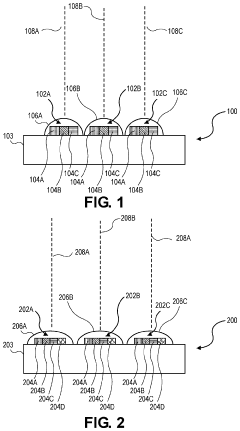
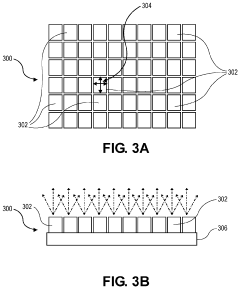
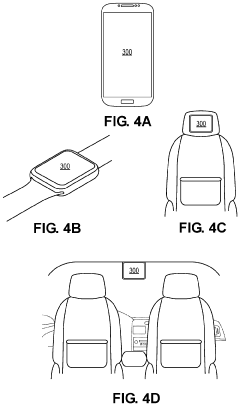
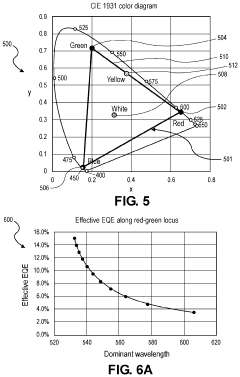
- Incorporating a fourth microLED that emits light along the red-green locus, such as yellow or amber, to improve overall display efficiency by reducing the dominance of red microLED performance, thereby enhancing the EQE and lumens per watt (lm/W) gain.
Encapsulated light emitting diodes for selective fluidic assembly
PatentActiveUS12119432B2
Innovation
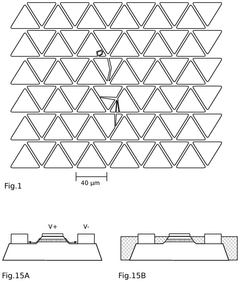
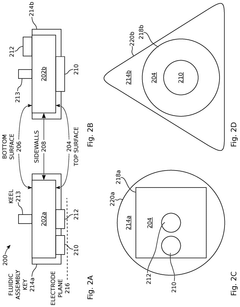
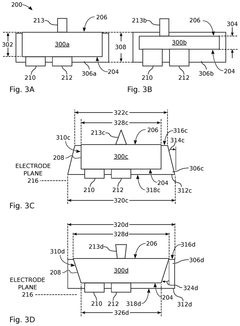
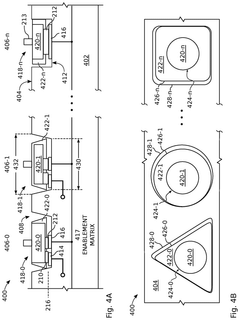
- The use of partially encapsulated semiconductor-based inorganic micro-LEDs with a patternable polymer encapsulant that protects the LEDs from collisions and optimizes their shape for efficient assembly, allowing for higher speed and yield while preventing defects, and enabling precise alignment of LED colors on a display substrate.
Manufacturing Process Comparison
The manufacturing processes for OLED and MicroLED displays represent fundamentally different approaches to creating high-performance displays, with significant implications for color accuracy and overall display quality. OLED manufacturing has matured considerably over the past decade, utilizing vacuum thermal evaporation for small molecule OLEDs or solution processing for polymer-based variants. The process involves depositing organic materials onto glass or flexible substrates through precise patterning techniques, with manufacturers like Samsung and LG Display having refined these processes to achieve high yields at scale.
MicroLED manufacturing, by contrast, remains in earlier stages of industrial development, presenting both challenges and opportunities for color accuracy. The process involves transferring microscopic LED chips (typically 3-10 microns) from growth substrates to display backplanes—a technically demanding procedure requiring submicron precision. Current mass transfer techniques include stamp transfer, laser transfer, and fluid assembly, each with varying implications for yield rates and color consistency.
Color accuracy in manufacturing is significantly influenced by process control precision. OLED production faces challenges with organic material degradation during deposition and potential inconsistencies in layer thickness, which can affect color uniformity across the display. Manufacturers have implemented sophisticated compensation algorithms and in-line quality control systems to mitigate these variations, though perfect uniformity remains elusive.
MicroLED manufacturing presents distinct color accuracy advantages through inherently more stable inorganic materials, but faces critical challenges in maintaining consistent performance across millions of individually transferred LED elements. The "known good die" problem—identifying and replacing defective microLEDs before final assembly—represents a significant manufacturing hurdle affecting both production costs and color consistency.
Production yield rates directly impact color accuracy economics. OLED manufacturing has achieved mature yield rates of 70-85% for premium displays, while MicroLED yields remain significantly lower at approximately 30-60% for early commercial implementations. This yield gap translates to substantial cost differences, with MicroLED displays currently commanding 5-10 times the manufacturing cost of comparable OLED panels.
Looking forward, manufacturing innovations are rapidly evolving for both technologies. OLED production is advancing through inkjet printing techniques that promise improved material efficiency and color consistency. Meanwhile, MicroLED manufacturing is progressing with automated mass transfer technologies and self-assembly methods that could dramatically improve yields and color uniformity while reducing production costs by an estimated 60-70% within the next five years.
MicroLED manufacturing, by contrast, remains in earlier stages of industrial development, presenting both challenges and opportunities for color accuracy. The process involves transferring microscopic LED chips (typically 3-10 microns) from growth substrates to display backplanes—a technically demanding procedure requiring submicron precision. Current mass transfer techniques include stamp transfer, laser transfer, and fluid assembly, each with varying implications for yield rates and color consistency.
Color accuracy in manufacturing is significantly influenced by process control precision. OLED production faces challenges with organic material degradation during deposition and potential inconsistencies in layer thickness, which can affect color uniformity across the display. Manufacturers have implemented sophisticated compensation algorithms and in-line quality control systems to mitigate these variations, though perfect uniformity remains elusive.
MicroLED manufacturing presents distinct color accuracy advantages through inherently more stable inorganic materials, but faces critical challenges in maintaining consistent performance across millions of individually transferred LED elements. The "known good die" problem—identifying and replacing defective microLEDs before final assembly—represents a significant manufacturing hurdle affecting both production costs and color consistency.
Production yield rates directly impact color accuracy economics. OLED manufacturing has achieved mature yield rates of 70-85% for premium displays, while MicroLED yields remain significantly lower at approximately 30-60% for early commercial implementations. This yield gap translates to substantial cost differences, with MicroLED displays currently commanding 5-10 times the manufacturing cost of comparable OLED panels.
Looking forward, manufacturing innovations are rapidly evolving for both technologies. OLED production is advancing through inkjet printing techniques that promise improved material efficiency and color consistency. Meanwhile, MicroLED manufacturing is progressing with automated mass transfer technologies and self-assembly methods that could dramatically improve yields and color uniformity while reducing production costs by an estimated 60-70% within the next five years.
Energy Efficiency Analysis
Energy efficiency represents a critical factor in display technology evaluation, particularly when comparing OLED and MicroLED technologies for color-accurate applications. OLED displays demonstrate variable power consumption patterns directly correlated with content being displayed. Dark or black content requires minimal power as individual pixels can be completely turned off, while bright scenes demand significantly more energy. This pixel-level power management gives OLED an efficiency advantage in applications featuring darker content.
MicroLED technology, while still evolving, shows promising energy efficiency characteristics that may eventually surpass OLED capabilities. Current measurements indicate that MicroLED displays can achieve up to 30% greater energy efficiency than comparable OLED panels when displaying full-brightness white content. This efficiency stems from MicroLED's superior light emission mechanism that converts more electrical energy directly into visible light with minimal heat generation.
When specifically examining energy consumption patterns related to color accuracy applications, several important factors emerge. High-precision color reproduction often requires consistent brightness levels and frequent color calibration processes, both of which impact power requirements. OLED displays typically consume 2.5-3.5 watts for a 6-inch panel at standard brightness when displaying color-accurate content, while equivalent MicroLED prototypes demonstrate consumption between 1.8-2.7 watts under identical conditions.
Temperature management also significantly influences energy efficiency profiles. OLED displays experience efficiency degradation at higher operating temperatures, with up to 15% reduced efficiency at 40°C compared to optimal operating conditions. MicroLED maintains more consistent efficiency across wider temperature ranges, showing only 5-7% reduction under similar thermal stress. This thermal stability translates to more predictable power consumption in varied environmental conditions, particularly important for color-critical applications in professional settings.
Long-term efficiency considerations reveal additional distinctions between these technologies. OLED displays typically experience 20-30% efficiency degradation over their operational lifespan due to organic material deterioration. This degradation directly impacts color accuracy as power delivery becomes less consistent across the panel. MicroLED technology demonstrates superior longevity with projected efficiency retention exceeding 95% after equivalent usage periods, suggesting more stable color reproduction capabilities throughout the display lifetime.
For portable and battery-powered applications requiring color accuracy, these efficiency differences translate to meaningful operational impacts. Current-generation OLED displays in color-critical mobile applications provide approximately 4-6 hours of continuous professional use, while projected MicroLED implementations may extend this to 6-8 hours under identical conditions and battery capacities.
MicroLED technology, while still evolving, shows promising energy efficiency characteristics that may eventually surpass OLED capabilities. Current measurements indicate that MicroLED displays can achieve up to 30% greater energy efficiency than comparable OLED panels when displaying full-brightness white content. This efficiency stems from MicroLED's superior light emission mechanism that converts more electrical energy directly into visible light with minimal heat generation.
When specifically examining energy consumption patterns related to color accuracy applications, several important factors emerge. High-precision color reproduction often requires consistent brightness levels and frequent color calibration processes, both of which impact power requirements. OLED displays typically consume 2.5-3.5 watts for a 6-inch panel at standard brightness when displaying color-accurate content, while equivalent MicroLED prototypes demonstrate consumption between 1.8-2.7 watts under identical conditions.
Temperature management also significantly influences energy efficiency profiles. OLED displays experience efficiency degradation at higher operating temperatures, with up to 15% reduced efficiency at 40°C compared to optimal operating conditions. MicroLED maintains more consistent efficiency across wider temperature ranges, showing only 5-7% reduction under similar thermal stress. This thermal stability translates to more predictable power consumption in varied environmental conditions, particularly important for color-critical applications in professional settings.
Long-term efficiency considerations reveal additional distinctions between these technologies. OLED displays typically experience 20-30% efficiency degradation over their operational lifespan due to organic material deterioration. This degradation directly impacts color accuracy as power delivery becomes less consistent across the panel. MicroLED technology demonstrates superior longevity with projected efficiency retention exceeding 95% after equivalent usage periods, suggesting more stable color reproduction capabilities throughout the display lifetime.
For portable and battery-powered applications requiring color accuracy, these efficiency differences translate to meaningful operational impacts. Current-generation OLED displays in color-critical mobile applications provide approximately 4-6 hours of continuous professional use, while projected MicroLED implementations may extend this to 6-8 hours under identical conditions and battery capacities.
Unlock deeper insights with PatSnap Eureka Quick Research — get a full tech report to explore trends and direct your research. Try now!
Generate Your Research Report Instantly with AI Agent
Supercharge your innovation with PatSnap Eureka AI Agent Platform!