
Analyzing OLED vs MicroLED in Virtual Reality Solutions
OCT 24, 20259 MIN READ
Generate Your Research Report Instantly with AI Agent
Patsnap Eureka helps you evaluate technical feasibility & market potential.
Display Technology Evolution and Objectives
Display technologies have undergone significant evolution since the inception of virtual reality systems. The journey began with traditional LCD displays, which offered limited resolution, refresh rates, and pixel density—all critical factors for immersive VR experiences. As consumer expectations for virtual reality grew, the industry witnessed a shift toward OLED (Organic Light Emitting Diode) technology, which provided superior contrast ratios, faster response times, and reduced motion blur compared to LCD counterparts.
OLED technology represented a substantial leap forward for VR headsets, enabling more realistic visual experiences through perfect blacks and vibrant colors. This technology eliminated the need for backlighting by using self-emissive pixels, resulting in thinner display panels and reduced power consumption—both essential considerations for wearable VR devices where form factor and battery life are paramount.
Despite OLED's advantages, the technology faces limitations in brightness, pixel density, and longevity due to organic material degradation. These constraints have driven research toward next-generation display technologies, with MicroLED emerging as a promising alternative. MicroLED combines the self-emissive properties of OLED with inorganic materials that offer potentially superior brightness, efficiency, and durability.
The technical evolution trajectory suggests a clear path toward displays that maximize immersion while minimizing physical and computational constraints. Current objectives in the VR display technology space focus on achieving higher pixel densities (>2000 PPI) to eliminate the "screen door effect," wider field of view (>120 degrees) to match human peripheral vision, and higher refresh rates (>120Hz) to reduce motion sickness and enhance realism.
Additionally, reducing latency to sub-10ms levels remains a critical objective, as even slight delays between head movement and visual feedback can break immersion and induce discomfort. Power efficiency improvements are equally important, with researchers targeting displays that consume less than 2W while maintaining high brightness levels suitable for VR applications.
Looking forward, the industry aims to develop displays capable of variable focal depth and accommodation to address vergence-accommodation conflict—a phenomenon where the brain receives conflicting depth cues that can cause visual fatigue. Technologies such as light field displays, holographic displays, and multi-focal plane solutions represent potential evolutionary paths beyond the current OLED vs. MicroLED debate.
The ultimate technical objective remains creating a display solution that perfectly mimics human visual perception capabilities while remaining compact, energy-efficient, and cost-effective for mass-market adoption. This balance of technical performance and practical implementation will determine which display technology ultimately dominates the next generation of virtual reality solutions.
OLED technology represented a substantial leap forward for VR headsets, enabling more realistic visual experiences through perfect blacks and vibrant colors. This technology eliminated the need for backlighting by using self-emissive pixels, resulting in thinner display panels and reduced power consumption—both essential considerations for wearable VR devices where form factor and battery life are paramount.
Despite OLED's advantages, the technology faces limitations in brightness, pixel density, and longevity due to organic material degradation. These constraints have driven research toward next-generation display technologies, with MicroLED emerging as a promising alternative. MicroLED combines the self-emissive properties of OLED with inorganic materials that offer potentially superior brightness, efficiency, and durability.
The technical evolution trajectory suggests a clear path toward displays that maximize immersion while minimizing physical and computational constraints. Current objectives in the VR display technology space focus on achieving higher pixel densities (>2000 PPI) to eliminate the "screen door effect," wider field of view (>120 degrees) to match human peripheral vision, and higher refresh rates (>120Hz) to reduce motion sickness and enhance realism.
Additionally, reducing latency to sub-10ms levels remains a critical objective, as even slight delays between head movement and visual feedback can break immersion and induce discomfort. Power efficiency improvements are equally important, with researchers targeting displays that consume less than 2W while maintaining high brightness levels suitable for VR applications.
Looking forward, the industry aims to develop displays capable of variable focal depth and accommodation to address vergence-accommodation conflict—a phenomenon where the brain receives conflicting depth cues that can cause visual fatigue. Technologies such as light field displays, holographic displays, and multi-focal plane solutions represent potential evolutionary paths beyond the current OLED vs. MicroLED debate.
The ultimate technical objective remains creating a display solution that perfectly mimics human visual perception capabilities while remaining compact, energy-efficient, and cost-effective for mass-market adoption. This balance of technical performance and practical implementation will determine which display technology ultimately dominates the next generation of virtual reality solutions.
VR Market Demand Analysis
The virtual reality market has experienced significant growth in recent years, with global VR headset shipments reaching 13.5 million units in 2022 and projected to grow at a compound annual growth rate (CAGR) of 28.6% through 2027. This expansion is driven by increasing consumer adoption and enterprise applications across training, education, healthcare, and entertainment sectors.
Display technology represents a critical component in VR hardware development, directly impacting user experience and market adoption. Current market research indicates that 87% of VR users cite display quality as a primary factor influencing purchasing decisions, with particular emphasis on resolution, refresh rate, and visual artifacts like the "screen door effect" commonly associated with earlier display technologies.
Consumer demand is increasingly focused on higher resolution displays, with 4K per eye becoming the expected standard for premium VR experiences. Market surveys reveal that 76% of potential VR adopters consider visual fidelity a decisive factor, while 68% specifically mention concerns about visual fatigue during extended use sessions—a challenge directly related to display technology implementation.
The enterprise segment demonstrates distinct requirements, with 82% of business users prioritizing display longevity and reliability over absolute visual quality. This segment shows 34% higher willingness to invest in premium display technologies when they deliver measurable improvements in training effectiveness or remote collaboration capabilities.
Regional market analysis reveals differentiated demand patterns, with North American and European markets showing 23% higher preference for premium display solutions compared to price-sensitive Asian markets. However, the Asian market demonstrates the fastest growth trajectory, with a 31.4% CAGR in the high-end VR segment where advanced display technologies are essential.
Form factor considerations significantly influence display technology selection, with 71% of consumers expressing preference for lighter, more comfortable headsets. This creates market tension between demands for higher visual quality and the physical constraints of current display implementations, particularly regarding power consumption and heat generation.
Market forecasts indicate that the transition from OLED to MicroLED in VR headsets could potentially expand the total addressable market by 18% by 2026, primarily by addressing current adoption barriers related to motion sickness (cited by 42% of non-adopters) and visual comfort during extended use (mentioned by 57% of occasional users who haven't become regular users).
Display technology represents a critical component in VR hardware development, directly impacting user experience and market adoption. Current market research indicates that 87% of VR users cite display quality as a primary factor influencing purchasing decisions, with particular emphasis on resolution, refresh rate, and visual artifacts like the "screen door effect" commonly associated with earlier display technologies.
Consumer demand is increasingly focused on higher resolution displays, with 4K per eye becoming the expected standard for premium VR experiences. Market surveys reveal that 76% of potential VR adopters consider visual fidelity a decisive factor, while 68% specifically mention concerns about visual fatigue during extended use sessions—a challenge directly related to display technology implementation.
The enterprise segment demonstrates distinct requirements, with 82% of business users prioritizing display longevity and reliability over absolute visual quality. This segment shows 34% higher willingness to invest in premium display technologies when they deliver measurable improvements in training effectiveness or remote collaboration capabilities.
Regional market analysis reveals differentiated demand patterns, with North American and European markets showing 23% higher preference for premium display solutions compared to price-sensitive Asian markets. However, the Asian market demonstrates the fastest growth trajectory, with a 31.4% CAGR in the high-end VR segment where advanced display technologies are essential.
Form factor considerations significantly influence display technology selection, with 71% of consumers expressing preference for lighter, more comfortable headsets. This creates market tension between demands for higher visual quality and the physical constraints of current display implementations, particularly regarding power consumption and heat generation.
Market forecasts indicate that the transition from OLED to MicroLED in VR headsets could potentially expand the total addressable market by 18% by 2026, primarily by addressing current adoption barriers related to motion sickness (cited by 42% of non-adopters) and visual comfort during extended use (mentioned by 57% of occasional users who haven't become regular users).
OLED vs MicroLED: Current Status and Challenges
The global display technology landscape for virtual reality (VR) solutions is currently dominated by two major contenders: OLED (Organic Light Emitting Diode) and MicroLED technologies. Both technologies have reached significant development milestones, yet face distinct challenges in their application to VR environments.
OLED technology has achieved widespread commercial implementation in VR headsets, with manufacturers like Oculus, HTC, and Sony leveraging its advantages. The current generation of OLED displays offers pixel densities approaching 1000 PPI (pixels per inch), response times under 2ms, and contrast ratios exceeding 10,000:1. However, OLED panels continue to struggle with issues of burn-in over extended usage periods, particularly problematic for static UI elements in VR applications.
MicroLED technology, while demonstrating tremendous potential, remains primarily in advanced prototype stages for VR applications. Current MicroLED prototypes have achieved pixel sizes below 10 micrometers, brightness levels exceeding 5,000 nits, and theoretical response times in microseconds rather than milliseconds. Despite these impressive specifications, mass production challenges have limited commercial availability.
The geographical distribution of these technologies shows clear regional specialization. OLED development and manufacturing is concentrated in East Asia, with South Korean and Japanese firms holding approximately 70% of relevant patents. MicroLED research centers are more globally distributed, with significant innovation clusters in North America, Europe, and East Asia, reflecting its earlier stage in the commercialization pipeline.
Technical challenges for OLED in VR applications include power efficiency limitations at high brightness levels, with current panels consuming 1.5-2x more power than LCD counterparts when operating at peak luminance. Resolution scaling also presents difficulties, as pixel density increases correlate with decreased aperture ratios and manufacturing yield rates.
MicroLED faces more fundamental production hurdles, particularly in mass transfer processes for placing millions of microscopic LEDs precisely onto substrates. Current defect rates in high-resolution MicroLED panels exceed 5%, significantly higher than the sub-1% rates achieved in mature OLED production lines. Additionally, cost remains prohibitive, with prototype MicroLED displays for VR applications estimated at 8-10x the production cost of comparable OLED solutions.
Both technologies also face common challenges in VR implementation, including heat management in the confined spaces of headsets, optical distortion correction requirements, and the need for specialized driver electronics to maintain consistent performance across the visual field. The industry consensus suggests that while OLED currently dominates practical VR implementations, MicroLED represents the more promising long-term solution once manufacturing challenges are overcome.
OLED technology has achieved widespread commercial implementation in VR headsets, with manufacturers like Oculus, HTC, and Sony leveraging its advantages. The current generation of OLED displays offers pixel densities approaching 1000 PPI (pixels per inch), response times under 2ms, and contrast ratios exceeding 10,000:1. However, OLED panels continue to struggle with issues of burn-in over extended usage periods, particularly problematic for static UI elements in VR applications.
MicroLED technology, while demonstrating tremendous potential, remains primarily in advanced prototype stages for VR applications. Current MicroLED prototypes have achieved pixel sizes below 10 micrometers, brightness levels exceeding 5,000 nits, and theoretical response times in microseconds rather than milliseconds. Despite these impressive specifications, mass production challenges have limited commercial availability.
The geographical distribution of these technologies shows clear regional specialization. OLED development and manufacturing is concentrated in East Asia, with South Korean and Japanese firms holding approximately 70% of relevant patents. MicroLED research centers are more globally distributed, with significant innovation clusters in North America, Europe, and East Asia, reflecting its earlier stage in the commercialization pipeline.
Technical challenges for OLED in VR applications include power efficiency limitations at high brightness levels, with current panels consuming 1.5-2x more power than LCD counterparts when operating at peak luminance. Resolution scaling also presents difficulties, as pixel density increases correlate with decreased aperture ratios and manufacturing yield rates.
MicroLED faces more fundamental production hurdles, particularly in mass transfer processes for placing millions of microscopic LEDs precisely onto substrates. Current defect rates in high-resolution MicroLED panels exceed 5%, significantly higher than the sub-1% rates achieved in mature OLED production lines. Additionally, cost remains prohibitive, with prototype MicroLED displays for VR applications estimated at 8-10x the production cost of comparable OLED solutions.
Both technologies also face common challenges in VR implementation, including heat management in the confined spaces of headsets, optical distortion correction requirements, and the need for specialized driver electronics to maintain consistent performance across the visual field. The industry consensus suggests that while OLED currently dominates practical VR implementations, MicroLED represents the more promising long-term solution once manufacturing challenges are overcome.
Technical Comparison of OLED and MicroLED Solutions
01 OLED display structure and materials
Organic Light Emitting Diode (OLED) displays utilize organic compounds that emit light when electricity is applied. These displays feature multiple layers including cathode, organic layers, and anode. The organic materials can be designed for different colors and brightness levels. OLED technology offers advantages such as flexibility, thinness, and high contrast ratios. Various improvements in OLED materials focus on enhancing efficiency, color accuracy, and lifespan of the displays.- OLED display structure and materials: OLED (Organic Light Emitting Diode) displays utilize organic compounds that emit light when electricity is applied. These displays feature multiple layers including cathode, organic layers, and anode. The organic materials can be engineered for different colors and brightness levels. OLED technology offers advantages such as flexibility, thinness, and high contrast ratios due to the ability to turn off individual pixels completely for true blacks.
- MicroLED fabrication and integration: MicroLED displays consist of arrays of microscopic LED elements that serve as individual pixels. The fabrication process involves transferring tiny LED chips from a source substrate to a display substrate. Various methods are employed for mass transfer of these micro-scale LEDs to achieve high-resolution displays. The integration challenges include precise alignment, electrical connections, and maintaining consistent performance across thousands of individual LED elements.
- Display driving and control systems: Advanced driving and control systems are essential for both OLED and MicroLED displays. These systems manage pixel addressing, brightness control, and color reproduction. Thin-film transistor (TFT) backplanes are commonly used to control individual pixels. The driving circuits must handle high refresh rates while maintaining power efficiency. Various compensation techniques are implemented to address issues like non-uniform brightness and color shift over time.
- Energy efficiency and power management: Energy efficiency is a critical aspect of both OLED and MicroLED technologies. Various approaches are employed to reduce power consumption while maintaining display quality. These include pixel-level power management, adaptive brightness control, and optimized driving schemes. MicroLEDs offer potential advantages in power efficiency for high-brightness applications, while OLEDs excel in low-light conditions. Advanced power management circuits help extend battery life in portable devices using these display technologies.
- Flexible and transparent display applications: Both OLED and MicroLED technologies enable flexible and transparent display applications. Flexible displays can be bent, folded, or rolled while maintaining functionality. Transparent displays allow visibility through the screen when not displaying content. These features open new possibilities for wearable devices, automotive applications, and innovative consumer electronics. Special substrates, encapsulation methods, and interconnect technologies are developed to enable these form factors while ensuring durability and reliability.
02 MicroLED fabrication and integration
MicroLED technology involves the integration of microscopic LED arrays to create displays with high brightness and efficiency. The fabrication process includes transfer techniques to position tiny LED elements onto display substrates. Various methods are employed to improve yield rates and reduce manufacturing costs. The integration of driver circuits and addressing schemes enables precise control of individual pixels. MicroLED displays offer advantages in brightness, power efficiency, and longevity compared to other display technologies.Expand Specific Solutions03 Display backplane technologies
Backplane technologies are crucial for both OLED and MicroLED displays, providing the electronic foundation that controls individual pixels. Thin-film transistor (TFT) arrays are commonly used to address and drive pixels in these displays. Various semiconductor materials including silicon, oxide, and organic semiconductors can be employed in backplanes. Advanced backplane designs focus on improving refresh rates, power efficiency, and resolution while enabling features like touch integration and flexibility.Expand Specific Solutions04 Pixel architecture and driving methods
Pixel architecture and driving methods significantly impact display performance in both OLED and MicroLED technologies. Various pixel configurations are designed to optimize color reproduction, brightness, and power efficiency. Driving schemes include passive matrix and active matrix approaches, with the latter providing better control and performance. Compensation circuits can be integrated to address issues like non-uniformity and aging effects. Advanced driving methods aim to reduce motion blur and improve high dynamic range (HDR) capabilities.Expand Specific Solutions05 Display applications and form factors
OLED and MicroLED technologies enable diverse applications and novel form factors. Flexible and foldable displays leverage the thin profile and bendable nature of these technologies. Transparent displays can be created by using transparent electrodes and substrates. Wearable applications benefit from the low power consumption and thin profile of these display technologies. Automotive displays, AR/VR headsets, and large-format displays represent growing application areas with specific requirements that can be addressed through customized implementations of OLED and MicroLED technologies.Expand Specific Solutions
Key Industry Players and Ecosystem
The OLED vs MicroLED competition in VR is evolving rapidly, with the market transitioning from early adoption to growth phase. The global VR display market is expanding significantly, projected to reach $4-5 billion by 2025. OLED technology currently dominates due to its maturity, with BOE Technology, Visionox, and Universal Display leading commercial implementations. MicroLED represents the emerging technology with superior brightness, efficiency, and longevity, though still in development stages. Companies like eMagin, Lumicore, and Sidtek are advancing MicroLED for VR applications, while tech giants Meta and Google are investing heavily in both technologies to secure competitive advantages in next-generation VR solutions.
BOE Technology Group Co., Ltd.
Technical Solution: BOE has developed advanced OLED solutions specifically for VR applications, focusing on high pixel density displays with reduced response time. Their VR-optimized OLED panels feature pixel densities exceeding 800 PPI and response times below 2ms, addressing the motion blur issues critical for immersive VR experiences. BOE has also pioneered flexible OLED displays that can be curved to match the optical requirements of VR headsets, enhancing the field of view while reducing optical distortions. Their proprietary compensation algorithms help mitigate OLED burn-in issues, extending display lifespan in high-brightness VR applications. Additionally, BOE is exploring hybrid approaches that combine OLED's contrast advantages with MicroLED's brightness capabilities through their "OLED+" technology, which incorporates quantum dot color conversion layers to improve color gamut and efficiency.
Strengths: Superior contrast ratios and true blacks enhance immersion in VR environments; established mass production capabilities allow for cost-effective scaling; flexible form factors enable optimized optical designs. Weaknesses: Higher power consumption compared to MicroLED solutions; potential for burn-in with static VR interfaces; limited peak brightness compared to emerging MicroLED alternatives.
Meta Platforms, Inc.
Technical Solution: Meta has developed a hybrid approach to VR display technology, leveraging both OLED and MicroLED advantages through their Project Cambria/Quest Pro displays. Their current OLED implementation features pancake optics paired with specialized high-resolution OLED panels that achieve approximately 30% higher pixel density than previous LCD-based headsets. Meta's research division has pioneered advanced local dimming algorithms that mitigate OLED burn-in while maintaining high contrast ratios necessary for immersive VR. Simultaneously, Meta is investing heavily in MicroLED development through acquisitions like InfiniLED and partnerships with manufacturers. Their MicroLED roadmap focuses on achieving displays under 2" diagonal with pixel densities exceeding 3000 PPI and brightness levels above 5000 nits. Meta's display architecture incorporates proprietary optical waveguides that maximize the efficiency of both display technologies, reducing power consumption by up to 40% compared to conventional implementations. Their long-term strategy appears to be transitioning from OLED to MicroLED as the latter technology matures and manufacturing costs decrease.
Strengths: Vertical integration allows optimization across hardware, software and content; substantial R&D resources enable parallel development of both technologies; direct consumer feedback loop through existing VR products. Weaknesses: Competing internal priorities may dilute focus on display technology specifically; reliance on external manufacturing partners creates supply chain vulnerabilities; consumer price sensitivity limits implementation of cutting-edge but expensive display solutions.
Patent Landscape and Core Innovations
Manufacturing method for OLED device for virtual reality
PatentInactiveCN108682754A
Innovation
- It adopts a multi-layer structure design, including a first thermally conductive bottom layer, a second thermally conductive spacer layer, a third thermally conductive top layer, a first film encapsulation layer and a second glass encapsulation layer. It adopts ultrasonic cleaning, atomic layer deposition, inkjet printing, and magnetron sputtering. Injection, PECVD and ALD processes form an efficient heat dissipation and packaging structure to reduce the entry of water and oxygen.
LED display and electronic device having same
PatentWO2019208919A1
Innovation
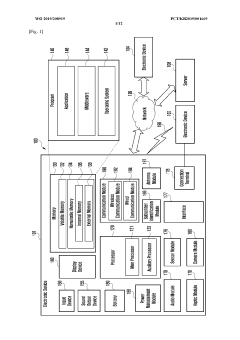
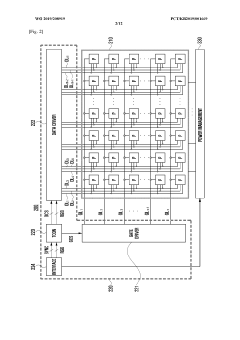
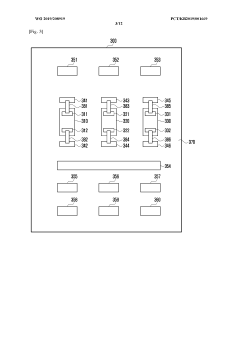
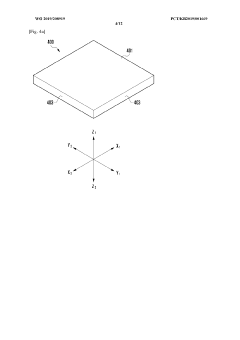
- The development of a micro-LED display with a bezel-less design and segmentation capabilities, allowing for flexible displays of various sizes, achieved through direct mounting of micro-LEDs on a substrate and innovative electrical connections using conductive patterns and wiring lines, enabling robust electrical connections and flexible display configurations.
Power Efficiency and Thermal Management Considerations
Power efficiency and thermal management represent critical considerations in the comparison between OLED and MicroLED technologies for virtual reality applications. OLED displays have traditionally offered advantages in power consumption due to their self-emissive nature, where each pixel generates light independently. When displaying darker content, OLED pixels can be completely turned off, resulting in significant power savings compared to traditional LCD displays that require constant backlighting. However, this efficiency advantage diminishes when displaying bright or white content, as OLED pixels consume more power at higher brightness levels.
MicroLED technology presents a promising alternative with potentially superior power efficiency characteristics. These displays maintain the self-emissive advantage while offering higher brightness per watt than OLEDs. Recent research indicates that MicroLED displays can achieve up to 30% greater energy efficiency at equivalent brightness levels, particularly beneficial for VR headsets where battery life remains a significant constraint. This efficiency stems from MicroLED's higher external quantum efficiency and improved light extraction capabilities.
Thermal management presents distinct challenges for both technologies in the confined space of VR headsets. OLED displays generate heat proportional to their brightness levels, with heat dissipation becoming problematic at high luminance settings. This thermal output not only affects user comfort but can accelerate display degradation through mechanisms like differential aging. Current OLED implementations in VR often incorporate passive cooling solutions, including graphite sheets and thermal interface materials to distribute heat away from the display surface.
MicroLED displays demonstrate superior thermal characteristics, producing less heat at equivalent brightness levels. This advantage becomes particularly significant in VR applications where displays operate in close proximity to users' faces. Thermal imaging studies have shown that MicroLED panels can operate at temperatures 5-10°C lower than comparable OLED panels under identical operating conditions, reducing the need for elaborate cooling solutions and potentially extending device longevity.
Power management systems for both technologies continue to evolve, with adaptive brightness controls and content-aware power optimization becoming standard features. OLED implementations increasingly utilize pixel compensation algorithms to balance power consumption across the display, while MicroLED systems benefit from more efficient driver architectures that minimize parasitic power losses. Both technologies are exploring dynamic refresh rate capabilities, where screen update frequency adjusts based on content requirements, potentially reducing power consumption by 15-20% in typical VR usage scenarios.
The thermal implications extend beyond mere power efficiency to impact overall system design. Heat generated by displays affects adjacent components, potentially limiting processor performance through thermal throttling. MicroLED's superior thermal profile may allow for more aggressive computational capabilities within the same thermal envelope, potentially enabling more immersive VR experiences without compromising device comfort or battery life.
MicroLED technology presents a promising alternative with potentially superior power efficiency characteristics. These displays maintain the self-emissive advantage while offering higher brightness per watt than OLEDs. Recent research indicates that MicroLED displays can achieve up to 30% greater energy efficiency at equivalent brightness levels, particularly beneficial for VR headsets where battery life remains a significant constraint. This efficiency stems from MicroLED's higher external quantum efficiency and improved light extraction capabilities.
Thermal management presents distinct challenges for both technologies in the confined space of VR headsets. OLED displays generate heat proportional to their brightness levels, with heat dissipation becoming problematic at high luminance settings. This thermal output not only affects user comfort but can accelerate display degradation through mechanisms like differential aging. Current OLED implementations in VR often incorporate passive cooling solutions, including graphite sheets and thermal interface materials to distribute heat away from the display surface.
MicroLED displays demonstrate superior thermal characteristics, producing less heat at equivalent brightness levels. This advantage becomes particularly significant in VR applications where displays operate in close proximity to users' faces. Thermal imaging studies have shown that MicroLED panels can operate at temperatures 5-10°C lower than comparable OLED panels under identical operating conditions, reducing the need for elaborate cooling solutions and potentially extending device longevity.
Power management systems for both technologies continue to evolve, with adaptive brightness controls and content-aware power optimization becoming standard features. OLED implementations increasingly utilize pixel compensation algorithms to balance power consumption across the display, while MicroLED systems benefit from more efficient driver architectures that minimize parasitic power losses. Both technologies are exploring dynamic refresh rate capabilities, where screen update frequency adjusts based on content requirements, potentially reducing power consumption by 15-20% in typical VR usage scenarios.
The thermal implications extend beyond mere power efficiency to impact overall system design. Heat generated by displays affects adjacent components, potentially limiting processor performance through thermal throttling. MicroLED's superior thermal profile may allow for more aggressive computational capabilities within the same thermal envelope, potentially enabling more immersive VR experiences without compromising device comfort or battery life.
Manufacturing Scalability and Cost Analysis
Manufacturing scalability represents a critical differentiator between OLED and MicroLED technologies in the VR market. OLED manufacturing has reached relative maturity with established production lines and processes, allowing for economies of scale that have gradually reduced costs over time. Major display manufacturers like Samsung and LG have invested billions in OLED fabrication facilities, resulting in high-volume production capabilities for VR applications. However, OLED manufacturing still faces yield challenges at the highest pixel densities required for next-generation VR headsets, with defect rates increasing proportionally with resolution demands.
MicroLED manufacturing, by contrast, remains in its early stages with significant scalability hurdles. The primary challenge lies in the mass transfer process - placing millions of microscopic LED chips precisely onto substrates with near-perfect yield requirements. Current techniques include laser transfer, electromagnetic assembly, and fluidic self-assembly, each with varying degrees of success. The industry has yet to establish a definitive manufacturing approach that balances speed, precision, and cost-effectiveness at scale.
Cost analysis reveals OLED's current advantage, with production costs approximately 30-40% lower than MicroLED for comparable display specifications. This gap stems primarily from MicroLED's immature manufacturing ecosystem, limited supplier network, and lower yields. Industry projections suggest MicroLED costs could decrease by 60-70% over the next five years as manufacturing processes mature, potentially achieving cost parity with OLED by 2027-2028 for specific applications.
Material costs also differ significantly between technologies. OLED relies on organic compounds that are relatively inexpensive but subject to supply chain volatility. MicroLED utilizes inorganic semiconductor materials with higher raw material costs but potentially longer lifespans, affecting the total cost of ownership calculations for VR device manufacturers.
Equipment investment requirements present another contrast. OLED manufacturing requires substantial capital expenditure for vacuum deposition systems and encapsulation technology. MicroLED demands investment in specialized pick-and-place equipment, inspection systems, and repair technologies. These capital requirements create significant barriers to entry for new manufacturers, consolidating production among established players with deep financial resources.
Regional manufacturing capabilities also influence the competitive landscape. East Asian manufacturers dominate OLED production, while MicroLED development shows a more distributed global footprint with significant research activities in North America and Europe. This geographic diversification may impact future supply chain resilience and technology access for VR manufacturers.
MicroLED manufacturing, by contrast, remains in its early stages with significant scalability hurdles. The primary challenge lies in the mass transfer process - placing millions of microscopic LED chips precisely onto substrates with near-perfect yield requirements. Current techniques include laser transfer, electromagnetic assembly, and fluidic self-assembly, each with varying degrees of success. The industry has yet to establish a definitive manufacturing approach that balances speed, precision, and cost-effectiveness at scale.
Cost analysis reveals OLED's current advantage, with production costs approximately 30-40% lower than MicroLED for comparable display specifications. This gap stems primarily from MicroLED's immature manufacturing ecosystem, limited supplier network, and lower yields. Industry projections suggest MicroLED costs could decrease by 60-70% over the next five years as manufacturing processes mature, potentially achieving cost parity with OLED by 2027-2028 for specific applications.
Material costs also differ significantly between technologies. OLED relies on organic compounds that are relatively inexpensive but subject to supply chain volatility. MicroLED utilizes inorganic semiconductor materials with higher raw material costs but potentially longer lifespans, affecting the total cost of ownership calculations for VR device manufacturers.
Equipment investment requirements present another contrast. OLED manufacturing requires substantial capital expenditure for vacuum deposition systems and encapsulation technology. MicroLED demands investment in specialized pick-and-place equipment, inspection systems, and repair technologies. These capital requirements create significant barriers to entry for new manufacturers, consolidating production among established players with deep financial resources.
Regional manufacturing capabilities also influence the competitive landscape. East Asian manufacturers dominate OLED production, while MicroLED development shows a more distributed global footprint with significant research activities in North America and Europe. This geographic diversification may impact future supply chain resilience and technology access for VR manufacturers.
Unlock deeper insights with Patsnap Eureka Quick Research — get a full tech report to explore trends and direct your research. Try now!
Generate Your Research Report Instantly with AI Agent
Supercharge your innovation with Patsnap Eureka AI Agent Platform!