Comparative Analysis of OLED vs MicroLED Consumer Applications
OCT 24, 20259 MIN READ
Generate Your Research Report Instantly with AI Agent
Patsnap Eureka helps you evaluate technical feasibility & market potential.
OLED and MicroLED Technology Evolution and Objectives
Display technology has undergone significant evolution over the past decades, with OLED (Organic Light Emitting Diode) emerging as a revolutionary advancement in the early 2000s. OLED technology represented a paradigm shift from traditional LCD displays by eliminating the need for backlighting, enabling thinner form factors, and delivering superior contrast ratios with true blacks. The technology's development trajectory has been characterized by continuous improvements in efficiency, color accuracy, and manufacturing processes.
MicroLED, a more recent innovation, builds upon the self-emissive principle of OLED while addressing some of its inherent limitations. First demonstrated in laboratory settings in the early 2010s, MicroLED utilizes inorganic gallium nitride-based LEDs at microscopic scales. This technology promises longer lifespans, higher brightness levels, and improved energy efficiency compared to OLED, positioning it as a potential successor in premium display applications.
The technical evolution of both technologies has been driven by increasing consumer demands for higher resolution, better color reproduction, reduced power consumption, and novel form factors. OLED has matured significantly, with manufacturers overcoming early challenges related to blue pixel degradation and production yields. The technology has expanded from small smartphone displays to large-format televisions and flexible applications.
MicroLED development has focused on overcoming mass production challenges, particularly in the precise placement of millions of microscopic LEDs. Recent advancements in mass transfer techniques and manufacturing processes have accelerated the technology's path toward commercial viability, though significant hurdles remain in cost reduction.
The primary technical objectives for both technologies include enhancing energy efficiency, extending operational lifespan, improving brightness and color performance, and reducing production costs. For OLED, specific goals include mitigating burn-in issues, increasing peak brightness, and developing more efficient blue emitters. MicroLED development aims to perfect mass transfer techniques, reduce pixel pitch, and establish scalable manufacturing processes that can compete with OLED's cost structure.
Industry roadmaps suggest OLED will continue dominating mid-range consumer applications in the near term, while MicroLED gradually penetrates premium segments where its superior performance characteristics justify higher costs. The convergence point where MicroLED achieves price parity with OLED represents a critical milestone that could reshape the competitive landscape of consumer display technologies.
Both technologies are evolving toward enabling novel form factors, including transparent, flexible, and modular displays that could fundamentally transform how consumers interact with visual information across multiple device categories.
MicroLED, a more recent innovation, builds upon the self-emissive principle of OLED while addressing some of its inherent limitations. First demonstrated in laboratory settings in the early 2010s, MicroLED utilizes inorganic gallium nitride-based LEDs at microscopic scales. This technology promises longer lifespans, higher brightness levels, and improved energy efficiency compared to OLED, positioning it as a potential successor in premium display applications.
The technical evolution of both technologies has been driven by increasing consumer demands for higher resolution, better color reproduction, reduced power consumption, and novel form factors. OLED has matured significantly, with manufacturers overcoming early challenges related to blue pixel degradation and production yields. The technology has expanded from small smartphone displays to large-format televisions and flexible applications.
MicroLED development has focused on overcoming mass production challenges, particularly in the precise placement of millions of microscopic LEDs. Recent advancements in mass transfer techniques and manufacturing processes have accelerated the technology's path toward commercial viability, though significant hurdles remain in cost reduction.
The primary technical objectives for both technologies include enhancing energy efficiency, extending operational lifespan, improving brightness and color performance, and reducing production costs. For OLED, specific goals include mitigating burn-in issues, increasing peak brightness, and developing more efficient blue emitters. MicroLED development aims to perfect mass transfer techniques, reduce pixel pitch, and establish scalable manufacturing processes that can compete with OLED's cost structure.
Industry roadmaps suggest OLED will continue dominating mid-range consumer applications in the near term, while MicroLED gradually penetrates premium segments where its superior performance characteristics justify higher costs. The convergence point where MicroLED achieves price parity with OLED represents a critical milestone that could reshape the competitive landscape of consumer display technologies.
Both technologies are evolving toward enabling novel form factors, including transparent, flexible, and modular displays that could fundamentally transform how consumers interact with visual information across multiple device categories.
Consumer Market Demand Analysis for Advanced Display Technologies
The display technology market has witnessed a significant shift in consumer preferences towards advanced display solutions that offer superior visual experiences. Current market analysis indicates that consumers are increasingly prioritizing display quality as a decisive factor when purchasing electronic devices. This trend is particularly evident in premium smartphones, televisions, and wearable technology segments, where OLED has established a strong foothold while MicroLED is emerging as a promising alternative.
Consumer demand for OLED technology has shown robust growth, with the global OLED display market valued at approximately $38.4 billion in 2022 and projected to reach $72.8 billion by 2026. Smartphones represent the largest application segment, accounting for over 50% of OLED panel shipments, followed by televisions and wearable devices. The primary drivers behind this demand include OLED's superior contrast ratios, color accuracy, flexibility, and energy efficiency in dark-mode applications.
MicroLED, though still in its early commercialization phase, is generating substantial consumer interest due to its exceptional brightness capabilities, longevity, and potential for modular configurations. Market research indicates growing consumer awareness of MicroLED benefits, with 67% of premium television buyers expressing interest in MicroLED technology once it becomes more affordable. The current high price point remains the principal barrier to widespread adoption, with premium MicroLED televisions commanding prices 5-10 times higher than equivalent OLED models.
Regional analysis reveals varying consumer preferences, with Asian markets, particularly South Korea and China, showing stronger early adoption rates for new display technologies. North American consumers demonstrate greater price sensitivity but higher interest in premium television segments, while European markets show balanced demand across multiple device categories.
Device-specific demand patterns indicate that smartphones will continue driving OLED adoption, with penetration expected to reach 70% in premium smartphones by 2024. For televisions, OLED currently dominates the premium segment, but MicroLED is projected to capture 15% of the high-end market by 2026 as manufacturing costs decrease. In wearables, OLED remains the preferred technology due to its energy efficiency advantages, though MicroLED's brightness benefits are attracting interest for outdoor-focused devices.
Consumer surveys reveal that key purchasing factors include color accuracy (cited by 78% of respondents), brightness (65%), energy efficiency (61%), and longevity (57%). MicroLED outperforms in brightness and longevity metrics, while OLED currently leads in color accuracy and form factor versatility. These demand patterns suggest a segmented market approach will persist in the near term, with each technology finding optimal application in specific consumer device categories.
Consumer demand for OLED technology has shown robust growth, with the global OLED display market valued at approximately $38.4 billion in 2022 and projected to reach $72.8 billion by 2026. Smartphones represent the largest application segment, accounting for over 50% of OLED panel shipments, followed by televisions and wearable devices. The primary drivers behind this demand include OLED's superior contrast ratios, color accuracy, flexibility, and energy efficiency in dark-mode applications.
MicroLED, though still in its early commercialization phase, is generating substantial consumer interest due to its exceptional brightness capabilities, longevity, and potential for modular configurations. Market research indicates growing consumer awareness of MicroLED benefits, with 67% of premium television buyers expressing interest in MicroLED technology once it becomes more affordable. The current high price point remains the principal barrier to widespread adoption, with premium MicroLED televisions commanding prices 5-10 times higher than equivalent OLED models.
Regional analysis reveals varying consumer preferences, with Asian markets, particularly South Korea and China, showing stronger early adoption rates for new display technologies. North American consumers demonstrate greater price sensitivity but higher interest in premium television segments, while European markets show balanced demand across multiple device categories.
Device-specific demand patterns indicate that smartphones will continue driving OLED adoption, with penetration expected to reach 70% in premium smartphones by 2024. For televisions, OLED currently dominates the premium segment, but MicroLED is projected to capture 15% of the high-end market by 2026 as manufacturing costs decrease. In wearables, OLED remains the preferred technology due to its energy efficiency advantages, though MicroLED's brightness benefits are attracting interest for outdoor-focused devices.
Consumer surveys reveal that key purchasing factors include color accuracy (cited by 78% of respondents), brightness (65%), energy efficiency (61%), and longevity (57%). MicroLED outperforms in brightness and longevity metrics, while OLED currently leads in color accuracy and form factor versatility. These demand patterns suggest a segmented market approach will persist in the near term, with each technology finding optimal application in specific consumer device categories.
Current Technical Limitations and Challenges in Display Technologies
Despite significant advancements in display technologies, both OLED and MicroLED face substantial technical limitations that impact their widespread adoption in consumer applications. OLED technology continues to struggle with burn-in issues, where static images displayed for extended periods cause permanent screen damage. This remains particularly problematic for devices displaying static elements like status bars or channel logos. Additionally, OLED panels suffer from limited brightness capabilities compared to competing technologies, restricting their performance in high-ambient light environments.
Lifespan concerns persist with OLED displays, especially with blue subpixels degrading faster than red or green counterparts, leading to color shift over time. Manufacturing challenges also remain significant, with low yield rates for large-format OLED panels driving up production costs and retail prices, particularly for television applications above 65 inches.
MicroLED technology, while promising, faces even more formidable production hurdles. The manufacturing process requires precise placement of millions of microscopic LED elements with near-perfect accuracy. Current production methods struggle with mass transfer techniques that can reliably position these tiny components without defects. The complexity increases exponentially with display size and resolution, resulting in prohibitively high manufacturing costs for consumer applications.
Heat management represents another critical challenge for MicroLED displays. The concentrated energy in these miniaturized components generates significant thermal output that must be efficiently dissipated to prevent performance degradation and ensure longevity. Current thermal management solutions add complexity, weight, and cost to MicroLED implementations.
Color uniformity presents technical difficulties for both technologies. OLED panels often exhibit slight variations in color reproduction across the display area, while MicroLED faces challenges in maintaining consistent performance across millions of individual emitters. These inconsistencies become more apparent as display sizes increase.
Power efficiency remains problematic, particularly for portable applications. While both technologies offer improvements over traditional LCD displays, neither has fully optimized power consumption for battery-powered devices. OLED's power usage varies dramatically with content brightness, while MicroLED's driving requirements still demand substantial energy input.
Supply chain constraints further complicate advancement, with limited manufacturing capacity for specialized components and materials. The highly specialized equipment required for production creates bottlenecks that slow technological progress and market penetration, particularly for MicroLED which requires entirely new manufacturing infrastructure compared to established OLED production lines.
Lifespan concerns persist with OLED displays, especially with blue subpixels degrading faster than red or green counterparts, leading to color shift over time. Manufacturing challenges also remain significant, with low yield rates for large-format OLED panels driving up production costs and retail prices, particularly for television applications above 65 inches.
MicroLED technology, while promising, faces even more formidable production hurdles. The manufacturing process requires precise placement of millions of microscopic LED elements with near-perfect accuracy. Current production methods struggle with mass transfer techniques that can reliably position these tiny components without defects. The complexity increases exponentially with display size and resolution, resulting in prohibitively high manufacturing costs for consumer applications.
Heat management represents another critical challenge for MicroLED displays. The concentrated energy in these miniaturized components generates significant thermal output that must be efficiently dissipated to prevent performance degradation and ensure longevity. Current thermal management solutions add complexity, weight, and cost to MicroLED implementations.
Color uniformity presents technical difficulties for both technologies. OLED panels often exhibit slight variations in color reproduction across the display area, while MicroLED faces challenges in maintaining consistent performance across millions of individual emitters. These inconsistencies become more apparent as display sizes increase.
Power efficiency remains problematic, particularly for portable applications. While both technologies offer improvements over traditional LCD displays, neither has fully optimized power consumption for battery-powered devices. OLED's power usage varies dramatically with content brightness, while MicroLED's driving requirements still demand substantial energy input.
Supply chain constraints further complicate advancement, with limited manufacturing capacity for specialized components and materials. The highly specialized equipment required for production creates bottlenecks that slow technological progress and market penetration, particularly for MicroLED which requires entirely new manufacturing infrastructure compared to established OLED production lines.
Current Implementation Solutions for Consumer Display Applications
01 OLED Display Structure and Materials
OLED (Organic Light Emitting Diode) displays utilize organic compounds that emit light when electricity is applied. The structure typically includes multiple layers such as cathode, emissive layer, conductive layer, and anode. Advanced materials and configurations enhance efficiency, brightness, and color accuracy. These displays offer advantages including flexibility, thinness, and superior contrast ratios compared to traditional display technologies.- OLED display structure and materials: Organic Light Emitting Diode (OLED) displays utilize organic compounds that emit light when electricity is applied. These displays feature multiple layers including cathode, organic layers, and anode. The organic materials can be engineered for different colors and brightness levels. OLED technology offers advantages such as flexibility, thinness, and high contrast ratios. Various improvements in OLED materials and structures have been developed to enhance efficiency, lifespan, and color accuracy.
- MicroLED fabrication and integration: MicroLED technology involves the use of microscopic LED arrays that serve as individual pixels. The fabrication process includes growing LED structures on substrates, transferring them to display backplanes, and establishing electrical connections. Various methods have been developed to improve the mass transfer of microLEDs to achieve high-resolution displays. MicroLEDs offer advantages such as high brightness, energy efficiency, and longer lifespan compared to other display technologies.
- Display driving and control systems: Advanced driving and control systems are essential for both OLED and MicroLED displays. These systems include thin-film transistor (TFT) backplanes, driving circuits, and control algorithms that manage pixel activation, brightness, and color reproduction. Innovations in this area focus on reducing power consumption, improving refresh rates, and enhancing display performance. Various compensation techniques have been developed to address issues such as non-uniformity and aging effects in display panels.
- Flexible and foldable display technologies: Both OLED and MicroLED technologies can be implemented in flexible and foldable display applications. These displays utilize specialized substrates and encapsulation methods to enable bending without damaging the light-emitting components. Innovations in this area include stress-resistant materials, neutral plane designs, and specialized interconnects that maintain functionality during repeated folding and unfolding. These technologies enable new form factors for mobile devices, wearables, and other consumer electronics.
- Thermal management and reliability enhancement: Thermal management is crucial for both OLED and MicroLED displays to ensure optimal performance and longevity. Various cooling solutions and heat dissipation structures have been developed to address thermal challenges. Additionally, reliability enhancement techniques include specialized encapsulation methods to protect against moisture and oxygen, compensation circuits to address aging effects, and redundancy designs to maintain display quality over time. These innovations help extend the lifespan of displays and maintain consistent performance under various operating conditions.
02 MicroLED Fabrication and Integration
MicroLED technology involves the integration of microscopic LED arrays to create high-resolution displays. Fabrication processes include transfer printing, mass transfer, and epitaxial growth methods to position tiny LED elements precisely. These displays offer superior brightness, energy efficiency, and longevity compared to other technologies. Integration challenges include achieving consistent performance across millions of individual LED elements and developing cost-effective manufacturing methods.Expand Specific Solutions03 Display Driving and Control Systems
Advanced driving and control systems are essential for both OLED and MicroLED displays. These include thin-film transistor (TFT) backplanes, integrated circuits for pixel addressing, and sophisticated algorithms for brightness and color management. Innovations in this area focus on reducing power consumption, increasing refresh rates, and enabling features such as local dimming and adaptive brightness control to enhance display performance and user experience.Expand Specific Solutions04 Flexible and Foldable Display Technologies
Advancements in OLED and MicroLED technologies have enabled the development of flexible, bendable, and foldable displays. These displays incorporate specialized substrates, encapsulation techniques, and mechanical designs to maintain functionality while being deformed. Applications include smartphones with foldable screens, wearable devices, and curved displays for automotive and consumer electronics, offering new form factors and user interaction possibilities.Expand Specific Solutions05 Thermal Management and Reliability Enhancement
Effective thermal management is crucial for the performance and longevity of both OLED and MicroLED displays. Innovations include heat dissipation structures, thermal interface materials, and cooling systems designed to prevent degradation from excessive heat. Reliability enhancements also address issues such as pixel aging, color shift, and moisture sensitivity through improved encapsulation methods, compensation algorithms, and protective coatings to extend the operational lifetime of these display technologies.Expand Specific Solutions
Key Industry Players in OLED and MicroLED Manufacturing
The OLED vs MicroLED consumer applications market is currently in a transitional phase, with OLED technology reaching maturity while MicroLED remains in early commercialization. The global display market is projected to exceed $150 billion by 2025, with premium consumer applications driving growth. Samsung and BOE Technology lead OLED production, while companies like Lumileds, Chengdu Vistar, and TCL China Star are advancing MicroLED technology. Samsung has achieved commercial MicroLED TVs, though at premium price points. Universal Display Corporation maintains leadership in OLED materials, while Applied Materials provides critical manufacturing equipment. The ecosystem shows increasing competition as Asian manufacturers like BOE, TCL, and Japan Display expand capabilities to challenge established players.
BOE Technology Group Co., Ltd.
Technical Solution: BOE has developed comprehensive solutions in both OLED and MicroLED technologies for consumer applications. Their OLED technology includes flexible AMOLED displays with integrated touch functionality (on-cell touch AMOLED) that reduces overall thickness by 20% compared to traditional implementations. BOE's OLED panels achieve 100% DCI-P3 color gamut coverage with HDR10+ certification. For MicroLED, BOE has pioneered an active-matrix driving architecture using LTPS (Low-Temperature Polysilicon) backplanes that enables higher integration density. Their glass-based MicroLED technology utilizes a proprietary mass transfer process achieving placement accuracy of ±1.5μm, critical for high-resolution displays. BOE has demonstrated MicroLED displays with pixel pitches below 0.4mm for consumer applications, achieving brightness levels of 1,500 nits while maintaining power efficiency approximately 50% better than comparable OLED panels. Their recent advancements include hybrid RGB+blue MicroLED architectures that combine the efficiency of blue MicroLEDs with color conversion layers for red and green subpixels.
Strengths: BOE's vertical integration from panel manufacturing to module assembly enables better cost control and production scaling. Their flexible OLED technology has achieved industry-leading bend radii below 1mm, enabling innovative form factors. Their MicroLED transfer technology shows promising yields above 99% for mass production feasibility. Weaknesses: BOE's MicroLED color uniformity still lags behind OLED, particularly in wide viewing angle scenarios. Their current MicroLED solutions face challenges in achieving the pixel densities required for smaller consumer devices like smartphones and watches without significant cost increases.
Samsung Electronics Co., Ltd.
Technical Solution: Samsung has pioneered both OLED and MicroLED technologies for consumer applications. For OLED, Samsung utilizes its proprietary AMOLED technology with quantum dot enhancement (QD-OLED) that combines quantum dots with blue OLED emitters to achieve superior color volume and brightness. Their OLED panels feature pixel-level light control, enabling perfect blacks and infinite contrast ratios. For MicroLED, Samsung has developed "The Wall" technology using micrometer-sized LED modules that are self-emissive and inorganic. Each microscopic LED chip measures less than 100 micrometers, allowing for modular configurations that can scale to various sizes. Samsung's MicroLED implementation achieves brightness levels exceeding 2,000 nits while maintaining a 100,000-hour lifetime, significantly longer than OLED's typical 30,000-hour rating. Their MicroLED technology also incorporates AI-powered upscaling processors to optimize content regardless of native resolution.
Strengths: Samsung's dual technology approach allows them to target different market segments simultaneously. Their QD-OLED technology offers cost advantages over pure RGB OLED implementations while maintaining excellent color performance. Their MicroLED modular design provides unprecedented scalability. Weaknesses: Samsung's MicroLED solutions remain prohibitively expensive for mainstream consumer adoption, with current prices 5-10x higher than premium OLED displays. Manufacturing yields for MicroLED continue to be challenging, particularly for smaller pixel pitches needed in consumer applications.
Critical Patents and Innovations in OLED and MicroLED Technologies
Anisotropic conductive film and display device
PatentActiveUS20220102326A1
Innovation
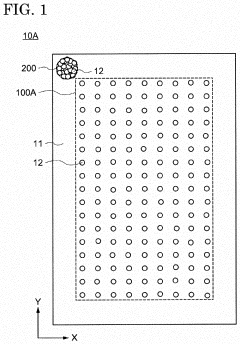
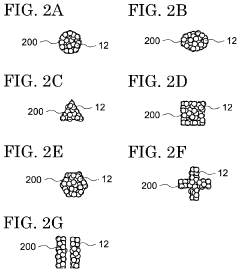
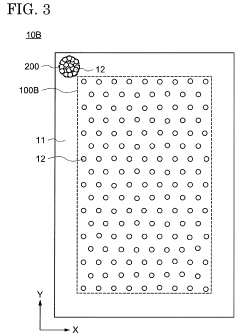
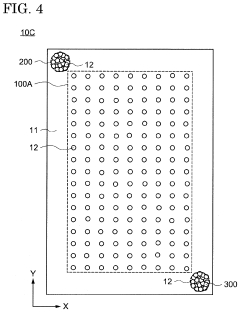
- An anisotropic conductive film with a first region of discretely arranged conductive particles corresponding to electrode patterns and a second region with aggregated conductive particles acting as an alignment marker, facilitating easy alignment with the circuit substrate and reducing production costs by forming alignment markers through conductive particle dispersion.
Encapsulated light emitting diodes for selective fluidic assembly
PatentActiveUS12119432B2
Innovation
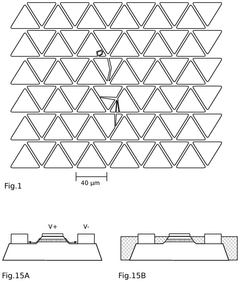
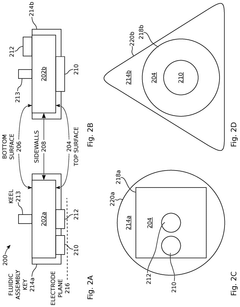
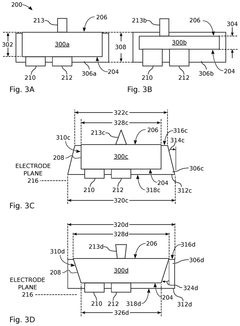
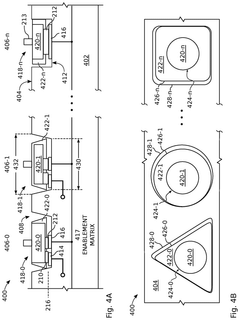
- The use of partially encapsulated semiconductor-based inorganic micro-LEDs with a patternable polymer encapsulant that protects the LEDs from collisions and optimizes their shape for efficient assembly, allowing for higher speed and yield while preventing defects, and enabling precise alignment of LED colors on a display substrate.
Energy Efficiency and Environmental Impact Assessment
Energy efficiency represents a critical differentiator between OLED and MicroLED technologies in consumer applications. OLED displays demonstrate variable power consumption patterns directly correlated with content displayed—showing black pixels requires virtually no power as these pixels are simply turned off. This characteristic gives OLED a significant advantage when displaying content with abundant dark areas, particularly beneficial for mobile devices where battery conservation is paramount.
MicroLED technology, while still evolving in consumer markets, shows promising energy efficiency metrics in laboratory testing. Current implementations indicate that MicroLED displays can achieve up to 30% greater energy efficiency than comparable OLED panels when displaying full-brightness content. This efficiency stems from MicroLED's superior light emission properties, requiring less power to achieve equivalent brightness levels.
The manufacturing environmental footprint of these technologies presents notable contrasts. OLED production involves organic compounds that may include rare earth elements and potentially hazardous materials. The manufacturing process generates chemical waste requiring specialized disposal protocols. Industry data indicates that a standard 55-inch OLED panel production generates approximately 85kg of CO2 equivalent emissions.
MicroLED manufacturing currently demonstrates a higher environmental impact per unit due to complex production requirements and lower yield rates. The fabrication process demands precision equipment operating in ultra-clean environments, resulting in substantial energy consumption. However, the longer theoretical lifespan of MicroLED displays (potentially exceeding 100,000 hours versus OLED's typical 30,000-50,000 hours) may offset initial production impacts through reduced replacement frequency.
End-of-life considerations reveal that OLED panels present recycling challenges due to their organic components and laminated construction. Current recycling rates for OLED displays remain below 20% in most markets. MicroLED displays, composed primarily of inorganic materials, offer potentially better recyclability, though the technology's nascent state means comprehensive recycling infrastructure has yet to be established.
Carbon footprint analysis across the complete lifecycle indicates that a typical 65-inch OLED television generates approximately 1,200kg of CO2 equivalent over a 10-year lifespan, with 70% attributed to operational energy consumption. Comparable MicroLED displays are projected to reduce this figure by 15-25% through improved operational efficiency, despite currently higher manufacturing emissions.
MicroLED technology, while still evolving in consumer markets, shows promising energy efficiency metrics in laboratory testing. Current implementations indicate that MicroLED displays can achieve up to 30% greater energy efficiency than comparable OLED panels when displaying full-brightness content. This efficiency stems from MicroLED's superior light emission properties, requiring less power to achieve equivalent brightness levels.
The manufacturing environmental footprint of these technologies presents notable contrasts. OLED production involves organic compounds that may include rare earth elements and potentially hazardous materials. The manufacturing process generates chemical waste requiring specialized disposal protocols. Industry data indicates that a standard 55-inch OLED panel production generates approximately 85kg of CO2 equivalent emissions.
MicroLED manufacturing currently demonstrates a higher environmental impact per unit due to complex production requirements and lower yield rates. The fabrication process demands precision equipment operating in ultra-clean environments, resulting in substantial energy consumption. However, the longer theoretical lifespan of MicroLED displays (potentially exceeding 100,000 hours versus OLED's typical 30,000-50,000 hours) may offset initial production impacts through reduced replacement frequency.
End-of-life considerations reveal that OLED panels present recycling challenges due to their organic components and laminated construction. Current recycling rates for OLED displays remain below 20% in most markets. MicroLED displays, composed primarily of inorganic materials, offer potentially better recyclability, though the technology's nascent state means comprehensive recycling infrastructure has yet to be established.
Carbon footprint analysis across the complete lifecycle indicates that a typical 65-inch OLED television generates approximately 1,200kg of CO2 equivalent over a 10-year lifespan, with 70% attributed to operational energy consumption. Comparable MicroLED displays are projected to reduce this figure by 15-25% through improved operational efficiency, despite currently higher manufacturing emissions.
Supply Chain and Manufacturing Scalability Analysis
The supply chain dynamics for OLED and MicroLED technologies reveal significant differences that impact their market adoption trajectories. OLED manufacturing has matured considerably over the past decade, with established production facilities across Asia, particularly in South Korea and China. Samsung Display and LG Display have developed sophisticated vertical integration strategies, controlling critical components from materials to finished panels. This maturity translates to economies of scale that have gradually reduced production costs, though high-end OLED panels remain premium-priced.
In contrast, MicroLED supply chains are still in nascent development stages. The technology faces substantial manufacturing challenges, particularly in mass transfer processes where millions of microscopic LED chips must be precisely placed. Current yields remain problematic, with defect rates significantly higher than mature OLED production lines. Companies like Apple, Samsung, and Sony have made substantial investments in MicroLED manufacturing technologies, but truly scalable solutions remain elusive.
Material sourcing presents another critical distinction. OLED production relies on organic compounds with established supplier networks, though certain rare materials continue to constrain production scaling. MicroLED utilizes inorganic semiconductor materials with potentially more stable supply chains once scaled, but currently faces bottlenecks in specialized equipment and precision manufacturing tools.
Regional manufacturing capabilities also differ markedly. OLED production capacity is concentrated in East Asia, with recent expansions into China increasing competitive pressure. MicroLED manufacturing expertise remains more globally distributed, with significant research and development occurring in North America and Europe, though production capacity is limited to specialized facilities.
Cost trajectory analysis indicates OLED manufacturing has followed a predictable decline curve as volumes increased, with panel costs decreasing approximately 20-30% with each doubling of production capacity. MicroLED costs remain prohibitively high for mass consumer applications, with estimates suggesting a 5-10x premium over equivalent OLED displays. Industry projections indicate MicroLED will require at least 3-5 more years of manufacturing innovation before reaching price points viable for mainstream consumer electronics.
Equipment infrastructure represents another significant divergence point. OLED manufacturing utilizes established vapor deposition and encapsulation technologies with multiple equipment vendors. MicroLED requires novel precision placement equipment with limited supplier options, creating potential bottlenecks as manufacturers attempt to scale production.
In contrast, MicroLED supply chains are still in nascent development stages. The technology faces substantial manufacturing challenges, particularly in mass transfer processes where millions of microscopic LED chips must be precisely placed. Current yields remain problematic, with defect rates significantly higher than mature OLED production lines. Companies like Apple, Samsung, and Sony have made substantial investments in MicroLED manufacturing technologies, but truly scalable solutions remain elusive.
Material sourcing presents another critical distinction. OLED production relies on organic compounds with established supplier networks, though certain rare materials continue to constrain production scaling. MicroLED utilizes inorganic semiconductor materials with potentially more stable supply chains once scaled, but currently faces bottlenecks in specialized equipment and precision manufacturing tools.
Regional manufacturing capabilities also differ markedly. OLED production capacity is concentrated in East Asia, with recent expansions into China increasing competitive pressure. MicroLED manufacturing expertise remains more globally distributed, with significant research and development occurring in North America and Europe, though production capacity is limited to specialized facilities.
Cost trajectory analysis indicates OLED manufacturing has followed a predictable decline curve as volumes increased, with panel costs decreasing approximately 20-30% with each doubling of production capacity. MicroLED costs remain prohibitively high for mass consumer applications, with estimates suggesting a 5-10x premium over equivalent OLED displays. Industry projections indicate MicroLED will require at least 3-5 more years of manufacturing innovation before reaching price points viable for mainstream consumer electronics.
Equipment infrastructure represents another significant divergence point. OLED manufacturing utilizes established vapor deposition and encapsulation technologies with multiple equipment vendors. MicroLED requires novel precision placement equipment with limited supplier options, creating potential bottlenecks as manufacturers attempt to scale production.
Unlock deeper insights with Patsnap Eureka Quick Research — get a full tech report to explore trends and direct your research. Try now!
Generate Your Research Report Instantly with AI Agent
Supercharge your innovation with Patsnap Eureka AI Agent Platform!