Exploring OLED vs MicroLED Compatibility with IoT
OCT 24, 202510 MIN READ
Generate Your Research Report Instantly with AI Agent
PatSnap Eureka helps you evaluate technical feasibility & market potential.
OLED and MicroLED Technology Evolution and Objectives
Display technologies have undergone significant evolution over the past decades, transitioning from CRT to LCD, and now advancing toward OLED and MicroLED. OLED (Organic Light Emitting Diode) technology emerged commercially in the early 2000s, pioneered by companies like Kodak and Sony. The technology utilizes organic compounds that emit light when electricity is applied, eliminating the need for backlighting and enabling thinner, more flexible displays with superior contrast ratios and energy efficiency for dark content.
MicroLED represents a more recent innovation, with its development gaining momentum around 2010. This technology employs microscopic inorganic LED arrays, each functioning as individual pixels. Unlike OLED, MicroLED offers higher brightness, longer lifespan, and immunity to burn-in issues, while maintaining the perfect black levels and wide viewing angles that OLED is known for.
The technological trajectory for both display technologies has been driven by several key factors: miniaturization, power efficiency, manufacturing scalability, and integration capabilities. For OLED, advancements have focused on improving blue emitter lifespans, reducing production costs, and enhancing brightness levels. MicroLED development has concentrated on overcoming mass transfer challenges, reducing pixel sizes, and improving manufacturing yields.
In the context of IoT compatibility, both technologies present unique advantages and challenges. OLED offers lower power consumption for predominantly dark interfaces, flexibility for curved or foldable IoT devices, and simpler driver electronics. MicroLED provides superior brightness for outdoor IoT applications, longer operational lifespans critical for embedded systems, and better performance in variable temperature environments.
The technical objectives for these display technologies in IoT applications include achieving ultra-low power consumption to support battery-operated devices, developing robust integration protocols for seamless connectivity with various IoT platforms, and creating scalable solutions that can be implemented across diverse device categories from wearables to smart home interfaces.
Current research is focused on addressing specific challenges: for OLED, enhancing operational stability in varying environmental conditions and reducing production costs; for MicroLED, overcoming mass transfer yield issues and developing more efficient manufacturing processes to make the technology viable for smaller IoT devices.
The convergence of these display technologies with IoT represents a significant opportunity for creating more intuitive, responsive, and energy-efficient user interfaces across the expanding ecosystem of connected devices, potentially transforming how users interact with technology in their daily lives.
MicroLED represents a more recent innovation, with its development gaining momentum around 2010. This technology employs microscopic inorganic LED arrays, each functioning as individual pixels. Unlike OLED, MicroLED offers higher brightness, longer lifespan, and immunity to burn-in issues, while maintaining the perfect black levels and wide viewing angles that OLED is known for.
The technological trajectory for both display technologies has been driven by several key factors: miniaturization, power efficiency, manufacturing scalability, and integration capabilities. For OLED, advancements have focused on improving blue emitter lifespans, reducing production costs, and enhancing brightness levels. MicroLED development has concentrated on overcoming mass transfer challenges, reducing pixel sizes, and improving manufacturing yields.
In the context of IoT compatibility, both technologies present unique advantages and challenges. OLED offers lower power consumption for predominantly dark interfaces, flexibility for curved or foldable IoT devices, and simpler driver electronics. MicroLED provides superior brightness for outdoor IoT applications, longer operational lifespans critical for embedded systems, and better performance in variable temperature environments.
The technical objectives for these display technologies in IoT applications include achieving ultra-low power consumption to support battery-operated devices, developing robust integration protocols for seamless connectivity with various IoT platforms, and creating scalable solutions that can be implemented across diverse device categories from wearables to smart home interfaces.
Current research is focused on addressing specific challenges: for OLED, enhancing operational stability in varying environmental conditions and reducing production costs; for MicroLED, overcoming mass transfer yield issues and developing more efficient manufacturing processes to make the technology viable for smaller IoT devices.
The convergence of these display technologies with IoT represents a significant opportunity for creating more intuitive, responsive, and energy-efficient user interfaces across the expanding ecosystem of connected devices, potentially transforming how users interact with technology in their daily lives.
IoT Market Requirements for Display Technologies
The Internet of Things (IoT) ecosystem demands specific display technology characteristics that align with its unique operational requirements. As connected devices proliferate across consumer, industrial, and commercial environments, display technologies must adapt to serve diverse use cases while maintaining compatibility with IoT infrastructure constraints.
Power efficiency stands as the paramount requirement for IoT display technologies. With many IoT devices operating on battery power or energy harvesting systems, displays must minimize power consumption to extend device operational lifespan. This requirement favors technologies that consume power only when information changes or that can operate efficiently at lower refresh rates. Both OLED and MicroLED offer advantages in this domain, with OLED's pixel-level control enabling partial screen updates and MicroLED's high efficiency promising longer battery life in always-on applications.
Size adaptability represents another critical market requirement. IoT implementations range from tiny wearables to large industrial control panels, necessitating display technologies that can scale effectively across dimensions. The manufacturing processes must support both miniaturization for space-constrained applications and larger formats for information-rich interfaces, all while maintaining consistent performance characteristics.
Environmental resilience features prominently in IoT market requirements, as connected devices often operate in challenging conditions. Displays must withstand temperature extremes, humidity variations, vibration, and in some cases, direct exposure to elements. MicroLED technology demonstrates particular promise in this area due to its robust construction and resistance to environmental stressors compared to organic-based alternatives.
Readability across diverse lighting conditions emerges as essential for IoT applications spanning indoor and outdoor environments. Display technologies must deliver sufficient brightness for outdoor visibility while maintaining clarity in low-light settings. High contrast ratios and wide viewing angles ensure information remains accessible regardless of user positioning or ambient conditions.
Integration capabilities with existing IoT communication protocols and power management systems represent another market imperative. Display technologies must operate harmoniously within standardized IoT frameworks, supporting common interfaces while minimizing electromagnetic interference that could disrupt wireless connectivity crucial to IoT functionality.
Cost-effectiveness at scale rounds out the core market requirements, as IoT business models often depend on deploying large numbers of devices. The display component must balance performance with economic viability, with particular sensitivity to manufacturing complexity, yield rates, and material costs that impact overall device pricing and market adoption potential.
Power efficiency stands as the paramount requirement for IoT display technologies. With many IoT devices operating on battery power or energy harvesting systems, displays must minimize power consumption to extend device operational lifespan. This requirement favors technologies that consume power only when information changes or that can operate efficiently at lower refresh rates. Both OLED and MicroLED offer advantages in this domain, with OLED's pixel-level control enabling partial screen updates and MicroLED's high efficiency promising longer battery life in always-on applications.
Size adaptability represents another critical market requirement. IoT implementations range from tiny wearables to large industrial control panels, necessitating display technologies that can scale effectively across dimensions. The manufacturing processes must support both miniaturization for space-constrained applications and larger formats for information-rich interfaces, all while maintaining consistent performance characteristics.
Environmental resilience features prominently in IoT market requirements, as connected devices often operate in challenging conditions. Displays must withstand temperature extremes, humidity variations, vibration, and in some cases, direct exposure to elements. MicroLED technology demonstrates particular promise in this area due to its robust construction and resistance to environmental stressors compared to organic-based alternatives.
Readability across diverse lighting conditions emerges as essential for IoT applications spanning indoor and outdoor environments. Display technologies must deliver sufficient brightness for outdoor visibility while maintaining clarity in low-light settings. High contrast ratios and wide viewing angles ensure information remains accessible regardless of user positioning or ambient conditions.
Integration capabilities with existing IoT communication protocols and power management systems represent another market imperative. Display technologies must operate harmoniously within standardized IoT frameworks, supporting common interfaces while minimizing electromagnetic interference that could disrupt wireless connectivity crucial to IoT functionality.
Cost-effectiveness at scale rounds out the core market requirements, as IoT business models often depend on deploying large numbers of devices. The display component must balance performance with economic viability, with particular sensitivity to manufacturing complexity, yield rates, and material costs that impact overall device pricing and market adoption potential.
Current Technical Limitations and Challenges in IoT Displays
IoT display technologies face significant technical limitations that impact their integration and performance. Power consumption remains a critical challenge, particularly for battery-operated IoT devices. While OLED offers advantages in power efficiency through its ability to completely turn off individual pixels, it still consumes considerable power when displaying bright content. MicroLED promises better efficiency but currently requires more power during manufacturing and implementation phases, creating a substantial barrier for widespread IoT adoption.
Size constraints present another major challenge. IoT devices often require compact displays that maintain high resolution and visibility. OLED technology has matured to accommodate thin and flexible form factors, but suffers from limited lifespan and brightness degradation over time. MicroLED, while offering superior brightness and longevity, faces significant miniaturization challenges, with current manufacturing processes struggling to produce consistently reliable displays at the microscopic scales required for small IoT implementations.
Durability requirements pose additional complications. IoT devices deployed in industrial, outdoor, or high-traffic environments must withstand temperature fluctuations, humidity, and physical impacts. OLED displays are particularly vulnerable to moisture and oxygen exposure, requiring sophisticated encapsulation techniques that add cost and complexity. MicroLED offers better inherent durability but remains prohibitively expensive for mass-market IoT applications where cost sensitivity is paramount.
Manufacturing scalability represents a significant bottleneck, especially for MicroLED technology. The precise placement of millions of microscopic LED elements demands extraordinary manufacturing precision, resulting in low yields and high costs. OLED manufacturing has achieved greater maturity but still faces challenges in consistent quality control at scale, particularly for specialized IoT applications requiring custom display configurations.
Connectivity and integration issues further complicate IoT display implementation. Both technologies require sophisticated drivers and controllers that must interface seamlessly with various IoT communication protocols. The additional processing requirements for display management can strain limited computational resources in IoT devices, creating performance bottlenecks and increasing system complexity.
Cost considerations ultimately determine adoption feasibility. While OLED has achieved reasonable cost efficiency for consumer electronics, specialized IoT implementations often require customized solutions that elevate costs. MicroLED remains prohibitively expensive for most IoT applications, with current manufacturing costs far exceeding practical implementation thresholds for all but the most premium IoT devices.
Size constraints present another major challenge. IoT devices often require compact displays that maintain high resolution and visibility. OLED technology has matured to accommodate thin and flexible form factors, but suffers from limited lifespan and brightness degradation over time. MicroLED, while offering superior brightness and longevity, faces significant miniaturization challenges, with current manufacturing processes struggling to produce consistently reliable displays at the microscopic scales required for small IoT implementations.
Durability requirements pose additional complications. IoT devices deployed in industrial, outdoor, or high-traffic environments must withstand temperature fluctuations, humidity, and physical impacts. OLED displays are particularly vulnerable to moisture and oxygen exposure, requiring sophisticated encapsulation techniques that add cost and complexity. MicroLED offers better inherent durability but remains prohibitively expensive for mass-market IoT applications where cost sensitivity is paramount.
Manufacturing scalability represents a significant bottleneck, especially for MicroLED technology. The precise placement of millions of microscopic LED elements demands extraordinary manufacturing precision, resulting in low yields and high costs. OLED manufacturing has achieved greater maturity but still faces challenges in consistent quality control at scale, particularly for specialized IoT applications requiring custom display configurations.
Connectivity and integration issues further complicate IoT display implementation. Both technologies require sophisticated drivers and controllers that must interface seamlessly with various IoT communication protocols. The additional processing requirements for display management can strain limited computational resources in IoT devices, creating performance bottlenecks and increasing system complexity.
Cost considerations ultimately determine adoption feasibility. While OLED has achieved reasonable cost efficiency for consumer electronics, specialized IoT implementations often require customized solutions that elevate costs. MicroLED remains prohibitively expensive for most IoT applications, with current manufacturing costs far exceeding practical implementation thresholds for all but the most premium IoT devices.
Comparative Analysis of OLED vs MicroLED Solutions for IoT
01 Integration of OLED and MicroLED technologies in hybrid displays
Hybrid display systems that combine OLED and MicroLED technologies can leverage the advantages of both. These systems typically use MicroLEDs for high-brightness areas and OLEDs for areas requiring better color reproduction and flexibility. The integration allows for optimized power consumption while maintaining display quality across different lighting conditions. Such hybrid approaches enable new form factors and applications in consumer electronics, automotive displays, and wearable devices.- Integration of OLED and MicroLED technologies in hybrid displays: Hybrid display systems that combine OLED and MicroLED technologies can leverage the advantages of both. These systems typically use MicroLEDs for high-brightness areas and OLEDs for areas requiring better color reproduction and flexibility. The integration allows for optimized power consumption while maintaining high display quality. Various approaches include using separate panels for different functions or integrating both technologies within the same display architecture.
- Substrate compatibility solutions for dual-technology displays: Developing compatible substrate materials is crucial for integrating OLED and MicroLED technologies. Specialized substrates that can accommodate both technologies' manufacturing requirements have been developed, including flexible substrates that support both OLED's organic layers and MicroLED's inorganic components. These substrates often incorporate specialized barrier layers to prevent contamination between the different material systems while maintaining electrical and optical performance.
- Driver circuit compatibility for dual-technology displays: Unified driver architectures have been developed to control both OLED and MicroLED elements within the same display system. These circuits address the different voltage and current requirements of each technology while maintaining synchronization. Advanced thin-film transistor (TFT) backplanes capable of driving both technologies have been designed with adjustable current delivery systems. Some implementations use separate driving circuits for each technology with a master controller for coordination.
- Thermal management solutions for hybrid displays: Thermal management is critical when combining OLED and MicroLED technologies due to their different heat generation profiles. Innovative heat dissipation structures have been developed to address the higher operating temperatures of MicroLEDs while protecting temperature-sensitive OLED materials. These solutions include specialized heat sinks, thermal interface materials, and active cooling systems designed to maintain optimal operating temperatures for both technologies within a single display unit.
- Manufacturing process compatibility enhancements: Specialized manufacturing processes have been developed to enable the production of displays incorporating both OLED and MicroLED technologies. These processes include sequential deposition techniques that protect existing layers while adding new ones, transfer printing methods for integrating pre-fabricated components, and modular assembly approaches. Advanced encapsulation methods have also been created to protect both organic and inorganic materials from environmental degradation while maintaining the performance characteristics of each technology.
02 Substrate and backplane compatibility solutions
Specialized substrate materials and backplane architectures have been developed to accommodate both OLED and MicroLED technologies on the same display panel. These solutions address differences in driving requirements, thermal management, and manufacturing processes between the two technologies. Flexible substrates and thin-film transistor arrays can be designed to support both technologies, enabling seamless integration and manufacturing efficiency while maintaining display performance characteristics.Expand Specific Solutions03 Driver circuit and signal processing compatibility
Specialized driver circuits and signal processing systems have been developed to manage the different electrical requirements of OLED and MicroLED components. These circuits can dynamically adjust voltage levels, current delivery, and timing parameters to optimize performance for each technology. Advanced control algorithms enable seamless transitions between display modes and technologies, while maintaining color accuracy and brightness consistency across the entire display surface.Expand Specific Solutions04 Manufacturing process compatibility enhancements
Innovations in manufacturing processes have improved compatibility between OLED and MicroLED production techniques. These include modified transfer methods for MicroLEDs that can work alongside OLED deposition processes, shared encapsulation technologies, and unified testing procedures. Advances in pick-and-place technology, laser transfer methods, and mass transfer techniques have enabled efficient production of hybrid displays while maintaining yield rates and reducing manufacturing costs.Expand Specific Solutions05 Power management and thermal compatibility solutions
Power management systems designed specifically for hybrid OLED-MicroLED displays address the different power consumption profiles and thermal characteristics of each technology. These systems include adaptive brightness controls, selective pixel activation, and intelligent power distribution networks. Thermal management solutions incorporate heat dissipation structures optimized for both technologies, ensuring consistent performance and extended operational lifetime while maintaining energy efficiency across various usage scenarios.Expand Specific Solutions
Leading Manufacturers and Ecosystem Analysis
The OLED vs MicroLED compatibility with IoT landscape is currently in a transitional phase, with the market expanding rapidly as smart devices proliferate. Major players like Samsung Electronics and BOE Technology Group are leading OLED development, while companies such as X Display Co. and Lumileds are advancing MicroLED technology. The market is characterized by significant investments in R&D, with established display manufacturers competing against specialized startups. Technical challenges remain in power efficiency and miniaturization for IoT applications. Companies like Intel and Meta Platforms are exploring integration possibilities, while research organizations such as Fraunhofer-Gesellschaft are developing next-generation solutions that could bridge compatibility gaps between these display technologies and IoT ecosystems.
BOE Technology Group Co., Ltd.
Technical Solution: BOE has pioneered IoT-optimized display solutions through their "Display + IoT" strategy, developing both OLED and MicroLED technologies with specific IoT integration capabilities. Their OLED technology features ultra-low power consumption modes that reduce energy usage by up to 40% compared to conventional OLEDs when displaying static content, addressing a critical requirement for battery-operated IoT devices. BOE's MicroLED development focuses on high-brightness, high-efficiency displays with pixel pitches as small as 30 micrometers, enabling integration into compact IoT devices while maintaining visual performance. Their proprietary Active Matrix addressing technology allows for individual pixel control with minimal power draw, essential for IoT applications requiring partial screen updates. BOE has also developed specialized thin-film encapsulation techniques that reduce OLED thickness to below 0.5mm while maintaining durability against environmental factors, making these displays suitable for wearable IoT devices and smart home interfaces. Additionally, BOE's displays incorporate embedded touch and sensor technologies that eliminate the need for separate sensor layers, reducing overall device thickness and power requirements.
Strengths: BOE offers comprehensive vertical integration from panel manufacturing to system integration, providing cost advantages and customization capabilities for IoT device manufacturers. Their flexible OLED technology enables novel form factors for IoT devices. Weaknesses: Their MicroLED technology still faces mass production challenges at smaller sizes, resulting in higher costs compared to OLED solutions. Power efficiency improvements, while significant, still don't match e-paper solutions for static content applications in ultra-low-power IoT scenarios.
Wuhan China Star Optoelectronics Technology Co., Ltd.
Technical Solution: Wuhan China Star Optoelectronics (CSOT) has developed specialized OLED and MicroLED display solutions tailored for IoT integration. Their OLED technology features a proprietary low-temperature polysilicon (LTPS) backplane that reduces power consumption by approximately 25% compared to conventional amorphous silicon backplanes, making it particularly suitable for battery-powered IoT devices. CSOT's MicroLED development has focused on achieving high pixel density (over 200 PPI) while maintaining energy efficiency through innovative semiconductor materials and manufacturing processes. Their displays incorporate dedicated power management ICs that enable dynamic refresh rate adjustment from 1Hz to 120Hz based on content requirements, significantly extending battery life in IoT applications. For IoT compatibility, CSOT has developed specialized interface protocols that support direct communication with common IoT microcontrollers and wireless modules without requiring additional driver hardware. Their flexible OLED technology achieves bending radii as small as 1mm, enabling integration into curved and form-fitting IoT devices such as wearables and smart home controls. Additionally, CSOT has implemented ambient light sensing and automatic brightness adjustment directly into their display modules, reducing the component count and integration complexity for IoT device manufacturers.
Strengths: CSOT offers competitive pricing compared to other premium display manufacturers, making their solutions more accessible for mass-market IoT applications. Their displays feature excellent color accuracy and viewing angles suitable for various environmental conditions. Weaknesses: Their MicroLED technology remains in earlier stages of commercialization compared to their OLED offerings, with higher costs and more limited size options. Power consumption, while improved, still exceeds that of e-paper solutions for static content applications in ultra-low-power IoT scenarios.
Key Patents and Research Breakthroughs in Display Technologies
Anisotropic conductive film and display device
PatentActiveUS20220102326A1
Innovation
- An anisotropic conductive film with a first region of discretely arranged conductive particles corresponding to electrode patterns and a second region with aggregated conductive particles acting as an alignment marker, facilitating easy alignment with the circuit substrate and reducing production costs by forming alignment markers through conductive particle dispersion.
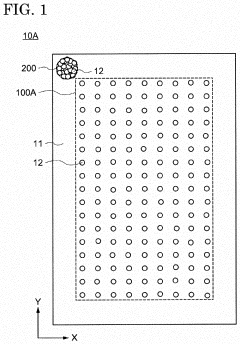
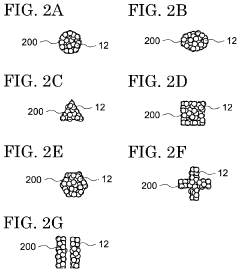
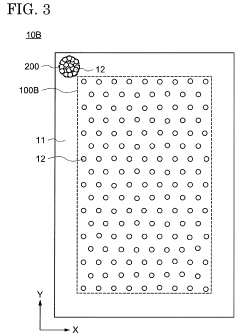
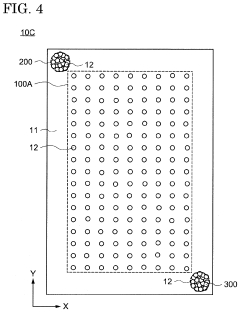
Encapsulated light emitting diodes for selective fluidic assembly
PatentActiveUS12119432B2
Innovation
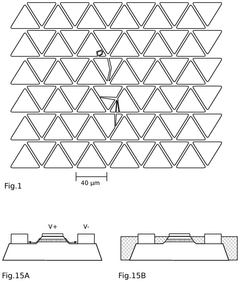
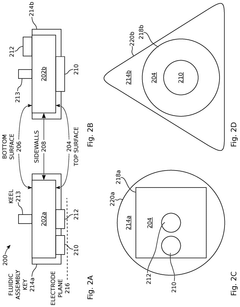
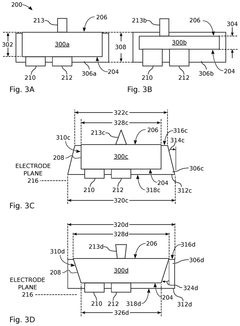
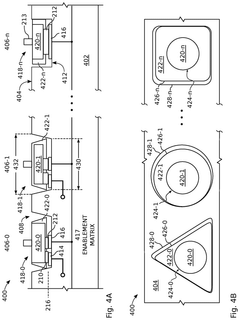
- The use of partially encapsulated semiconductor-based inorganic micro-LEDs with a patternable polymer encapsulant that protects the LEDs from collisions and optimizes their shape for efficient assembly, allowing for higher speed and yield while preventing defects, and enabling precise alignment of LED colors on a display substrate.
Energy Efficiency and Power Management Considerations
Energy efficiency represents a critical factor when evaluating display technologies for IoT applications. OLED and MicroLED technologies demonstrate distinct power consumption profiles that significantly impact their suitability for various IoT implementations. OLED displays offer pixel-level control, consuming power only for illuminated pixels, which provides exceptional efficiency for applications displaying predominantly dark content. This characteristic makes OLEDs particularly advantageous for battery-powered IoT devices with intermittent display usage patterns.
MicroLED technology, while still evolving, promises even greater energy efficiency potential. With power consumption approximately 30% lower than comparable OLED displays, MicroLEDs can deliver higher brightness levels while maintaining lower overall power requirements. This efficiency stems from their fundamental architecture, which eliminates the need for backlighting and color filters found in traditional display technologies.
For IoT implementations, power management strategies must be tailored to the specific display technology. OLED-equipped devices benefit from dark-themed interfaces and selective pixel activation, while MicroLED systems can leverage their superior efficiency across varying brightness levels. Both technologies support adaptive brightness control, which can be integrated with ambient light sensors to optimize power consumption based on environmental conditions.
Battery life considerations remain paramount for portable IoT devices. The selection between OLED and MicroLED must account for the device's intended usage duration between charges. Current benchmarks indicate that MicroLED displays can extend battery life by 20-40% compared to OLED alternatives in typical IoT usage scenarios, though this advantage varies based on content displayed and operational parameters.
Thermal management presents another crucial dimension of power efficiency. OLED displays generate less heat during operation compared to traditional LCD technologies but may experience efficiency degradation at higher brightness levels. MicroLEDs demonstrate superior thermal characteristics, maintaining efficiency across broader temperature ranges—a significant advantage for IoT devices deployed in variable environmental conditions.
Emerging power management techniques specifically designed for these display technologies include pixel-level power modulation, content-adaptive brightness control, and selective refresh mechanisms. These approaches can be implemented through specialized display drivers and power management ICs that optimize the energy consumption profile based on displayed content and user interaction patterns.
The integration of these display technologies with low-power microcontrollers and communication modules requires holistic system-level power management. Techniques such as display sleep modes, partial updates, and context-aware refresh rates can significantly extend battery life in IoT implementations. As both technologies continue to mature, we anticipate further improvements in their energy efficiency profiles, potentially enabling new categories of ultra-low-power IoT devices with rich visual interfaces.
MicroLED technology, while still evolving, promises even greater energy efficiency potential. With power consumption approximately 30% lower than comparable OLED displays, MicroLEDs can deliver higher brightness levels while maintaining lower overall power requirements. This efficiency stems from their fundamental architecture, which eliminates the need for backlighting and color filters found in traditional display technologies.
For IoT implementations, power management strategies must be tailored to the specific display technology. OLED-equipped devices benefit from dark-themed interfaces and selective pixel activation, while MicroLED systems can leverage their superior efficiency across varying brightness levels. Both technologies support adaptive brightness control, which can be integrated with ambient light sensors to optimize power consumption based on environmental conditions.
Battery life considerations remain paramount for portable IoT devices. The selection between OLED and MicroLED must account for the device's intended usage duration between charges. Current benchmarks indicate that MicroLED displays can extend battery life by 20-40% compared to OLED alternatives in typical IoT usage scenarios, though this advantage varies based on content displayed and operational parameters.
Thermal management presents another crucial dimension of power efficiency. OLED displays generate less heat during operation compared to traditional LCD technologies but may experience efficiency degradation at higher brightness levels. MicroLEDs demonstrate superior thermal characteristics, maintaining efficiency across broader temperature ranges—a significant advantage for IoT devices deployed in variable environmental conditions.
Emerging power management techniques specifically designed for these display technologies include pixel-level power modulation, content-adaptive brightness control, and selective refresh mechanisms. These approaches can be implemented through specialized display drivers and power management ICs that optimize the energy consumption profile based on displayed content and user interaction patterns.
The integration of these display technologies with low-power microcontrollers and communication modules requires holistic system-level power management. Techniques such as display sleep modes, partial updates, and context-aware refresh rates can significantly extend battery life in IoT implementations. As both technologies continue to mature, we anticipate further improvements in their energy efficiency profiles, potentially enabling new categories of ultra-low-power IoT devices with rich visual interfaces.
Supply Chain and Manufacturing Scalability Assessment
The supply chain for OLED and MicroLED technologies presents distinct challenges and opportunities when considering their integration with IoT devices. OLED manufacturing has reached relative maturity with established production facilities across Asia, particularly in South Korea, Japan, and China. Companies like Samsung Display, LG Display, and BOE Technology have developed sophisticated production lines capable of mass-producing OLED panels at increasingly competitive price points. This established infrastructure provides OLED technology with a significant advantage in terms of immediate scalability for IoT applications.
In contrast, MicroLED manufacturing remains in its nascent stages, with limited mass production capabilities. The fabrication process for MicroLED displays involves complex transfer techniques to place millions of microscopic LEDs precisely onto substrates. Current manufacturing yields for MicroLED remain substantially lower than OLED, with defect rates presenting a significant challenge to cost-effective scaling. Companies like Apple, Samsung, and PlayNitride are investing heavily in improving these processes, but full-scale production comparable to OLED remains years away.
Material sourcing represents another critical dimension of the supply chain comparison. OLED production relies on organic materials that, while once scarce, now benefit from diversified supplier networks. However, these materials remain sensitive to oxygen and moisture, requiring specialized handling throughout the supply chain. MicroLED utilizes inorganic gallium nitride (GaN) materials that offer superior durability but face potential supply constraints as demand scales, particularly for rare earth elements used in phosphor components.
Equipment availability further differentiates these technologies. OLED manufacturing equipment has become standardized with multiple suppliers offering compatible solutions. MicroLED production requires highly specialized equipment for micro-transfer processes that currently has limited availability and significantly higher capital costs. This equipment bottleneck represents a substantial barrier to rapid scaling of MicroLED for widespread IoT implementation.
Regional manufacturing capabilities also impact IoT integration potential. OLED production is concentrated in East Asia, creating potential supply chain vulnerabilities for global IoT deployments. MicroLED manufacturing, though limited, is developing with greater geographical diversity, with significant research and early production facilities in North America and Europe alongside Asian facilities. This distribution may eventually provide more resilient supply chains for IoT manufacturers seeking display technologies less vulnerable to regional disruptions.
Looking forward, both technologies face different scaling trajectories. OLED manufacturing can leverage existing infrastructure for incremental improvements in yield and cost reduction. MicroLED requires fundamental manufacturing breakthroughs to achieve comparable economies of scale. For IoT applications requiring immediate deployment at scale, OLED presents the more viable near-term solution, while MicroLED offers potentially superior performance characteristics for premium IoT applications where cost sensitivity is lower.
In contrast, MicroLED manufacturing remains in its nascent stages, with limited mass production capabilities. The fabrication process for MicroLED displays involves complex transfer techniques to place millions of microscopic LEDs precisely onto substrates. Current manufacturing yields for MicroLED remain substantially lower than OLED, with defect rates presenting a significant challenge to cost-effective scaling. Companies like Apple, Samsung, and PlayNitride are investing heavily in improving these processes, but full-scale production comparable to OLED remains years away.
Material sourcing represents another critical dimension of the supply chain comparison. OLED production relies on organic materials that, while once scarce, now benefit from diversified supplier networks. However, these materials remain sensitive to oxygen and moisture, requiring specialized handling throughout the supply chain. MicroLED utilizes inorganic gallium nitride (GaN) materials that offer superior durability but face potential supply constraints as demand scales, particularly for rare earth elements used in phosphor components.
Equipment availability further differentiates these technologies. OLED manufacturing equipment has become standardized with multiple suppliers offering compatible solutions. MicroLED production requires highly specialized equipment for micro-transfer processes that currently has limited availability and significantly higher capital costs. This equipment bottleneck represents a substantial barrier to rapid scaling of MicroLED for widespread IoT implementation.
Regional manufacturing capabilities also impact IoT integration potential. OLED production is concentrated in East Asia, creating potential supply chain vulnerabilities for global IoT deployments. MicroLED manufacturing, though limited, is developing with greater geographical diversity, with significant research and early production facilities in North America and Europe alongside Asian facilities. This distribution may eventually provide more resilient supply chains for IoT manufacturers seeking display technologies less vulnerable to regional disruptions.
Looking forward, both technologies face different scaling trajectories. OLED manufacturing can leverage existing infrastructure for incremental improvements in yield and cost reduction. MicroLED requires fundamental manufacturing breakthroughs to achieve comparable economies of scale. For IoT applications requiring immediate deployment at scale, OLED presents the more viable near-term solution, while MicroLED offers potentially superior performance characteristics for premium IoT applications where cost sensitivity is lower.
Unlock deeper insights with PatSnap Eureka Quick Research — get a full tech report to explore trends and direct your research. Try now!
Generate Your Research Report Instantly with AI Agent
Supercharge your innovation with PatSnap Eureka AI Agent Platform!