
Exploring OLED vs MicroLED Flexibility and Bendability
OCT 24, 20259 MIN READ
Generate Your Research Report Instantly with AI Agent
Patsnap Eureka helps you evaluate technical feasibility & market potential.
OLED and MicroLED Flexible Display Evolution
The evolution of flexible display technology has witnessed significant advancements over the past decade, with OLED (Organic Light-Emitting Diode) and MicroLED emerging as the two primary competing technologies. OLED technology, first commercialized in flexible form around 2013 with Samsung's curved displays, represented the initial breakthrough in moving beyond rigid display constraints. These early implementations featured modest curvature rather than true flexibility, but established the foundation for subsequent innovations.
By 2015-2016, truly flexible OLED displays began appearing in commercial products, enabling foldable smartphones and rollable displays. The technology's inherent advantages—including self-emissive pixels, elimination of backlighting requirements, and organic materials with natural flexibility—positioned OLED as the dominant flexible display solution. Samsung's Galaxy Fold (2019) and Huawei's Mate X marked significant milestones in bringing foldable OLED technology to mass market.
MicroLED technology, while conceptualized earlier, has followed a different evolutionary trajectory. Initially focused on high-brightness, high-efficiency rigid displays, MicroLED's potential for flexibility emerged more recently. Unlike OLED's organic compounds, MicroLED utilizes inorganic gallium nitride (GaN) LEDs miniaturized to microscopic dimensions. The technology's flexibility challenges stem from the need to transfer these rigid micro-components onto flexible substrates while maintaining electrical connectivity and performance.
Significant progress occurred around 2018-2020 when researchers demonstrated transfer techniques allowing MicroLED arrays to be placed on flexible polymer substrates. Companies like PlayNitride and X Display Company pioneered mass transfer technologies enabling higher yield rates for flexible MicroLED implementations. However, commercial flexible MicroLED displays remain largely in prototype stages, with full production models anticipated in the 2023-2025 timeframe.
The bendability characteristics of these technologies have evolved distinctly. OLED displays initially achieved bend radii of approximately 10mm, progressively improving to sub-5mm capabilities enabling the tight folds seen in current foldable smartphones. MicroLED flexibility has improved from early demonstrations with 30mm bend radii to recent prototypes achieving 10-15mm, though still lagging behind OLED's capabilities.
Looking forward, both technologies are pursuing ultra-thin form factors and enhanced durability. OLED development focuses on improving fold cycle durability and reducing crease visibility, while MicroLED research emphasizes novel transfer techniques and interconnect technologies to achieve comparable flexibility while maintaining its superior brightness and longevity advantages. The convergence of these parallel evolutionary paths may ultimately yield hybrid approaches combining the strengths of both technologies.
By 2015-2016, truly flexible OLED displays began appearing in commercial products, enabling foldable smartphones and rollable displays. The technology's inherent advantages—including self-emissive pixels, elimination of backlighting requirements, and organic materials with natural flexibility—positioned OLED as the dominant flexible display solution. Samsung's Galaxy Fold (2019) and Huawei's Mate X marked significant milestones in bringing foldable OLED technology to mass market.
MicroLED technology, while conceptualized earlier, has followed a different evolutionary trajectory. Initially focused on high-brightness, high-efficiency rigid displays, MicroLED's potential for flexibility emerged more recently. Unlike OLED's organic compounds, MicroLED utilizes inorganic gallium nitride (GaN) LEDs miniaturized to microscopic dimensions. The technology's flexibility challenges stem from the need to transfer these rigid micro-components onto flexible substrates while maintaining electrical connectivity and performance.
Significant progress occurred around 2018-2020 when researchers demonstrated transfer techniques allowing MicroLED arrays to be placed on flexible polymer substrates. Companies like PlayNitride and X Display Company pioneered mass transfer technologies enabling higher yield rates for flexible MicroLED implementations. However, commercial flexible MicroLED displays remain largely in prototype stages, with full production models anticipated in the 2023-2025 timeframe.
The bendability characteristics of these technologies have evolved distinctly. OLED displays initially achieved bend radii of approximately 10mm, progressively improving to sub-5mm capabilities enabling the tight folds seen in current foldable smartphones. MicroLED flexibility has improved from early demonstrations with 30mm bend radii to recent prototypes achieving 10-15mm, though still lagging behind OLED's capabilities.
Looking forward, both technologies are pursuing ultra-thin form factors and enhanced durability. OLED development focuses on improving fold cycle durability and reducing crease visibility, while MicroLED research emphasizes novel transfer techniques and interconnect technologies to achieve comparable flexibility while maintaining its superior brightness and longevity advantages. The convergence of these parallel evolutionary paths may ultimately yield hybrid approaches combining the strengths of both technologies.
Market Demand for Bendable Display Technologies
The global market for bendable display technologies has witnessed substantial growth in recent years, driven by increasing consumer demand for innovative form factors in electronic devices. The flexible display market was valued at approximately $23.1 billion in 2022 and is projected to reach $86.7 billion by 2030, representing a compound annual growth rate (CAGR) of 18.2% during the forecast period. This remarkable growth trajectory underscores the significant market potential for both OLED and MicroLED flexible display technologies.
Consumer electronics represents the largest application segment for bendable displays, with smartphones being the primary driver. Major smartphone manufacturers have introduced foldable devices featuring flexible OLED displays, with Samsung's Galaxy Z Fold and Z Flip series leading the market. According to industry reports, global shipments of foldable smartphones reached 14.2 million units in 2022, a 75% increase from 2021, demonstrating strong consumer interest in this emerging product category.
Beyond smartphones, wearable devices constitute another significant market segment for flexible display technologies. The global smartwatch market, valued at $30.4 billion in 2022, is increasingly adopting curved and flexible displays to enhance user experience and device functionality. Additionally, automotive displays, particularly curved instrument clusters and infotainment systems, represent a rapidly growing application area with a projected CAGR of 21.3% through 2030.
Regional analysis reveals that Asia Pacific dominates the flexible display market, accounting for approximately 62% of global market share. This dominance is attributed to the presence of major display manufacturers and electronic device producers in countries like South Korea, Japan, China, and Taiwan. North America and Europe follow as significant markets, driven by high consumer purchasing power and early technology adoption.
Consumer preference surveys indicate that flexibility and durability are becoming increasingly important purchasing factors. A recent study found that 68% of smartphone users consider bendability and foldability as "important" or "very important" features for their next device purchase. This trend is particularly pronounced among younger demographics (18-34 years), where the preference rises to 76%.
Industry forecasts suggest that as manufacturing processes mature and production costs decrease, bendable displays will penetrate mid-range device segments, significantly expanding the addressable market. The potential for MicroLED to offer superior flexibility compared to OLED, while maintaining excellent visual performance, positions it as a particularly promising technology for future market growth, especially in premium device categories where performance justifies higher price points.
Consumer electronics represents the largest application segment for bendable displays, with smartphones being the primary driver. Major smartphone manufacturers have introduced foldable devices featuring flexible OLED displays, with Samsung's Galaxy Z Fold and Z Flip series leading the market. According to industry reports, global shipments of foldable smartphones reached 14.2 million units in 2022, a 75% increase from 2021, demonstrating strong consumer interest in this emerging product category.
Beyond smartphones, wearable devices constitute another significant market segment for flexible display technologies. The global smartwatch market, valued at $30.4 billion in 2022, is increasingly adopting curved and flexible displays to enhance user experience and device functionality. Additionally, automotive displays, particularly curved instrument clusters and infotainment systems, represent a rapidly growing application area with a projected CAGR of 21.3% through 2030.
Regional analysis reveals that Asia Pacific dominates the flexible display market, accounting for approximately 62% of global market share. This dominance is attributed to the presence of major display manufacturers and electronic device producers in countries like South Korea, Japan, China, and Taiwan. North America and Europe follow as significant markets, driven by high consumer purchasing power and early technology adoption.
Consumer preference surveys indicate that flexibility and durability are becoming increasingly important purchasing factors. A recent study found that 68% of smartphone users consider bendability and foldability as "important" or "very important" features for their next device purchase. This trend is particularly pronounced among younger demographics (18-34 years), where the preference rises to 76%.
Industry forecasts suggest that as manufacturing processes mature and production costs decrease, bendable displays will penetrate mid-range device segments, significantly expanding the addressable market. The potential for MicroLED to offer superior flexibility compared to OLED, while maintaining excellent visual performance, positions it as a particularly promising technology for future market growth, especially in premium device categories where performance justifies higher price points.
Technical Challenges in Flexible Display Development
Flexible display technology faces numerous technical challenges that must be overcome to achieve commercial viability. The fundamental challenge lies in the material science domain, where researchers must develop substrate materials that maintain electrical conductivity while being repeatedly bent or folded. Traditional glass substrates are inherently brittle, necessitating the development of polymer-based alternatives like polyimide that can withstand mechanical stress without degradation.
For OLED displays, a critical challenge is the sensitivity of organic materials to oxygen and moisture, which accelerates degradation when exposed to environmental factors. This necessitates advanced encapsulation technologies to protect the organic layers while maintaining flexibility. Thin film encapsulation (TFE) has emerged as a promising solution, but achieving perfect barrier properties while preserving bendability remains problematic.
MicroLED technology, while offering superior brightness and longevity compared to OLED, presents unique challenges in flexible implementations. The transfer process of microscopic LED chips onto flexible substrates requires unprecedented precision at scale. Current pick-and-place methods struggle with the throughput requirements for commercial production, especially as pixel densities increase for high-resolution displays.
Both technologies face interconnection challenges when subjected to repeated bending. Metal traces can develop microcracks that progressively increase resistance and eventually lead to circuit failure. Novel approaches using liquid metal conductors and stretchable conductive polymers show promise but face integration difficulties with existing manufacturing processes.
Thermal management represents another significant hurdle. Flexible displays must dissipate heat effectively without rigid heat sinks, as excessive heat accelerates material degradation and reduces device lifespan. This is particularly challenging for MicroLED displays, which can generate substantial heat during operation at high brightness levels.
Touch functionality integration adds another layer of complexity. Traditional indium tin oxide (ITO) touch sensors crack under bending stress, necessitating alternative materials like silver nanowires or metal mesh structures that maintain conductivity during flexing while remaining optically transparent.
Manufacturing scalability remains perhaps the most significant barrier to widespread adoption. Current production methods for flexible displays involve complex, multi-step processes with relatively low yields compared to conventional rigid display manufacturing. The precision required for layer deposition on non-rigid substrates demands specialized equipment and processes that significantly increase production costs.
Addressing these technical challenges requires interdisciplinary collaboration across materials science, electrical engineering, manufacturing technology, and chemical engineering fields. Recent advances in nanomaterials and hybrid organic-inorganic structures show promise for overcoming many of these limitations, potentially enabling truly flexible, durable display technologies for next-generation devices.
For OLED displays, a critical challenge is the sensitivity of organic materials to oxygen and moisture, which accelerates degradation when exposed to environmental factors. This necessitates advanced encapsulation technologies to protect the organic layers while maintaining flexibility. Thin film encapsulation (TFE) has emerged as a promising solution, but achieving perfect barrier properties while preserving bendability remains problematic.
MicroLED technology, while offering superior brightness and longevity compared to OLED, presents unique challenges in flexible implementations. The transfer process of microscopic LED chips onto flexible substrates requires unprecedented precision at scale. Current pick-and-place methods struggle with the throughput requirements for commercial production, especially as pixel densities increase for high-resolution displays.
Both technologies face interconnection challenges when subjected to repeated bending. Metal traces can develop microcracks that progressively increase resistance and eventually lead to circuit failure. Novel approaches using liquid metal conductors and stretchable conductive polymers show promise but face integration difficulties with existing manufacturing processes.
Thermal management represents another significant hurdle. Flexible displays must dissipate heat effectively without rigid heat sinks, as excessive heat accelerates material degradation and reduces device lifespan. This is particularly challenging for MicroLED displays, which can generate substantial heat during operation at high brightness levels.
Touch functionality integration adds another layer of complexity. Traditional indium tin oxide (ITO) touch sensors crack under bending stress, necessitating alternative materials like silver nanowires or metal mesh structures that maintain conductivity during flexing while remaining optically transparent.
Manufacturing scalability remains perhaps the most significant barrier to widespread adoption. Current production methods for flexible displays involve complex, multi-step processes with relatively low yields compared to conventional rigid display manufacturing. The precision required for layer deposition on non-rigid substrates demands specialized equipment and processes that significantly increase production costs.
Addressing these technical challenges requires interdisciplinary collaboration across materials science, electrical engineering, manufacturing technology, and chemical engineering fields. Recent advances in nanomaterials and hybrid organic-inorganic structures show promise for overcoming many of these limitations, potentially enabling truly flexible, durable display technologies for next-generation devices.
Current Bendability Solutions Comparison
01 Flexible OLED display structures
Flexible OLED displays incorporate specialized structural elements that enable bending and folding capabilities while maintaining display performance. These structures typically include flexible substrates, specialized encapsulation layers, and modified electrode designs that can withstand repeated flexing without degradation. The flexibility is achieved through the inherent advantages of organic light-emitting materials combined with thin-film technology that allows for ultra-thin display construction.- Flexible OLED display structures: Flexible OLED displays incorporate specialized structural elements that enable bendability while maintaining display performance. These structures typically include flexible substrates, specialized encapsulation layers, and modified electrode configurations that can withstand repeated bending without degradation. The flexibility is achieved through thin-film technology and materials that distribute stress evenly across the display surface during bending operations.
- MicroLED flexibility solutions: MicroLED displays achieve flexibility through innovative transfer techniques and substrate engineering. These displays utilize ultra-small LED elements that can be arranged on flexible backplanes, allowing for bendable configurations while maintaining high brightness and energy efficiency. Special bonding methods ensure the microLEDs remain functional during bending, with strain-relieving structures incorporated to prevent damage to the light-emitting components.
- Flexible substrate materials: Advanced substrate materials are crucial for enabling flexibility in both OLED and MicroLED displays. These include polyimide films, ultra-thin glass, and specialized polymer composites that provide the necessary mechanical properties for bending while maintaining dimensional stability. These substrates are engineered to have low thermal expansion coefficients and high resistance to cracking under repeated flexing conditions.
- Encapsulation technologies for flexible displays: Specialized encapsulation methods protect flexible OLED and MicroLED displays from environmental factors while maintaining bendability. These include thin-film encapsulation layers, hybrid organic-inorganic barrier films, and advanced lamination techniques that prevent moisture and oxygen ingress while allowing the display to flex. The encapsulation systems are designed with multiple alternating layers that can accommodate mechanical stress during bending operations.
- Interconnect systems for bendable displays: Innovative interconnect technologies enable electrical connections to remain intact during bending operations in flexible displays. These include stretchable conductive materials, serpentine wiring patterns, and specialized bonding techniques that accommodate mechanical deformation. Advanced interconnect systems distribute stress evenly across connection points and incorporate redundancy to maintain signal integrity even when the display is repeatedly flexed or folded.
02 MicroLED flexibility solutions
MicroLED displays achieve flexibility through innovative transfer techniques and substrate technologies. Unlike traditional rigid LED displays, flexible MicroLED implementations utilize ultra-small LED units that can be arranged on bendable substrates. These solutions often involve specialized bonding methods, stress-relief structures, and interconnect technologies that maintain electrical connectivity during bending. The miniaturized nature of MicroLEDs enables them to withstand mechanical deformation while preserving their superior brightness and efficiency.Expand Specific Solutions03 Substrate materials for bendable displays
Advanced substrate materials are crucial for enabling flexibility in both OLED and MicroLED displays. These materials include specialized polymers, ultra-thin glass, and composite structures that provide the necessary mechanical properties for bending while maintaining dimensional stability. The substrates must balance flexibility with protection against oxygen and moisture ingress, which can degrade display components. Some implementations incorporate multi-layer substrate designs with barrier films to enhance both flexibility and durability.Expand Specific Solutions04 Encapsulation technologies for flexible displays
Specialized encapsulation technologies protect flexible OLED and MicroLED displays from environmental factors while maintaining bendability. These include thin-film encapsulation layers, hybrid organic-inorganic barrier structures, and edge sealing techniques that prevent moisture and oxygen penetration while allowing the display to flex. Advanced encapsulation solutions often employ multiple alternating layers of different materials to create effective barriers that can withstand repeated bending cycles without cracking or delamination.Expand Specific Solutions05 Interconnect and wiring solutions for bendable displays
Flexible interconnect and wiring technologies enable electrical connectivity in bendable OLED and MicroLED displays. These solutions include stretchable conductive materials, serpentine wiring patterns, and specialized bonding techniques that maintain electrical performance during bending. Some implementations use liquid metal alloys or conductive polymers that can deform without breaking. Advanced designs incorporate stress-relief structures at connection points to prevent fractures and ensure reliable operation throughout the display's flexible range of motion.Expand Specific Solutions
Key Industry Players in Flexible Display Market
The OLED vs MicroLED flexibility competition is currently in an early growth phase, with the market expanding rapidly as demand for bendable displays increases across consumer electronics. While OLED technology has reached commercial maturity with established manufacturing processes, MicroLED remains in the emerging development stage with promising potential. Key industry players demonstrate varying technological capabilities: Samsung Display and LG Electronics lead in OLED flexibility solutions, while BOE Technology and China Star Optoelectronics are advancing rapidly. Universal Display Corporation provides critical OLED materials technology, and companies like Sony are exploring MicroLED applications. The competitive landscape is characterized by intensive R&D investment as manufacturers seek to overcome technical challenges in both technologies to achieve superior flexibility performance.
BOE Technology Group Co., Ltd.
Technical Solution: BOE has developed advanced flexible OLED technology through their 6th generation flexible AMOLED production lines. Their proprietary COP (Chip on Plastic) packaging technology enables displays with bend radii down to 1mm while maintaining display integrity. For flexible displays, BOE employs LTPO (Low-Temperature Polycrystalline Oxide) backplane technology that reduces power consumption by up to 30% compared to conventional displays. In the MicroLED space, BOE has introduced their "AM-MicroLED" technology featuring an active-matrix driving method on flexible substrates that allows for bendable implementations. Their flexible MicroLED displays utilize a unique "transfer printing" process that places microscopic LED chips onto polymer substrates with specialized elastic interlayers to accommodate bending stress. BOE's latest flexible display innovations include their "BD Cell" technology that combines flexible OLED benefits with mini-LED backlighting for improved contrast while maintaining bendability properties.
Strengths: Comprehensive vertical integration from substrate manufacturing to module assembly; strong R&D capabilities with over 10,000 patents in flexible display technologies; cost-effective manufacturing processes. Weaknesses: MicroLED flexibility solutions still in early commercialization stages; challenges with color uniformity maintenance in highly bent MicroLED configurations; lower brightness retention after repeated bending cycles compared to industry leaders.
SAMSUNG DISPLAY CO LTD
Technical Solution: Samsung Display has pioneered flexible OLED technology with their Y-OCTA (Youm On-Cell Touch AMOLED) technology that integrates the touch sensor directly into the display panel, reducing thickness and enhancing flexibility. Their latest flexible OLED panels achieve bend radii as small as 1.4mm while maintaining full functionality. For MicroLED development, Samsung has introduced "The Wall" technology featuring modular MicroLED displays with flexibility capabilities through their specialized "stretchable pixel" architecture that allows for up to 30% elongation without performance degradation. Samsung's proprietary Quantum Matrix Technology enables precise control of their ultra-small LEDs, allowing them to create bendable MicroLED prototypes with minimal light leakage at flex points. Their M-series MicroLED displays incorporate a specialized substrate that enhances both durability and flexibility compared to traditional rigid displays.
Strengths: Industry-leading mass production capabilities for flexible OLED; proprietary pixel compensation technology that maintains color accuracy during bending; extensive IP portfolio in flexible display technologies. Weaknesses: Higher production costs for flexible MicroLED solutions; current MicroLED flexibility still more limited than OLED counterparts; challenges with yield rates for highly flexible MicroLED panels.
Core Patents in Flexible Display Technologies
Method for attaching display cover and attaching device
PatentPendingUS20250165031A1
Innovation
- A method for attaching a display cover using an attaching device that involves fixing the cover to the bottom of an accommodating cavity, sealing the display panel within the cavity, heating the panel, filling the sealed space with pressurized gas, and using a stretching mechanism to bond the display panel and cover together under controlled pressure and temperature.


LED display and electronic device having same
PatentWO2019208919A1
Innovation
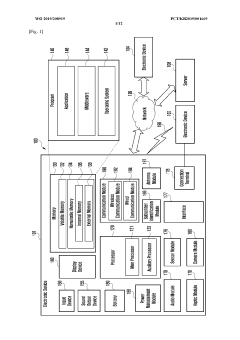
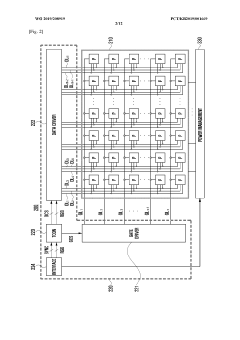
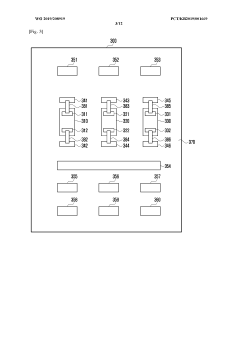
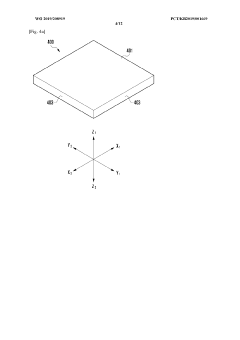
- The development of a micro-LED display with a bezel-less design and segmentation capabilities, allowing for flexible displays of various sizes, achieved through direct mounting of micro-LEDs on a substrate and innovative electrical connections using conductive patterns and wiring lines, enabling robust electrical connections and flexible display configurations.
Material Science Advancements for Display Flexibility
The evolution of flexible display technology has been significantly influenced by advancements in material science. Traditional rigid displays have given way to bendable and flexible alternatives through innovative material engineering. For OLED technology, the development of flexible substrates has been crucial, with polyimide films replacing conventional glass substrates. These films offer exceptional thermal stability, chemical resistance, and mechanical flexibility while maintaining dimensional stability under stress conditions.
The organic layers in OLED displays have been reformulated to withstand repeated bending without performance degradation. Researchers have developed specialized elastic conductive materials and stretchable electrodes that maintain conductivity even when subjected to mechanical deformation. Thin-film encapsulation techniques have evolved to provide effective moisture and oxygen barriers while preserving flexibility, with multi-layer approaches combining organic and inorganic materials proving particularly effective.
MicroLED technology presents different material challenges due to its inorganic nature. Recent breakthroughs include the development of transfer processes that enable the placement of microscopic LED arrays onto flexible substrates without compromising performance. Novel interconnect materials with high elasticity and conductivity have been engineered specifically for MicroLED applications, allowing for reliable electrical connections even during bending cycles.
Significant progress has been made in developing composite substrates that combine the advantages of multiple materials. These engineered substrates provide the necessary mechanical properties for flexibility while maintaining thermal management capabilities essential for MicroLED operation. Researchers have also explored nanomaterials such as graphene and carbon nanotubes as potential components in flexible display architectures, offering exceptional mechanical properties and electrical conductivity.
Encapsulation technologies have advanced considerably, with atomic layer deposition techniques enabling ultra-thin barrier layers that maintain flexibility while providing superior protection against environmental factors. Self-healing materials represent another frontier, with polymers capable of repairing minor damage automatically, potentially extending the lifespan of flexible displays significantly.
The integration of these material science advancements has led to displays capable of withstanding thousands of bending cycles without performance degradation. OLED technology currently maintains an advantage in flexibility due to its inherently organic nature, but MicroLED solutions are rapidly advancing through innovative material engineering approaches that may eventually overcome current limitations in bendability and durability.
The organic layers in OLED displays have been reformulated to withstand repeated bending without performance degradation. Researchers have developed specialized elastic conductive materials and stretchable electrodes that maintain conductivity even when subjected to mechanical deformation. Thin-film encapsulation techniques have evolved to provide effective moisture and oxygen barriers while preserving flexibility, with multi-layer approaches combining organic and inorganic materials proving particularly effective.
MicroLED technology presents different material challenges due to its inorganic nature. Recent breakthroughs include the development of transfer processes that enable the placement of microscopic LED arrays onto flexible substrates without compromising performance. Novel interconnect materials with high elasticity and conductivity have been engineered specifically for MicroLED applications, allowing for reliable electrical connections even during bending cycles.
Significant progress has been made in developing composite substrates that combine the advantages of multiple materials. These engineered substrates provide the necessary mechanical properties for flexibility while maintaining thermal management capabilities essential for MicroLED operation. Researchers have also explored nanomaterials such as graphene and carbon nanotubes as potential components in flexible display architectures, offering exceptional mechanical properties and electrical conductivity.
Encapsulation technologies have advanced considerably, with atomic layer deposition techniques enabling ultra-thin barrier layers that maintain flexibility while providing superior protection against environmental factors. Self-healing materials represent another frontier, with polymers capable of repairing minor damage automatically, potentially extending the lifespan of flexible displays significantly.
The integration of these material science advancements has led to displays capable of withstanding thousands of bending cycles without performance degradation. OLED technology currently maintains an advantage in flexibility due to its inherently organic nature, but MicroLED solutions are rapidly advancing through innovative material engineering approaches that may eventually overcome current limitations in bendability and durability.
Manufacturing Process Optimization for Yield Improvement
Manufacturing process optimization for OLED and MicroLED flexible displays represents a critical challenge in achieving commercially viable bendable display technologies. Current yield rates for flexible OLED production have improved significantly over the past five years, reaching approximately 70-80% for established manufacturers, while flexible MicroLED remains at experimental stages with yields below 30% for prototype production.
The primary yield challenges for flexible OLED manufacturing include pixel defects, encapsulation failures, and thin-film transistor (TFT) inconsistencies when subjected to bending stress. Manufacturers have implemented several optimization strategies, including advanced laser repair techniques for pixel defects, which have reduced defect rates by up to 40% compared to earlier production methods.
For MicroLED flexible displays, the mass transfer process presents the most significant yield bottleneck. Current pick-and-place technologies struggle with placement accuracy when working with flexible substrates that may deform during manufacturing. Leading research teams have developed elastomer stamp transfer methods that accommodate substrate movement, improving transfer yields from below 10% to approximately 25% in laboratory settings.
Encapsulation technologies have evolved substantially for flexible displays, with atomic layer deposition (ALD) emerging as the preferred method for creating moisture barriers on bendable surfaces. This technique has reduced permeation rates to less than 10^-6 g/m²/day, extending flexible display lifetimes by an estimated 300% compared to earlier barrier technologies.
Temperature management during flexible display manufacturing has proven critical for yield improvement. Precise thermal control systems maintaining variances within ±1.5°C across large substrates have reduced thermal stress-related defects by approximately 35% in production environments. Additionally, real-time optical inspection systems utilizing machine learning algorithms have improved defect detection accuracy to over 95%, allowing for immediate process adjustments.
Material innovations have also contributed significantly to yield improvements. The development of stress-resistant transparent conductive oxides has reduced cracking incidents during bending by approximately 60% compared to conventional ITO layers. Similarly, composite substrate materials with engineered neutral planes have minimized stress concentration during flexing operations.
Looking forward, emerging techniques such as solution-processed semiconductor layers and direct printing of emissive materials show promise for further yield improvements. These approaches could potentially reduce process steps by 30-40% while improving material utilization efficiency from current rates of 15-20% to theoretical maximums approaching 80-90% for next-generation flexible display manufacturing.
The primary yield challenges for flexible OLED manufacturing include pixel defects, encapsulation failures, and thin-film transistor (TFT) inconsistencies when subjected to bending stress. Manufacturers have implemented several optimization strategies, including advanced laser repair techniques for pixel defects, which have reduced defect rates by up to 40% compared to earlier production methods.
For MicroLED flexible displays, the mass transfer process presents the most significant yield bottleneck. Current pick-and-place technologies struggle with placement accuracy when working with flexible substrates that may deform during manufacturing. Leading research teams have developed elastomer stamp transfer methods that accommodate substrate movement, improving transfer yields from below 10% to approximately 25% in laboratory settings.
Encapsulation technologies have evolved substantially for flexible displays, with atomic layer deposition (ALD) emerging as the preferred method for creating moisture barriers on bendable surfaces. This technique has reduced permeation rates to less than 10^-6 g/m²/day, extending flexible display lifetimes by an estimated 300% compared to earlier barrier technologies.
Temperature management during flexible display manufacturing has proven critical for yield improvement. Precise thermal control systems maintaining variances within ±1.5°C across large substrates have reduced thermal stress-related defects by approximately 35% in production environments. Additionally, real-time optical inspection systems utilizing machine learning algorithms have improved defect detection accuracy to over 95%, allowing for immediate process adjustments.
Material innovations have also contributed significantly to yield improvements. The development of stress-resistant transparent conductive oxides has reduced cracking incidents during bending by approximately 60% compared to conventional ITO layers. Similarly, composite substrate materials with engineered neutral planes have minimized stress concentration during flexing operations.
Looking forward, emerging techniques such as solution-processed semiconductor layers and direct printing of emissive materials show promise for further yield improvements. These approaches could potentially reduce process steps by 30-40% while improving material utilization efficiency from current rates of 15-20% to theoretical maximums approaching 80-90% for next-generation flexible display manufacturing.
Unlock deeper insights with Patsnap Eureka Quick Research — get a full tech report to explore trends and direct your research. Try now!
Generate Your Research Report Instantly with AI Agent
Supercharge your innovation with Patsnap Eureka AI Agent Platform!