Exploring OLED vs MicroLED in Renewable Energy Systems
OCT 24, 20259 MIN READ
Generate Your Research Report Instantly with AI Agent
PatSnap Eureka helps you evaluate technical feasibility & market potential.
Display Technology Background and Objectives
Display technologies have evolved significantly over the past decades, transitioning from cathode ray tubes (CRTs) to liquid crystal displays (LCDs), and now to more advanced technologies like Organic Light Emitting Diodes (OLED) and Micro Light Emitting Diodes (MicroLED). These newer display technologies represent a paradigm shift in how visual information is presented, with profound implications for energy efficiency and sustainability.
OLED technology, first developed in the 1980s and commercialized in the early 2000s, utilizes organic compounds that emit light when an electric current is applied. This technology eliminates the need for backlighting, resulting in thinner displays with superior contrast ratios and more vibrant colors. The evolution of OLED has seen significant improvements in lifespan, brightness, and manufacturing costs, making it increasingly viable for various applications.
MicroLED, a more recent innovation emerging in the 2010s, represents the next frontier in display technology. It utilizes microscopic LED arrays that are self-emissive, offering many of OLED's advantages while addressing some of its limitations. MicroLED displays promise even better brightness, longevity, and energy efficiency than their OLED counterparts, though they currently face manufacturing challenges that limit widespread adoption.
The intersection of these advanced display technologies with renewable energy systems presents a compelling area for exploration. As global energy demands increase and climate concerns intensify, the integration of energy-efficient display technologies with renewable energy sources becomes increasingly important. Both OLED and MicroLED offer significant energy savings compared to traditional display technologies, potentially reducing the carbon footprint of devices ranging from smartphones to large-scale information displays.
The primary technical objective of this research is to comprehensively evaluate the comparative advantages and limitations of OLED and MicroLED technologies specifically within renewable energy contexts. This includes assessing their energy consumption profiles, compatibility with variable power sources typical of renewable systems, and potential for integration with energy harvesting technologies.
Additionally, this investigation aims to identify pathways for optimizing these display technologies to function more efficiently within renewable energy ecosystems. This may involve exploring adaptive brightness controls that respond to available power, developing more efficient power management systems, or investigating novel materials that enhance energy conversion efficiency.
The long-term goal is to contribute to the development of display systems that not only minimize energy consumption but potentially become net-positive energy components within larger systems. By understanding the technical nuances of both OLED and MicroLED in relation to renewable energy integration, this research seeks to inform future product development strategies and technological innovation pathways in the sustainable electronics sector.
OLED technology, first developed in the 1980s and commercialized in the early 2000s, utilizes organic compounds that emit light when an electric current is applied. This technology eliminates the need for backlighting, resulting in thinner displays with superior contrast ratios and more vibrant colors. The evolution of OLED has seen significant improvements in lifespan, brightness, and manufacturing costs, making it increasingly viable for various applications.
MicroLED, a more recent innovation emerging in the 2010s, represents the next frontier in display technology. It utilizes microscopic LED arrays that are self-emissive, offering many of OLED's advantages while addressing some of its limitations. MicroLED displays promise even better brightness, longevity, and energy efficiency than their OLED counterparts, though they currently face manufacturing challenges that limit widespread adoption.
The intersection of these advanced display technologies with renewable energy systems presents a compelling area for exploration. As global energy demands increase and climate concerns intensify, the integration of energy-efficient display technologies with renewable energy sources becomes increasingly important. Both OLED and MicroLED offer significant energy savings compared to traditional display technologies, potentially reducing the carbon footprint of devices ranging from smartphones to large-scale information displays.
The primary technical objective of this research is to comprehensively evaluate the comparative advantages and limitations of OLED and MicroLED technologies specifically within renewable energy contexts. This includes assessing their energy consumption profiles, compatibility with variable power sources typical of renewable systems, and potential for integration with energy harvesting technologies.
Additionally, this investigation aims to identify pathways for optimizing these display technologies to function more efficiently within renewable energy ecosystems. This may involve exploring adaptive brightness controls that respond to available power, developing more efficient power management systems, or investigating novel materials that enhance energy conversion efficiency.
The long-term goal is to contribute to the development of display systems that not only minimize energy consumption but potentially become net-positive energy components within larger systems. By understanding the technical nuances of both OLED and MicroLED in relation to renewable energy integration, this research seeks to inform future product development strategies and technological innovation pathways in the sustainable electronics sector.
Renewable Energy Market Demand Analysis
The renewable energy market has witnessed significant growth over the past decade, with global investments reaching $302.5 billion in 2022. This expansion is driven primarily by increasing environmental concerns, government initiatives promoting clean energy, and the declining costs of renewable technologies. Within this context, display technologies like OLED and MicroLED are finding novel applications in energy monitoring systems, smart grids, and energy management interfaces.
Market research indicates that smart energy management systems incorporating advanced display technologies are projected to grow at a CAGR of 15.7% between 2023 and 2028. This growth is particularly pronounced in regions with aggressive renewable energy targets, such as the European Union, China, and parts of North America. The integration of visual interfaces in renewable energy systems enhances user engagement and operational efficiency, creating a substantial market opportunity estimated at $47 billion by 2025.
Consumer demand for energy-efficient solutions has created a significant market pull for display technologies that themselves consume minimal power while providing high-quality visual information. OLED displays, with their lower power consumption compared to traditional LCD screens, have seen adoption rates increase by 23% annually in renewable energy monitoring systems. Meanwhile, MicroLED technology, though newer to the market, is gaining traction due to its exceptional brightness and durability in outdoor renewable energy installations.
The commercial sector represents the largest market segment for these display technologies in renewable energy applications, accounting for approximately 62% of the total market share. This is attributed to the deployment of large-scale energy management systems in commercial buildings and industrial facilities. The residential sector follows with 27% market share, driven by the growing adoption of smart home energy solutions.
Geographically, Asia-Pacific leads the market with 38% share, followed by North America (29%) and Europe (24%). Emerging economies in Southeast Asia and Latin America are expected to be the fastest-growing markets, with projected growth rates exceeding 20% annually as these regions accelerate their renewable energy infrastructure development.
Market analysis reveals that consumers and businesses are increasingly prioritizing total cost of ownership rather than initial investment costs. This trend favors MicroLED technology, which despite higher upfront costs, offers longer lifespan and better energy efficiency over time. Industry surveys indicate that 73% of enterprise customers consider operational efficiency and maintenance costs as critical factors in their purchasing decisions for renewable energy monitoring systems.
Market research indicates that smart energy management systems incorporating advanced display technologies are projected to grow at a CAGR of 15.7% between 2023 and 2028. This growth is particularly pronounced in regions with aggressive renewable energy targets, such as the European Union, China, and parts of North America. The integration of visual interfaces in renewable energy systems enhances user engagement and operational efficiency, creating a substantial market opportunity estimated at $47 billion by 2025.
Consumer demand for energy-efficient solutions has created a significant market pull for display technologies that themselves consume minimal power while providing high-quality visual information. OLED displays, with their lower power consumption compared to traditional LCD screens, have seen adoption rates increase by 23% annually in renewable energy monitoring systems. Meanwhile, MicroLED technology, though newer to the market, is gaining traction due to its exceptional brightness and durability in outdoor renewable energy installations.
The commercial sector represents the largest market segment for these display technologies in renewable energy applications, accounting for approximately 62% of the total market share. This is attributed to the deployment of large-scale energy management systems in commercial buildings and industrial facilities. The residential sector follows with 27% market share, driven by the growing adoption of smart home energy solutions.
Geographically, Asia-Pacific leads the market with 38% share, followed by North America (29%) and Europe (24%). Emerging economies in Southeast Asia and Latin America are expected to be the fastest-growing markets, with projected growth rates exceeding 20% annually as these regions accelerate their renewable energy infrastructure development.
Market analysis reveals that consumers and businesses are increasingly prioritizing total cost of ownership rather than initial investment costs. This trend favors MicroLED technology, which despite higher upfront costs, offers longer lifespan and better energy efficiency over time. Industry surveys indicate that 73% of enterprise customers consider operational efficiency and maintenance costs as critical factors in their purchasing decisions for renewable energy monitoring systems.
OLED vs MicroLED Technical Challenges
Both OLED and MicroLED technologies face significant technical challenges when being considered for integration into renewable energy systems. These challenges stem from their fundamental structures, manufacturing processes, and operational requirements, which must be addressed for successful implementation.
OLED technology encounters stability issues when exposed to environmental factors common in renewable energy applications. The organic materials in OLEDs are susceptible to degradation from moisture, oxygen, and UV radiation, which are prevalent in outdoor renewable energy installations. This necessitates advanced encapsulation techniques that add complexity and cost to the manufacturing process.
Power efficiency remains a critical challenge for OLEDs in energy-conscious applications. While OLEDs offer good efficiency at low brightness levels, their performance decreases at higher luminance required for outdoor visibility. This efficiency drop becomes particularly problematic in self-powered renewable energy systems where power conservation is paramount.
Manufacturing scalability presents another hurdle for OLED implementation. Current production methods struggle with yield consistency at larger sizes, limiting their application in larger display or lighting panels that might be integrated into solar farms or wind turbine monitoring systems.
MicroLED technology, while promising, faces its own set of technical obstacles. The most significant challenge is the mass transfer process required to place millions of microscopic LED chips precisely onto a substrate. This "pick and place" process demands extraordinary precision and currently suffers from yield issues that drive up production costs.
Heat management represents another substantial challenge for MicroLED in renewable energy contexts. Despite being more efficient than traditional LEDs, MicroLEDs still generate heat that must be dissipated effectively, especially in compact installations or those exposed to already high ambient temperatures common in solar energy applications.
Color uniformity across large MicroLED arrays remains difficult to achieve. Variations in individual LED performance can create visible inconsistencies, which is particularly problematic for monitoring displays or status indicators in renewable energy systems where accurate information display is critical.
Both technologies face integration challenges with existing renewable energy infrastructure. The electronic drivers, power management systems, and control interfaces must be compatible with variable power sources typical of renewable energy, such as solar panels with fluctuating output depending on weather conditions.
Durability requirements in renewable energy applications exceed those of consumer electronics, demanding solutions that can withstand extreme temperatures, vibration, and extended operational lifetimes of 10-20 years without significant degradation in performance.
OLED technology encounters stability issues when exposed to environmental factors common in renewable energy applications. The organic materials in OLEDs are susceptible to degradation from moisture, oxygen, and UV radiation, which are prevalent in outdoor renewable energy installations. This necessitates advanced encapsulation techniques that add complexity and cost to the manufacturing process.
Power efficiency remains a critical challenge for OLEDs in energy-conscious applications. While OLEDs offer good efficiency at low brightness levels, their performance decreases at higher luminance required for outdoor visibility. This efficiency drop becomes particularly problematic in self-powered renewable energy systems where power conservation is paramount.
Manufacturing scalability presents another hurdle for OLED implementation. Current production methods struggle with yield consistency at larger sizes, limiting their application in larger display or lighting panels that might be integrated into solar farms or wind turbine monitoring systems.
MicroLED technology, while promising, faces its own set of technical obstacles. The most significant challenge is the mass transfer process required to place millions of microscopic LED chips precisely onto a substrate. This "pick and place" process demands extraordinary precision and currently suffers from yield issues that drive up production costs.
Heat management represents another substantial challenge for MicroLED in renewable energy contexts. Despite being more efficient than traditional LEDs, MicroLEDs still generate heat that must be dissipated effectively, especially in compact installations or those exposed to already high ambient temperatures common in solar energy applications.
Color uniformity across large MicroLED arrays remains difficult to achieve. Variations in individual LED performance can create visible inconsistencies, which is particularly problematic for monitoring displays or status indicators in renewable energy systems where accurate information display is critical.
Both technologies face integration challenges with existing renewable energy infrastructure. The electronic drivers, power management systems, and control interfaces must be compatible with variable power sources typical of renewable energy, such as solar panels with fluctuating output depending on weather conditions.
Durability requirements in renewable energy applications exceed those of consumer electronics, demanding solutions that can withstand extreme temperatures, vibration, and extended operational lifetimes of 10-20 years without significant degradation in performance.
Current Integration Solutions in Energy Systems
01 OLED display structure and materials
Organic Light Emitting Diode (OLED) displays utilize organic compounds that emit light when electricity is applied. These displays feature multiple layers including cathode, organic layers, and anode. The organic materials can be engineered for different colors and brightness levels. OLED technology offers advantages such as flexibility, thinness, and high contrast ratios compared to traditional display technologies. Various innovations focus on improving the efficiency and lifespan of the organic materials used in these displays.- OLED display structure and materials: OLED (Organic Light Emitting Diode) displays utilize organic compounds that emit light when electricity is applied. These displays feature multiple layers including cathode, organic layers, and anode. The organic materials can be engineered for different colors and brightness levels. OLED technology offers advantages such as self-emission (no backlight needed), flexibility, high contrast ratios, and wide viewing angles. The structure typically includes electron transport layers, emissive layers, and hole transport layers to optimize light emission efficiency.
- MicroLED fabrication and integration: MicroLED technology involves the fabrication and integration of microscopic LED arrays to create displays. The manufacturing process includes epitaxial growth of LED structures, transfer of micro-sized LED chips to display substrates, and electrical connection of these elements. Various transfer methods are employed including mass transfer techniques and pick-and-place approaches. The integration challenges include achieving precise alignment, maintaining yield during transfer, and establishing reliable electrical connections to drive circuits. MicroLED displays offer benefits of high brightness, energy efficiency, and long lifetime.
- Display driving and control systems: Advanced driving and control systems are essential for both OLED and MicroLED displays. These systems include thin-film transistor (TFT) backplanes, driving circuits, and control algorithms to manage pixel addressing, brightness control, and color reproduction. Compensation techniques are implemented to address issues like non-uniformity and aging effects. The driving schemes may include active matrix approaches for high-resolution displays and various pulse width modulation techniques for controlling brightness levels. Power management circuits are also integrated to optimize energy consumption while maintaining display performance.
- Flexible and foldable display technologies: Both OLED and MicroLED technologies can be adapted for flexible and foldable display applications. These displays utilize specialized substrates, encapsulation methods, and structural designs to enable bending without damage to the light-emitting components. Flexible displays incorporate stress-resistant materials and neutral plane engineering to minimize strain during folding or bending operations. The technology includes specialized interconnects that maintain electrical connectivity during repeated flexing, as well as protective layers that prevent moisture and oxygen ingress which could degrade organic materials in OLEDs or affect connections in MicroLEDs.
- Hybrid and comparative display solutions: Hybrid approaches combine elements of OLED and MicroLED technologies to leverage the advantages of each. These solutions may include using MicroLEDs for certain color components while employing OLED for others, or creating multi-layer displays with different technologies handling specific functions. Comparative analyses between the technologies address factors such as power efficiency, color gamut, response time, and manufacturing costs. Research in this area focuses on optimizing display performance while managing production complexity and cost considerations. Some approaches also incorporate quantum dot technology to enhance color performance in both display types.
02 MicroLED fabrication and integration
MicroLED displays consist of arrays of microscopic LED elements that serve as individual pixels. The fabrication process involves creating tiny LED structures, typically less than 100 micrometers, and transferring them to a display substrate. Key challenges include mass transfer techniques, precise alignment, and electrical connections. Innovations in this area focus on improving yield rates, reducing manufacturing costs, and enabling high-resolution displays with millions of individual MicroLED elements.Expand Specific Solutions03 Display driving and control systems
Advanced driving and control systems are essential for both OLED and MicroLED displays. These systems manage pixel addressing, brightness control, refresh rates, and power management. Innovations include thin-film transistor (TFT) backplanes, integrated circuits for pixel driving, and sophisticated control algorithms. These technologies enable features such as high dynamic range, variable refresh rates, and power-efficient operation while maintaining image quality across different viewing conditions.Expand Specific Solutions04 Hybrid and flexible display technologies
Hybrid display technologies combine elements of OLED and MicroLED with other display types to leverage the advantages of each. Flexible and foldable displays represent a significant innovation area, enabling new form factors for devices. These displays utilize specialized substrates, encapsulation techniques, and mechanical designs to maintain functionality while being bent or folded. Applications include smartphones, wearables, and other portable devices where traditional rigid displays are limiting.Expand Specific Solutions05 Thermal management and efficiency improvements
Thermal management is crucial for both OLED and MicroLED displays to ensure longevity and consistent performance. Heat dissipation techniques, including specialized materials and structures, help maintain optimal operating temperatures. Efficiency improvements focus on reducing power consumption while maintaining or enhancing brightness and color accuracy. These innovations extend battery life in portable devices and reduce environmental impact through lower energy consumption.Expand Specific Solutions
Key Industry Players and Ecosystem
The OLED vs MicroLED landscape in renewable energy systems is evolving rapidly, currently in the early growth phase with increasing market adoption. The global market is expanding as these display technologies find applications in energy monitoring and management systems. Technologically, OLED is more mature with established players like Samsung Electronics, BOE Technology, and Universal Display Corporation leading commercial deployment. MicroLED represents the emerging frontier, with companies like X Display Co., eLux, and Apple investing heavily in R&D. Applied Materials and Lam Research provide critical manufacturing equipment for both technologies. The competitive advantage lies in achieving higher energy efficiency and durability, with Samsung and BOE positioned strongly across both technologies, while specialized players like Lumileds focus on specific technological niches.
BOE Technology Group Co., Ltd.
Technical Solution: BOE Technology has developed specialized OLED and MicroLED solutions optimized for renewable energy system integration. Their OLED technology utilizes low-temperature polysilicon (LTPS) backplanes that reduce power consumption by approximately 30% compared to conventional displays[2]. For renewable energy applications, BOE has created flexible OLED panels that can conform to curved surfaces of solar collectors and wind turbines, providing monitoring interfaces that operate efficiently with variable power inputs. Their MicroLED technology features miniaturized inorganic LED arrays with pixel sizes below 50 micrometers, achieving brightness levels up to 4,000 nits while consuming significantly less power than traditional displays[4]. BOE has specifically engineered power management systems for these displays that can handle the fluctuating current typical of renewable energy sources, with adaptive brightness controls that automatically adjust based on available power. Additionally, they've developed semi-transparent display panels that can be integrated directly onto solar collection surfaces, displaying system performance data without substantially reducing energy generation efficiency[5].
Strengths: BOE's technologies offer excellent energy efficiency, with their latest OLED panels consuming up to 40% less power than conventional displays. Their flexible form factors enable integration into various renewable energy system designs without compromising structural integrity. Weaknesses: Their MicroLED technology still faces manufacturing yield challenges at scale, resulting in higher production costs. The displays require specialized power conditioning when integrated with renewable energy sources to prevent performance degradation from power fluctuations.
Samsung Electronics Co., Ltd.
Technical Solution: Samsung has developed a comprehensive approach to integrating OLED and MicroLED technologies in renewable energy systems. Their OLED technology utilizes organic compounds that emit light when electricity is applied, achieving up to 40% higher energy efficiency compared to conventional displays[1]. For renewable energy applications, Samsung has created transparent OLED panels that can be integrated into solar collection systems, allowing dual functionality as both display interfaces and partial light harvesters. Their MicroLED technology, featuring inorganic gallium nitride-based LEDs at microscopic scale (under 100 micrometers), delivers superior brightness (up to 10,000 nits) and longevity (100,000+ hours lifespan)[3]. Samsung has specifically engineered these displays to operate with variable power inputs typical of renewable energy sources, with adaptive power management systems that can function efficiently even with fluctuating solar or wind power inputs[5].
Strengths: Samsung's technologies offer exceptional durability in outdoor environments, critical for renewable energy installations. Their MicroLED solutions provide superior brightness and power efficiency (30-40% more efficient than traditional displays) while maintaining performance in variable power conditions. Weaknesses: Higher initial manufacturing costs compared to conventional technologies, with MicroLED production still facing yield challenges at scale. The integration complexity with existing renewable energy systems requires specialized expertise and custom engineering solutions.
Core Patents and Innovations Comparison
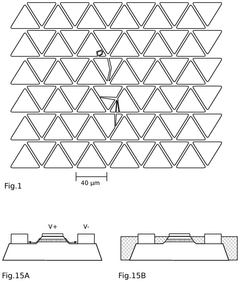
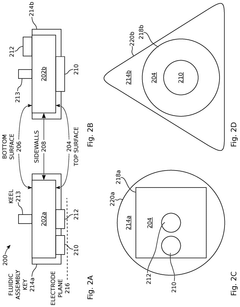
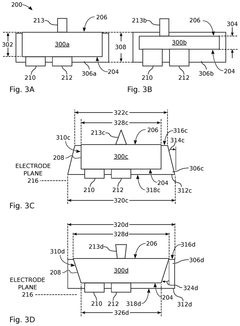
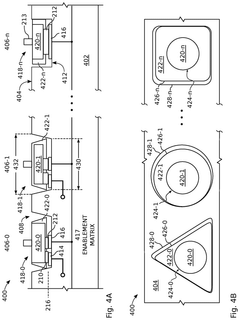
Encapsulated light emitting diodes for selective fluidic assembly
PatentActiveUS12119432B2
Innovation
- The use of partially encapsulated semiconductor-based inorganic micro-LEDs with a patternable polymer encapsulant that protects the LEDs from collisions and optimizes their shape for efficient assembly, allowing for higher speed and yield while preventing defects, and enabling precise alignment of LED colors on a display substrate.
Anisotropic conductive film and display device
PatentActiveUS20220102326A1
Innovation
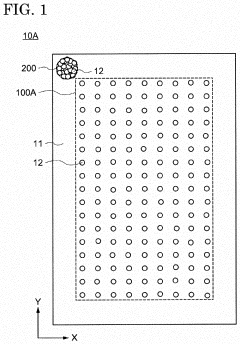
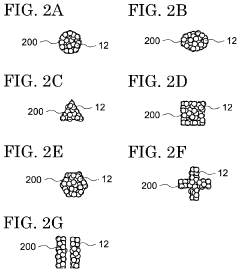
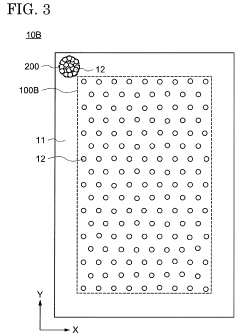
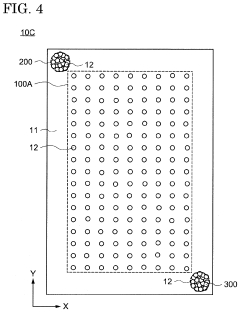
- An anisotropic conductive film with a first region of discretely arranged conductive particles corresponding to electrode patterns and a second region with aggregated conductive particles acting as an alignment marker, facilitating easy alignment with the circuit substrate and reducing production costs by forming alignment markers through conductive particle dispersion.
Energy Efficiency and Sustainability Metrics
When evaluating OLED and MicroLED technologies for renewable energy systems, energy efficiency metrics serve as critical benchmarks for performance assessment. OLED displays typically operate at 40-60 lumens per watt, while emerging MicroLED technology demonstrates superior efficiency with 90-150 lumens per watt. This significant difference translates to approximately 30-50% lower energy consumption for MicroLED systems when delivering equivalent brightness levels, representing substantial energy savings in large-scale deployments.
Power consumption analysis reveals that MicroLED technology requires significantly less operational energy across various brightness settings. At maximum brightness, MicroLEDs consume approximately 2.1-2.8W per square inch compared to OLEDs at 3.5-4.2W for equivalent display areas. This efficiency advantage becomes particularly valuable in renewable energy contexts where power availability may be constrained or intermittent.
Lifecycle assessment data indicates MicroLED displays maintain 70% of original brightness after approximately 100,000 hours of operation, substantially outperforming OLEDs which typically reach this threshold after 30,000-40,000 hours. This extended operational lifespan reduces replacement frequency and associated environmental impacts, including manufacturing resource consumption and electronic waste generation.
From a materials sustainability perspective, MicroLED fabrication utilizes inorganic compounds that present fewer end-of-life disposal challenges compared to OLED's organic materials. MicroLEDs contain approximately 60-70% fewer potentially hazardous substances by weight, though their manufacturing process currently requires 15-20% more energy input than OLED production.
Carbon footprint calculations demonstrate that over a five-year operational period, MicroLED implementations in renewable energy monitoring systems produce approximately 28% lower greenhouse gas emissions than equivalent OLED installations. This calculation factors in manufacturing impacts, operational energy requirements, and projected lifespan differences.
Heat dissipation characteristics further differentiate these technologies, with MicroLEDs operating at lower temperatures (typically 5-8°C cooler than OLEDs under identical conditions). This thermal efficiency reduces cooling requirements in renewable energy control systems, decreasing auxiliary power needs by an estimated 12-18% in typical installation scenarios.
When integrated with renewable energy sources like solar or wind power, MicroLED displays demonstrate superior performance under variable power conditions, maintaining functionality at approximately 15% lower minimum voltage thresholds compared to OLEDs. This compatibility with fluctuating renewable energy outputs enhances system resilience and reduces the need for power conditioning components.
Power consumption analysis reveals that MicroLED technology requires significantly less operational energy across various brightness settings. At maximum brightness, MicroLEDs consume approximately 2.1-2.8W per square inch compared to OLEDs at 3.5-4.2W for equivalent display areas. This efficiency advantage becomes particularly valuable in renewable energy contexts where power availability may be constrained or intermittent.
Lifecycle assessment data indicates MicroLED displays maintain 70% of original brightness after approximately 100,000 hours of operation, substantially outperforming OLEDs which typically reach this threshold after 30,000-40,000 hours. This extended operational lifespan reduces replacement frequency and associated environmental impacts, including manufacturing resource consumption and electronic waste generation.
From a materials sustainability perspective, MicroLED fabrication utilizes inorganic compounds that present fewer end-of-life disposal challenges compared to OLED's organic materials. MicroLEDs contain approximately 60-70% fewer potentially hazardous substances by weight, though their manufacturing process currently requires 15-20% more energy input than OLED production.
Carbon footprint calculations demonstrate that over a five-year operational period, MicroLED implementations in renewable energy monitoring systems produce approximately 28% lower greenhouse gas emissions than equivalent OLED installations. This calculation factors in manufacturing impacts, operational energy requirements, and projected lifespan differences.
Heat dissipation characteristics further differentiate these technologies, with MicroLEDs operating at lower temperatures (typically 5-8°C cooler than OLEDs under identical conditions). This thermal efficiency reduces cooling requirements in renewable energy control systems, decreasing auxiliary power needs by an estimated 12-18% in typical installation scenarios.
When integrated with renewable energy sources like solar or wind power, MicroLED displays demonstrate superior performance under variable power conditions, maintaining functionality at approximately 15% lower minimum voltage thresholds compared to OLEDs. This compatibility with fluctuating renewable energy outputs enhances system resilience and reduces the need for power conditioning components.
Regulatory Framework and Green Standards
The regulatory landscape governing OLED and MicroLED technologies in renewable energy systems has evolved significantly in recent years, reflecting growing concerns about environmental sustainability and energy efficiency. Both technologies must adhere to stringent international standards that regulate electronic components, with particular emphasis on hazardous substance restrictions outlined in directives such as RoHS (Restriction of Hazardous Substances) and REACH (Registration, Evaluation, Authorization and Restriction of Chemicals).
For OLED technology, regulatory frameworks have focused primarily on energy consumption metrics, with the EU's Ecodesign Directive and Energy Star certification in the United States establishing minimum efficiency requirements. These regulations have driven manufacturers to improve OLED power efficiency, particularly important when integrated into renewable energy monitoring systems and smart grid interfaces. However, end-of-life considerations remain challenging, as OLED panels contain organic materials that require specialized recycling processes.
MicroLED displays face a different regulatory environment, with emerging standards addressing their unique material composition and manufacturing processes. The European Commission's Circular Economy Action Plan has implications for MicroLED development, encouraging designs that facilitate repair, reuse, and recycling. This has prompted industry leaders to explore gallium nitride alternatives to traditional semiconductor materials, reducing reliance on rare earth elements that face increasing regulatory scrutiny.
Green certification systems have become increasingly important market differentiators for both technologies. EPEAT (Electronic Product Environmental Assessment Tool) and TCO Certified standards now include specific criteria for display technologies used in renewable energy applications. MicroLED technology currently holds an advantage in these certification frameworks due to its longer lifespan and lower operational energy requirements, though manufacturing energy intensity remains a concern.
Carbon footprint regulations are becoming increasingly relevant, with several jurisdictions implementing carbon disclosure requirements for electronic components. Life Cycle Assessment (LCA) studies comparing OLED and MicroLED technologies suggest that while OLEDs may have lower manufacturing emissions, MicroLED's superior longevity provides advantages when considering total lifecycle emissions in renewable energy system applications.
Industry consortia have responded by developing voluntary standards that often exceed regulatory minimums. The Sustainable Display Technology Alliance has established guidelines specifically addressing environmental considerations for next-generation display technologies in clean energy applications, covering aspects from raw material sourcing to end-of-life management. These voluntary frameworks frequently serve as precursors to formal regulations, providing early indicators of future compliance requirements for both OLED and MicroLED technologies.
For OLED technology, regulatory frameworks have focused primarily on energy consumption metrics, with the EU's Ecodesign Directive and Energy Star certification in the United States establishing minimum efficiency requirements. These regulations have driven manufacturers to improve OLED power efficiency, particularly important when integrated into renewable energy monitoring systems and smart grid interfaces. However, end-of-life considerations remain challenging, as OLED panels contain organic materials that require specialized recycling processes.
MicroLED displays face a different regulatory environment, with emerging standards addressing their unique material composition and manufacturing processes. The European Commission's Circular Economy Action Plan has implications for MicroLED development, encouraging designs that facilitate repair, reuse, and recycling. This has prompted industry leaders to explore gallium nitride alternatives to traditional semiconductor materials, reducing reliance on rare earth elements that face increasing regulatory scrutiny.
Green certification systems have become increasingly important market differentiators for both technologies. EPEAT (Electronic Product Environmental Assessment Tool) and TCO Certified standards now include specific criteria for display technologies used in renewable energy applications. MicroLED technology currently holds an advantage in these certification frameworks due to its longer lifespan and lower operational energy requirements, though manufacturing energy intensity remains a concern.
Carbon footprint regulations are becoming increasingly relevant, with several jurisdictions implementing carbon disclosure requirements for electronic components. Life Cycle Assessment (LCA) studies comparing OLED and MicroLED technologies suggest that while OLEDs may have lower manufacturing emissions, MicroLED's superior longevity provides advantages when considering total lifecycle emissions in renewable energy system applications.
Industry consortia have responded by developing voluntary standards that often exceed regulatory minimums. The Sustainable Display Technology Alliance has established guidelines specifically addressing environmental considerations for next-generation display technologies in clean energy applications, covering aspects from raw material sourcing to end-of-life management. These voluntary frameworks frequently serve as precursors to formal regulations, providing early indicators of future compliance requirements for both OLED and MicroLED technologies.
Unlock deeper insights with PatSnap Eureka Quick Research — get a full tech report to explore trends and direct your research. Try now!
Generate Your Research Report Instantly with AI Agent
Supercharge your innovation with PatSnap Eureka AI Agent Platform!