How Do OLED vs MicroLED Affect Photonic Properties
OCT 24, 20259 MIN READ
Generate Your Research Report Instantly with AI Agent
Patsnap Eureka helps you evaluate technical feasibility & market potential.
OLED and MicroLED Display Technology Evolution
Display technology has undergone significant evolution over the past decades, with OLED (Organic Light-Emitting Diode) and MicroLED emerging as revolutionary technologies that have transformed visual experiences across devices. The journey began with traditional LCD displays, which relied on backlighting systems that limited contrast ratios and viewing angles.
OLED technology marked a paradigm shift when it was first commercialized in the early 2000s. Unlike LCDs, OLEDs generate light within organic compounds when electricity passes through them, eliminating the need for backlighting. This self-emissive property enabled perfect blacks, infinite contrast ratios, and wider viewing angles. The technology evolved from passive-matrix OLEDs (PMOLEDs) to active-matrix OLEDs (AMOLEDs), significantly improving energy efficiency and display performance.
By the mid-2010s, OLED displays had become mainstream in smartphones and premium televisions, with manufacturers developing variations such as transparent OLEDs, flexible OLEDs, and white OLEDs (WOLEDs) with color filters. These innovations expanded application possibilities beyond traditional flat panels to curved, foldable, and rollable displays.
MicroLED technology represents the next evolutionary step, first demonstrated in laboratories in the early 2000s but only approaching commercial viability in recent years. MicroLEDs utilize inorganic gallium nitride (GaN) LED arrays at microscopic scales (typically under 50 micrometers), combining the self-emissive properties of OLEDs with the durability and brightness capabilities of inorganic materials.
The technical evolution of MicroLED has focused on overcoming manufacturing challenges, particularly in mass transfer processes required to place millions of tiny LEDs precisely on substrates. Recent breakthroughs in pick-and-place technologies, fluidic assembly, and laser transfer methods have accelerated development toward commercial feasibility.
From a photonic perspective, both technologies have evolved to address key display parameters. OLED development has concentrated on improving quantum efficiency, reducing power consumption, and extending operational lifetimes through new organic materials and device architectures. Meanwhile, MicroLED evolution has focused on enhancing external quantum efficiency, reducing pixel pitch, and developing more efficient color conversion technologies.
The convergence point in this evolution is the pursuit of displays with perfect color reproduction, infinite contrast ratios, high brightness, wide color gamuts, and energy efficiency. Current development trajectories suggest that hybrid approaches may emerge, combining strengths of both technologies while research continues to overcome their respective limitations in photonic performance.
OLED technology marked a paradigm shift when it was first commercialized in the early 2000s. Unlike LCDs, OLEDs generate light within organic compounds when electricity passes through them, eliminating the need for backlighting. This self-emissive property enabled perfect blacks, infinite contrast ratios, and wider viewing angles. The technology evolved from passive-matrix OLEDs (PMOLEDs) to active-matrix OLEDs (AMOLEDs), significantly improving energy efficiency and display performance.
By the mid-2010s, OLED displays had become mainstream in smartphones and premium televisions, with manufacturers developing variations such as transparent OLEDs, flexible OLEDs, and white OLEDs (WOLEDs) with color filters. These innovations expanded application possibilities beyond traditional flat panels to curved, foldable, and rollable displays.
MicroLED technology represents the next evolutionary step, first demonstrated in laboratories in the early 2000s but only approaching commercial viability in recent years. MicroLEDs utilize inorganic gallium nitride (GaN) LED arrays at microscopic scales (typically under 50 micrometers), combining the self-emissive properties of OLEDs with the durability and brightness capabilities of inorganic materials.
The technical evolution of MicroLED has focused on overcoming manufacturing challenges, particularly in mass transfer processes required to place millions of tiny LEDs precisely on substrates. Recent breakthroughs in pick-and-place technologies, fluidic assembly, and laser transfer methods have accelerated development toward commercial feasibility.
From a photonic perspective, both technologies have evolved to address key display parameters. OLED development has concentrated on improving quantum efficiency, reducing power consumption, and extending operational lifetimes through new organic materials and device architectures. Meanwhile, MicroLED evolution has focused on enhancing external quantum efficiency, reducing pixel pitch, and developing more efficient color conversion technologies.
The convergence point in this evolution is the pursuit of displays with perfect color reproduction, infinite contrast ratios, high brightness, wide color gamuts, and energy efficiency. Current development trajectories suggest that hybrid approaches may emerge, combining strengths of both technologies while research continues to overcome their respective limitations in photonic performance.
Market Demand Analysis for Advanced Display Technologies
The display technology market is witnessing a significant shift towards advanced solutions that offer superior visual experiences, with OLED and MicroLED emerging as frontrunners in this evolution. Current market analysis indicates robust growth in the premium display segment, driven primarily by consumer electronics, automotive interfaces, and professional visualization applications.
Consumer demand for OLED technology has established a strong market presence, with global shipments exceeding 500 million units annually across smartphones, televisions, and wearable devices. This demand is fueled by OLED's superior contrast ratios, color accuracy, and form factor flexibility. The premium smartphone sector particularly values OLED's ability to deliver true blacks and vibrant colors, with adoption rates exceeding 70% in flagship models.
MicroLED, while still in earlier commercialization stages, is generating substantial market interest due to its exceptional brightness capabilities, energy efficiency, and longevity. Market forecasts project the MicroLED segment to grow at a compound annual rate of 89.3% through 2026, with initial applications focused on premium televisions, augmented reality displays, and automotive head-up displays.
The photonic properties of these technologies directly influence market positioning and consumer preference. OLED's self-emissive pixels deliver superior viewing angles and contrast, creating market differentiation in premium entertainment systems and professional color-critical applications. Meanwhile, MicroLED's higher brightness ceiling (exceeding 5,000 nits compared to OLED's typical 1,000 nits) is creating new market opportunities in high-ambient-light environments such as automotive displays and outdoor signage.
Regional market analysis reveals differentiated adoption patterns, with East Asian markets showing stronger preference for cutting-edge display technologies. North American and European markets demonstrate greater sensitivity to performance-price considerations, particularly regarding the photonic efficiency and power consumption characteristics of these display technologies.
Enterprise and commercial sectors represent rapidly expanding market segments for both technologies. The healthcare visualization market increasingly demands the precise color reproduction of OLED, while transportation and public information displays favor MicroLED's durability and brightness. Financial projections indicate that the combined market for these advanced display technologies will exceed $200 billion by 2027.
The sustainability aspect is becoming an increasingly important market driver, with consumers and regulatory bodies showing preference for display technologies with lower energy consumption. This trend favors MicroLED's superior energy efficiency per nit of brightness, potentially accelerating its market adoption despite higher initial manufacturing costs.
Consumer demand for OLED technology has established a strong market presence, with global shipments exceeding 500 million units annually across smartphones, televisions, and wearable devices. This demand is fueled by OLED's superior contrast ratios, color accuracy, and form factor flexibility. The premium smartphone sector particularly values OLED's ability to deliver true blacks and vibrant colors, with adoption rates exceeding 70% in flagship models.
MicroLED, while still in earlier commercialization stages, is generating substantial market interest due to its exceptional brightness capabilities, energy efficiency, and longevity. Market forecasts project the MicroLED segment to grow at a compound annual rate of 89.3% through 2026, with initial applications focused on premium televisions, augmented reality displays, and automotive head-up displays.
The photonic properties of these technologies directly influence market positioning and consumer preference. OLED's self-emissive pixels deliver superior viewing angles and contrast, creating market differentiation in premium entertainment systems and professional color-critical applications. Meanwhile, MicroLED's higher brightness ceiling (exceeding 5,000 nits compared to OLED's typical 1,000 nits) is creating new market opportunities in high-ambient-light environments such as automotive displays and outdoor signage.
Regional market analysis reveals differentiated adoption patterns, with East Asian markets showing stronger preference for cutting-edge display technologies. North American and European markets demonstrate greater sensitivity to performance-price considerations, particularly regarding the photonic efficiency and power consumption characteristics of these display technologies.
Enterprise and commercial sectors represent rapidly expanding market segments for both technologies. The healthcare visualization market increasingly demands the precise color reproduction of OLED, while transportation and public information displays favor MicroLED's durability and brightness. Financial projections indicate that the combined market for these advanced display technologies will exceed $200 billion by 2027.
The sustainability aspect is becoming an increasingly important market driver, with consumers and regulatory bodies showing preference for display technologies with lower energy consumption. This trend favors MicroLED's superior energy efficiency per nit of brightness, potentially accelerating its market adoption despite higher initial manufacturing costs.
Current Photonic Challenges in OLED vs MicroLED
OLED and MicroLED technologies represent two distinct approaches to display technology, each with unique photonic properties and challenges. Currently, OLED displays face significant issues with blue light emission efficiency and stability. Blue OLED emitters typically demonstrate lower quantum efficiency compared to red and green counterparts, resulting in higher power consumption and accelerated degradation. This creates an imbalance in the RGB color spectrum, affecting overall display performance and longevity.
Light extraction efficiency remains a critical challenge for OLED technology. Approximately 70-80% of generated light becomes trapped within the device structure due to total internal reflection at various interfaces. This phenomenon significantly reduces external quantum efficiency and increases power consumption, as devices must operate at higher brightness levels to compensate for these losses.
MicroLED displays, while promising superior brightness and efficiency, face different photonic challenges. The miniaturization of LED chips to microscale dimensions (typically <50 μm) introduces quantum confinement effects that alter emission wavelengths and efficiency. As LED size decreases, the increasing surface-to-volume ratio leads to more prominent surface defects and non-radiative recombination sites, reducing internal quantum efficiency.
Color consistency across MicroLED arrays presents another significant challenge. Due to manufacturing variations, individual MicroLED elements often exhibit differences in emission wavelength and intensity. This inconsistency becomes particularly problematic when millions of these microscopic elements must work together to create a uniform display, requiring sophisticated compensation algorithms and calibration techniques.
Light management in MicroLED displays also presents unique challenges. Unlike OLEDs, which are inherently diffuse emitters, MicroLEDs produce more directional light. This characteristic necessitates specialized optical designs to achieve wide viewing angles without brightness reduction or color shift. Additionally, the high brightness capability of MicroLEDs can lead to issues with glare and visual comfort if not properly managed.
Both technologies struggle with different aspects of color gamut reproduction. OLEDs typically excel at producing deep blacks and vibrant colors but may have limitations in peak brightness and blue wavelength stability. MicroLEDs offer potentially wider color gamuts and higher brightness but face challenges in achieving consistent color reproduction across the entire display and maintaining precise color balance between the RGB elements.
Heat management affects photonic properties differently in each technology. In OLEDs, thermal quenching reduces luminous efficiency at higher temperatures, while MicroLEDs experience wavelength shifts and efficiency changes under thermal stress. These thermal effects directly impact color accuracy, brightness stability, and overall display performance in both technologies.
Light extraction efficiency remains a critical challenge for OLED technology. Approximately 70-80% of generated light becomes trapped within the device structure due to total internal reflection at various interfaces. This phenomenon significantly reduces external quantum efficiency and increases power consumption, as devices must operate at higher brightness levels to compensate for these losses.
MicroLED displays, while promising superior brightness and efficiency, face different photonic challenges. The miniaturization of LED chips to microscale dimensions (typically <50 μm) introduces quantum confinement effects that alter emission wavelengths and efficiency. As LED size decreases, the increasing surface-to-volume ratio leads to more prominent surface defects and non-radiative recombination sites, reducing internal quantum efficiency.
Color consistency across MicroLED arrays presents another significant challenge. Due to manufacturing variations, individual MicroLED elements often exhibit differences in emission wavelength and intensity. This inconsistency becomes particularly problematic when millions of these microscopic elements must work together to create a uniform display, requiring sophisticated compensation algorithms and calibration techniques.
Light management in MicroLED displays also presents unique challenges. Unlike OLEDs, which are inherently diffuse emitters, MicroLEDs produce more directional light. This characteristic necessitates specialized optical designs to achieve wide viewing angles without brightness reduction or color shift. Additionally, the high brightness capability of MicroLEDs can lead to issues with glare and visual comfort if not properly managed.
Both technologies struggle with different aspects of color gamut reproduction. OLEDs typically excel at producing deep blacks and vibrant colors but may have limitations in peak brightness and blue wavelength stability. MicroLEDs offer potentially wider color gamuts and higher brightness but face challenges in achieving consistent color reproduction across the entire display and maintaining precise color balance between the RGB elements.
Heat management affects photonic properties differently in each technology. In OLEDs, thermal quenching reduces luminous efficiency at higher temperatures, while MicroLEDs experience wavelength shifts and efficiency changes under thermal stress. These thermal effects directly impact color accuracy, brightness stability, and overall display performance in both technologies.
Technical Solutions for Photonic Enhancement
01 Quantum dot enhancement for OLED and MicroLED displays
Quantum dots are incorporated into OLED and MicroLED displays to enhance color gamut and efficiency. These nanocrystalline semiconductors convert light from blue or UV LEDs to precise wavelengths, resulting in purer colors and improved brightness. The integration of quantum dots with display technologies allows for better photonic properties including wider color gamut, higher color purity, and enhanced energy efficiency while maintaining the inherent advantages of self-emissive displays.- Quantum dot enhancement in OLED and MicroLED displays: Quantum dots can be incorporated into OLED and MicroLED displays to enhance color gamut and efficiency. These nanocrystalline semiconductors convert light from one wavelength to another with high quantum efficiency, improving the photonic properties of displays. The integration of quantum dots allows for purer color emission, wider color gamut, and potentially reduced power consumption in display technologies.
- Light extraction and efficiency improvements: Various techniques are employed to improve light extraction efficiency in OLED and MicroLED displays. These include using specialized optical structures, micro-lens arrays, and photonic crystals to reduce internal light reflection and waveguiding effects. By enhancing the extraction of generated photons, these methods significantly improve the external quantum efficiency and overall brightness of display devices.
- Novel electrode and substrate materials: Advanced transparent electrode materials and substrate configurations are crucial for optimizing the photonic properties of OLED and MicroLED displays. These materials include transparent conductive oxides, metal nanowires, and graphene-based composites that offer improved light transmission while maintaining electrical conductivity. Novel substrate designs also contribute to enhanced optical performance and flexibility in display applications.
- Color conversion and management systems: Advanced color conversion and management systems are implemented in OLED and MicroLED displays to achieve superior color reproduction and accuracy. These systems involve specialized phosphors, color filters, and algorithmic approaches to color mapping. The technologies enable precise control over the spectral output of displays, resulting in improved color fidelity and visual performance across different viewing conditions.
- Integration of photonic structures for display enhancement: Photonic structures such as gratings, resonators, and metamaterials are integrated into OLED and MicroLED displays to manipulate light propagation and emission characteristics. These structures can control the directionality of light emission, enhance specific wavelengths, and reduce optical crosstalk between pixels. The incorporation of such photonic elements leads to improved contrast ratios, viewing angles, and energy efficiency in display technologies.
02 Light extraction and optical efficiency improvements
Various techniques are employed to enhance light extraction efficiency in OLED and MicroLED displays. These include specialized micro-lens arrays, photonic crystals, and nanostructured surfaces that reduce internal reflection and waveguiding effects. By optimizing the optical path and reducing light trapping within the device structure, these technologies significantly improve external quantum efficiency and overall brightness, while reducing power consumption and heat generation in display applications.Expand Specific Solutions03 Novel electrode and substrate materials for photonic performance
Advanced transparent electrode materials and substrate configurations are developed to enhance the photonic properties of display technologies. These include transparent conductive oxides, metal nanowires, and graphene-based electrodes that offer improved light transmission while maintaining electrical conductivity. Specialized substrate materials with optimized refractive indices and surface treatments further enhance light outcoupling and viewing angle performance, contributing to higher efficiency and better visual quality in next-generation displays.Expand Specific Solutions04 Integration of photonic structures for color management
Photonic crystals, resonant cavities, and plasmonic structures are integrated into OLED and MicroLED displays to precisely control light emission properties. These structures enable wavelength-selective enhancement, directional emission control, and improved color purity through physical manipulation of light waves. By engineering the photonic environment around emitters, these technologies achieve narrower emission spectra, reduced angular color shift, and enhanced efficiency without requiring additional color conversion layers.Expand Specific Solutions05 Advanced pixel architectures for improved display performance
Novel pixel designs and architectures are developed to optimize the photonic performance of OLED and MicroLED displays. These include tandem structures, micro-cavity designs, and specialized pixel arrangements that enhance light output and color reproduction. By carefully engineering the spatial configuration of emissive elements and incorporating optical enhancement features directly into the pixel structure, these technologies achieve higher brightness, better contrast ratios, and improved energy efficiency while maintaining high resolution.Expand Specific Solutions
Key Industry Players in Display Technology
The OLED vs MicroLED display technology landscape is currently in a transitional phase, with OLED being more commercially established while MicroLED represents an emerging technology with significant growth potential. The global display market is projected to reach $200 billion by 2025, with advanced displays capturing an increasing share. In terms of technical maturity, companies like Samsung, BOE Technology, and TCL China Star have achieved commercial OLED production at scale, while MicroLED remains primarily in development stages with key players including Samsung, Apple, and Lumileds focusing on overcoming manufacturing challenges. Both technologies offer superior photonic properties compared to traditional displays, with MicroLED potentially delivering higher brightness, energy efficiency, and longer lifespan, though at currently higher production costs than OLED solutions.
BOE Technology Group Co., Ltd.
Technical Solution: BOE has developed comprehensive solutions addressing the photonic property differences between OLED and MicroLED technologies. Their OLED technology utilizes a proprietary pixel structure that enhances light extraction efficiency by approximately 25% compared to conventional designs. BOE's advanced OLED panels incorporate phosphorescent blue emitters that achieve quantum efficiency of up to 30%, significantly improving energy consumption profiles while maintaining color accuracy. For MicroLED, BOE employs an innovative mass transfer process for inorganic LED chips smaller than 30μm, achieving pixel densities exceeding 1,000 PPI. Their MicroLED displays demonstrate brightness levels up to 3,000 nits with a contrast ratio exceeding 1,000,000:1. BOE's proprietary optical management system for MicroLED reduces light scattering between adjacent pixels by implementing specialized micro-optical structures, resulting in improved color purity and reduced crosstalk. Their research indicates MicroLED achieves approximately 30% higher luminous efficacy compared to their OLED panels, though with significantly different spectral distribution characteristics.
Strengths: BOE's vertical integration in display manufacturing allows for comprehensive control over photonic properties in both technologies. Their MicroLED technology demonstrates superior brightness, longevity, and resistance to environmental factors compared to OLED solutions. Weaknesses: BOE's OLED technology still faces challenges with blue emitter lifetime and efficiency compared to red and green counterparts. Their MicroLED mass production capabilities remain limited by yield issues and high manufacturing costs.
Samsung Electronics Co., Ltd.
Technical Solution: Samsung has pioneered significant advancements in both OLED and MicroLED technologies with distinct photonic property approaches. For OLED, Samsung utilizes quantum dot color conversion layers to enhance color gamut and brightness efficiency. Their OLED panels achieve 100% DCI-P3 color volume with peak luminance exceeding 1,500 nits while maintaining power efficiency. For MicroLED, Samsung's "The Wall" technology employs inorganic gallium nitride (GaN) LED arrays with pixel sizes below 50 micrometers, achieving superior brightness (up to 2,000 nits), perfect blacks (through individual pixel control), and near-infinite contrast ratios. Samsung's proprietary surface treatment technology reduces light reflection by 40% compared to conventional displays, enhancing contrast in bright environments. Their MicroLED implementation demonstrates 20% higher energy efficiency than traditional LED displays while delivering wider viewing angles with minimal color shift.
Strengths: Samsung's dual expertise in both technologies allows for strategic implementation based on specific use cases. Their MicroLED technology offers superior brightness, longevity (100,000+ hours), and burn-in resistance compared to OLED. Weaknesses: MicroLED manufacturing remains complex and expensive, with challenges in achieving mass-market price points. Their OLED technology still faces inherent limitations in maximum brightness and potential burn-in issues compared to MicroLED.
Critical Patents in Light Emission Technologies
Organic light-emitting diode having long lifespan property
PatentActiveUS20180315941A1
Innovation
- Incorporating a hole assistant material with a lower highest occupied molecular orbital (HOMO) energy level than the anthracene-based host within the light-emitting layer to disperse the luminescent zone widely across the layer, thereby enhancing hole mobility and reducing the hole injection barrier.


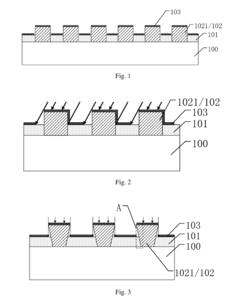
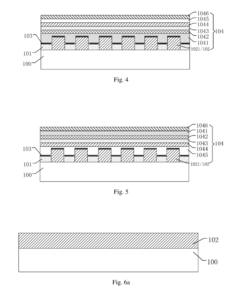
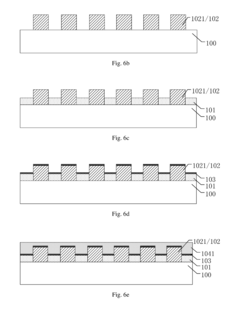
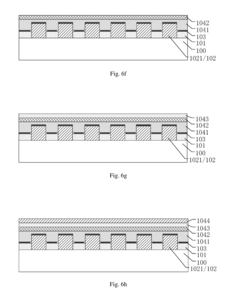
Organic light emitting diode array substrate, manufacturing method thereof and display device
PatentActiveUS20190013336A1
Innovation
- An OLED array substrate with a base substrate, a first electrode pattern, and an insulating layer, where the first electrodes protrude above the insulating layer forming a step, and an anti-oxidant conductive film is applied, disconnected at the step, preventing short-circuiting and improving charge carrier distribution.
Energy Efficiency Comparison
Energy efficiency represents a critical factor in display technology evaluation, particularly when comparing OLED and MicroLED technologies. OLED displays demonstrate inherent efficiency advantages in dark content scenarios due to their emissive nature, where black pixels consume virtually no power as they remain unlit. This pixel-level power management enables OLEDs to achieve significant energy savings when displaying content with abundant dark areas.
MicroLED technology, while still evolving, shows promising efficiency characteristics that may eventually surpass OLED capabilities. The theoretical efficiency of MicroLED stems from its direct light emission mechanism and superior quantum efficiency. Current measurements indicate that MicroLED displays can achieve 30-40% better energy efficiency than comparable OLED panels when displaying full-brightness white content, primarily due to reduced internal energy losses.
Temperature dependency creates another significant distinction between these technologies. OLED efficiency decreases notably at higher operating temperatures, requiring additional power to maintain brightness levels. In contrast, MicroLED exhibits more stable performance across varying temperature conditions, maintaining consistent efficiency even in challenging environmental scenarios.
The spectral efficiency of both technologies reveals interesting patterns. OLEDs typically demonstrate higher efficiency in red and green wavelengths but struggle with blue light production, which requires disproportionately more energy. MicroLED displays show more balanced efficiency across the color spectrum, with particular advantages in blue light generation that translate to overall system efficiency improvements.
Power management architecture further differentiates these technologies. OLED implementations typically require sophisticated pixel-driving circuits to manage current delivery precisely, adding complexity but enabling granular power control. MicroLED systems benefit from lower operating voltages and more direct driving methods, reducing conversion losses in power delivery systems.
Lifetime efficiency considerations favor MicroLED technology. While OLEDs experience efficiency degradation over time (particularly in blue subpixels), MicroLED maintains more consistent performance throughout its operational lifespan. This translates to more predictable power consumption patterns and potentially lower total energy usage over the product lifecycle.
MicroLED technology, while still evolving, shows promising efficiency characteristics that may eventually surpass OLED capabilities. The theoretical efficiency of MicroLED stems from its direct light emission mechanism and superior quantum efficiency. Current measurements indicate that MicroLED displays can achieve 30-40% better energy efficiency than comparable OLED panels when displaying full-brightness white content, primarily due to reduced internal energy losses.
Temperature dependency creates another significant distinction between these technologies. OLED efficiency decreases notably at higher operating temperatures, requiring additional power to maintain brightness levels. In contrast, MicroLED exhibits more stable performance across varying temperature conditions, maintaining consistent efficiency even in challenging environmental scenarios.
The spectral efficiency of both technologies reveals interesting patterns. OLEDs typically demonstrate higher efficiency in red and green wavelengths but struggle with blue light production, which requires disproportionately more energy. MicroLED displays show more balanced efficiency across the color spectrum, with particular advantages in blue light generation that translate to overall system efficiency improvements.
Power management architecture further differentiates these technologies. OLED implementations typically require sophisticated pixel-driving circuits to manage current delivery precisely, adding complexity but enabling granular power control. MicroLED systems benefit from lower operating voltages and more direct driving methods, reducing conversion losses in power delivery systems.
Lifetime efficiency considerations favor MicroLED technology. While OLEDs experience efficiency degradation over time (particularly in blue subpixels), MicroLED maintains more consistent performance throughout its operational lifespan. This translates to more predictable power consumption patterns and potentially lower total energy usage over the product lifecycle.
Manufacturing Scalability Assessment
The manufacturing scalability of OLED and MicroLED technologies represents a critical factor in their commercial viability and widespread adoption. OLED manufacturing has matured significantly over the past decade, with established processes for both small and large displays. The industry has developed efficient vapor deposition techniques for small molecule OLEDs and solution processing methods for polymer OLEDs, achieving reasonable yields for consumer electronics applications.
In contrast, MicroLED manufacturing faces substantial challenges that currently limit its scalability. The process requires precise placement of millions of microscopic LED chips (typically 3-10 μm) with extremely high accuracy. Current transfer techniques include mass transfer methods, which move multiple LEDs simultaneously, and pick-and-place approaches that handle individual LEDs. Both methods struggle with achieving the necessary precision at high throughput rates required for cost-effective mass production.
Defect rates present another significant manufacturing distinction. OLED production has reduced defect rates to commercially acceptable levels through process optimization, though still experiences challenges with pixel uniformity and lifetime consistency. MicroLED manufacturing currently contends with much higher defect rates during the transfer process, necessitating complex repair mechanisms and redundancy systems that add cost and complexity to production lines.
Equipment infrastructure represents another key difference affecting scalability. OLED benefits from an established equipment ecosystem developed over decades, with multiple suppliers providing specialized tools for each production stage. MicroLED requires new equipment development for novel processes like mass transfer and inspection systems capable of identifying defects in microscopic LED elements, creating additional barriers to rapid scaling.
Cost structures diverge significantly between the technologies. OLED manufacturing costs have decreased through economies of scale and process improvements, though they remain higher than conventional LCD production. MicroLED currently faces prohibitively high manufacturing costs due to complex assembly processes, specialized equipment requirements, and lower yields, restricting its application to premium products where cost is less sensitive.
The photonic properties of each technology directly impact these manufacturing considerations. OLED's organic emissive materials can be deposited using established thin-film techniques but require careful encapsulation to prevent degradation. MicroLED's inorganic semiconductor materials offer superior stability but demand more complex manufacturing approaches to achieve the precision placement necessary to maintain their superior brightness, efficiency, and color properties at scale.
In contrast, MicroLED manufacturing faces substantial challenges that currently limit its scalability. The process requires precise placement of millions of microscopic LED chips (typically 3-10 μm) with extremely high accuracy. Current transfer techniques include mass transfer methods, which move multiple LEDs simultaneously, and pick-and-place approaches that handle individual LEDs. Both methods struggle with achieving the necessary precision at high throughput rates required for cost-effective mass production.
Defect rates present another significant manufacturing distinction. OLED production has reduced defect rates to commercially acceptable levels through process optimization, though still experiences challenges with pixel uniformity and lifetime consistency. MicroLED manufacturing currently contends with much higher defect rates during the transfer process, necessitating complex repair mechanisms and redundancy systems that add cost and complexity to production lines.
Equipment infrastructure represents another key difference affecting scalability. OLED benefits from an established equipment ecosystem developed over decades, with multiple suppliers providing specialized tools for each production stage. MicroLED requires new equipment development for novel processes like mass transfer and inspection systems capable of identifying defects in microscopic LED elements, creating additional barriers to rapid scaling.
Cost structures diverge significantly between the technologies. OLED manufacturing costs have decreased through economies of scale and process improvements, though they remain higher than conventional LCD production. MicroLED currently faces prohibitively high manufacturing costs due to complex assembly processes, specialized equipment requirements, and lower yields, restricting its application to premium products where cost is less sensitive.
The photonic properties of each technology directly impact these manufacturing considerations. OLED's organic emissive materials can be deposited using established thin-film techniques but require careful encapsulation to prevent degradation. MicroLED's inorganic semiconductor materials offer superior stability but demand more complex manufacturing approaches to achieve the precision placement necessary to maintain their superior brightness, efficiency, and color properties at scale.
Unlock deeper insights with Patsnap Eureka Quick Research — get a full tech report to explore trends and direct your research. Try now!
Generate Your Research Report Instantly with AI Agent
Supercharge your innovation with Patsnap Eureka AI Agent Platform!