How OLED vs MicroLED Innovation Affects Industry Standards
OCT 24, 20259 MIN READ
Generate Your Research Report Instantly with AI Agent
Patsnap Eureka helps you evaluate technical feasibility & market potential.
OLED vs MicroLED Background and Innovation Goals
Display technology has undergone significant evolution over the past decades, from CRT to LCD, and now to advanced technologies like OLED (Organic Light Emitting Diode) and MicroLED. These two cutting-edge display technologies represent the current pinnacle of visual display innovation, each with distinct development trajectories and technological foundations.
OLED technology emerged commercially in the early 2000s, utilizing organic compounds that emit light when electricity is applied. The technology has matured considerably over the past decade, becoming mainstream in high-end smartphones, televisions, and other consumer electronics. Its evolution has been characterized by improvements in efficiency, color accuracy, and manufacturing processes, with significant contributions from companies like Samsung, LG Display, and Sony.
MicroLED, by contrast, represents a newer technological approach, building upon traditional LED technology but miniaturizing the light-emitting diodes to microscopic sizes. While conceptualized earlier, meaningful commercial development of MicroLED began in earnest during the 2010s, with companies like Apple, Samsung, and Sony investing heavily in research and development. The technology promises to combine the best aspects of OLED with improved durability and brightness.
The innovation trajectory for both technologies has been driven by increasing consumer and industry demands for higher resolution, better color reproduction, energy efficiency, and novel form factors such as flexible or transparent displays. These demands have shaped the technical goals for both OLED and MicroLED development.
Current innovation goals for OLED technology focus on addressing its inherent limitations, including susceptibility to burn-in, limited lifespan of organic materials, and manufacturing yield challenges for larger displays. Research is concentrated on developing more stable organic compounds, improving manufacturing processes, and reducing production costs to maintain competitiveness.
For MicroLED, the primary innovation goals revolve around overcoming mass production challenges, particularly the precise placement of millions of microscopic LEDs, improving yield rates, and reducing costs to make the technology commercially viable for mainstream adoption. Additionally, researchers are working on enhancing energy efficiency and developing flexible MicroLED displays.
Both technologies are evolving toward enabling next-generation display applications, including augmented reality (AR), virtual reality (VR), automotive displays, and large-format public information systems. The technical evolution of these display technologies is increasingly intertwined with advancements in semiconductor manufacturing, materials science, and quantum physics, indicating a convergence of multiple scientific disciplines in display innovation.
OLED technology emerged commercially in the early 2000s, utilizing organic compounds that emit light when electricity is applied. The technology has matured considerably over the past decade, becoming mainstream in high-end smartphones, televisions, and other consumer electronics. Its evolution has been characterized by improvements in efficiency, color accuracy, and manufacturing processes, with significant contributions from companies like Samsung, LG Display, and Sony.
MicroLED, by contrast, represents a newer technological approach, building upon traditional LED technology but miniaturizing the light-emitting diodes to microscopic sizes. While conceptualized earlier, meaningful commercial development of MicroLED began in earnest during the 2010s, with companies like Apple, Samsung, and Sony investing heavily in research and development. The technology promises to combine the best aspects of OLED with improved durability and brightness.
The innovation trajectory for both technologies has been driven by increasing consumer and industry demands for higher resolution, better color reproduction, energy efficiency, and novel form factors such as flexible or transparent displays. These demands have shaped the technical goals for both OLED and MicroLED development.
Current innovation goals for OLED technology focus on addressing its inherent limitations, including susceptibility to burn-in, limited lifespan of organic materials, and manufacturing yield challenges for larger displays. Research is concentrated on developing more stable organic compounds, improving manufacturing processes, and reducing production costs to maintain competitiveness.
For MicroLED, the primary innovation goals revolve around overcoming mass production challenges, particularly the precise placement of millions of microscopic LEDs, improving yield rates, and reducing costs to make the technology commercially viable for mainstream adoption. Additionally, researchers are working on enhancing energy efficiency and developing flexible MicroLED displays.
Both technologies are evolving toward enabling next-generation display applications, including augmented reality (AR), virtual reality (VR), automotive displays, and large-format public information systems. The technical evolution of these display technologies is increasingly intertwined with advancements in semiconductor manufacturing, materials science, and quantum physics, indicating a convergence of multiple scientific disciplines in display innovation.
Market Demand Analysis for Advanced Display Technologies
The display technology market is experiencing a significant shift as OLED (Organic Light Emitting Diode) and MicroLED technologies compete for dominance. Current market analysis indicates robust growth in the advanced display sector, with the global OLED market valued at approximately $38.4 billion in 2022 and projected to reach $72.8 billion by 2030. Meanwhile, the emerging MicroLED market, though smaller at around $2.3 billion, is forecasted to grow at a remarkable CAGR of 80.5% through 2027.
Consumer electronics remains the primary driver of demand for these advanced display technologies. Smartphones represent the largest application segment for OLED displays, accounting for over 60% of total OLED panel production. This dominance stems from OLED's advantages in producing thinner, lighter devices with superior color reproduction and perfect black levels. Samsung and Apple continue to lead adoption, with nearly all flagship devices now featuring OLED screens.
The television segment presents a particularly interesting market dynamic. While OLED TVs command premium pricing positions, MicroLED is positioned as the ultimate display technology for ultra-high-end home theaters and commercial installations. Market research indicates consumers are increasingly willing to pay premium prices for superior visual experiences, with the average selling price of high-end TVs increasing by 15% annually despite overall TV market stagnation.
Commercial applications represent a rapidly expanding market segment for both technologies. Digital signage, automotive displays, and augmented/virtual reality devices collectively account for approximately 28% of advanced display demand. The automotive sector specifically shows promising growth potential, with premium vehicle manufacturers integrating curved OLED displays for instrument clusters and entertainment systems, while exploring MicroLED for next-generation head-up displays.
Regional analysis reveals Asia-Pacific as the dominant manufacturing hub, with South Korea and China leading OLED production. However, demand distribution shows North America and Europe accounting for over 55% of premium display purchases by value, indicating a geographic disconnect between production and consumption of high-margin products.
Industry forecasts suggest a bifurcated market evolution: OLED technology will continue dominating mid-to-high-end consumer electronics for the next 3-5 years, while MicroLED gradually captures ultra-premium segments. The total addressable market for these technologies is expected to expand as manufacturing costs decrease and new applications emerge, particularly in wearable technology, smart home devices, and industrial displays where energy efficiency and form factor flexibility provide compelling advantages over traditional LCD technology.
Consumer electronics remains the primary driver of demand for these advanced display technologies. Smartphones represent the largest application segment for OLED displays, accounting for over 60% of total OLED panel production. This dominance stems from OLED's advantages in producing thinner, lighter devices with superior color reproduction and perfect black levels. Samsung and Apple continue to lead adoption, with nearly all flagship devices now featuring OLED screens.
The television segment presents a particularly interesting market dynamic. While OLED TVs command premium pricing positions, MicroLED is positioned as the ultimate display technology for ultra-high-end home theaters and commercial installations. Market research indicates consumers are increasingly willing to pay premium prices for superior visual experiences, with the average selling price of high-end TVs increasing by 15% annually despite overall TV market stagnation.
Commercial applications represent a rapidly expanding market segment for both technologies. Digital signage, automotive displays, and augmented/virtual reality devices collectively account for approximately 28% of advanced display demand. The automotive sector specifically shows promising growth potential, with premium vehicle manufacturers integrating curved OLED displays for instrument clusters and entertainment systems, while exploring MicroLED for next-generation head-up displays.
Regional analysis reveals Asia-Pacific as the dominant manufacturing hub, with South Korea and China leading OLED production. However, demand distribution shows North America and Europe accounting for over 55% of premium display purchases by value, indicating a geographic disconnect between production and consumption of high-margin products.
Industry forecasts suggest a bifurcated market evolution: OLED technology will continue dominating mid-to-high-end consumer electronics for the next 3-5 years, while MicroLED gradually captures ultra-premium segments. The total addressable market for these technologies is expected to expand as manufacturing costs decrease and new applications emerge, particularly in wearable technology, smart home devices, and industrial displays where energy efficiency and form factor flexibility provide compelling advantages over traditional LCD technology.
Current Technical Challenges in OLED and MicroLED Development
Despite significant advancements in both OLED and MicroLED technologies, several critical technical challenges continue to impede their widespread adoption and standardization across industries. For OLED technology, material degradation remains a persistent issue, with blue OLED emitters exhibiting shorter lifespans compared to red and green counterparts. This differential degradation leads to color shifting over time, compromising display quality and consistency. Additionally, OLED panels still suffer from burn-in problems when static images are displayed for extended periods, particularly affecting commercial applications requiring constant information display.
Manufacturing scalability presents another significant hurdle for OLED technology. While small and medium-sized OLED panels have achieved reasonable production yields, large-format displays continue to face yield challenges that increase costs and limit market penetration in television and professional display segments. The complex vapor deposition processes required for OLED manufacturing demand extremely precise control conditions, further complicating mass production efforts.
MicroLED technology faces even more formidable manufacturing challenges. The mass transfer process—moving millions of microscopic LED chips from growth substrates to display backplanes with perfect precision—remains the industry's most significant technical bottleneck. Current pick-and-place technologies struggle to achieve the necessary throughput while maintaining acceptable yields, dramatically increasing production costs and limiting commercial viability.
Color consistency across MicroLED displays represents another major technical challenge. Due to the discrete nature of individual LED chips, achieving uniform brightness and color reproduction across large display areas requires sophisticated compensation algorithms and precise manufacturing controls that have not yet been fully mastered at production scale.
Both technologies face efficiency challenges, albeit in different forms. OLED displays continue to struggle with power consumption, particularly when displaying bright content, limiting their application in portable devices where battery life is critical. MicroLED displays, while theoretically more energy-efficient, currently suffer from lower-than-expected efficiency due to optical and electrical losses in the complex display architecture.
Heat management presents additional complications for both technologies. OLED displays experience accelerated degradation at higher operating temperatures, while densely packed MicroLED displays generate significant heat that must be effectively dissipated to maintain performance and longevity. These thermal management challenges directly impact product design, limiting form factor options and increasing system complexity.
From a standardization perspective, the industry lacks unified testing methodologies and performance metrics that adequately address the unique characteristics of these emerging display technologies. This absence of standardized evaluation frameworks hampers meaningful comparison between competing solutions and slows industry-wide adoption of best practices.
Manufacturing scalability presents another significant hurdle for OLED technology. While small and medium-sized OLED panels have achieved reasonable production yields, large-format displays continue to face yield challenges that increase costs and limit market penetration in television and professional display segments. The complex vapor deposition processes required for OLED manufacturing demand extremely precise control conditions, further complicating mass production efforts.
MicroLED technology faces even more formidable manufacturing challenges. The mass transfer process—moving millions of microscopic LED chips from growth substrates to display backplanes with perfect precision—remains the industry's most significant technical bottleneck. Current pick-and-place technologies struggle to achieve the necessary throughput while maintaining acceptable yields, dramatically increasing production costs and limiting commercial viability.
Color consistency across MicroLED displays represents another major technical challenge. Due to the discrete nature of individual LED chips, achieving uniform brightness and color reproduction across large display areas requires sophisticated compensation algorithms and precise manufacturing controls that have not yet been fully mastered at production scale.
Both technologies face efficiency challenges, albeit in different forms. OLED displays continue to struggle with power consumption, particularly when displaying bright content, limiting their application in portable devices where battery life is critical. MicroLED displays, while theoretically more energy-efficient, currently suffer from lower-than-expected efficiency due to optical and electrical losses in the complex display architecture.
Heat management presents additional complications for both technologies. OLED displays experience accelerated degradation at higher operating temperatures, while densely packed MicroLED displays generate significant heat that must be effectively dissipated to maintain performance and longevity. These thermal management challenges directly impact product design, limiting form factor options and increasing system complexity.
From a standardization perspective, the industry lacks unified testing methodologies and performance metrics that adequately address the unique characteristics of these emerging display technologies. This absence of standardized evaluation frameworks hampers meaningful comparison between competing solutions and slows industry-wide adoption of best practices.
Current Implementation Solutions for Both Technologies
01 OLED Display Technology Standards
OLED (Organic Light Emitting Diode) display technology has established industry standards for manufacturing processes, materials, and performance metrics. These standards cover aspects such as pixel arrangement, color gamut, brightness levels, and power efficiency. OLED displays are known for their self-emissive properties, allowing for true blacks and high contrast ratios. Industry standards ensure consistency in production and compatibility across different manufacturers and devices.- OLED Display Technology Standards: OLED (Organic Light Emitting Diode) display technology has established industry standards for manufacturing processes, materials, and performance metrics. These standards ensure consistency in display quality, color accuracy, and energy efficiency across different manufacturers. OLED displays are known for their self-emissive properties, allowing for thinner panels, better contrast ratios, and wider viewing angles compared to traditional display technologies.
- MicroLED Display Technology Standards: MicroLED display technology standards focus on the miniaturization of LED components, manufacturing processes, and integration techniques. These standards address the challenges of mass transfer of microscopic LED chips, electrical connections, and uniform light emission. MicroLED displays offer advantages such as higher brightness, longer lifespan, and better energy efficiency compared to other display technologies, making them suitable for various applications from smartphones to large-scale displays.
- Display Driver and Control Standards: Industry standards for display drivers and control systems ensure compatibility between OLED and MicroLED displays and various electronic devices. These standards define protocols for signal processing, refresh rates, and power management to optimize display performance. They also address requirements for touch integration, brightness control, and color calibration to provide consistent user experiences across different display technologies and applications.
- Manufacturing and Quality Control Standards: Manufacturing and quality control standards for OLED and MicroLED displays establish benchmarks for production processes, defect detection, and performance testing. These standards ensure consistency in panel production, pixel uniformity, and display reliability. They cover aspects such as substrate preparation, deposition techniques, encapsulation methods, and testing protocols to maintain high-quality displays that meet industry requirements for brightness, contrast, color accuracy, and lifespan.
- Integration Standards for Consumer Electronics: Integration standards for OLED and MicroLED displays in consumer electronics define requirements for incorporating these display technologies into various devices such as smartphones, televisions, wearables, and automotive displays. These standards address aspects such as form factors, power consumption, heat management, and interface protocols. They ensure that displays can be seamlessly integrated with other components while maintaining optimal performance, durability, and user experience across different applications and environments.
02 MicroLED Display Technology Standards
MicroLED display technology has emerging industry standards that address the unique challenges of manufacturing and implementing these displays. These standards focus on the miniaturization of LED components, integration methods, and quality control processes. MicroLED standards also cover specifications for color accuracy, brightness uniformity, and energy efficiency. As a newer technology, these standards continue to evolve to support advancements in manufacturing techniques and applications.Expand Specific Solutions03 Display Driver and Control Interface Standards
Industry standards for OLED and MicroLED display technologies include specifications for driver circuits and control interfaces. These standards ensure proper signal processing, timing control, and power management for optimal display performance. They define protocols for communication between the display panel and the host device, including data transfer rates and command structures. Standardized interfaces facilitate integration of displays into various electronic devices while maintaining consistent performance.Expand Specific Solutions04 Testing and Quality Assurance Standards
Testing and quality assurance standards for OLED and MicroLED displays establish methodologies for evaluating display performance and reliability. These standards define procedures for measuring parameters such as luminance, color accuracy, viewing angle, response time, and lifespan. They also specify acceptable ranges for these parameters to ensure consistent quality across the industry. Standardized testing protocols enable manufacturers to validate their products and provide consumers with reliable performance information.Expand Specific Solutions05 Environmental and Safety Standards
Environmental and safety standards for OLED and MicroLED display technologies address concerns related to material composition, energy consumption, and end-of-life disposal. These standards limit the use of hazardous substances and promote recyclability of display components. They also establish requirements for power efficiency to reduce environmental impact during operation. Safety standards ensure that displays do not pose risks such as excessive heat generation or harmful radiation, protecting both users and the environment.Expand Specific Solutions
Key Industry Players and Competitive Landscape
The OLED vs MicroLED innovation landscape is currently in a transitional phase, with OLED technology reaching maturity while MicroLED remains in early commercialization stages. The global market for these advanced display technologies is projected to exceed $200 billion by 2025, driven by demand for higher performance displays in consumer electronics and automotive applications. In terms of technological maturity, established players like Samsung Electronics, BOE Technology, and TCL China Star have achieved mass production capabilities for OLED, while companies including Lumileds and Applied Materials are advancing MicroLED development. Universal Display Corporation maintains leadership in OLED materials research, while newer entrants like Huawei and Barco are focusing on specialized applications. The competitive landscape is characterized by intense patent activity and strategic partnerships as companies position themselves in this high-growth sector.
BOE Technology Group Co., Ltd.
Technical Solution: BOE has developed comprehensive solutions in both OLED and MicroLED technologies that are reshaping industry standards. In OLED, BOE has mastered flexible AMOLED manufacturing with their 6th generation flexible production lines, achieving pixel densities over 700 PPI with reduced power consumption. Their oxide backplane technology improves electron mobility and display stability. For MicroLED, BOE employs a hybrid integration approach combining wafer-level and panel-level processes to overcome manufacturing challenges. Their proprietary "active matrix glass substrate" technology enables precise control of thousands of MicroLEDs simultaneously. BOE has demonstrated MicroLED displays with brightness exceeding 10,000 nits while maintaining power efficiency[3]. Their mass transfer process achieves placement accuracy within ±1.5μm, critical for high-resolution applications[4]. BOE's glass-based TFT backplanes for MicroLED displays offer superior thermal stability compared to traditional substrates.
Strengths: Extensive manufacturing infrastructure with multiple production lines; strong R&D capabilities with over 10,000 display patents; vertical integration from materials to modules. Weaknesses: Still catching up to Samsung in premium OLED market segments; MicroLED mass production yields remain challenging; higher defect rates in large-format MicroLED displays compared to industry leaders.
Samsung Electronics Co., Ltd.
Technical Solution: Samsung has pioneered both OLED and MicroLED technologies, significantly influencing industry standards. For OLED, Samsung developed proprietary AMOLED technology that powers their flagship displays with enhanced color accuracy and energy efficiency. Their QD-OLED innovation combines quantum dots with OLED for improved brightness and color volume. In MicroLED, Samsung's "The Wall" represents breakthrough modular technology featuring micrometer-sized LEDs that are self-emissive with inorganic materials. Samsung has established manufacturing processes that address the complex transfer and placement challenges of MicroLED, achieving pixel densities exceeding 4000 PPI for AR/VR applications[1]. Their mass transfer technology enables precise placement of millions of microscopic LED chips with high yield rates, setting new benchmarks for display manufacturing[2].
Strengths: Vertical integration from component manufacturing to end products; established mass production capabilities for both technologies; strong IP portfolio with over 2,500 display patents. Weaknesses: Higher production costs for MicroLED limiting mainstream adoption; yield challenges in ultra-high resolution MicroLED displays; OLED technology still faces burn-in issues in certain applications.
Core Patents and Technical Breakthroughs
Anisotropic conductive film and display device
PatentActiveUS20220102326A1
Innovation
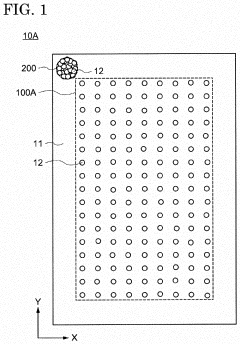
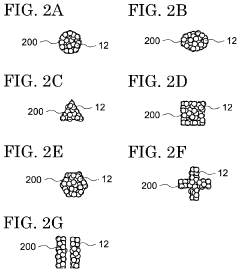
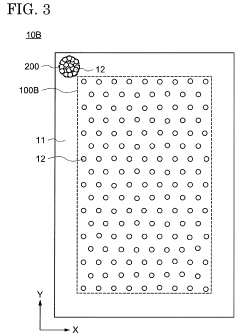
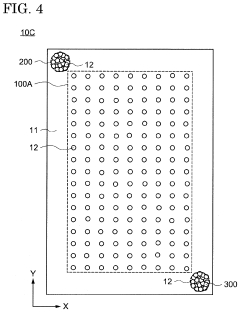
- An anisotropic conductive film with a first region of discretely arranged conductive particles corresponding to electrode patterns and a second region with aggregated conductive particles acting as an alignment marker, facilitating easy alignment with the circuit substrate and reducing production costs by forming alignment markers through conductive particle dispersion.
Encapsulated light emitting diodes for selective fluidic assembly
PatentActiveUS12119432B2
Innovation
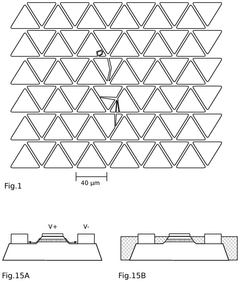
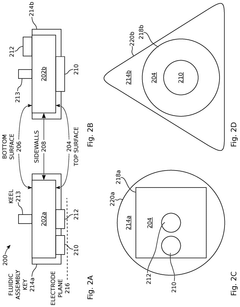
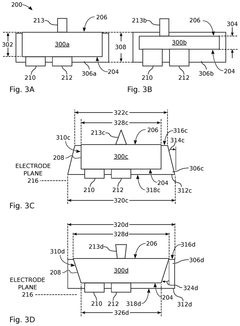
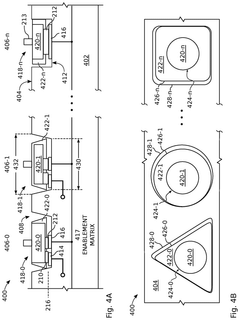
- The use of partially encapsulated semiconductor-based inorganic micro-LEDs with a patternable polymer encapsulant that protects the LEDs from collisions and optimizes their shape for efficient assembly, allowing for higher speed and yield while preventing defects, and enabling precise alignment of LED colors on a display substrate.
Industry Standards Development and Adoption
The evolution of display technologies, particularly the transition from OLED to MicroLED, has significantly influenced the development and adoption of industry standards. These standards serve as crucial frameworks that ensure compatibility, quality, and performance across different manufacturers and applications.
Industry standards for display technologies typically encompass specifications for color accuracy, brightness levels, power consumption, and durability. As OLED technology matured, organizations like the International Electrotechnical Commission (IEC) and the Video Electronics Standards Association (VESA) established comprehensive standards that manufacturers needed to meet. These standards helped drive market adoption by providing consumers with confidence in product quality and performance.
MicroLED innovation has necessitated the revision of existing standards and the creation of new ones. The superior brightness capabilities, longer lifespan, and different power consumption profiles of MicroLED displays have prompted standard-setting bodies to reconsider metrics for high dynamic range (HDR) content, color gamut requirements, and energy efficiency ratings. This evolution reflects the industry's recognition of MicroLED's distinct technological advantages over OLED.
The adoption of these standards follows a predictable pattern across the industry. Initially, pioneering manufacturers collaborate with standards organizations to define preliminary specifications based on early technological capabilities. As the technology matures and becomes more widespread, these standards undergo refinement through industry consensus, eventually becoming mandatory requirements for market participation.
Regional differences in standards adoption present challenges for global manufacturers. European markets typically emphasize energy efficiency standards, while North American standards focus more on performance metrics. Asian markets, particularly Japan and South Korea, often lead in establishing advanced display quality standards due to their strong manufacturing presence in this sector.
The timeline for standards development has accelerated with MicroLED technology. While OLED standards evolved over approximately a decade, MicroLED standards are developing more rapidly due to lessons learned from previous display technologies and increased industry collaboration. This acceleration helps reduce market fragmentation and ensures faster consumer adoption.
Certification programs linked to these standards play a vital role in market acceptance. Displays meeting specific standards receive certifications that serve as quality indicators for consumers and procurement specialists. The competition between OLED and MicroLED technologies has intensified the importance of these certifications as differentiating factors in the marketplace.
Industry standards for display technologies typically encompass specifications for color accuracy, brightness levels, power consumption, and durability. As OLED technology matured, organizations like the International Electrotechnical Commission (IEC) and the Video Electronics Standards Association (VESA) established comprehensive standards that manufacturers needed to meet. These standards helped drive market adoption by providing consumers with confidence in product quality and performance.
MicroLED innovation has necessitated the revision of existing standards and the creation of new ones. The superior brightness capabilities, longer lifespan, and different power consumption profiles of MicroLED displays have prompted standard-setting bodies to reconsider metrics for high dynamic range (HDR) content, color gamut requirements, and energy efficiency ratings. This evolution reflects the industry's recognition of MicroLED's distinct technological advantages over OLED.
The adoption of these standards follows a predictable pattern across the industry. Initially, pioneering manufacturers collaborate with standards organizations to define preliminary specifications based on early technological capabilities. As the technology matures and becomes more widespread, these standards undergo refinement through industry consensus, eventually becoming mandatory requirements for market participation.
Regional differences in standards adoption present challenges for global manufacturers. European markets typically emphasize energy efficiency standards, while North American standards focus more on performance metrics. Asian markets, particularly Japan and South Korea, often lead in establishing advanced display quality standards due to their strong manufacturing presence in this sector.
The timeline for standards development has accelerated with MicroLED technology. While OLED standards evolved over approximately a decade, MicroLED standards are developing more rapidly due to lessons learned from previous display technologies and increased industry collaboration. This acceleration helps reduce market fragmentation and ensures faster consumer adoption.
Certification programs linked to these standards play a vital role in market acceptance. Displays meeting specific standards receive certifications that serve as quality indicators for consumers and procurement specialists. The competition between OLED and MicroLED technologies has intensified the importance of these certifications as differentiating factors in the marketplace.
Environmental and Sustainability Considerations
The environmental impact of display technologies has become increasingly important as sustainability concerns gain prominence in both consumer preferences and regulatory frameworks. OLED and MicroLED technologies present distinct environmental profiles that are reshaping industry standards across the display manufacturing ecosystem.
OLED displays offer several environmental advantages, particularly in energy consumption during operation. Their self-emissive nature eliminates the need for backlighting, resulting in power savings of up to 40% compared to traditional LCD displays when displaying darker content. However, OLED manufacturing processes involve organic compounds and rare materials that present end-of-life recycling challenges. Current industry standards are evolving to address these concerns, with organizations like JEDEC and IEEE developing specifications for reduced hazardous substance usage in OLED production.
MicroLED technology demonstrates promising environmental credentials that may establish new sustainability benchmarks. These displays potentially offer 30% greater energy efficiency than OLEDs while providing superior brightness and longevity. The extended lifespan of MicroLED displays—estimated at over 100,000 hours versus 30,000-50,000 for OLEDs—significantly reduces electronic waste generation. This longevity factor is driving industry standards bodies to reconsider product lifecycle requirements in display certification programs.
Manufacturing sustainability represents a critical differentiator between these technologies. OLED production typically requires vacuum deposition processes and organic solvents with substantial environmental footprints. Conversely, MicroLED manufacturing, while currently energy-intensive, utilizes more recyclable inorganic materials and fewer toxic substances. The International Electrotechnical Commission (IEC) has begun developing new environmental assessment standards specifically addressing these manufacturing distinctions.
Carbon footprint considerations are increasingly integrated into industry standards for both technologies. Recent lifecycle assessments indicate that while MicroLED displays may have higher initial production emissions, their extended operational lifespan results in lower overall carbon impact. This finding is prompting organizations like VESA and CTA to incorporate carbon accounting metrics into their certification requirements, potentially favoring technologies with better lifetime environmental performance.
Water usage presents another environmental dimension influencing standards development. OLED manufacturing typically requires 20-30% more water than conventional LCD production, while early MicroLED fabrication data suggests potentially lower water requirements once production scales. This aspect is driving the development of new water conservation benchmarks within industry standards, particularly in regions facing water scarcity challenges.
OLED displays offer several environmental advantages, particularly in energy consumption during operation. Their self-emissive nature eliminates the need for backlighting, resulting in power savings of up to 40% compared to traditional LCD displays when displaying darker content. However, OLED manufacturing processes involve organic compounds and rare materials that present end-of-life recycling challenges. Current industry standards are evolving to address these concerns, with organizations like JEDEC and IEEE developing specifications for reduced hazardous substance usage in OLED production.
MicroLED technology demonstrates promising environmental credentials that may establish new sustainability benchmarks. These displays potentially offer 30% greater energy efficiency than OLEDs while providing superior brightness and longevity. The extended lifespan of MicroLED displays—estimated at over 100,000 hours versus 30,000-50,000 for OLEDs—significantly reduces electronic waste generation. This longevity factor is driving industry standards bodies to reconsider product lifecycle requirements in display certification programs.
Manufacturing sustainability represents a critical differentiator between these technologies. OLED production typically requires vacuum deposition processes and organic solvents with substantial environmental footprints. Conversely, MicroLED manufacturing, while currently energy-intensive, utilizes more recyclable inorganic materials and fewer toxic substances. The International Electrotechnical Commission (IEC) has begun developing new environmental assessment standards specifically addressing these manufacturing distinctions.
Carbon footprint considerations are increasingly integrated into industry standards for both technologies. Recent lifecycle assessments indicate that while MicroLED displays may have higher initial production emissions, their extended operational lifespan results in lower overall carbon impact. This finding is prompting organizations like VESA and CTA to incorporate carbon accounting metrics into their certification requirements, potentially favoring technologies with better lifetime environmental performance.
Water usage presents another environmental dimension influencing standards development. OLED manufacturing typically requires 20-30% more water than conventional LCD production, while early MicroLED fabrication data suggests potentially lower water requirements once production scales. This aspect is driving the development of new water conservation benchmarks within industry standards, particularly in regions facing water scarcity challenges.
Unlock deeper insights with Patsnap Eureka Quick Research — get a full tech report to explore trends and direct your research. Try now!
Generate Your Research Report Instantly with AI Agent
Supercharge your innovation with Patsnap Eureka AI Agent Platform!