

How OLED vs MicroLED Performance Drives Innovation
OCT 24, 202510 MIN READ
Generate Your Research Report Instantly with AI Agent
PatSnap Eureka helps you evaluate technical feasibility & market potential.
OLED and MicroLED Technology Background and Objectives
Display technologies have undergone significant evolution over the past decades, with OLED (Organic Light-Emitting Diode) emerging as a dominant force in the 2010s. OLED technology, which utilizes organic compounds that emit light when electricity is applied, revolutionized displays by enabling thinner, more flexible screens with superior contrast ratios and energy efficiency compared to traditional LCD displays.
MicroLED represents the next frontier in display technology, first conceptualized in the early 2000s but only recently approaching commercial viability. Unlike OLEDs, MicroLEDs utilize inorganic gallium nitride-based materials to create microscopic LED arrays that individually emit light. This fundamental difference in materials science underpins many of the performance distinctions between these technologies.
The historical trajectory of both technologies reveals an industry constantly pushing boundaries of pixel density, power consumption, and form factor. OLED technology has matured significantly, overcoming early challenges related to blue pixel degradation and manufacturing yields. Meanwhile, MicroLED development has accelerated dramatically since 2016, with major investments from technology giants seeking to overcome mass production challenges.
Current technical objectives in the display industry center around several key performance metrics: brightness capabilities, energy efficiency, color accuracy, response time, and longevity. OLED displays excel in producing perfect blacks and wide viewing angles but face limitations in peak brightness and lifetime. MicroLED aims to deliver OLED's contrast benefits while dramatically improving brightness, efficiency, and durability.
The innovation trajectory is increasingly driven by emerging application demands. Extended reality (XR) devices require displays with microsecond response times and extreme pixel densities. Automotive displays must function reliably in high-brightness environments. Foldable and rollable devices demand flexibility without performance compromise.
Both technologies are evolving toward specific convergence points: higher efficiency blue light emitters, reduced production costs, and improved manufacturing yields at scale. The technical roadmaps for both OLED and MicroLED show parallel paths of innovation, with each technology pushing the boundaries of what's possible in different application domains.
The ultimate objective for both technologies is to achieve the "perfect display" - one that combines infinite contrast, perfect color reproduction, maximum energy efficiency, unlimited brightness range, and indefinite lifespan. While neither technology has achieved this ideal, their competitive development continues to accelerate innovation across the entire display ecosystem.
MicroLED represents the next frontier in display technology, first conceptualized in the early 2000s but only recently approaching commercial viability. Unlike OLEDs, MicroLEDs utilize inorganic gallium nitride-based materials to create microscopic LED arrays that individually emit light. This fundamental difference in materials science underpins many of the performance distinctions between these technologies.
The historical trajectory of both technologies reveals an industry constantly pushing boundaries of pixel density, power consumption, and form factor. OLED technology has matured significantly, overcoming early challenges related to blue pixel degradation and manufacturing yields. Meanwhile, MicroLED development has accelerated dramatically since 2016, with major investments from technology giants seeking to overcome mass production challenges.
Current technical objectives in the display industry center around several key performance metrics: brightness capabilities, energy efficiency, color accuracy, response time, and longevity. OLED displays excel in producing perfect blacks and wide viewing angles but face limitations in peak brightness and lifetime. MicroLED aims to deliver OLED's contrast benefits while dramatically improving brightness, efficiency, and durability.
The innovation trajectory is increasingly driven by emerging application demands. Extended reality (XR) devices require displays with microsecond response times and extreme pixel densities. Automotive displays must function reliably in high-brightness environments. Foldable and rollable devices demand flexibility without performance compromise.
Both technologies are evolving toward specific convergence points: higher efficiency blue light emitters, reduced production costs, and improved manufacturing yields at scale. The technical roadmaps for both OLED and MicroLED show parallel paths of innovation, with each technology pushing the boundaries of what's possible in different application domains.
The ultimate objective for both technologies is to achieve the "perfect display" - one that combines infinite contrast, perfect color reproduction, maximum energy efficiency, unlimited brightness range, and indefinite lifespan. While neither technology has achieved this ideal, their competitive development continues to accelerate innovation across the entire display ecosystem.
Market Demand Analysis for Advanced Display Technologies
The display technology market is experiencing a significant shift as consumer and enterprise demands evolve toward higher performance, energy efficiency, and innovative form factors. OLED (Organic Light Emitting Diode) technology has dominated premium segments for several years, but MicroLED is emerging as a potentially disruptive technology that could reshape market dynamics across multiple sectors.
Current market analysis indicates the global advanced display market reached approximately $143 billion in 2022, with projections suggesting growth to $206 billion by 2027, representing a compound annual growth rate of 7.6%. OLED displays currently command roughly 30% of this market, primarily in smartphones, premium televisions, and wearable devices, while MicroLED remains in early commercialization phases with less than 1% market share.
Consumer electronics continues to drive demand, with smartphone manufacturers representing the largest segment seeking advanced display technologies. Apple's adoption of OLED across its iPhone lineup and Samsung's continued investment in both OLED and MicroLED research exemplify this trend. The premium television sector has also embraced OLED technology, with LG Display and Sony leading implementation, while Samsung has positioned its MicroLED televisions as ultra-premium offerings.
Automotive displays represent the fastest-growing segment, with a projected 12.3% CAGR through 2027. As vehicles become more software-defined and autonomous features increase, demand for larger, more durable, and higher-performance displays is accelerating. Here, MicroLED's advantages in brightness, durability, and longevity make it particularly attractive despite current cost barriers.
Enterprise and commercial applications are increasingly driving specialized display requirements. Digital signage, control rooms, and simulation environments demand displays with exceptional brightness, color accuracy, and longevity—attributes where MicroLED potentially outperforms OLED. The healthcare sector specifically requires displays with precise color reproduction and reliability for diagnostic imaging, creating another potential growth avenue for MicroLED technology.
Regional analysis reveals Asia-Pacific dominates manufacturing capacity for both technologies, with South Korea and China leading OLED production and Taiwan emerging as a potential MicroLED manufacturing hub. North America and Europe represent primary consumption markets, particularly for premium applications, while also hosting significant R&D investments in next-generation display technologies.
Consumer surveys indicate willingness to pay premium prices for displays offering tangible benefits in visual experience, with 68% of respondents citing picture quality as their primary purchase consideration. Energy efficiency ranks second at 53%, an area where the OLED versus MicroLED competition continues to evolve as both technologies improve power management capabilities.
Current market analysis indicates the global advanced display market reached approximately $143 billion in 2022, with projections suggesting growth to $206 billion by 2027, representing a compound annual growth rate of 7.6%. OLED displays currently command roughly 30% of this market, primarily in smartphones, premium televisions, and wearable devices, while MicroLED remains in early commercialization phases with less than 1% market share.
Consumer electronics continues to drive demand, with smartphone manufacturers representing the largest segment seeking advanced display technologies. Apple's adoption of OLED across its iPhone lineup and Samsung's continued investment in both OLED and MicroLED research exemplify this trend. The premium television sector has also embraced OLED technology, with LG Display and Sony leading implementation, while Samsung has positioned its MicroLED televisions as ultra-premium offerings.
Automotive displays represent the fastest-growing segment, with a projected 12.3% CAGR through 2027. As vehicles become more software-defined and autonomous features increase, demand for larger, more durable, and higher-performance displays is accelerating. Here, MicroLED's advantages in brightness, durability, and longevity make it particularly attractive despite current cost barriers.
Enterprise and commercial applications are increasingly driving specialized display requirements. Digital signage, control rooms, and simulation environments demand displays with exceptional brightness, color accuracy, and longevity—attributes where MicroLED potentially outperforms OLED. The healthcare sector specifically requires displays with precise color reproduction and reliability for diagnostic imaging, creating another potential growth avenue for MicroLED technology.
Regional analysis reveals Asia-Pacific dominates manufacturing capacity for both technologies, with South Korea and China leading OLED production and Taiwan emerging as a potential MicroLED manufacturing hub. North America and Europe represent primary consumption markets, particularly for premium applications, while also hosting significant R&D investments in next-generation display technologies.
Consumer surveys indicate willingness to pay premium prices for displays offering tangible benefits in visual experience, with 68% of respondents citing picture quality as their primary purchase consideration. Energy efficiency ranks second at 53%, an area where the OLED versus MicroLED competition continues to evolve as both technologies improve power management capabilities.
Current Technical Challenges in OLED and MicroLED Development
Despite significant advancements in display technologies, both OLED and MicroLED face substantial technical challenges that impede their widespread adoption and performance optimization. For OLED technology, material degradation remains a persistent issue, with blue OLED emitters exhibiting shorter lifespans compared to red and green counterparts. This differential aging leads to color shifts over time, compromising display quality and necessitating complex compensation algorithms.
Manufacturing scalability presents another significant hurdle for OLED, particularly for large-format displays where maintaining uniform organic layer deposition across expansive substrates proves technically demanding. The industry continues to grapple with yield rates that impact production costs, especially for higher-resolution panels requiring precise pixel arrangements.
Power efficiency in OLED displays, while superior to traditional LCD technology, still faces limitations. High brightness scenarios significantly increase power consumption, creating challenges for mobile applications where battery life is paramount. Additionally, OLED's susceptibility to burn-in effects, where static images leave permanent ghosting, remains problematic for applications requiring sustained static content display.
MicroLED technology, while promising superior performance characteristics, confronts even more formidable manufacturing challenges. The mass transfer process—moving millions of microscopic LED chips from growth substrates to display backplanes with micrometer precision—represents an extraordinary technical feat. Current yield rates for this process significantly impact production economics, with even minor defects potentially rendering entire displays unusable.
Miniaturization presents another critical challenge for MicroLED. As pixel sizes decrease below 10 micrometers, quantum efficiency tends to deteriorate due to increased surface defects relative to volume. This efficiency drop becomes particularly pronounced for blue MicroLEDs, creating color balance difficulties similar to those in OLED technology.
Both technologies face integration challenges with driving circuitry. OLED requires sophisticated thin-film transistor backplanes to deliver precise current control, while MicroLED demands high-precision integration between extremely small LED elements and their driving electronics. The complexity increases exponentially with resolution, creating significant yield and cost implications.
Heat management represents another shared challenge, albeit manifesting differently. OLED displays experience accelerated degradation at elevated temperatures, while MicroLED's concentrated light emission can create localized hotspots requiring sophisticated thermal management solutions. This becomes particularly critical in high-brightness applications like automotive displays or outdoor signage.
Color gamut optimization and viewing angle performance, while generally superior to LCD technology, still present ongoing development challenges for both technologies as they strive to meet increasingly demanding visual performance standards across diverse application scenarios.
Manufacturing scalability presents another significant hurdle for OLED, particularly for large-format displays where maintaining uniform organic layer deposition across expansive substrates proves technically demanding. The industry continues to grapple with yield rates that impact production costs, especially for higher-resolution panels requiring precise pixel arrangements.
Power efficiency in OLED displays, while superior to traditional LCD technology, still faces limitations. High brightness scenarios significantly increase power consumption, creating challenges for mobile applications where battery life is paramount. Additionally, OLED's susceptibility to burn-in effects, where static images leave permanent ghosting, remains problematic for applications requiring sustained static content display.
MicroLED technology, while promising superior performance characteristics, confronts even more formidable manufacturing challenges. The mass transfer process—moving millions of microscopic LED chips from growth substrates to display backplanes with micrometer precision—represents an extraordinary technical feat. Current yield rates for this process significantly impact production economics, with even minor defects potentially rendering entire displays unusable.
Miniaturization presents another critical challenge for MicroLED. As pixel sizes decrease below 10 micrometers, quantum efficiency tends to deteriorate due to increased surface defects relative to volume. This efficiency drop becomes particularly pronounced for blue MicroLEDs, creating color balance difficulties similar to those in OLED technology.
Both technologies face integration challenges with driving circuitry. OLED requires sophisticated thin-film transistor backplanes to deliver precise current control, while MicroLED demands high-precision integration between extremely small LED elements and their driving electronics. The complexity increases exponentially with resolution, creating significant yield and cost implications.
Heat management represents another shared challenge, albeit manifesting differently. OLED displays experience accelerated degradation at elevated temperatures, while MicroLED's concentrated light emission can create localized hotspots requiring sophisticated thermal management solutions. This becomes particularly critical in high-brightness applications like automotive displays or outdoor signage.
Color gamut optimization and viewing angle performance, while generally superior to LCD technology, still present ongoing development challenges for both technologies as they strive to meet increasingly demanding visual performance standards across diverse application scenarios.
Comparative Analysis of OLED vs MicroLED Solutions
01 Efficiency and brightness characteristics of OLED and MicroLED displays
OLED and MicroLED display technologies differ significantly in their efficiency and brightness capabilities. OLEDs utilize organic compounds that emit light when electricity is applied, offering excellent color reproduction but with limitations in peak brightness. MicroLEDs, composed of microscopic inorganic LED arrays, provide superior brightness, energy efficiency, and longer lifespan compared to OLEDs. These technologies employ different mechanisms for light emission, resulting in varying performance characteristics for high-brightness applications and power consumption profiles.- Efficiency and brightness characteristics of OLED vs MicroLED displays: OLED and MicroLED technologies differ significantly in their efficiency and brightness capabilities. MicroLEDs generally offer higher brightness levels and better power efficiency compared to OLEDs, making them suitable for high-brightness applications. OLEDs excel in power efficiency at lower brightness levels and can achieve perfect black levels by turning off individual pixels. The different emission mechanisms in these technologies result in varying color performance and luminance efficiency across different operating conditions.
- Pixel structure and manufacturing techniques: The pixel architecture and manufacturing processes for OLED and MicroLED displays present distinct challenges and advantages. MicroLED displays utilize microscopic LED arrays that require precise transfer and placement techniques, while OLEDs use organic materials deposited in layers. The pixel density, arrangement, and driving methods significantly impact display performance metrics such as resolution, response time, and uniformity. Advanced manufacturing techniques aim to overcome challenges like mass transfer for MicroLEDs and degradation prevention for OLEDs.
- Lifespan and reliability comparison: The longevity and reliability of display technologies are critical performance factors. MicroLEDs generally demonstrate superior lifetime characteristics compared to OLEDs, which are susceptible to organic material degradation, particularly for blue emitters. Differential aging in OLEDs can lead to color shifts and burn-in over time. MicroLEDs offer enhanced stability under various environmental conditions, including temperature fluctuations and humidity, contributing to their longer operational lifespan in demanding applications.
- Color gamut and display quality: Color reproduction capabilities vary between OLED and MicroLED technologies. Both can achieve wide color gamuts, but through different mechanisms. MicroLEDs typically offer higher peak brightness while maintaining color accuracy, whereas OLEDs excel in contrast ratio due to their ability to produce true blacks. The color stability over time and viewing angle performance also differ between these technologies, with MicroLEDs generally maintaining better color consistency across wider viewing angles and throughout their operational lifetime.
- Energy consumption and heat management: Power efficiency and thermal management are crucial aspects of display performance. MicroLEDs typically demonstrate superior energy efficiency at high brightness levels, while OLEDs are more efficient at lower brightness. Heat generation and dissipation characteristics differ significantly between the technologies, with MicroLEDs generally handling heat better due to their inorganic nature. Power management systems and driving schemes are designed differently for each technology to optimize energy consumption while maintaining display quality across various usage scenarios.
02 Pixel structure and resolution capabilities
The pixel architecture in OLED and MicroLED displays fundamentally affects their resolution capabilities and image quality. MicroLEDs feature extremely small individual LED elements that can be densely packed, enabling higher pixel density and resolution while maintaining excellent brightness. OLEDs utilize a layered organic structure with individually addressable pixels that provide exceptional contrast but face manufacturing challenges at ultra-high resolutions. The different pixel structures influence color accuracy, viewing angles, and the ability to produce high-definition images in various display sizes.Expand Specific Solutions03 Lifespan and degradation characteristics
OLED and MicroLED displays exhibit different degradation patterns and operational lifespans. OLEDs are susceptible to organic material degradation over time, particularly with blue subpixels degrading faster than others, leading to color shift and reduced brightness. MicroLEDs demonstrate superior longevity due to their inorganic semiconductor materials, which are less prone to degradation under normal operating conditions. These differences in material stability affect the long-term performance consistency and maintenance requirements for displays using these technologies.Expand Specific Solutions04 Response time and motion performance
The response time characteristics of OLED and MicroLED technologies significantly impact their performance in displaying fast-moving content. MicroLEDs offer extremely fast response times in the nanosecond range, virtually eliminating motion blur in high-action content. OLEDs also provide excellent response times compared to traditional LCD technology but are typically slower than MicroLEDs. These response time differences affect the clarity of motion, gaming performance, and suitability for applications requiring rapid screen updates such as virtual reality displays.Expand Specific Solutions05 Manufacturing challenges and scalability
The production processes for OLED and MicroLED displays present distinct manufacturing challenges that affect their market availability and performance consistency. MicroLED manufacturing involves complex processes for precisely transferring millions of microscopic LEDs to a substrate with extremely low defect rates. OLED production has matured but still faces challenges with uniform deposition of organic materials at larger sizes. These manufacturing differences impact production yields, cost efficiency, and the ability to scale these technologies across different display sizes while maintaining consistent performance characteristics.Expand Specific Solutions
Key Industry Players in Advanced Display Manufacturing
The OLED vs MicroLED competition is currently in a transitional market phase, with OLED technology reaching maturity while MicroLED remains in early commercialization stages. The global display market for these technologies is expanding rapidly, projected to exceed $200 billion by 2025. Samsung Display and BOE Technology lead OLED production with established manufacturing capabilities, while Samsung Electronics, Apple, and TCL are investing heavily in MicroLED development. Companies like Universal Display Corporation provide critical materials technology, while Applied Materials supports manufacturing equipment needs. Asian manufacturers, particularly from China and South Korea, dominate the competitive landscape, with Western companies focusing on intellectual property and specialized applications in this increasingly strategic technology sector.
BOE Technology Group Co., Ltd.
Technical Solution: BOE has developed comprehensive solutions in both OLED and MicroLED technologies. Their OLED technology includes flexible AMOLED displays utilizing LTPO (Low-Temperature Polycrystalline Oxide) backplanes that reduce power consumption by up to 30% through variable refresh rates from 1-120Hz. BOE's proprietary pixel compensation algorithms address OLED aging issues, extending panel lifespan by approximately 25% compared to standard implementations. For MicroLED, BOE has created an innovative "active matrix glass substrate" approach that integrates driving circuits directly into the glass, simplifying the manufacturing process while maintaining pixel densities above 1,500 PPI. Their hybrid transfer technology combines fluid self-assembly for initial positioning with laser-assisted precision alignment, achieving placement accuracy within 1μm while increasing transfer efficiency by 40% compared to conventional methods. BOE has also developed a unique "silicon-based MicroLED" architecture that integrates RGB MicroLEDs onto silicon substrates rather than traditional TFT backplanes, potentially reducing production costs by 30-40% at scale.
Strengths: Massive production capacity with multiple advanced display manufacturing facilities; strong vertical integration from materials to finished displays; substantial government backing for technology development. Weaknesses: Still catching up to Samsung and LG in high-end OLED quality; MicroLED technology remains primarily in prototype stage rather than mass production; faces yield challenges in larger MicroLED panels.
Samsung Electronics Co., Ltd.
Technical Solution: Samsung has pioneered both OLED and MicroLED technologies with significant innovations. For OLED, Samsung developed their proprietary AMOLED technology featuring Quantum Dot (QD-OLED) displays that combine quantum dots with OLED to achieve superior color volume and brightness. Their OLED panels utilize a unique pixel structure that enhances energy efficiency while maintaining vibrant colors. For MicroLED, Samsung has commercialized "The Wall" - a modular MicroLED display system using inorganic gallium nitride-based LEDs measuring less than 50 micrometers. Their MicroLED technology implements a transfer process that places millions of microscopic RGB LED chips onto a substrate with near-perfect precision, achieving 100% color volume in DCI-P3 color space with brightness levels exceeding 2,000 nits while maintaining perfect blacks.
Strengths: Industry-leading production capacity for both technologies; proprietary manufacturing processes that enhance yield rates; vertical integration from component manufacturing to final display production. Weaknesses: High production costs for MicroLED limiting mass market adoption; OLED technology still faces burn-in issues and shorter lifespan compared to traditional LCD displays.
Critical Patents and Technical Breakthroughs in Display Technology
Microled display
PatentActiveUS20230196965A1
Innovation
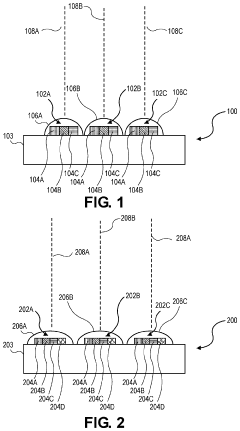
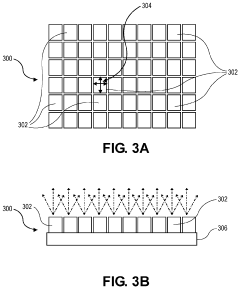
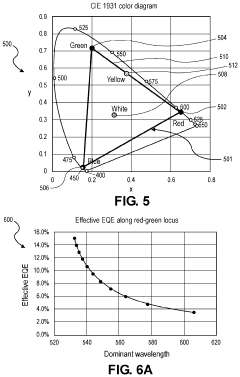
- Incorporating a fourth microLED that emits light along the red-green locus, such as yellow or amber, to improve overall display efficiency by reducing the dominance of red microLED performance, thereby enhancing the EQE and lumens per watt (lm/W) gain.
Display device comprising display module, and manufacturing method therefor
PatentPendingEP4401159A1
Innovation
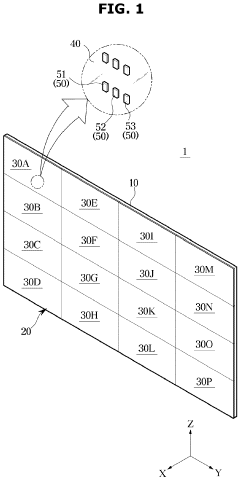
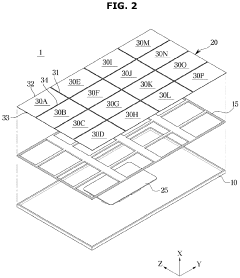
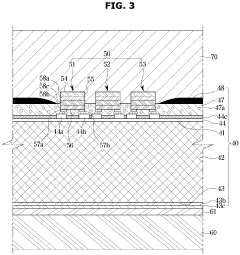
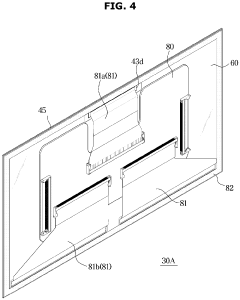
- The display apparatus incorporates a substrate with inorganic light-emitting diodes, a front cover, a metal plate, a side cover, and a side end member with ribs for enhanced conductivity and sealing, which improves electrostatic discharge protection and reduces gaps between modules, making the display apparatus more robust and visually seamless.
Supply Chain Considerations for Advanced Display Technologies
The global supply chain for advanced display technologies represents a complex ecosystem that significantly impacts both OLED and MicroLED development trajectories. Material sourcing constitutes a critical differentiator between these technologies, with OLED requiring organic compounds and specialized chemicals, while MicroLED depends on semiconductor materials and inorganic LED components. This fundamental difference creates distinct vulnerability profiles and scaling challenges.
For OLED production, manufacturers rely heavily on specialized chemical suppliers predominantly located in South Korea, Japan, and Germany. The organic materials essential for OLED displays face stability challenges during transportation and storage, necessitating sophisticated logistics solutions. In contrast, MicroLED supply chains leverage existing semiconductor infrastructure but encounter unique challenges in mass transfer processes and miniaturization technologies.
Manufacturing capacity presents another crucial consideration. OLED production has achieved significant scale, with major facilities established in East Asia. Companies like Samsung Display and LG Display have invested billions in dedicated OLED fabrication plants, creating substantial barriers to entry. MicroLED manufacturing remains more fragmented, with fewer large-scale production facilities currently operational, though significant investments are underway from companies including Apple, Samsung, and several Chinese manufacturers.
Equipment supply represents a potential bottleneck for both technologies. OLED requires specialized deposition equipment and encapsulation technologies, while MicroLED demands advanced pick-and-place machinery and inspection systems. Key equipment suppliers like Applied Materials, ULVAC, and Coherent wield considerable influence over production capabilities and technological advancement rates.
Geopolitical factors increasingly impact these supply chains, with trade tensions between major economies creating uncertainty. The concentration of critical materials and manufacturing expertise in specific regions introduces strategic vulnerabilities that companies must navigate. For instance, rare earth elements essential for certain display components face supply constraints and price volatility due to geographic concentration.
Sustainability considerations are gaining prominence in supply chain decisions. OLED manufacturing processes involve potentially hazardous chemicals requiring careful handling and disposal, while MicroLED production may offer advantages in resource efficiency and recyclability. These environmental factors increasingly influence both regulatory compliance requirements and consumer preferences.
As innovation accelerates in both technologies, supply chain agility becomes a competitive differentiator. Companies capable of securing reliable material sources, manufacturing capacity, and equipment access gain significant advantages in bringing next-generation displays to market. This dynamic increasingly shapes strategic partnerships and vertical integration efforts across the display industry.
For OLED production, manufacturers rely heavily on specialized chemical suppliers predominantly located in South Korea, Japan, and Germany. The organic materials essential for OLED displays face stability challenges during transportation and storage, necessitating sophisticated logistics solutions. In contrast, MicroLED supply chains leverage existing semiconductor infrastructure but encounter unique challenges in mass transfer processes and miniaturization technologies.
Manufacturing capacity presents another crucial consideration. OLED production has achieved significant scale, with major facilities established in East Asia. Companies like Samsung Display and LG Display have invested billions in dedicated OLED fabrication plants, creating substantial barriers to entry. MicroLED manufacturing remains more fragmented, with fewer large-scale production facilities currently operational, though significant investments are underway from companies including Apple, Samsung, and several Chinese manufacturers.
Equipment supply represents a potential bottleneck for both technologies. OLED requires specialized deposition equipment and encapsulation technologies, while MicroLED demands advanced pick-and-place machinery and inspection systems. Key equipment suppliers like Applied Materials, ULVAC, and Coherent wield considerable influence over production capabilities and technological advancement rates.
Geopolitical factors increasingly impact these supply chains, with trade tensions between major economies creating uncertainty. The concentration of critical materials and manufacturing expertise in specific regions introduces strategic vulnerabilities that companies must navigate. For instance, rare earth elements essential for certain display components face supply constraints and price volatility due to geographic concentration.
Sustainability considerations are gaining prominence in supply chain decisions. OLED manufacturing processes involve potentially hazardous chemicals requiring careful handling and disposal, while MicroLED production may offer advantages in resource efficiency and recyclability. These environmental factors increasingly influence both regulatory compliance requirements and consumer preferences.
As innovation accelerates in both technologies, supply chain agility becomes a competitive differentiator. Companies capable of securing reliable material sources, manufacturing capacity, and equipment access gain significant advantages in bringing next-generation displays to market. This dynamic increasingly shapes strategic partnerships and vertical integration efforts across the display industry.
Energy Efficiency and Sustainability Impact of Display Technologies
The environmental impact of display technologies has become increasingly important as consumer electronics proliferate globally. OLED and MicroLED technologies present distinct profiles in terms of energy efficiency and sustainability that significantly influence their market adoption and technological development trajectories.
OLED displays demonstrate notable energy efficiency advantages when displaying darker content due to their self-emissive nature, where black pixels consume virtually no power. This characteristic makes OLEDs particularly energy-efficient for applications with predominantly dark interfaces or content. However, their efficiency decreases substantially when displaying bright or white content, with power consumption increasing linearly with brightness levels.
MicroLED technology, while still evolving, promises superior energy efficiency across all brightness levels compared to OLED. Initial research indicates that MicroLEDs can achieve up to 30% greater energy efficiency at maximum brightness, with even more significant advantages in high-ambient light conditions. This efficiency stems from their higher luminance output per watt and reduced heat generation during operation.
From a manufacturing sustainability perspective, OLED production currently involves several environmentally challenging processes, including the use of rare earth materials and organic compounds that present recycling difficulties. The production process also requires significant energy inputs and generates substantial waste materials, though advancements in manufacturing techniques have improved yields considerably over the past decade.
MicroLED manufacturing, despite its theoretical advantages, currently faces sustainability challenges due to complex production processes and lower yields. However, the technology utilizes more environmentally stable inorganic materials that potentially offer longer lifespans and better recyclability. As manufacturing scales and matures, these sustainability advantages may become more pronounced.
Lifecycle assessment studies indicate that the extended operational lifespan of MicroLED displays—potentially 2-3 times longer than current OLED panels—could significantly reduce electronic waste despite higher initial resource requirements. This longevity factor is increasingly important as consumers and regulatory bodies focus on reducing electronic waste streams.
Water usage represents another critical sustainability metric, with OLED manufacturing typically requiring 20-30% more water resources than projected for optimized MicroLED production. Similarly, carbon footprint analyses suggest that while current MicroLED prototypes have higher embodied carbon due to manufacturing complexity, their extended lifespan and operational efficiency may yield lower lifetime emissions.
These energy efficiency and sustainability considerations are driving significant innovation in both technologies, with manufacturers investing heavily in production process improvements, material science advancements, and power management systems to address environmental concerns while meeting market performance demands.
OLED displays demonstrate notable energy efficiency advantages when displaying darker content due to their self-emissive nature, where black pixels consume virtually no power. This characteristic makes OLEDs particularly energy-efficient for applications with predominantly dark interfaces or content. However, their efficiency decreases substantially when displaying bright or white content, with power consumption increasing linearly with brightness levels.
MicroLED technology, while still evolving, promises superior energy efficiency across all brightness levels compared to OLED. Initial research indicates that MicroLEDs can achieve up to 30% greater energy efficiency at maximum brightness, with even more significant advantages in high-ambient light conditions. This efficiency stems from their higher luminance output per watt and reduced heat generation during operation.
From a manufacturing sustainability perspective, OLED production currently involves several environmentally challenging processes, including the use of rare earth materials and organic compounds that present recycling difficulties. The production process also requires significant energy inputs and generates substantial waste materials, though advancements in manufacturing techniques have improved yields considerably over the past decade.
MicroLED manufacturing, despite its theoretical advantages, currently faces sustainability challenges due to complex production processes and lower yields. However, the technology utilizes more environmentally stable inorganic materials that potentially offer longer lifespans and better recyclability. As manufacturing scales and matures, these sustainability advantages may become more pronounced.
Lifecycle assessment studies indicate that the extended operational lifespan of MicroLED displays—potentially 2-3 times longer than current OLED panels—could significantly reduce electronic waste despite higher initial resource requirements. This longevity factor is increasingly important as consumers and regulatory bodies focus on reducing electronic waste streams.
Water usage represents another critical sustainability metric, with OLED manufacturing typically requiring 20-30% more water resources than projected for optimized MicroLED production. Similarly, carbon footprint analyses suggest that while current MicroLED prototypes have higher embodied carbon due to manufacturing complexity, their extended lifespan and operational efficiency may yield lower lifetime emissions.
These energy efficiency and sustainability considerations are driving significant innovation in both technologies, with manufacturers investing heavily in production process improvements, material science advancements, and power management systems to address environmental concerns while meeting market performance demands.
Unlock deeper insights with PatSnap Eureka Quick Research — get a full tech report to explore trends and direct your research. Try now!
Generate Your Research Report Instantly with AI Agent
Supercharge your innovation with PatSnap Eureka AI Agent Platform!