

How OLED vs MicroLED Revolutionize Display Manufacturing
OCT 24, 20259 MIN READ
Generate Your Research Report Instantly with AI Agent
PatSnap Eureka helps you evaluate technical feasibility & market potential.
Display Technology Evolution and Objectives
Display technology has undergone remarkable evolution since the introduction of cathode ray tubes (CRTs) in the early 20th century. The progression from CRTs to liquid crystal displays (LCDs) marked the first major shift, bringing flatter, more energy-efficient screens to consumers. This was followed by plasma display panels, which offered improved contrast ratios and viewing angles but struggled with power consumption and screen burn-in issues.
The introduction of OLED (Organic Light-Emitting Diode) technology in the early 2000s represented a paradigm shift in display manufacturing. Unlike LCDs that require backlighting, OLED pixels emit their own light when electrical current passes through organic compounds. This self-emissive property enabled thinner, lighter displays with perfect blacks, wider viewing angles, and potentially flexible form factors.
MicroLED technology, emerging in the late 2010s, represents the next frontier in display evolution. Building on the self-emissive principle of OLEDs, MicroLEDs utilize inorganic gallium nitride-based LEDs at microscopic scales. This addresses several limitations of OLED technology, particularly regarding brightness capabilities, longevity, and burn-in susceptibility.
The technical objectives driving display technology evolution have consistently centered around several key parameters: visual performance (resolution, contrast, color gamut), form factor (thickness, weight, flexibility), energy efficiency, manufacturing scalability, and production costs. Both OLED and MicroLED technologies represent significant advancements in meeting these objectives, albeit through different technical approaches.
Current industry trends indicate a bifurcation in display technology applications. OLED has achieved mainstream adoption in mobile devices and premium televisions, while MicroLED is positioned as the next-generation technology for high-end displays where cost sensitivity is lower. The technical objective for OLED manufacturing focuses on improving production yields and reducing costs, while MicroLED development aims to overcome mass production challenges related to microscopic LED transfer and integration.
Looking forward, the display technology roadmap suggests continued refinement of both technologies, with particular emphasis on addressing their respective limitations. For OLED, this means improving luminance efficiency and operational lifespan, while MicroLED development focuses on miniaturization and mass transfer techniques. The ultimate objective for both technologies is to achieve the perfect display: one that offers infinite contrast, perfect color reproduction, maximum energy efficiency, flexible form factors, and economical manufacturing costs.
The introduction of OLED (Organic Light-Emitting Diode) technology in the early 2000s represented a paradigm shift in display manufacturing. Unlike LCDs that require backlighting, OLED pixels emit their own light when electrical current passes through organic compounds. This self-emissive property enabled thinner, lighter displays with perfect blacks, wider viewing angles, and potentially flexible form factors.
MicroLED technology, emerging in the late 2010s, represents the next frontier in display evolution. Building on the self-emissive principle of OLEDs, MicroLEDs utilize inorganic gallium nitride-based LEDs at microscopic scales. This addresses several limitations of OLED technology, particularly regarding brightness capabilities, longevity, and burn-in susceptibility.
The technical objectives driving display technology evolution have consistently centered around several key parameters: visual performance (resolution, contrast, color gamut), form factor (thickness, weight, flexibility), energy efficiency, manufacturing scalability, and production costs. Both OLED and MicroLED technologies represent significant advancements in meeting these objectives, albeit through different technical approaches.
Current industry trends indicate a bifurcation in display technology applications. OLED has achieved mainstream adoption in mobile devices and premium televisions, while MicroLED is positioned as the next-generation technology for high-end displays where cost sensitivity is lower. The technical objective for OLED manufacturing focuses on improving production yields and reducing costs, while MicroLED development aims to overcome mass production challenges related to microscopic LED transfer and integration.
Looking forward, the display technology roadmap suggests continued refinement of both technologies, with particular emphasis on addressing their respective limitations. For OLED, this means improving luminance efficiency and operational lifespan, while MicroLED development focuses on miniaturization and mass transfer techniques. The ultimate objective for both technologies is to achieve the perfect display: one that offers infinite contrast, perfect color reproduction, maximum energy efficiency, flexible form factors, and economical manufacturing costs.
Market Demand Analysis for Advanced Display Technologies
The display technology market is experiencing unprecedented growth driven by consumer demand for superior visual experiences across multiple device categories. Current market analysis indicates that the global advanced display market, encompassing both OLED and emerging MicroLED technologies, is projected to reach $200 billion by 2025, with a compound annual growth rate exceeding 18%. This growth trajectory is primarily fueled by increasing adoption in smartphones, televisions, wearables, and automotive displays.
Consumer preferences are shifting dramatically toward thinner, more energy-efficient displays with superior color reproduction and contrast ratios. OLED technology currently dominates the premium smartphone segment, with over 60% market penetration in high-end devices. This dominance reflects consumer willingness to pay premium prices for enhanced visual experiences, particularly in mobile applications where power efficiency and display quality significantly impact user satisfaction.
The television segment presents another substantial growth vector, with OLED TVs experiencing 30% year-over-year growth despite their premium pricing. Market research indicates that consumers increasingly prioritize picture quality over price considerations when purchasing high-end televisions. Meanwhile, MicroLED is positioned to capture the ultra-premium television market, with early adopters demonstrating willingness to invest in cutting-edge visual technology despite current high production costs.
Emerging application areas are expanding market potential beyond traditional consumer electronics. The automotive industry is rapidly incorporating advanced displays into vehicle interiors, with projections suggesting that the automotive display market will grow at 22% annually through 2026. This growth is driven by increasing demand for digital dashboards, entertainment systems, and augmented reality displays in next-generation vehicles.
Commercial applications represent another significant market opportunity. Digital signage, retail displays, and public information systems are transitioning to advanced display technologies to deliver more impactful visual communications. The commercial display segment is expected to grow at 15% annually, creating substantial demand for both OLED and MicroLED solutions optimized for durability and high-brightness environments.
Regional analysis reveals differentiated market dynamics. Asia-Pacific leads in manufacturing capacity and consumption, accounting for approximately 65% of global display production. North America and Europe represent premium markets with higher average selling prices and earlier adoption of cutting-edge technologies like MicroLED. Emerging markets are experiencing accelerated growth as smartphone penetration increases and television ownership expands beyond urban centers.
Market forecasts indicate that while OLED will maintain dominance in the near term, MicroLED is positioned for exponential growth starting from 2024-2025 as manufacturing processes mature and costs decrease. Industry analysts project that by 2028, MicroLED could capture up to 25% of the premium display market, primarily in large-format applications where its superior brightness and longevity provide compelling advantages.
Consumer preferences are shifting dramatically toward thinner, more energy-efficient displays with superior color reproduction and contrast ratios. OLED technology currently dominates the premium smartphone segment, with over 60% market penetration in high-end devices. This dominance reflects consumer willingness to pay premium prices for enhanced visual experiences, particularly in mobile applications where power efficiency and display quality significantly impact user satisfaction.
The television segment presents another substantial growth vector, with OLED TVs experiencing 30% year-over-year growth despite their premium pricing. Market research indicates that consumers increasingly prioritize picture quality over price considerations when purchasing high-end televisions. Meanwhile, MicroLED is positioned to capture the ultra-premium television market, with early adopters demonstrating willingness to invest in cutting-edge visual technology despite current high production costs.
Emerging application areas are expanding market potential beyond traditional consumer electronics. The automotive industry is rapidly incorporating advanced displays into vehicle interiors, with projections suggesting that the automotive display market will grow at 22% annually through 2026. This growth is driven by increasing demand for digital dashboards, entertainment systems, and augmented reality displays in next-generation vehicles.
Commercial applications represent another significant market opportunity. Digital signage, retail displays, and public information systems are transitioning to advanced display technologies to deliver more impactful visual communications. The commercial display segment is expected to grow at 15% annually, creating substantial demand for both OLED and MicroLED solutions optimized for durability and high-brightness environments.
Regional analysis reveals differentiated market dynamics. Asia-Pacific leads in manufacturing capacity and consumption, accounting for approximately 65% of global display production. North America and Europe represent premium markets with higher average selling prices and earlier adoption of cutting-edge technologies like MicroLED. Emerging markets are experiencing accelerated growth as smartphone penetration increases and television ownership expands beyond urban centers.
Market forecasts indicate that while OLED will maintain dominance in the near term, MicroLED is positioned for exponential growth starting from 2024-2025 as manufacturing processes mature and costs decrease. Industry analysts project that by 2028, MicroLED could capture up to 25% of the premium display market, primarily in large-format applications where its superior brightness and longevity provide compelling advantages.
OLED vs MicroLED: Current Status and Technical Challenges
OLED (Organic Light Emitting Diode) and MicroLED technologies represent the cutting edge of display manufacturing, each with distinct technological characteristics and market positioning. Currently, OLED dominates the premium display market with widespread commercial adoption across smartphones, televisions, and wearable devices. Samsung and LG Display lead OLED production, having refined manufacturing processes that allow for flexible, thin, and energy-efficient displays with superior contrast ratios and color reproduction.
Despite its market prevalence, OLED technology faces persistent challenges. Manufacturing yields remain problematic, particularly for larger panels, contributing to higher production costs. OLED materials suffer from differential aging, where blue organic compounds degrade faster than red and green, causing color shifts over time. Additionally, burn-in issues persist when static images are displayed for extended periods, and brightness limitations restrict outdoor visibility compared to competing technologies.
MicroLED, while less commercially established, represents the next evolutionary step in display technology. Companies like Samsung, Apple, and Sony have demonstrated impressive prototypes, but full-scale production remains limited to specialized applications and premium segments. The technology promises significant advantages including longer lifespan, higher brightness, improved energy efficiency, and immunity to burn-in issues that plague OLED displays.
However, MicroLED faces formidable manufacturing challenges. Mass transfer of millions of microscopic LED chips with near-perfect precision remains the primary technical hurdle. Current yield rates are insufficient for cost-effective mass production, with defect rates significantly impacting manufacturing economics. Color consistency across these miniature LEDs presents another substantial challenge, requiring sophisticated calibration techniques to ensure uniform display performance.
Geographically, display technology development shows distinct regional patterns. South Korea leads in OLED manufacturing infrastructure through Samsung and LG investments. Taiwan excels in LCD and increasingly in MicroLED development through companies like AUO and Innolux. China has rapidly expanded its display manufacturing capacity with significant government support, while Japan maintains strength in specialized materials and components essential to both technologies.
The technical gap between laboratory demonstrations and mass production capabilities remains substantial for MicroLED, while OLED continues to improve incrementally in addressing its inherent limitations. Industry experts project that hybrid approaches may emerge as transitional solutions, with technologies like Mini-LED backlighting for LCD displays serving as stepping stones toward full MicroLED implementation.
Despite its market prevalence, OLED technology faces persistent challenges. Manufacturing yields remain problematic, particularly for larger panels, contributing to higher production costs. OLED materials suffer from differential aging, where blue organic compounds degrade faster than red and green, causing color shifts over time. Additionally, burn-in issues persist when static images are displayed for extended periods, and brightness limitations restrict outdoor visibility compared to competing technologies.
MicroLED, while less commercially established, represents the next evolutionary step in display technology. Companies like Samsung, Apple, and Sony have demonstrated impressive prototypes, but full-scale production remains limited to specialized applications and premium segments. The technology promises significant advantages including longer lifespan, higher brightness, improved energy efficiency, and immunity to burn-in issues that plague OLED displays.
However, MicroLED faces formidable manufacturing challenges. Mass transfer of millions of microscopic LED chips with near-perfect precision remains the primary technical hurdle. Current yield rates are insufficient for cost-effective mass production, with defect rates significantly impacting manufacturing economics. Color consistency across these miniature LEDs presents another substantial challenge, requiring sophisticated calibration techniques to ensure uniform display performance.
Geographically, display technology development shows distinct regional patterns. South Korea leads in OLED manufacturing infrastructure through Samsung and LG investments. Taiwan excels in LCD and increasingly in MicroLED development through companies like AUO and Innolux. China has rapidly expanded its display manufacturing capacity with significant government support, while Japan maintains strength in specialized materials and components essential to both technologies.
The technical gap between laboratory demonstrations and mass production capabilities remains substantial for MicroLED, while OLED continues to improve incrementally in addressing its inherent limitations. Industry experts project that hybrid approaches may emerge as transitional solutions, with technologies like Mini-LED backlighting for LCD displays serving as stepping stones toward full MicroLED implementation.
Current Manufacturing Solutions for OLED and MicroLED
01 Advanced OLED manufacturing techniques
Innovations in OLED manufacturing processes have revolutionized display technology production. These advancements include improved deposition methods for organic materials, enhanced electrode formation techniques, and novel encapsulation processes that protect sensitive organic layers from environmental degradation. These manufacturing improvements have led to higher production yields, better device performance, and longer display lifetimes while enabling the production of flexible and transparent OLED displays.- Advanced OLED Manufacturing Techniques: Recent innovations in OLED manufacturing focus on improving production efficiency and display quality. These techniques include novel deposition methods for organic materials, enhanced electrode structures, and improved encapsulation processes. These advancements allow for thinner, more flexible displays with better color accuracy and energy efficiency, while reducing production costs and enabling mass manufacturing of high-quality OLED panels.
- MicroLED Transfer and Integration Technologies: MicroLED manufacturing has seen revolutionary developments in transfer and integration methods. These technologies focus on efficiently moving microscopic LED elements from growth substrates to display backplanes with high precision and yield. Advanced pick-and-place techniques, mass transfer methods, and self-assembly processes enable the production of high-resolution displays with millions of individual microLEDs, overcoming one of the major hurdles in microLED commercialization.
- Semiconductor Structures for Next-Generation Displays: Novel semiconductor structures are being developed specifically for OLED and microLED displays. These include improved thin-film transistor (TFT) backplanes, specialized quantum dot materials, and innovative pixel architectures. These semiconductor advances enable higher pixel densities, faster refresh rates, and better power efficiency, while supporting features like transparent and flexible displays for consumer electronics and automotive applications.
- Manufacturing Equipment and Process Optimization: Specialized equipment and optimized manufacturing processes are transforming display production. These include advanced lithography systems, automated inspection tools, and precision deposition equipment designed specifically for OLED and microLED fabrication. Process innovations focus on improving yield rates, reducing defects, and enabling high-volume production while maintaining strict quality control standards necessary for these advanced display technologies.
- Hybrid and Flexible Display Technologies: Emerging manufacturing approaches combine elements of OLED and microLED technologies to create hybrid or flexible display solutions. These include stretchable substrates, foldable display architectures, and composite material systems that enable new form factors. Manufacturing innovations in this area focus on maintaining display performance while enabling bending, folding, or rolling capabilities, opening new possibilities for wearable devices, rollable screens, and conformable displays.
02 MicroLED transfer and integration methods
Revolutionary manufacturing techniques for MicroLED displays focus on efficient transfer and integration of microscopic LED elements onto display substrates. These methods include mass transfer processes, pick-and-place technologies, and self-assembly techniques that enable precise positioning of thousands of tiny LED elements. Advanced integration approaches allow for the combination of drive circuits with MicroLED arrays, creating high-resolution displays with exceptional brightness, contrast, and energy efficiency.Expand Specific Solutions03 Novel materials for next-generation displays
The development of new materials has been crucial for advancing both OLED and MicroLED technologies. These include improved emissive materials with higher efficiency and color purity, novel electrode materials that enhance conductivity while maintaining transparency, and specialized substrate materials that enable flexible and foldable displays. Advanced encapsulation materials protect sensitive components from oxygen and moisture, significantly extending device lifetimes and enabling new form factors.Expand Specific Solutions04 Semiconductor processing innovations for display manufacturing
Semiconductor manufacturing techniques have been adapted and enhanced specifically for display production. These innovations include specialized etching processes, advanced lithography methods for creating microscopic features, and novel doping techniques that optimize the performance of display elements. Improvements in semiconductor processing have enabled higher pixel densities, better uniformity across large display areas, and more efficient production methods that reduce manufacturing costs.Expand Specific Solutions05 Automation and quality control in display production
Manufacturing revolution in display technologies has been driven by advances in automation and quality control systems. These include AI-powered inspection systems that can detect microscopic defects, robotic handling systems that minimize contamination and damage during production, and advanced testing methodologies that ensure consistent performance across manufactured displays. These improvements have significantly increased production yields while reducing costs and enabling the mass production of high-quality displays for consumer electronics.Expand Specific Solutions
Key Industry Players in OLED and MicroLED Manufacturing
The OLED vs MicroLED display manufacturing landscape is currently in a transitional phase, with OLED technology reaching maturity while MicroLED remains in early commercialization stages. The global display market, valued at approximately $150 billion, is witnessing significant technological competition. Companies like Samsung Electronics and BOE Technology Group lead in OLED mass production, while Applied Materials and Lumileds are advancing MicroLED manufacturing processes. Chinese manufacturers including TCL China Star Optoelectronics and Shenzhen China Star are rapidly expanding production capacity, challenging traditional leaders like Japan Display and Innolux. The technological maturity gap between these display technologies is driving strategic investments, with MicroLED promising superior performance but facing yield and cost challenges that OLED has largely overcome.
BOE Technology Group Co., Ltd.
Technical Solution: BOE has developed comprehensive solutions for both OLED and MicroLED manufacturing. For OLED, BOE employs flexible AMOLED technology with oxide TFT backplanes that enable higher electron mobility and lower power consumption. Their production utilizes advanced vapor deposition techniques for organic materials with precise shadow masking to achieve higher pixel densities. BOE's OLED manufacturing incorporates AI-driven defect detection systems that have reportedly improved yield rates by 15%. For MicroLED, BOE has developed a proprietary "chip-on-glass" transfer technology that places micro-sized LED chips directly onto TFT glass substrates. Their process combines photolithography techniques with mass transfer printing to achieve placement accuracy within 1 micrometer. BOE has also pioneered a unique repair process for MicroLED displays that can identify and replace defective LED units post-assembly, significantly improving manufacturing yields.
Strengths: Large-scale production capacity; advanced oxide TFT backplane technology; innovative transfer methods for MicroLED; strong vertical integration from materials to finished displays. Weaknesses: Still catching up to Samsung in high-end OLED quality; MicroLED technology remains primarily in prototype stage with limited commercial deployment; higher defect rates in initial production runs.
Applied Materials, Inc.
Technical Solution: As a leading equipment supplier, Applied Materials has developed critical manufacturing technologies for both OLED and MicroLED production. For OLED, their Precision CVD™ and ALD systems enable the deposition of ultra-thin films with atomic-level precision, crucial for OLED stack formation. Their PixelClear™ technology provides advanced encapsulation solutions that extend OLED lifetime by creating impermeable barrier layers against moisture and oxygen. For MicroLED, Applied Materials has pioneered specialized equipment including their Epi Precision™ system for growing high-quality LED structures and their SmartFactory™ automation platform that integrates AI-powered defect detection with precision handling systems. Their proprietary mass transfer technology achieves placement accuracy of less than 1μm while maintaining throughput rates suitable for commercial production. Applied Materials has also developed specialized etching and patterning equipment that enables the creation of microscopic LED structures with near-perfect uniformity across large substrates.
Strengths: Comprehensive equipment portfolio spanning the entire manufacturing process; deep expertise in thin-film deposition and material science; strong relationships with all major display manufacturers; advanced process control systems. Weaknesses: Dependent on display manufacturers' technology roadmaps; not directly involved in end-product development; equipment solutions require significant capital investment from customers.
Core Patents and Innovations in Display Manufacturing
Transfer substrate
PatentPendingUS20220109081A1
Innovation
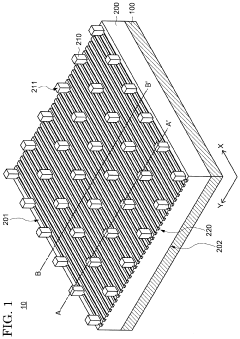
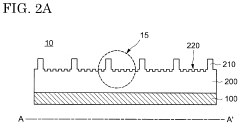
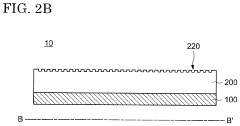
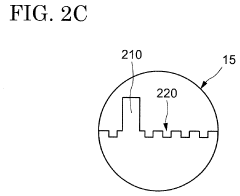
- A transfer substrate with projection portions and groove portions on its surface, where the groove portions have varying depths and shapes to minimize contact area with the micro LEDs, preventing re-pickup and enhancing the transfer process accuracy.
LED display and electronic device having same
PatentWO2019208919A1
Innovation
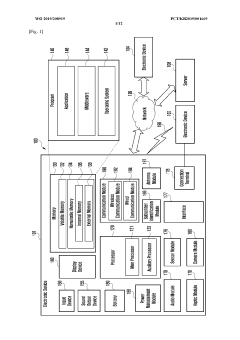
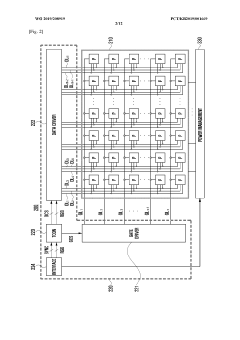
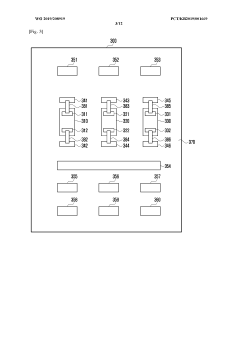
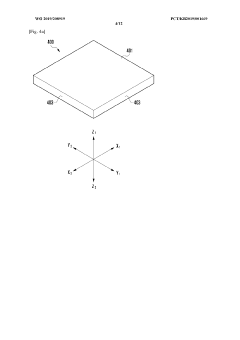
- The development of a micro-LED display with a bezel-less design and segmentation capabilities, allowing for flexible displays of various sizes, achieved through direct mounting of micro-LEDs on a substrate and innovative electrical connections using conductive patterns and wiring lines, enabling robust electrical connections and flexible display configurations.
Supply Chain Analysis for Display Manufacturing
The display manufacturing supply chain has undergone significant transformation with the emergence of OLED and MicroLED technologies. These advanced display technologies require fundamentally different component sourcing, manufacturing processes, and quality control systems compared to traditional LCD displays.
OLED supply chains are currently more mature, with established players like Samsung Display, LG Display, and BOE dominating production capacity. The OLED manufacturing ecosystem involves specialized materials suppliers providing organic compounds, thin-film transistor (TFT) backplanes, and encapsulation materials. Key raw materials include organic light-emitting materials, indium tin oxide (ITO), and flexible substrates for newer applications. The supply chain has gradually expanded globally, though South Korea and China remain the primary manufacturing hubs.
MicroLED represents a more disruptive shift in supply chain dynamics, requiring new specialized equipment and materials. The technology demands ultra-precise manufacturing capabilities for producing microscopic LED chips at scale. Current MicroLED supply chains are less consolidated, with companies like Apple, Samsung, and Sony investing heavily in developing proprietary manufacturing processes. The mass transfer process—moving millions of tiny LED chips to display substrates—remains a critical bottleneck requiring specialized equipment providers.
Component availability presents contrasting challenges for both technologies. OLED faces periodic shortages of high-quality organic materials and specialized thin-film encapsulation solutions. MicroLED supply chains struggle with consistent production of uniform micro-scale LED chips and reliable mass transfer equipment. These constraints directly impact production capacity and market adoption timelines.
Regional dependencies also differ significantly. OLED manufacturing remains concentrated in East Asia, with South Korea leading in high-end displays and China rapidly expanding capacity for mid-range applications. MicroLED production capabilities are emerging in more diverse locations, including North America and Europe, as new entrants develop specialized manufacturing techniques.
The transition toward these advanced display technologies is reshaping supplier relationships throughout the electronics industry. Traditional LCD component suppliers must adapt or risk obsolescence, while specialized materials and equipment providers for OLED and MicroLED gain strategic importance. This evolution creates both opportunities and challenges for display manufacturers seeking to secure reliable supply chains while managing the higher costs associated with these premium display technologies.
OLED supply chains are currently more mature, with established players like Samsung Display, LG Display, and BOE dominating production capacity. The OLED manufacturing ecosystem involves specialized materials suppliers providing organic compounds, thin-film transistor (TFT) backplanes, and encapsulation materials. Key raw materials include organic light-emitting materials, indium tin oxide (ITO), and flexible substrates for newer applications. The supply chain has gradually expanded globally, though South Korea and China remain the primary manufacturing hubs.
MicroLED represents a more disruptive shift in supply chain dynamics, requiring new specialized equipment and materials. The technology demands ultra-precise manufacturing capabilities for producing microscopic LED chips at scale. Current MicroLED supply chains are less consolidated, with companies like Apple, Samsung, and Sony investing heavily in developing proprietary manufacturing processes. The mass transfer process—moving millions of tiny LED chips to display substrates—remains a critical bottleneck requiring specialized equipment providers.
Component availability presents contrasting challenges for both technologies. OLED faces periodic shortages of high-quality organic materials and specialized thin-film encapsulation solutions. MicroLED supply chains struggle with consistent production of uniform micro-scale LED chips and reliable mass transfer equipment. These constraints directly impact production capacity and market adoption timelines.
Regional dependencies also differ significantly. OLED manufacturing remains concentrated in East Asia, with South Korea leading in high-end displays and China rapidly expanding capacity for mid-range applications. MicroLED production capabilities are emerging in more diverse locations, including North America and Europe, as new entrants develop specialized manufacturing techniques.
The transition toward these advanced display technologies is reshaping supplier relationships throughout the electronics industry. Traditional LCD component suppliers must adapt or risk obsolescence, while specialized materials and equipment providers for OLED and MicroLED gain strategic importance. This evolution creates both opportunities and challenges for display manufacturers seeking to secure reliable supply chains while managing the higher costs associated with these premium display technologies.
Environmental Impact and Sustainability Considerations
The environmental footprint of display manufacturing has become increasingly significant as consumer electronics proliferate globally. OLED and MicroLED technologies represent fundamentally different approaches to sustainability challenges in the display industry. OLED manufacturing processes typically consume less energy during production compared to traditional LCD manufacturing, but the organic materials used in OLEDs present unique end-of-life challenges due to their chemical composition and degradation properties.
MicroLED manufacturing, while currently more energy-intensive during production phases, offers promising long-term sustainability benefits. The inorganic materials used in MicroLED displays are generally more recyclable and contain fewer potentially hazardous substances than the organic compounds in OLEDs. Additionally, the exceptional longevity of MicroLED displays—potentially lasting decades rather than years—significantly reduces electronic waste generation over time.
Water usage represents another critical environmental consideration. OLED manufacturing processes have gradually improved water efficiency, but still require substantial quantities for cleaning and chemical processes. MicroLED production currently demands higher water usage during the complex transfer processes, though emerging techniques aim to reduce this requirement substantially.
Resource efficiency varies significantly between these technologies. OLED displays utilize rare elements including iridium and platinum in their phosphorescent compounds, raising concerns about resource scarcity and extraction impacts. MicroLED technology relies on gallium nitride and other semiconductor materials that, while not without environmental impact, generally present fewer resource constraints and extraction challenges.
Energy consumption during device operation strongly favors both technologies compared to conventional displays, but with important distinctions. OLEDs demonstrate excellent efficiency when displaying darker content due to their emissive nature, while MicroLEDs maintain superior efficiency across all brightness levels, potentially reducing lifetime energy consumption by 20-30% compared to OLEDs for equivalent display applications.
Carbon footprint assessments across the full lifecycle reveal that manufacturing emissions currently favor OLED technology due to its more established production infrastructure. However, the extended operational lifespan of MicroLED displays creates a compelling long-term carbon advantage when amortized over the product lifetime. Industry projections suggest MicroLED displays could reduce overall lifecycle carbon emissions by up to 40% compared to current display technologies when manufacturing processes reach full maturity and scale.
MicroLED manufacturing, while currently more energy-intensive during production phases, offers promising long-term sustainability benefits. The inorganic materials used in MicroLED displays are generally more recyclable and contain fewer potentially hazardous substances than the organic compounds in OLEDs. Additionally, the exceptional longevity of MicroLED displays—potentially lasting decades rather than years—significantly reduces electronic waste generation over time.
Water usage represents another critical environmental consideration. OLED manufacturing processes have gradually improved water efficiency, but still require substantial quantities for cleaning and chemical processes. MicroLED production currently demands higher water usage during the complex transfer processes, though emerging techniques aim to reduce this requirement substantially.
Resource efficiency varies significantly between these technologies. OLED displays utilize rare elements including iridium and platinum in their phosphorescent compounds, raising concerns about resource scarcity and extraction impacts. MicroLED technology relies on gallium nitride and other semiconductor materials that, while not without environmental impact, generally present fewer resource constraints and extraction challenges.
Energy consumption during device operation strongly favors both technologies compared to conventional displays, but with important distinctions. OLEDs demonstrate excellent efficiency when displaying darker content due to their emissive nature, while MicroLEDs maintain superior efficiency across all brightness levels, potentially reducing lifetime energy consumption by 20-30% compared to OLEDs for equivalent display applications.
Carbon footprint assessments across the full lifecycle reveal that manufacturing emissions currently favor OLED technology due to its more established production infrastructure. However, the extended operational lifespan of MicroLED displays creates a compelling long-term carbon advantage when amortized over the product lifetime. Industry projections suggest MicroLED displays could reduce overall lifecycle carbon emissions by up to 40% compared to current display technologies when manufacturing processes reach full maturity and scale.
Unlock deeper insights with PatSnap Eureka Quick Research — get a full tech report to explore trends and direct your research. Try now!
Generate Your Research Report Instantly with AI Agent
Supercharge your innovation with PatSnap Eureka AI Agent Platform!