Microinjection Molding in Aerospace: Challenges and Solutions
OCT 15, 202510 MIN READ
Generate Your Research Report Instantly with AI Agent
PatSnap Eureka helps you evaluate technical feasibility & market potential.
Aerospace Microinjection Molding Background and Objectives
Microinjection molding technology has evolved significantly since its inception in the 1980s, transitioning from a niche manufacturing process to a critical technology in various high-precision industries. In aerospace applications, this evolution has been particularly pronounced over the past decade, with increasing demands for miniaturized components that maintain exceptional mechanical properties and dimensional accuracy under extreme operating conditions.
The aerospace industry's shift toward lighter, more fuel-efficient aircraft and spacecraft has accelerated the adoption of microinjection molding techniques. This manufacturing process enables the production of complex, lightweight polymer and ceramic components with microscale features, often replacing traditional metal parts while offering significant weight reduction advantages. The historical trajectory shows a steady improvement in material capabilities, processing precision, and quality control methodologies.
Current technological trends in aerospace microinjection molding focus on multi-material capabilities, enhanced surface finishes, and integration with other manufacturing processes such as 3D printing and micro-assembly techniques. The convergence of these technologies is creating new possibilities for component design and functionality that were previously unattainable.
The primary technical objectives for advancing microinjection molding in aerospace applications include developing new high-performance polymer composites capable of withstanding extreme temperature fluctuations and radiation exposure. Additionally, there is a pressing need to improve process repeatability and quality assurance methods to meet the stringent certification requirements of aerospace components.
Another critical objective involves enhancing simulation and modeling capabilities to predict material behavior during the molding process and subsequent service life. This predictive capability is essential for reducing development cycles and ensuring component reliability in mission-critical applications.
The integration of smart materials and embedded sensors within microinjected components represents an emerging frontier, with objectives centered on creating multifunctional parts that can provide real-time performance data and respond to environmental changes. This development path aligns with the broader aerospace industry trend toward more intelligent, adaptive systems.
Research efforts are also directed toward improving the sustainability aspects of microinjection molding, including the development of bio-based and recyclable high-performance polymers suitable for aerospace applications. This environmental consideration is becoming increasingly important as the industry faces growing pressure to reduce its ecological footprint.
The ultimate goal of these technological advancements is to establish microinjection molding as a cornerstone manufacturing process for next-generation aerospace systems, enabling unprecedented levels of miniaturization, integration, and performance while maintaining the reliability standards essential for flight safety.
The aerospace industry's shift toward lighter, more fuel-efficient aircraft and spacecraft has accelerated the adoption of microinjection molding techniques. This manufacturing process enables the production of complex, lightweight polymer and ceramic components with microscale features, often replacing traditional metal parts while offering significant weight reduction advantages. The historical trajectory shows a steady improvement in material capabilities, processing precision, and quality control methodologies.
Current technological trends in aerospace microinjection molding focus on multi-material capabilities, enhanced surface finishes, and integration with other manufacturing processes such as 3D printing and micro-assembly techniques. The convergence of these technologies is creating new possibilities for component design and functionality that were previously unattainable.
The primary technical objectives for advancing microinjection molding in aerospace applications include developing new high-performance polymer composites capable of withstanding extreme temperature fluctuations and radiation exposure. Additionally, there is a pressing need to improve process repeatability and quality assurance methods to meet the stringent certification requirements of aerospace components.
Another critical objective involves enhancing simulation and modeling capabilities to predict material behavior during the molding process and subsequent service life. This predictive capability is essential for reducing development cycles and ensuring component reliability in mission-critical applications.
The integration of smart materials and embedded sensors within microinjected components represents an emerging frontier, with objectives centered on creating multifunctional parts that can provide real-time performance data and respond to environmental changes. This development path aligns with the broader aerospace industry trend toward more intelligent, adaptive systems.
Research efforts are also directed toward improving the sustainability aspects of microinjection molding, including the development of bio-based and recyclable high-performance polymers suitable for aerospace applications. This environmental consideration is becoming increasingly important as the industry faces growing pressure to reduce its ecological footprint.
The ultimate goal of these technological advancements is to establish microinjection molding as a cornerstone manufacturing process for next-generation aerospace systems, enabling unprecedented levels of miniaturization, integration, and performance while maintaining the reliability standards essential for flight safety.
Market Demand Analysis for Aerospace Microinjection Components
The aerospace industry is witnessing a significant shift towards miniaturization and lightweight components, driving substantial demand for microinjection molded parts. Market research indicates that the global aerospace microinjection molding market is projected to grow at a compound annual growth rate of 11.2% from 2023 to 2030, reaching a market value of 2.7 billion USD by the end of the forecast period. This growth is primarily fueled by the increasing adoption of complex, lightweight components in modern aircraft design.
Key demand drivers include the need for fuel efficiency improvements, which necessitates weight reduction across all aircraft systems. Each kilogram of weight saved translates to approximately 3,900 USD in fuel savings over an aircraft's lifetime, creating a compelling economic case for microinjection molded components that can be up to 70% lighter than their metal counterparts.
The commercial aviation segment currently represents the largest market share at 45%, followed by military applications at 30% and space systems at 25%. However, the space systems segment is expected to demonstrate the highest growth rate due to increasing satellite deployments and private space ventures requiring highly specialized, lightweight components capable of withstanding extreme conditions.
Geographically, North America dominates the market with 38% share, followed by Europe at 32% and Asia-Pacific at 22%. The Asia-Pacific region, particularly China and India, is anticipated to exhibit the fastest growth due to expanding aerospace manufacturing capabilities and increasing defense budgets.
Specific high-demand microinjection molded components include fluid handling systems, electrical connectors, sensor housings, and structural brackets. These components require exceptional dimensional precision, with tolerances often below 10 micrometers, and must maintain performance integrity under extreme temperature variations from -65°C to 260°C.
Customer requirements are increasingly focused on multi-material capabilities, with 65% of aerospace manufacturers expressing interest in components combining high-performance polymers with metal inserts or reinforcement materials. Additionally, there is growing demand for components with integrated functionality, such as embedded sensors or conductive pathways, which can reduce assembly steps and enhance reliability.
Supply chain considerations are becoming more critical, with aerospace OEMs seeking suppliers capable of providing complete solutions from design to manufacturing. This trend is driving consolidation among specialized microinjection molding providers, with tier-one suppliers expanding their capabilities through strategic acquisitions and partnerships to meet the comprehensive needs of aerospace customers.
Key demand drivers include the need for fuel efficiency improvements, which necessitates weight reduction across all aircraft systems. Each kilogram of weight saved translates to approximately 3,900 USD in fuel savings over an aircraft's lifetime, creating a compelling economic case for microinjection molded components that can be up to 70% lighter than their metal counterparts.
The commercial aviation segment currently represents the largest market share at 45%, followed by military applications at 30% and space systems at 25%. However, the space systems segment is expected to demonstrate the highest growth rate due to increasing satellite deployments and private space ventures requiring highly specialized, lightweight components capable of withstanding extreme conditions.
Geographically, North America dominates the market with 38% share, followed by Europe at 32% and Asia-Pacific at 22%. The Asia-Pacific region, particularly China and India, is anticipated to exhibit the fastest growth due to expanding aerospace manufacturing capabilities and increasing defense budgets.
Specific high-demand microinjection molded components include fluid handling systems, electrical connectors, sensor housings, and structural brackets. These components require exceptional dimensional precision, with tolerances often below 10 micrometers, and must maintain performance integrity under extreme temperature variations from -65°C to 260°C.
Customer requirements are increasingly focused on multi-material capabilities, with 65% of aerospace manufacturers expressing interest in components combining high-performance polymers with metal inserts or reinforcement materials. Additionally, there is growing demand for components with integrated functionality, such as embedded sensors or conductive pathways, which can reduce assembly steps and enhance reliability.
Supply chain considerations are becoming more critical, with aerospace OEMs seeking suppliers capable of providing complete solutions from design to manufacturing. This trend is driving consolidation among specialized microinjection molding providers, with tier-one suppliers expanding their capabilities through strategic acquisitions and partnerships to meet the comprehensive needs of aerospace customers.
Technical Challenges and Limitations in Aerospace Microinjection Molding
Despite significant advancements in microinjection molding technology, its application in aerospace faces substantial technical challenges. The extreme operating conditions of aerospace components demand exceptional precision and reliability that push the boundaries of current manufacturing capabilities. The primary limitation stems from the microscale dimensions required for aerospace applications, typically ranging from 10-1000 micrometers, which necessitate extraordinary tooling precision and process control beyond conventional injection molding parameters.
Material selection presents another critical challenge. Aerospace-grade polymers and composites must withstand extreme temperature fluctuations (-65°C to +150°C), radiation exposure, and vacuum conditions while maintaining dimensional stability. High-performance polymers like PEEK, PEI, and specialized composites offer suitable properties but exhibit complex flow behaviors at the microscale, leading to unpredictable shrinkage and warpage that compromise part accuracy.
Tool design and fabrication represent significant technical hurdles. Creating mold cavities with micro-features requires advanced manufacturing techniques such as micro-EDM, laser ablation, or LIGA processes. These tools must maintain tolerances within ±1-3 micrometers while withstanding thousands of high-pressure injection cycles without degradation. The high aspect ratios of aerospace micro-components (often exceeding 10:1) further complicate mold design and increase the risk of incomplete filling.
Process control limitations significantly impact production consistency. The rapid cooling rates at the microscale (often less than 0.1 seconds) create extremely narrow processing windows. Variables including injection speed, pressure profiles, and melt temperature must be controlled with unprecedented precision. Current sensor technology struggles to provide real-time feedback at this scale, making closed-loop control systems inadequate for ensuring part-to-part consistency.
Quality assurance presents unique challenges as conventional inspection methods lack sufficient resolution for microscale features. Non-destructive testing techniques must be adapted to verify internal structures without compromising the integrity of delicate components. Additionally, the detection of micro-defects such as voids (smaller than 5 micrometers) or molecular orientation anomalies requires specialized equipment not widely available in production environments.
Scalability remains problematic for aerospace applications, where production volumes are typically lower than consumer electronics but quality requirements are substantially higher. The significant investment in specialized equipment and expertise creates economic barriers that limit widespread adoption. Furthermore, the aerospace industry's stringent certification requirements demand extensive validation testing and documentation that can extend development timelines by 200-300% compared to non-aerospace applications.
Material selection presents another critical challenge. Aerospace-grade polymers and composites must withstand extreme temperature fluctuations (-65°C to +150°C), radiation exposure, and vacuum conditions while maintaining dimensional stability. High-performance polymers like PEEK, PEI, and specialized composites offer suitable properties but exhibit complex flow behaviors at the microscale, leading to unpredictable shrinkage and warpage that compromise part accuracy.
Tool design and fabrication represent significant technical hurdles. Creating mold cavities with micro-features requires advanced manufacturing techniques such as micro-EDM, laser ablation, or LIGA processes. These tools must maintain tolerances within ±1-3 micrometers while withstanding thousands of high-pressure injection cycles without degradation. The high aspect ratios of aerospace micro-components (often exceeding 10:1) further complicate mold design and increase the risk of incomplete filling.
Process control limitations significantly impact production consistency. The rapid cooling rates at the microscale (often less than 0.1 seconds) create extremely narrow processing windows. Variables including injection speed, pressure profiles, and melt temperature must be controlled with unprecedented precision. Current sensor technology struggles to provide real-time feedback at this scale, making closed-loop control systems inadequate for ensuring part-to-part consistency.
Quality assurance presents unique challenges as conventional inspection methods lack sufficient resolution for microscale features. Non-destructive testing techniques must be adapted to verify internal structures without compromising the integrity of delicate components. Additionally, the detection of micro-defects such as voids (smaller than 5 micrometers) or molecular orientation anomalies requires specialized equipment not widely available in production environments.
Scalability remains problematic for aerospace applications, where production volumes are typically lower than consumer electronics but quality requirements are substantially higher. The significant investment in specialized equipment and expertise creates economic barriers that limit widespread adoption. Furthermore, the aerospace industry's stringent certification requirements demand extensive validation testing and documentation that can extend development timelines by 200-300% compared to non-aerospace applications.
Current Technical Solutions for Aerospace Microinjection Challenges
01 Equipment and apparatus for microinjection molding
Specialized equipment and apparatus are essential for microinjection molding processes. These include precision molds, micro-scale injection units, and advanced control systems that enable the accurate formation of microscopic components. The equipment often features high-precision positioning mechanisms, specialized heating elements, and monitoring systems to ensure dimensional accuracy and quality in the final molded products.- Microinjection molding equipment and machinery: Specialized equipment and machinery designed specifically for microinjection molding processes. These include precision injection molding machines with advanced control systems, micro-molds with high accuracy features, and auxiliary equipment that enables the production of microscale components. The equipment is characterized by high precision, stability, and the ability to handle small shot sizes with tight tolerances.
- Materials for microinjection molding: Various materials specifically formulated or selected for microinjection molding applications. These include specialized polymers, biocompatible materials, high-performance thermoplastics, and composite materials that exhibit suitable flow properties at the microscale. The materials are engineered to maintain dimensional stability, achieve complete mold filling at the micro level, and provide the required mechanical, optical, or biological properties in the final microparts.
- Biomedical applications of microinjection molding: Implementation of microinjection molding technology in biomedical fields, including the production of medical devices, drug delivery systems, microfluidic chips, and diagnostic tools. This approach enables the fabrication of miniaturized components with biocompatible materials that can interact with biological systems at the cellular or molecular level, supporting advancements in personalized medicine, point-of-care diagnostics, and minimally invasive treatments.
- Process optimization for microinjection molding: Techniques and methodologies for optimizing the microinjection molding process to achieve higher precision, better repeatability, and improved part quality. This includes parameter optimization (temperature, pressure, injection speed), simulation-based process design, real-time monitoring systems, and advanced control strategies. These optimizations address common challenges in microinjection molding such as incomplete filling, premature solidification, and part ejection difficulties.
- Microstructure fabrication techniques: Specialized techniques for creating microstructures and surface features through microinjection molding. These include approaches for producing high-aspect-ratio features, micro-texturing, hierarchical structures, and functional surfaces. The techniques often combine microinjection molding with complementary processes such as insert molding, multi-material molding, or post-processing methods to achieve complex geometries and enhanced surface properties at the microscale.
02 Materials for microinjection molding
Various materials are used in microinjection molding processes, including specialized polymers, biocompatible materials, and composite materials. These materials are selected based on their flow properties, mechanical strength, and suitability for specific applications. The choice of material significantly impacts the molding parameters, product quality, and final performance characteristics of the micro-molded components.Expand Specific Solutions03 Biomedical applications of microinjection molding
Microinjection molding has significant applications in the biomedical field, including the production of medical devices, drug delivery systems, and diagnostic tools. The technology enables the creation of precise microstructures for cell culture, tissue engineering, and microfluidic devices. These applications benefit from the ability to produce small, complex components with high precision and reproducibility.Expand Specific Solutions04 Process optimization for microinjection molding
Optimizing the microinjection molding process involves controlling various parameters such as injection pressure, temperature, cooling rate, and cycle time. Advanced techniques include simulation-based optimization, statistical process control, and real-time monitoring systems. These optimization strategies aim to improve product quality, reduce cycle times, minimize material waste, and enhance overall production efficiency.Expand Specific Solutions05 Innovations in mold design for microinjection molding
Innovative mold designs are crucial for successful microinjection molding. These include advanced micro-cavity designs, novel gating systems, and precision venting mechanisms. Recent innovations focus on reducing cycle times, improving part ejection, enhancing surface finish, and enabling the production of increasingly complex microstructures. These advancements in mold design contribute to the expanding capabilities and applications of microinjection molding technology.Expand Specific Solutions
Leading Companies and Research Institutions in Aerospace Microinjection
Microinjection molding in aerospace is currently in a growth phase, with increasing demand for miniaturized components driving market expansion. The global market is projected to reach significant value as aerospace applications require higher precision and reliability. The technology maturity varies across players, with established companies like Toyota Motor Corp., Fujitsu Ltd., and 3M Innovative Properties Co. leading innovation through advanced research capabilities. Specialized manufacturers such as Nissei Plastic Industrial, Trexel, Inc., and KraussMaffei Technologies are developing aerospace-specific solutions addressing material challenges and process control. Academic institutions like Georgia Tech Research Corp. and Harbin Institute of Technology are contributing fundamental research to overcome technical barriers in high-performance aerospace applications, particularly in extreme environment resistance and dimensional stability.
Trexel, Inc.
Technical Solution: Trexel has pioneered the MuCell® Microcellular Foam technology, which they've adapted specifically for aerospace microinjection molding applications. This process involves the precise introduction of supercritical fluid (typically nitrogen or carbon dioxide) into the polymer melt during injection, creating a controlled microcellular structure with cell sizes in the 5-50 micron range. For aerospace applications, Trexel has refined this technology to work with high-performance polymers like PEEK, PEI, and PPS, which are critical for high-temperature environments. Their process significantly reduces part weight while maintaining mechanical integrity, addressing the aerospace industry's constant demand for weight reduction. Trexel's technology also incorporates specialized control algorithms that adjust gas dosing based on part geometry and material characteristics, ensuring consistent cell structure throughout complex components. The company has developed specialized nozzle designs that prevent premature foaming and ensure precise material distribution in micro-featured molds. Additionally, their process reduces internal stresses in molded parts, which is particularly valuable for aerospace components that must maintain dimensional stability under varying environmental conditions.
Strengths: Significant weight reduction (typically 5-15%) without compromising mechanical properties; lower injection pressures and clamping forces that reduce tool wear and enable the use of smaller injection molding machines. Weaknesses: More complex process control requirements compared to conventional injection molding; potential surface quality challenges that may require additional finishing operations for certain aerospace applications.
Ford Global Technologies LLC
Technical Solution: Ford has developed advanced microinjection molding techniques specifically for aerospace applications, focusing on lightweight composite components. Their proprietary process combines high-precision injection molding with specialized polymer blends that incorporate carbon nanotubes and ceramic particles to enhance mechanical properties. Ford's approach addresses the thermal stability challenges in aerospace by utilizing multi-stage temperature control systems during the molding process, allowing for precise manipulation of crystallization behavior in high-performance polymers. The company has also pioneered micro-feature replication techniques capable of producing surface structures at the 5-10 micron scale with exceptional repeatability, which is critical for aerodynamic performance components. Their integrated quality control system employs in-mold sensors that provide real-time feedback on material flow, pressure distribution, and cooling rates, enabling adaptive process control to maintain dimensional stability across production runs.
Strengths: Superior material science expertise allowing for custom polymer formulations specifically designed for extreme aerospace environments; advanced process monitoring capabilities that significantly reduce defect rates compared to conventional methods. Weaknesses: Higher production costs compared to traditional manufacturing methods; limited scalability for very large aerospace components requiring specialized equipment modifications.
Key Patents and Innovations in Aerospace Microinjection Molding
Method for injection moulding shaped parts from plastics
PatentWO2002051612A1
Innovation
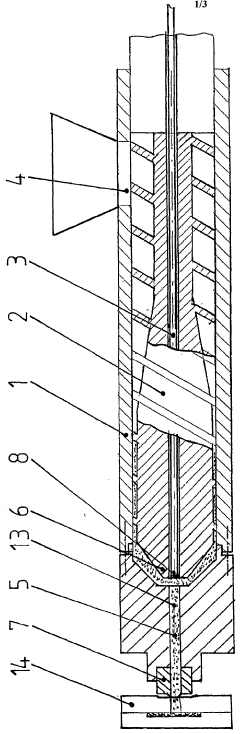
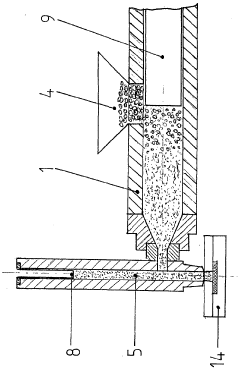
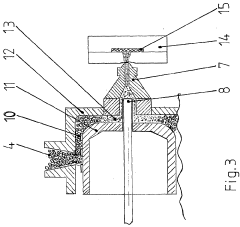
- The method involves injecting the melt directly into the mold using a gaseous or liquid medium, eliminating the need for mechanically movable assemblies and allowing for a sprue-free production with improved stability and reduced cooling time, applicable to various injection molding machines with different plasticizing and injection devices.
Material Science Advancements for Aerospace Microinjection Applications
Recent advancements in material science have revolutionized the field of microinjection molding for aerospace applications. The development of high-performance polymers with enhanced thermal stability, mechanical strength, and chemical resistance has significantly expanded the potential applications of microinjection molded components in aerospace systems. Materials such as PEEK (Polyether Ether Ketone), PEI (Polyetherimide), and LCP (Liquid Crystal Polymer) have emerged as frontrunners due to their exceptional properties under extreme conditions.
Nano-reinforced composites represent another breakthrough, incorporating carbon nanotubes, graphene, and ceramic nanoparticles to dramatically improve the mechanical properties of base polymers. These reinforcements enable weight reduction while maintaining or enhancing structural integrity, a critical factor in aerospace applications where every gram matters. Research indicates that carbon nanotube reinforced PEEK can achieve up to 40% improvement in tensile strength compared to standard formulations.
Metal-polymer hybrid materials have also gained significant attention, combining the lightweight characteristics of polymers with the superior mechanical properties of metals. These materials facilitate the production of complex geometries with embedded metallic features, addressing the multifunctional requirements of aerospace components. The interface between metal and polymer phases has been optimized through novel surface treatment techniques and coupling agents.
Biodegradable and sustainable materials are increasingly being explored for non-critical aerospace applications. Bio-based polymers derived from renewable resources offer reduced environmental impact while meeting specific performance requirements. Though currently limited in high-stress applications, ongoing research suggests potential for broader implementation in the near future.
Smart materials with self-healing capabilities and embedded sensors represent the cutting edge of material science for aerospace microinjection applications. These materials can detect damage, monitor structural health, and in some cases, repair minor defects autonomously. Piezoelectric polymers and shape memory materials enable components that can adapt to changing environmental conditions, enhancing reliability and longevity.
Processing technologies have evolved in parallel with material advancements. Techniques such as in-mold decoration, multi-material injection, and gas-assisted injection molding enable the production of increasingly complex components with enhanced functionality. The integration of these processing innovations with advanced materials has opened new possibilities for miniaturized aerospace systems.
Thermal management materials specifically designed for microinjection molding have addressed one of the most significant challenges in aerospace applications. Thermally conductive polymers with tailored heat dissipation properties ensure reliable operation of electronic components in confined spaces, where traditional cooling methods are impractical.
Nano-reinforced composites represent another breakthrough, incorporating carbon nanotubes, graphene, and ceramic nanoparticles to dramatically improve the mechanical properties of base polymers. These reinforcements enable weight reduction while maintaining or enhancing structural integrity, a critical factor in aerospace applications where every gram matters. Research indicates that carbon nanotube reinforced PEEK can achieve up to 40% improvement in tensile strength compared to standard formulations.
Metal-polymer hybrid materials have also gained significant attention, combining the lightweight characteristics of polymers with the superior mechanical properties of metals. These materials facilitate the production of complex geometries with embedded metallic features, addressing the multifunctional requirements of aerospace components. The interface between metal and polymer phases has been optimized through novel surface treatment techniques and coupling agents.
Biodegradable and sustainable materials are increasingly being explored for non-critical aerospace applications. Bio-based polymers derived from renewable resources offer reduced environmental impact while meeting specific performance requirements. Though currently limited in high-stress applications, ongoing research suggests potential for broader implementation in the near future.
Smart materials with self-healing capabilities and embedded sensors represent the cutting edge of material science for aerospace microinjection applications. These materials can detect damage, monitor structural health, and in some cases, repair minor defects autonomously. Piezoelectric polymers and shape memory materials enable components that can adapt to changing environmental conditions, enhancing reliability and longevity.
Processing technologies have evolved in parallel with material advancements. Techniques such as in-mold decoration, multi-material injection, and gas-assisted injection molding enable the production of increasingly complex components with enhanced functionality. The integration of these processing innovations with advanced materials has opened new possibilities for miniaturized aerospace systems.
Thermal management materials specifically designed for microinjection molding have addressed one of the most significant challenges in aerospace applications. Thermally conductive polymers with tailored heat dissipation properties ensure reliable operation of electronic components in confined spaces, where traditional cooling methods are impractical.
Quality Control and Certification Standards for Aerospace Components
Quality control and certification standards represent critical components in the aerospace manufacturing ecosystem, particularly for microinjection molded parts where precision and reliability are paramount. The aerospace industry operates under stringent regulatory frameworks established by authorities such as the Federal Aviation Administration (FAA), European Union Aviation Safety Agency (EASA), and International Organization for Standardization (ISO). These frameworks mandate comprehensive quality management systems that govern the entire production lifecycle of aerospace components.
For microinjection molded aerospace parts, AS9100 certification serves as the foundational quality management standard, extending ISO 9001 requirements with aerospace-specific provisions. This certification demands rigorous documentation, traceability systems, and risk management protocols throughout the manufacturing process. Manufacturers must implement statistical process control (SPC) methodologies to monitor critical parameters such as dimensional accuracy, material consistency, and surface finish quality.
Non-destructive testing (NDT) techniques play a vital role in quality assurance for microinjection molded components. These include X-ray computed tomography (CT) scanning, which enables inspection of internal features without damaging the part, ultrasonic testing for detecting subsurface defects, and optical coordinate measuring machines (CMMs) for precise dimensional verification. These technologies have evolved to accommodate the microscale features characteristic of aerospace microinjection molded parts.
Material certification represents another critical aspect of quality control. Raw materials must be accompanied by certificates of analysis (CoA) verifying chemical composition, mechanical properties, and batch traceability. For high-performance polymers used in aerospace applications, additional testing for thermal stability, outgassing characteristics, and radiation resistance may be required. Material suppliers must maintain aerospace-approved status through regular audits and compliance verification.
First article inspection (FAI) procedures are mandatory for new aerospace components, requiring comprehensive documentation and verification of all design characteristics. For microinjection molded parts, this includes validation of microscale features, material properties, and performance under simulated operating conditions. The FAI process typically involves collaboration between manufacturers, third-party inspection services, and regulatory authorities.
Supplier qualification programs constitute another layer of quality assurance. Aerospace OEMs implement rigorous assessment protocols for microinjection molding suppliers, evaluating technical capabilities, quality management systems, and financial stability. Approved suppliers undergo periodic requalification and must demonstrate continuous improvement in manufacturing processes and quality metrics.
The emergence of Industry 4.0 technologies has transformed quality control in aerospace microinjection molding. Real-time monitoring systems, machine learning algorithms for defect prediction, and digital twin simulations enable proactive quality management rather than reactive inspection. These advanced technologies help manufacturers achieve the six-sigma quality levels increasingly demanded by aerospace customers.
For microinjection molded aerospace parts, AS9100 certification serves as the foundational quality management standard, extending ISO 9001 requirements with aerospace-specific provisions. This certification demands rigorous documentation, traceability systems, and risk management protocols throughout the manufacturing process. Manufacturers must implement statistical process control (SPC) methodologies to monitor critical parameters such as dimensional accuracy, material consistency, and surface finish quality.
Non-destructive testing (NDT) techniques play a vital role in quality assurance for microinjection molded components. These include X-ray computed tomography (CT) scanning, which enables inspection of internal features without damaging the part, ultrasonic testing for detecting subsurface defects, and optical coordinate measuring machines (CMMs) for precise dimensional verification. These technologies have evolved to accommodate the microscale features characteristic of aerospace microinjection molded parts.
Material certification represents another critical aspect of quality control. Raw materials must be accompanied by certificates of analysis (CoA) verifying chemical composition, mechanical properties, and batch traceability. For high-performance polymers used in aerospace applications, additional testing for thermal stability, outgassing characteristics, and radiation resistance may be required. Material suppliers must maintain aerospace-approved status through regular audits and compliance verification.
First article inspection (FAI) procedures are mandatory for new aerospace components, requiring comprehensive documentation and verification of all design characteristics. For microinjection molded parts, this includes validation of microscale features, material properties, and performance under simulated operating conditions. The FAI process typically involves collaboration between manufacturers, third-party inspection services, and regulatory authorities.
Supplier qualification programs constitute another layer of quality assurance. Aerospace OEMs implement rigorous assessment protocols for microinjection molding suppliers, evaluating technical capabilities, quality management systems, and financial stability. Approved suppliers undergo periodic requalification and must demonstrate continuous improvement in manufacturing processes and quality metrics.
The emergence of Industry 4.0 technologies has transformed quality control in aerospace microinjection molding. Real-time monitoring systems, machine learning algorithms for defect prediction, and digital twin simulations enable proactive quality management rather than reactive inspection. These advanced technologies help manufacturers achieve the six-sigma quality levels increasingly demanded by aerospace customers.
Unlock deeper insights with PatSnap Eureka Quick Research — get a full tech report to explore trends and direct your research. Try now!
Generate Your Research Report Instantly with AI Agent
Supercharge your innovation with PatSnap Eureka AI Agent Platform!