OLED vs MicroLED: Emerging Applications in Robotics
OCT 24, 20259 MIN READ
Generate Your Research Report Instantly with AI Agent
Patsnap Eureka helps you evaluate technical feasibility & market potential.
Display Technology Evolution and Objectives
Display technology has undergone remarkable evolution since the introduction of cathode ray tubes (CRTs) in the early 20th century. The progression from CRTs to liquid crystal displays (LCDs) marked the first major shift toward flatter, more energy-efficient screens. This evolution continued with the development of plasma displays in the 1990s, followed by the emergence of organic light-emitting diode (OLED) technology in the early 2000s, which revolutionized display capabilities with perfect blacks, vibrant colors, and flexible form factors.
The current technological landscape is witnessing a pivotal transition as MicroLED technology emerges as a potential successor to OLED. MicroLED displays utilize microscopic LED arrays that are self-emissive, similar to OLED, but offer significant advantages in brightness, longevity, and energy efficiency. This technological progression is particularly relevant for robotics applications, where display requirements often extend beyond conventional consumer electronics needs.
In robotics, displays serve multiple critical functions: user interfaces for human-robot interaction, status indicators, information visualization, and increasingly, as components of robot "faces" for social robots. The evolution from traditional displays to advanced OLED and MicroLED technologies enables robots to communicate more effectively with humans through higher resolution, better visibility in various lighting conditions, and more expressive capabilities.
The technical objectives driving display technology development for robotics applications include: minimizing power consumption to extend battery life; enhancing durability to withstand industrial or field environments; improving visibility across diverse lighting conditions from direct sunlight to complete darkness; reducing weight and thickness to accommodate space constraints in robot design; and enabling flexible or curved form factors to conform to non-planar robot surfaces.
OLED technology initially gained traction in robotics due to its thin profile, flexibility, and excellent color reproduction. However, limitations in brightness, burn-in susceptibility, and lifespan have constrained its application in certain robotics contexts. MicroLED technology addresses many of these limitations while introducing new capabilities such as higher brightness (crucial for outdoor robots), better durability, and potentially lower power consumption at high brightness levels.
The trajectory of display technology evolution suggests a future where robotics applications will increasingly leverage the unique advantages of MicroLED displays, particularly for autonomous mobile robots operating in variable environments, collaborative robots working alongside humans in industrial settings, and social robots requiring expressive interfaces. This technological shift aligns with broader trends toward more capable, versatile, and interactive robotic systems across consumer, commercial, and industrial domains.
The current technological landscape is witnessing a pivotal transition as MicroLED technology emerges as a potential successor to OLED. MicroLED displays utilize microscopic LED arrays that are self-emissive, similar to OLED, but offer significant advantages in brightness, longevity, and energy efficiency. This technological progression is particularly relevant for robotics applications, where display requirements often extend beyond conventional consumer electronics needs.
In robotics, displays serve multiple critical functions: user interfaces for human-robot interaction, status indicators, information visualization, and increasingly, as components of robot "faces" for social robots. The evolution from traditional displays to advanced OLED and MicroLED technologies enables robots to communicate more effectively with humans through higher resolution, better visibility in various lighting conditions, and more expressive capabilities.
The technical objectives driving display technology development for robotics applications include: minimizing power consumption to extend battery life; enhancing durability to withstand industrial or field environments; improving visibility across diverse lighting conditions from direct sunlight to complete darkness; reducing weight and thickness to accommodate space constraints in robot design; and enabling flexible or curved form factors to conform to non-planar robot surfaces.
OLED technology initially gained traction in robotics due to its thin profile, flexibility, and excellent color reproduction. However, limitations in brightness, burn-in susceptibility, and lifespan have constrained its application in certain robotics contexts. MicroLED technology addresses many of these limitations while introducing new capabilities such as higher brightness (crucial for outdoor robots), better durability, and potentially lower power consumption at high brightness levels.
The trajectory of display technology evolution suggests a future where robotics applications will increasingly leverage the unique advantages of MicroLED displays, particularly for autonomous mobile robots operating in variable environments, collaborative robots working alongside humans in industrial settings, and social robots requiring expressive interfaces. This technological shift aligns with broader trends toward more capable, versatile, and interactive robotic systems across consumer, commercial, and industrial domains.
Market Demand Analysis for Robotic Displays
The robotics display market is experiencing significant growth driven by the increasing integration of advanced visual interfaces in robotic systems across multiple sectors. Current market analysis indicates robust demand for high-performance displays in robotics, with particular emphasis on human-robot interaction applications where visual communication is critical. This demand spans across industrial robotics, service robots, healthcare robotics, and consumer robotics segments.
In industrial settings, there is growing recognition of the value that advanced displays bring to collaborative robots (cobots) working alongside human operators. These displays facilitate intuitive communication, status monitoring, and operational guidance, enhancing workplace safety and efficiency. Market research suggests that industrial robotics represents the largest current segment for advanced display integration, with manufacturing and logistics leading adoption.
The service robotics sector demonstrates the fastest growth rate for display technology implementation. Hospitality, retail, and public service robots increasingly rely on displays to engage with customers, provide information, and create personalized experiences. This segment values displays that combine durability with aesthetic appeal, driving demand for both OLED and MicroLED solutions.
Healthcare robotics presents a specialized but high-value market for advanced displays. Surgical robots, patient care assistants, and therapy robots require displays with exceptional color accuracy, reliability, and in some cases, sterilization compatibility. This sector prioritizes image quality and operational longevity over cost considerations, making it particularly receptive to premium display technologies.
Consumer robotics, including educational robots, entertainment robots, and home assistants, represents an expanding market segment with increasing display requirements. These applications typically emphasize energy efficiency, visual appeal, and cost-effectiveness, creating diverse demand profiles across price points.
Market forecasts indicate that display integration in robotics will grow at a compound annual rate exceeding the broader display market, driven by increasing robot deployment across sectors and rising expectations for human-robot interaction capabilities. The transition from basic LCD displays to advanced OLED and emerging MicroLED technologies is accelerating, particularly in premium and specialized applications.
Regional analysis reveals that East Asia leads in robotics display market volume, consistent with the region's dominance in both robotics manufacturing and display technology production. However, North America and Europe show stronger demand for cutting-edge display technologies in specialized robotics applications, particularly in healthcare, defense, and advanced industrial systems.
In industrial settings, there is growing recognition of the value that advanced displays bring to collaborative robots (cobots) working alongside human operators. These displays facilitate intuitive communication, status monitoring, and operational guidance, enhancing workplace safety and efficiency. Market research suggests that industrial robotics represents the largest current segment for advanced display integration, with manufacturing and logistics leading adoption.
The service robotics sector demonstrates the fastest growth rate for display technology implementation. Hospitality, retail, and public service robots increasingly rely on displays to engage with customers, provide information, and create personalized experiences. This segment values displays that combine durability with aesthetic appeal, driving demand for both OLED and MicroLED solutions.
Healthcare robotics presents a specialized but high-value market for advanced displays. Surgical robots, patient care assistants, and therapy robots require displays with exceptional color accuracy, reliability, and in some cases, sterilization compatibility. This sector prioritizes image quality and operational longevity over cost considerations, making it particularly receptive to premium display technologies.
Consumer robotics, including educational robots, entertainment robots, and home assistants, represents an expanding market segment with increasing display requirements. These applications typically emphasize energy efficiency, visual appeal, and cost-effectiveness, creating diverse demand profiles across price points.
Market forecasts indicate that display integration in robotics will grow at a compound annual rate exceeding the broader display market, driven by increasing robot deployment across sectors and rising expectations for human-robot interaction capabilities. The transition from basic LCD displays to advanced OLED and emerging MicroLED technologies is accelerating, particularly in premium and specialized applications.
Regional analysis reveals that East Asia leads in robotics display market volume, consistent with the region's dominance in both robotics manufacturing and display technology production. However, North America and Europe show stronger demand for cutting-edge display technologies in specialized robotics applications, particularly in healthcare, defense, and advanced industrial systems.
OLED vs MicroLED: Technical Challenges
Despite significant advancements in both OLED and MicroLED technologies, their implementation in robotics applications faces several critical technical challenges. For OLED displays, one primary concern is their limited operational lifespan, particularly in high-brightness environments often required in robotics. The organic compounds in OLEDs degrade over time, leading to reduced luminance and color shifts, which can compromise the reliability of robotic visual interfaces.
Power efficiency presents another significant challenge, especially for battery-operated robotic systems. While OLEDs offer better power efficiency than traditional LCDs when displaying darker content, they consume considerably more power when displaying bright content, creating a trade-off that robotics engineers must carefully consider based on specific use cases.
Environmental sensitivity remains problematic for OLED implementation in robotics. The organic materials are susceptible to moisture and oxygen, requiring sophisticated encapsulation techniques that add complexity and cost to manufacturing processes. This vulnerability makes OLEDs potentially less suitable for robots operating in harsh or outdoor environments.
MicroLED technology, while promising superior brightness and longevity, faces its own set of challenges. The manufacturing complexity of MicroLED displays represents a significant hurdle, particularly the mass transfer process of millions of microscopic LEDs onto a substrate with near-perfect yield. Current defect rates in this process contribute to prohibitively high production costs for widespread adoption in robotics.
Thermal management presents another critical challenge for MicroLED integration. The high brightness capabilities of MicroLEDs generate considerable heat, requiring sophisticated thermal dissipation systems that add weight and complexity to robotic designs where space and weight constraints are often paramount considerations.
Color uniformity across large MicroLED arrays remains difficult to achieve, with variations in individual LED performance creating potential inconsistencies in display quality. This challenge is particularly relevant for robotic applications requiring precise visual feedback or human-robot interaction interfaces.
For both technologies, flexibility and form factor adaptation present ongoing challenges. While OLEDs offer inherent flexibility advantages, creating truly conformable displays that can withstand the mechanical stresses of robotic movement requires further material innovation. MicroLEDs, meanwhile, are still developing flexible substrate solutions that maintain electrical connectivity and performance under repeated flexing.
Integration with existing robotic control systems presents additional challenges, as both display technologies require specialized drivers and interfaces that must be compatible with various robotic operating systems and power management schemes. This integration complexity can increase development time and costs for robotics manufacturers.
Power efficiency presents another significant challenge, especially for battery-operated robotic systems. While OLEDs offer better power efficiency than traditional LCDs when displaying darker content, they consume considerably more power when displaying bright content, creating a trade-off that robotics engineers must carefully consider based on specific use cases.
Environmental sensitivity remains problematic for OLED implementation in robotics. The organic materials are susceptible to moisture and oxygen, requiring sophisticated encapsulation techniques that add complexity and cost to manufacturing processes. This vulnerability makes OLEDs potentially less suitable for robots operating in harsh or outdoor environments.
MicroLED technology, while promising superior brightness and longevity, faces its own set of challenges. The manufacturing complexity of MicroLED displays represents a significant hurdle, particularly the mass transfer process of millions of microscopic LEDs onto a substrate with near-perfect yield. Current defect rates in this process contribute to prohibitively high production costs for widespread adoption in robotics.
Thermal management presents another critical challenge for MicroLED integration. The high brightness capabilities of MicroLEDs generate considerable heat, requiring sophisticated thermal dissipation systems that add weight and complexity to robotic designs where space and weight constraints are often paramount considerations.
Color uniformity across large MicroLED arrays remains difficult to achieve, with variations in individual LED performance creating potential inconsistencies in display quality. This challenge is particularly relevant for robotic applications requiring precise visual feedback or human-robot interaction interfaces.
For both technologies, flexibility and form factor adaptation present ongoing challenges. While OLEDs offer inherent flexibility advantages, creating truly conformable displays that can withstand the mechanical stresses of robotic movement requires further material innovation. MicroLEDs, meanwhile, are still developing flexible substrate solutions that maintain electrical connectivity and performance under repeated flexing.
Integration with existing robotic control systems presents additional challenges, as both display technologies require specialized drivers and interfaces that must be compatible with various robotic operating systems and power management schemes. This integration complexity can increase development time and costs for robotics manufacturers.
Current Implementation Solutions
01 OLED display structure and materials
Organic Light Emitting Diode (OLED) displays utilize organic compounds that emit light when electricity is applied. These displays feature multiple layers including cathode, organic layers, and anode. The organic materials can be engineered for different colors and brightness levels. OLED technology offers advantages such as flexibility, thinness, and high contrast ratios due to the ability to turn off individual pixels completely for true blacks.- OLED display structure and materials: OLED (Organic Light Emitting Diode) displays utilize organic compounds that emit light when an electric current is applied. These displays feature multiple layers including cathode, organic layers, and anode. The organic materials can be designed to emit different colors, eliminating the need for backlighting and allowing for thinner, more flexible displays with superior contrast ratios and energy efficiency compared to traditional LCD displays.
- MicroLED fabrication and integration: MicroLED technology involves the integration of microscopic LED arrays to create displays with high brightness, contrast, and energy efficiency. The fabrication process includes transferring tiny LED chips from a source substrate to a display substrate, establishing electrical connections, and implementing pixel addressing mechanisms. Advanced techniques for mass transfer of microLEDs and integration with driving circuits are critical for commercial viability of this technology.
- Display control and driving mechanisms: Both OLED and MicroLED displays require sophisticated driving and control mechanisms to manage pixel illumination. These systems include thin-film transistor (TFT) backplanes, gate drivers, data drivers, and timing controllers. Advanced control systems enable features such as variable refresh rates, local dimming, and power management to optimize display performance and energy efficiency across different usage scenarios.
- Flexible and foldable display technologies: Innovations in OLED and MicroLED technologies have enabled the development of flexible, bendable, and foldable displays. These displays incorporate specialized substrate materials, encapsulation techniques, and mechanical designs to maintain functionality while being deformed. The flexibility allows for novel form factors in consumer electronics, including rollable screens, foldable smartphones, and wearable displays that conform to curved surfaces.
- Thermal management and reliability enhancements: Effective thermal management is crucial for the performance and longevity of both OLED and MicroLED displays. Heat dissipation techniques, including specialized heat sinks, thermal interface materials, and active cooling systems, help maintain optimal operating temperatures. Additionally, encapsulation methods protect sensitive organic materials in OLEDs from moisture and oxygen, while MicroLEDs benefit from advanced packaging technologies to ensure reliability under various environmental conditions.
02 MicroLED fabrication and integration
MicroLED displays consist of arrays of microscopic LED elements that serve as individual pixels. The fabrication process involves transferring tiny LED chips from a source wafer to a display substrate. Various techniques are employed for mass transfer of these micro-scale components to achieve high-resolution displays. The integration challenges include precise alignment, electrical connections, and maintaining yield during the transfer process.Expand Specific Solutions03 Display driving and control systems
Advanced driving circuits and control systems are essential for both OLED and MicroLED displays. These systems manage pixel addressing, brightness control, and color reproduction. Thin-film transistor (TFT) backplanes are commonly used to drive individual pixels. The control architecture may include timing controllers, gate drivers, and data drivers to ensure proper image rendering and refresh rates.Expand Specific Solutions04 Energy efficiency and power management
Both OLED and MicroLED technologies focus on improving energy efficiency through various approaches. Power management circuits optimize electricity consumption while maintaining display quality. Techniques include pixel compensation, dynamic brightness adjustment, and selective pixel activation. Energy-saving modes can significantly extend battery life in portable devices while reducing heat generation during operation.Expand Specific Solutions05 Display form factors and applications
OLED and MicroLED technologies enable diverse display form factors including flexible, transparent, and foldable screens. These advanced displays are being integrated into various applications such as smartphones, televisions, wearable devices, automotive displays, and augmented reality systems. The technologies allow for curved surfaces, edge-to-edge displays, and innovative designs that were not possible with traditional display technologies.Expand Specific Solutions
Key Industry Players and Ecosystem
The OLED vs MicroLED landscape in robotics applications is currently in an early growth phase, with the market expanding as these display technologies offer unique advantages for robotic interfaces and vision systems. While OLED technology has reached commercial maturity with established players like Samsung, BOE Technology, and Universal Display Corporation leading production, MicroLED remains in the emerging development stage with companies like Rayleigh Vision Intelligence and Chengdu Vistar Optoelectronics pioneering advancements. The competitive landscape features traditional display manufacturers expanding into robotics applications alongside specialized startups developing proprietary solutions. Key technical challenges include miniaturization, power efficiency, and durability requirements specific to robotics, with companies like Sony Semiconductor Solutions and AUO Corp investing in specialized R&D to address these sector-specific demands.
BOE Technology Group Co., Ltd.
Technical Solution: BOE has developed specialized OLED and MicroLED solutions targeting robotics applications. Their flexible OLED technology features a 1.5R curvature radius that enables seamless integration into robotic joint areas and control interfaces. For industrial robots, BOE has engineered high-brightness OLED displays (1,000+ nits) that maintain visibility in factory environments while consuming 30% less power than comparable LCD solutions. On the MicroLED front, BOE has achieved significant breakthroughs with their Active Matrix MicroLED (AM-MicroLED) technology, featuring pixel pitches below 50μm suitable for high-resolution robot vision systems. Their robotics-focused displays incorporate specialized touch interfaces that function reliably even with gloved operation, achieving response times under 5ms. BOE has also developed ruggedized display modules with IP67 ratings specifically designed to withstand the vibration, dust, and occasional impacts common in robotics applications.
Strengths: Vertical integration from materials to finished displays enables customization for specific robotic requirements; advanced manufacturing facilities support both technologies at scale; strong presence in both consumer and industrial markets. Weaknesses: MicroLED manufacturing yields still present challenges at smaller pixel pitches; higher initial costs compared to traditional display technologies limit adoption in cost-sensitive robot applications.
Samsung Electronics Co., Ltd.
Technical Solution: Samsung has pioneered both OLED and MicroLED technologies with significant applications in robotics. For OLED, Samsung has developed flexible AMOLED displays that can be integrated into curved robot interfaces, featuring low power consumption and high contrast ratios essential for robot vision systems. Their MicroLED technology, showcased in their "The Wall" displays, has been adapted for robotics with modular MicroLED panels that offer 100,000+ hours of lifetime and near-perfect viewing angles. Samsung's robotics-specific displays incorporate specialized coatings to withstand industrial environments while maintaining touch sensitivity. Their latest developments include transparent MicroLED displays with 90%+ transparency rates for augmented reality applications in collaborative robots, allowing for information overlay while maintaining visual awareness of surroundings.
Strengths: Industry-leading pixel density (>1000 PPI) for robot vision systems; proprietary manufacturing processes enabling flexible form factors; superior durability in industrial environments. Weaknesses: Higher production costs compared to LCD alternatives; MicroLED technology still faces yield challenges at smaller pixel pitches needed for compact robot interfaces.
Patent Landscape and Technical Innovations
Anisotropic conductive film and display device
PatentActiveUS20220102326A1
Innovation
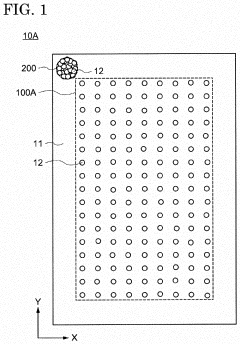
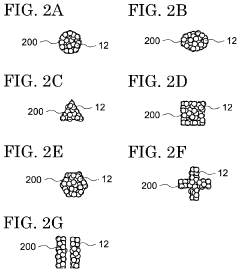
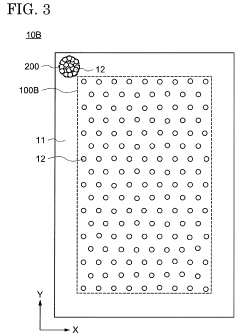
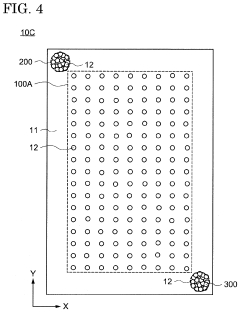
- An anisotropic conductive film with a first region of discretely arranged conductive particles corresponding to electrode patterns and a second region with aggregated conductive particles acting as an alignment marker, facilitating easy alignment with the circuit substrate and reducing production costs by forming alignment markers through conductive particle dispersion.
LED display and electronic device having same
PatentWO2019208919A1
Innovation
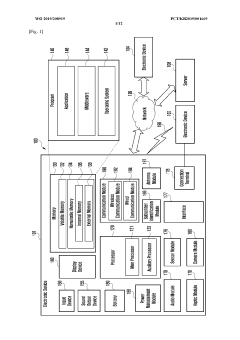
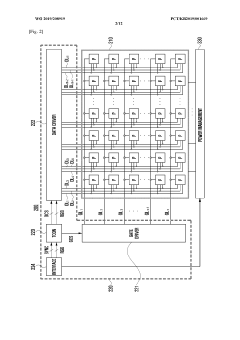
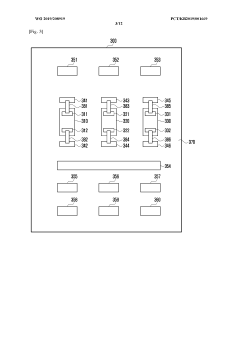
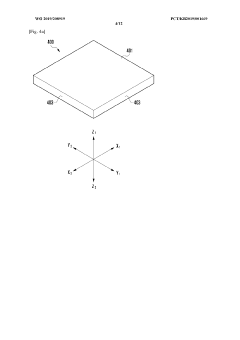
- The development of a micro-LED display with a bezel-less design and segmentation capabilities, allowing for flexible displays of various sizes, achieved through direct mounting of micro-LEDs on a substrate and innovative electrical connections using conductive patterns and wiring lines, enabling robust electrical connections and flexible display configurations.
Power Efficiency Considerations
Power efficiency represents a critical factor in the evaluation of display technologies for robotic applications, where battery life and operational duration are paramount concerns. OLED and MicroLED technologies demonstrate distinct power consumption profiles that significantly impact their suitability for various robotic implementations.
OLED displays offer inherent power efficiency advantages in certain scenarios due to their self-emissive nature. When displaying darker content, OLEDs consume substantially less power as individual pixels can be completely turned off. This characteristic makes them particularly advantageous for robotic applications with predominantly dark user interfaces or those operating in low-light environments. Tests have shown that OLED displays can consume up to 40% less power than traditional displays when showing content with significant black areas.
However, MicroLED technology is rapidly closing this efficiency gap while offering additional benefits. Recent advancements in MicroLED manufacturing have yielded impressive power efficiency improvements, with some prototypes demonstrating up to 30% better energy efficiency than comparable OLED panels at equivalent brightness levels. This efficiency stems from MicroLED's superior light emission mechanism and reduced internal power losses.
For mobile robotics and drones where weight and battery constraints are significant, the power-to-brightness ratio becomes especially important. MicroLED displays can achieve higher brightness levels (up to 5,000 nits) while maintaining reasonable power consumption, enabling better visibility in outdoor environments without excessive battery drain. This represents a substantial advantage over OLEDs, which typically struggle to maintain energy efficiency at higher brightness settings.
Thermal considerations also factor into the power efficiency equation. OLEDs generate more heat during operation, requiring additional power for cooling systems in enclosed robotic applications. MicroLED's superior thermal performance reduces this auxiliary power requirement, contributing to overall system efficiency. This becomes particularly relevant in compact robotic designs where thermal management presents significant challenges.
Looking toward future developments, both technologies continue to evolve with promising efficiency improvements. MicroLED research is focused on optimizing pixel architecture and reducing driving voltage requirements, while OLED development aims to address efficiency degradation at higher brightness levels through new materials and pixel structures. The integration of ambient light sensors and adaptive brightness technologies with both display types offers additional pathways to optimize power consumption based on environmental conditions and usage patterns in robotic applications.
OLED displays offer inherent power efficiency advantages in certain scenarios due to their self-emissive nature. When displaying darker content, OLEDs consume substantially less power as individual pixels can be completely turned off. This characteristic makes them particularly advantageous for robotic applications with predominantly dark user interfaces or those operating in low-light environments. Tests have shown that OLED displays can consume up to 40% less power than traditional displays when showing content with significant black areas.
However, MicroLED technology is rapidly closing this efficiency gap while offering additional benefits. Recent advancements in MicroLED manufacturing have yielded impressive power efficiency improvements, with some prototypes demonstrating up to 30% better energy efficiency than comparable OLED panels at equivalent brightness levels. This efficiency stems from MicroLED's superior light emission mechanism and reduced internal power losses.
For mobile robotics and drones where weight and battery constraints are significant, the power-to-brightness ratio becomes especially important. MicroLED displays can achieve higher brightness levels (up to 5,000 nits) while maintaining reasonable power consumption, enabling better visibility in outdoor environments without excessive battery drain. This represents a substantial advantage over OLEDs, which typically struggle to maintain energy efficiency at higher brightness settings.
Thermal considerations also factor into the power efficiency equation. OLEDs generate more heat during operation, requiring additional power for cooling systems in enclosed robotic applications. MicroLED's superior thermal performance reduces this auxiliary power requirement, contributing to overall system efficiency. This becomes particularly relevant in compact robotic designs where thermal management presents significant challenges.
Looking toward future developments, both technologies continue to evolve with promising efficiency improvements. MicroLED research is focused on optimizing pixel architecture and reducing driving voltage requirements, while OLED development aims to address efficiency degradation at higher brightness levels through new materials and pixel structures. The integration of ambient light sensors and adaptive brightness technologies with both display types offers additional pathways to optimize power consumption based on environmental conditions and usage patterns in robotic applications.
Durability and Reliability Assessment
Durability and reliability represent critical factors in the evaluation of display technologies for robotic applications, where operational conditions often include exposure to vibration, temperature fluctuations, and physical impacts. OLED and MicroLED technologies demonstrate distinct performance characteristics under these challenging environments, necessitating comprehensive assessment for robotics integration.
OLED displays exhibit notable vulnerability to environmental stressors. The organic compounds utilized in OLED construction degrade when exposed to oxygen and moisture, resulting in diminished brightness and color accuracy over time. Testing indicates that OLED panels typically maintain optimal performance for 30,000-50,000 hours under standard conditions, but this lifespan decreases significantly in high-humidity or temperature-variable robotic applications. Additionally, OLED displays demonstrate susceptibility to screen burn-in, where static interface elements create permanent image retention—a particular concern for robotic control panels with fixed status indicators.
MicroLED technology presents superior durability metrics across multiple parameters. The inorganic semiconductor materials employed in MicroLED construction demonstrate remarkable resistance to environmental degradation, with projected operational lifespans exceeding 100,000 hours even under variable conditions. Laboratory stress testing reveals MicroLED's exceptional resilience to temperature extremes (-40°C to 80°C), surpassing OLED's narrower operational range (0°C to 40°C)—a crucial advantage for outdoor and industrial robotic deployments.
Impact resistance constitutes another significant reliability differential between these technologies. MicroLED's solid-state construction withstands mechanical shock substantially better than OLED's more fragile organic layers. Accelerated life testing demonstrates MicroLED displays maintain functionality after exposure to vibration profiles mimicking industrial robotic operations, while OLED panels frequently develop pixel failures and connection interruptions under identical conditions.
Power consumption stability represents an additional reliability consideration. OLED displays exhibit increasing power requirements as they age, necessitating recalibration of robotic power management systems. Conversely, MicroLED maintains consistent power consumption throughout its operational lifespan, enabling more predictable energy budgeting for battery-powered robotic platforms.
Maintenance requirements further differentiate these technologies in robotic applications. OLED displays typically require protective enclosures and environmental controls to prevent premature degradation, adding complexity and potential failure points to robotic systems. MicroLED's inherent durability permits simplified integration with fewer protective measures, reducing maintenance frequency and extending mean time between failures (MTBF) in field deployments.
These durability and reliability considerations significantly impact total cost of ownership calculations for robotic systems, with MicroLED's superior performance potentially offsetting its higher initial implementation costs through reduced maintenance requirements and extended operational lifespan.
OLED displays exhibit notable vulnerability to environmental stressors. The organic compounds utilized in OLED construction degrade when exposed to oxygen and moisture, resulting in diminished brightness and color accuracy over time. Testing indicates that OLED panels typically maintain optimal performance for 30,000-50,000 hours under standard conditions, but this lifespan decreases significantly in high-humidity or temperature-variable robotic applications. Additionally, OLED displays demonstrate susceptibility to screen burn-in, where static interface elements create permanent image retention—a particular concern for robotic control panels with fixed status indicators.
MicroLED technology presents superior durability metrics across multiple parameters. The inorganic semiconductor materials employed in MicroLED construction demonstrate remarkable resistance to environmental degradation, with projected operational lifespans exceeding 100,000 hours even under variable conditions. Laboratory stress testing reveals MicroLED's exceptional resilience to temperature extremes (-40°C to 80°C), surpassing OLED's narrower operational range (0°C to 40°C)—a crucial advantage for outdoor and industrial robotic deployments.
Impact resistance constitutes another significant reliability differential between these technologies. MicroLED's solid-state construction withstands mechanical shock substantially better than OLED's more fragile organic layers. Accelerated life testing demonstrates MicroLED displays maintain functionality after exposure to vibration profiles mimicking industrial robotic operations, while OLED panels frequently develop pixel failures and connection interruptions under identical conditions.
Power consumption stability represents an additional reliability consideration. OLED displays exhibit increasing power requirements as they age, necessitating recalibration of robotic power management systems. Conversely, MicroLED maintains consistent power consumption throughout its operational lifespan, enabling more predictable energy budgeting for battery-powered robotic platforms.
Maintenance requirements further differentiate these technologies in robotic applications. OLED displays typically require protective enclosures and environmental controls to prevent premature degradation, adding complexity and potential failure points to robotic systems. MicroLED's inherent durability permits simplified integration with fewer protective measures, reducing maintenance frequency and extending mean time between failures (MTBF) in field deployments.
These durability and reliability considerations significantly impact total cost of ownership calculations for robotic systems, with MicroLED's superior performance potentially offsetting its higher initial implementation costs through reduced maintenance requirements and extended operational lifespan.
Unlock deeper insights with Patsnap Eureka Quick Research — get a full tech report to explore trends and direct your research. Try now!
Generate Your Research Report Instantly with AI Agent
Supercharge your innovation with Patsnap Eureka AI Agent Platform!