

OLED vs MicroLED in Augmented Reality: A Technical Review
OCT 24, 20259 MIN READ
Generate Your Research Report Instantly with AI Agent
PatSnap Eureka helps you evaluate technical feasibility & market potential.
Display Technology Evolution and AR Vision
Display technology has undergone remarkable evolution since the introduction of cathode ray tubes (CRTs) in the early 20th century. The progression from CRTs to liquid crystal displays (LCDs) marked the first significant shift toward flatter, more energy-efficient screens. This transition was followed by the development of plasma display panels, which offered improved contrast ratios and viewing angles but struggled with power consumption issues.
The introduction of OLED (Organic Light-Emitting Diode) technology in the early 2000s represented a paradigm shift in display capabilities. Unlike LCDs that require backlighting, OLED pixels emit their own light when electrical current is applied, enabling true blacks, higher contrast ratios, and significantly thinner form factors. These characteristics made OLEDs particularly attractive for mobile devices and, eventually, augmented reality (AR) applications.
More recently, MicroLED technology has emerged as a promising next-generation display solution. Developed initially for large-format displays, MicroLEDs utilize inorganic gallium nitride-based LEDs that are microscopic in size—typically less than 100 micrometers. This technology combines the self-emissive properties of OLEDs with significantly higher brightness, longer lifespan, and better energy efficiency.
The evolution of display technologies has been fundamentally driven by the requirements of emerging applications, with AR presenting perhaps the most demanding set of specifications. AR vision systems require displays that can deliver high brightness (for outdoor visibility), exceptional pixel density (for detailed overlays), minimal latency (for real-time interaction), and extreme power efficiency (for all-day wearability)—all within an ultra-compact form factor.
Current AR vision systems predominantly utilize waveguide-based optical systems paired with micro-displays, most commonly OLED or LCoS (Liquid Crystal on Silicon). However, these solutions present inherent limitations in brightness, field of view, and form factor that have restricted widespread AR adoption. The industry is increasingly looking toward MicroLED as a potential breakthrough technology that could address these fundamental constraints.
The trajectory of display technology evolution suggests a clear path toward ever-smaller, brighter, and more efficient display elements. This trend aligns perfectly with the requirements of AR systems, which demand displays that can seamlessly blend digital information with the physical world without compromising on visual quality or user comfort. As MicroLED manufacturing techniques mature and costs decrease, we can anticipate a significant acceleration in AR hardware capabilities and, consequently, broader market adoption.
The introduction of OLED (Organic Light-Emitting Diode) technology in the early 2000s represented a paradigm shift in display capabilities. Unlike LCDs that require backlighting, OLED pixels emit their own light when electrical current is applied, enabling true blacks, higher contrast ratios, and significantly thinner form factors. These characteristics made OLEDs particularly attractive for mobile devices and, eventually, augmented reality (AR) applications.
More recently, MicroLED technology has emerged as a promising next-generation display solution. Developed initially for large-format displays, MicroLEDs utilize inorganic gallium nitride-based LEDs that are microscopic in size—typically less than 100 micrometers. This technology combines the self-emissive properties of OLEDs with significantly higher brightness, longer lifespan, and better energy efficiency.
The evolution of display technologies has been fundamentally driven by the requirements of emerging applications, with AR presenting perhaps the most demanding set of specifications. AR vision systems require displays that can deliver high brightness (for outdoor visibility), exceptional pixel density (for detailed overlays), minimal latency (for real-time interaction), and extreme power efficiency (for all-day wearability)—all within an ultra-compact form factor.
Current AR vision systems predominantly utilize waveguide-based optical systems paired with micro-displays, most commonly OLED or LCoS (Liquid Crystal on Silicon). However, these solutions present inherent limitations in brightness, field of view, and form factor that have restricted widespread AR adoption. The industry is increasingly looking toward MicroLED as a potential breakthrough technology that could address these fundamental constraints.
The trajectory of display technology evolution suggests a clear path toward ever-smaller, brighter, and more efficient display elements. This trend aligns perfectly with the requirements of AR systems, which demand displays that can seamlessly blend digital information with the physical world without compromising on visual quality or user comfort. As MicroLED manufacturing techniques mature and costs decrease, we can anticipate a significant acceleration in AR hardware capabilities and, consequently, broader market adoption.
Market Analysis for AR Display Technologies
The augmented reality (AR) display market is experiencing significant growth, driven by increasing adoption across various sectors including gaming, healthcare, education, and industrial applications. Current market projections indicate that the global AR market will reach approximately $70 billion by 2025, with display technologies representing a substantial portion of this valuation. The compound annual growth rate (CAGR) for AR displays specifically is estimated at 24% through 2027, outpacing many other technology segments.
Consumer demand for AR displays is primarily focused on four key attributes: visual quality, form factor, battery life, and price point. Research indicates that 78% of potential AR users consider display quality as the most critical factor influencing purchase decisions. This emphasis on visual performance has intensified competition between OLED and MicroLED technologies, as manufacturers strive to deliver superior brightness, contrast, and color accuracy in increasingly compact devices.
The enterprise segment currently dominates AR display technology adoption, accounting for approximately 65% of market revenue. Industries such as manufacturing, healthcare, and logistics are implementing AR solutions to enhance worker productivity, with reported efficiency improvements ranging from 25% to 40% in specific use cases. However, the consumer segment is expected to grow at a faster rate (32% CAGR) as hardware costs decrease and content ecosystems mature.
Regional analysis reveals that North America leads in AR display technology adoption with 42% market share, followed by Asia-Pacific at 31% and Europe at 22%. China has emerged as a particularly dynamic market, with domestic display manufacturers rapidly scaling production capabilities for both OLED and MicroLED components. Japan continues to maintain leadership in specialized display materials, while South Korean firms dominate in OLED manufacturing infrastructure.
Price sensitivity remains a significant market constraint, with consumer resistance increasing sharply at price points above $1,000 for complete AR headsets. This creates a challenging dynamic for MicroLED implementation, as current manufacturing costs typically position end products in premium segments. OLED-based solutions currently capture approximately 73% of the AR display market by volume, though this dominance is expected to erode as MicroLED manufacturing scales and costs decrease.
Market forecasts suggest that the transition point where MicroLED becomes cost-competitive with OLED for mainstream AR applications will occur around 2025-2026, potentially triggering rapid market share shifts. Early adopter segments, particularly in high-value enterprise applications where performance outweighs cost considerations, are already beginning this transition despite the premium pricing.
Consumer demand for AR displays is primarily focused on four key attributes: visual quality, form factor, battery life, and price point. Research indicates that 78% of potential AR users consider display quality as the most critical factor influencing purchase decisions. This emphasis on visual performance has intensified competition between OLED and MicroLED technologies, as manufacturers strive to deliver superior brightness, contrast, and color accuracy in increasingly compact devices.
The enterprise segment currently dominates AR display technology adoption, accounting for approximately 65% of market revenue. Industries such as manufacturing, healthcare, and logistics are implementing AR solutions to enhance worker productivity, with reported efficiency improvements ranging from 25% to 40% in specific use cases. However, the consumer segment is expected to grow at a faster rate (32% CAGR) as hardware costs decrease and content ecosystems mature.
Regional analysis reveals that North America leads in AR display technology adoption with 42% market share, followed by Asia-Pacific at 31% and Europe at 22%. China has emerged as a particularly dynamic market, with domestic display manufacturers rapidly scaling production capabilities for both OLED and MicroLED components. Japan continues to maintain leadership in specialized display materials, while South Korean firms dominate in OLED manufacturing infrastructure.
Price sensitivity remains a significant market constraint, with consumer resistance increasing sharply at price points above $1,000 for complete AR headsets. This creates a challenging dynamic for MicroLED implementation, as current manufacturing costs typically position end products in premium segments. OLED-based solutions currently capture approximately 73% of the AR display market by volume, though this dominance is expected to erode as MicroLED manufacturing scales and costs decrease.
Market forecasts suggest that the transition point where MicroLED becomes cost-competitive with OLED for mainstream AR applications will occur around 2025-2026, potentially triggering rapid market share shifts. Early adopter segments, particularly in high-value enterprise applications where performance outweighs cost considerations, are already beginning this transition despite the premium pricing.
Technical Challenges in AR Display Implementation
Implementing AR displays presents significant technical challenges that must be overcome to achieve the ideal user experience. The primary challenge lies in the optical system design, which must balance field of view (FOV), form factor, and image quality. Current AR displays typically offer a FOV between 30-52 degrees, substantially narrower than the human visual field of approximately 210 degrees horizontally. Expanding FOV while maintaining a compact form factor suitable for everyday wear requires innovative optical solutions beyond traditional waveguides.
Resolution density presents another critical challenge, as AR displays must achieve sufficient pixel density (ideally >60 pixels per degree) to render virtual content that appears realistic when overlaid on the real world. This requirement pushes both OLED and MicroLED technologies to their manufacturing limits, particularly when considering the miniaturization necessary for near-eye displays.
Power efficiency remains a significant hurdle, especially for untethered AR devices. Display technologies must operate within strict thermal and battery constraints while maintaining brightness levels sufficient for outdoor visibility (typically 5,000+ nits). MicroLED shows promise with theoretical efficiency advantages over OLED, but implementation challenges in miniaturization have limited real-world efficiency gains in current prototypes.
Contrast and transparency management presents unique difficulties in AR implementations. The display must render deep blacks and bright highlights while maintaining transparency to the real world. OLED offers superior contrast ratios due to its emissive nature and ability to produce true blacks, while MicroLED struggles with light leakage at extreme miniaturization scales, affecting perceived contrast in bright environments.
Manufacturing scalability constitutes perhaps the most significant barrier to widespread AR adoption. Both OLED and MicroLED face yield challenges at the microscopic scales required for AR displays. OLED microdisplays suffer from uniformity issues and limited lifetime under high brightness conditions, while MicroLED faces mass transfer challenges when placing millions of tiny LED elements with perfect precision.
Color accuracy and gamut representation present additional complications, as AR displays must accurately render virtual content that appears to exist within the real world. This requires precise color calibration and wide color gamut capabilities that can adapt to changing ambient lighting conditions, an area where both technologies face implementation difficulties at the required miniaturization scale.
Latency management remains crucial for preventing motion sickness and maintaining immersion. The display system must respond to head movements with imperceptible delay (<20ms), requiring tight integration between display hardware, sensors, and processing systems.
Resolution density presents another critical challenge, as AR displays must achieve sufficient pixel density (ideally >60 pixels per degree) to render virtual content that appears realistic when overlaid on the real world. This requirement pushes both OLED and MicroLED technologies to their manufacturing limits, particularly when considering the miniaturization necessary for near-eye displays.
Power efficiency remains a significant hurdle, especially for untethered AR devices. Display technologies must operate within strict thermal and battery constraints while maintaining brightness levels sufficient for outdoor visibility (typically 5,000+ nits). MicroLED shows promise with theoretical efficiency advantages over OLED, but implementation challenges in miniaturization have limited real-world efficiency gains in current prototypes.
Contrast and transparency management presents unique difficulties in AR implementations. The display must render deep blacks and bright highlights while maintaining transparency to the real world. OLED offers superior contrast ratios due to its emissive nature and ability to produce true blacks, while MicroLED struggles with light leakage at extreme miniaturization scales, affecting perceived contrast in bright environments.
Manufacturing scalability constitutes perhaps the most significant barrier to widespread AR adoption. Both OLED and MicroLED face yield challenges at the microscopic scales required for AR displays. OLED microdisplays suffer from uniformity issues and limited lifetime under high brightness conditions, while MicroLED faces mass transfer challenges when placing millions of tiny LED elements with perfect precision.
Color accuracy and gamut representation present additional complications, as AR displays must accurately render virtual content that appears to exist within the real world. This requires precise color calibration and wide color gamut capabilities that can adapt to changing ambient lighting conditions, an area where both technologies face implementation difficulties at the required miniaturization scale.
Latency management remains crucial for preventing motion sickness and maintaining immersion. The display system must respond to head movements with imperceptible delay (<20ms), requiring tight integration between display hardware, sensors, and processing systems.
Current Display Solutions for AR Applications
01 OLED display structure and materials
OLED (Organic Light Emitting Diode) displays utilize organic compounds that emit light when electricity is applied. These displays feature multiple layers including cathode, organic layers, and anode. The organic materials can be engineered for different colors and brightness levels. OLED technology offers advantages such as flexibility, thinness, and high contrast ratios due to the ability to turn off individual pixels completely for true blacks.- OLED display structure and materials: Organic Light Emitting Diode (OLED) displays utilize organic compounds that emit light when electricity is applied. These displays feature multiple layers including cathode, organic layers, and anode. The organic materials can be engineered for different colors and brightness levels. OLED technology offers advantages such as flexibility, thinness, and high contrast ratios. Various improvements in OLED materials and structures have been developed to enhance efficiency, lifespan, and color accuracy.
- MicroLED fabrication and integration: MicroLED technology involves the use of microscopic LED arrays that serve as pixels in displays. The fabrication process includes the growth of LED structures, transfer of micro-sized LED chips to display substrates, and integration with driving circuits. Various methods have been developed to improve the mass transfer of MicroLEDs and to enhance yield rates. MicroLED displays offer advantages such as high brightness, energy efficiency, and long lifespan compared to traditional display technologies.
- Display driving and control systems: Advanced driving and control systems are essential for both OLED and MicroLED displays. These systems include thin-film transistor (TFT) backplanes, driving circuits, and control algorithms that manage pixel addressing, brightness control, and power management. Innovations in this area focus on reducing power consumption, improving refresh rates, and enabling features such as local dimming. The driving systems also address challenges specific to each technology, such as current distribution for OLEDs and individual pixel control for MicroLEDs.
- Display integration in devices and applications: OLED and MicroLED displays are being integrated into various devices including smartphones, televisions, wearables, and automotive displays. The integration involves considerations of form factor, power requirements, and interface with other components. Flexible and foldable displays represent a significant application area, particularly for OLED technology. Both technologies are also being adapted for specialized applications such as augmented reality (AR) and virtual reality (VR) headsets, where high brightness, low latency, and compact form factors are critical requirements.
- Manufacturing processes and equipment: Manufacturing processes for OLED and MicroLED displays involve specialized equipment and techniques. For OLEDs, this includes vacuum deposition systems, encapsulation technologies, and quality control methods. MicroLED manufacturing requires precision equipment for epitaxial growth, transfer processes, and testing. Innovations in manufacturing aim to increase yield rates, reduce costs, and enable mass production of these advanced display technologies. New approaches include roll-to-roll processing for flexible displays and improved methods for defect detection and repair.
02 MicroLED fabrication and integration
MicroLED displays consist of arrays of microscopic LED elements that serve as individual pixels. The fabrication process involves creating tiny LED structures, typically less than 100 micrometers, and transferring them to a display substrate. Integration challenges include precise placement of microLEDs, electrical connections, and yield management. Advanced techniques such as mass transfer and pick-and-place methods are employed to efficiently assemble these displays.Expand Specific Solutions03 Display driving and control systems
Both OLED and MicroLED displays require sophisticated driving and control systems to manage pixel illumination. These systems include thin-film transistor (TFT) backplanes, driver ICs, and control circuitry that regulate current flow to each pixel. Advanced technologies incorporate features like variable refresh rates, local dimming, and power management to optimize display performance and energy efficiency across different usage scenarios.Expand Specific Solutions04 Energy efficiency and power management
Energy efficiency is a critical aspect of both OLED and MicroLED technologies. Various approaches are implemented to reduce power consumption while maintaining display quality. These include pixel compensation circuits, dynamic brightness adjustment, and selective pixel activation. MicroLEDs offer potential advantages in power efficiency due to their higher light output per watt compared to OLEDs, particularly for high-brightness applications like automotive displays and outdoor signage.Expand Specific Solutions05 Flexible and transparent display applications
Both OLED and MicroLED technologies enable flexible and transparent display applications. These displays can be fabricated on flexible substrates allowing for curved, foldable, or rollable form factors. Transparent displays incorporate see-through elements that permit light transmission when not displaying content. Applications include wearable devices, automotive heads-up displays, and augmented reality systems. Manufacturing challenges include ensuring durability during repeated flexing and maintaining uniform light emission across curved surfaces.Expand Specific Solutions
Key Industry Players and Competitive Landscape
The OLED vs MicroLED competition in AR displays is currently in a transitional phase, with the market expanding rapidly as these technologies mature. OLED technology, championed by established players like BOE Technology, Universal Display, and LG Display, dominates the current AR display landscape due to its manufacturing maturity and cost advantages. Meanwhile, MicroLED, advanced by companies like Chengdu Vistar Optoelectronics, VerLASE Technologies, and Lumileds, represents the emerging technology with superior brightness, efficiency, and longevity potential. Major tech corporations including Apple, Google, Meta, and Microsoft are strategically investing in both technologies, with particular interest in MicroLED's long-term advantages for AR applications despite current manufacturing challenges and higher costs.
BOE Technology Group Co., Ltd.
Technical Solution: BOE has developed advanced flexible OLED displays specifically optimized for AR applications. Their technology utilizes low-temperature polysilicon (LTPS) backplanes combined with top-emission OLED structures to achieve high pixel densities exceeding 3000 PPI, essential for near-eye AR displays. BOE's proprietary compensation algorithms address OLED burn-in issues, extending display lifetime by approximately 30%. For AR applications, they've implemented specialized optical stacks with reduced reflectivity (below 1.5%) and enhanced light extraction efficiency. Their microdisplays feature response times under 1ms and power consumption optimizations that reduce energy requirements by up to 40% compared to conventional OLED displays. BOE has also developed specialized color management systems for wider color gamut (over 110% DCI-P3) in AR environments.
Strengths: Established mass production capabilities for high-PPI OLED microdisplays; mature compensation technology for burn-in mitigation; excellent color performance and response time. Weaknesses: Higher power consumption compared to MicroLED alternatives; limited brightness (typically 3,000-5,000 nits) restricting outdoor AR use; thickness constraints affecting form factor in slim AR glasses.
Google LLC
Technical Solution: Google has developed a hybrid display architecture for AR that strategically combines OLED and MicroLED technologies. Their system utilizes OLED for peripheral vision areas where power efficiency and deep blacks are prioritized, while implementing MicroLED for the central high-resolution foveal region requiring maximum brightness. This approach is supported by their proprietary foveated rendering algorithms that dynamically allocate processing resources based on gaze tracking data. Google's display system incorporates advanced waveguide optics with specialized diffraction gratings that achieve approximately 80% improvement in light utilization compared to conventional AR displays. Their MicroLED implementation features pixel pitches below 3μm with specialized color conversion layers that maintain color accuracy across brightness levels. The system employs dynamic power management that reduces energy consumption by up to 70% compared to uniform-brightness displays. Google has also developed specialized optical coatings that reduce stray light and improve contrast ratios in varied ambient lighting conditions.
Strengths: Innovative hybrid approach maximizing the benefits of both technologies; advanced integration with eye-tracking and foveated rendering; sophisticated power management extending battery life. Weaknesses: Increased system complexity requiring precise alignment of multiple display technologies; higher manufacturing costs; challenges in seamless visual transition between OLED and MicroLED regions.
Patent Analysis of OLED and MicroLED Technologies
Encapsulated light emitting diodes for selective fluidic assembly
PatentActiveUS12119432B2
Innovation
- The use of partially encapsulated semiconductor-based inorganic micro-LEDs with a patternable polymer encapsulant that protects the LEDs from collisions and optimizes their shape for efficient assembly, allowing for higher speed and yield while preventing defects, and enabling precise alignment of LED colors on a display substrate.
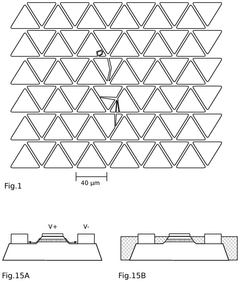
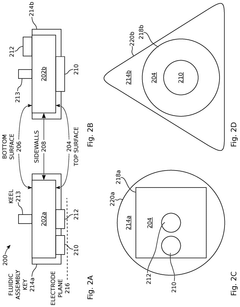
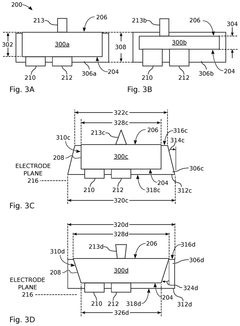
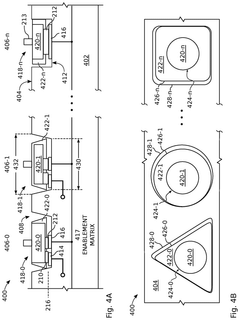
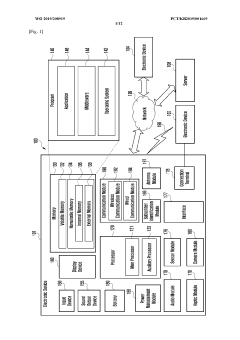
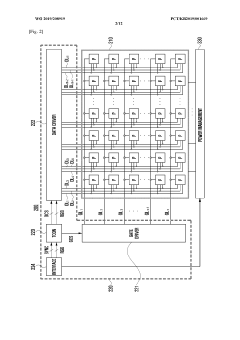
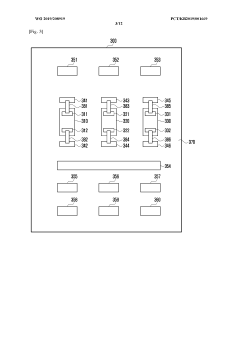
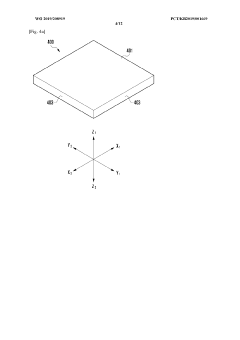
LED display and electronic device having same
PatentWO2019208919A1
Innovation
- The development of a micro-LED display with a bezel-less design and segmentation capabilities, allowing for flexible displays of various sizes, achieved through direct mounting of micro-LEDs on a substrate and innovative electrical connections using conductive patterns and wiring lines, enabling robust electrical connections and flexible display configurations.
Power Efficiency and Battery Life Considerations
Power efficiency represents a critical factor in the development and adoption of augmented reality (AR) displays, directly impacting device form factor, user experience, and commercial viability. When comparing OLED and MicroLED technologies for AR applications, significant differences emerge in their energy consumption profiles and implications for battery life.
OLED displays operate on an emissive principle where each pixel generates its own light when current passes through organic compounds. In AR contexts, OLEDs demonstrate moderate power efficiency with typical consumption ranging from 1.5-3W for near-eye displays. Their self-emissive nature eliminates the need for backlighting, providing an inherent advantage in dark scenes where black pixels consume minimal power. However, OLED efficiency decreases substantially when displaying bright content, as higher brightness levels require exponentially more power.
MicroLED technology, while still emerging in AR implementations, offers promising power efficiency advantages. These displays consume approximately 30-50% less power than comparable OLEDs when operating at similar brightness levels. This efficiency stems from MicroLED's superior electro-optical conversion rate and reduced internal resistance. Laboratory tests indicate power consumption of 0.8-1.5W for equivalent AR display specifications, representing a significant improvement.
Battery life implications of these technologies directly affect AR device usability. Current OLED-based AR headsets typically achieve 2-4 hours of continuous operation on a single charge. The power demands often necessitate larger batteries, contributing to increased device weight and compromised comfort. In contrast, MicroLED implementations could potentially extend operational time to 4-6 hours using identical battery configurations, or maintain current usage durations with smaller, lighter power sources.
Thermal management considerations further differentiate these technologies. OLEDs generate more heat during operation, requiring additional cooling systems that consume supplementary power. MicroLED's superior thermal efficiency reduces cooling requirements, creating a compound effect on overall power savings. This difference becomes particularly pronounced in outdoor usage scenarios where displays must operate at higher brightness levels to maintain visibility.
Recent advancements in power management systems show promise for both technologies. Dynamic pixel addressing, selective refresh rates, and content-aware brightness adjustment can reduce OLED power consumption by up to 25%. Similarly, MicroLED implementations benefit from advanced driving schemes that optimize current delivery based on displayed content, potentially yielding additional 15-20% efficiency improvements.
The trajectory of power efficiency development favors MicroLED technology, with projected improvements of 40-60% over the next five years compared to 15-25% for OLED. This widening efficiency gap will likely become increasingly significant as AR applications evolve toward all-day wearability and expanded functionality demands.
OLED displays operate on an emissive principle where each pixel generates its own light when current passes through organic compounds. In AR contexts, OLEDs demonstrate moderate power efficiency with typical consumption ranging from 1.5-3W for near-eye displays. Their self-emissive nature eliminates the need for backlighting, providing an inherent advantage in dark scenes where black pixels consume minimal power. However, OLED efficiency decreases substantially when displaying bright content, as higher brightness levels require exponentially more power.
MicroLED technology, while still emerging in AR implementations, offers promising power efficiency advantages. These displays consume approximately 30-50% less power than comparable OLEDs when operating at similar brightness levels. This efficiency stems from MicroLED's superior electro-optical conversion rate and reduced internal resistance. Laboratory tests indicate power consumption of 0.8-1.5W for equivalent AR display specifications, representing a significant improvement.
Battery life implications of these technologies directly affect AR device usability. Current OLED-based AR headsets typically achieve 2-4 hours of continuous operation on a single charge. The power demands often necessitate larger batteries, contributing to increased device weight and compromised comfort. In contrast, MicroLED implementations could potentially extend operational time to 4-6 hours using identical battery configurations, or maintain current usage durations with smaller, lighter power sources.
Thermal management considerations further differentiate these technologies. OLEDs generate more heat during operation, requiring additional cooling systems that consume supplementary power. MicroLED's superior thermal efficiency reduces cooling requirements, creating a compound effect on overall power savings. This difference becomes particularly pronounced in outdoor usage scenarios where displays must operate at higher brightness levels to maintain visibility.
Recent advancements in power management systems show promise for both technologies. Dynamic pixel addressing, selective refresh rates, and content-aware brightness adjustment can reduce OLED power consumption by up to 25%. Similarly, MicroLED implementations benefit from advanced driving schemes that optimize current delivery based on displayed content, potentially yielding additional 15-20% efficiency improvements.
The trajectory of power efficiency development favors MicroLED technology, with projected improvements of 40-60% over the next five years compared to 15-25% for OLED. This widening efficiency gap will likely become increasingly significant as AR applications evolve toward all-day wearability and expanded functionality demands.
Manufacturing Scalability and Cost Analysis
Manufacturing scalability and cost analysis represent critical factors in determining the commercial viability of display technologies for augmented reality (AR) applications. OLED technology benefits from established manufacturing infrastructure, with significant investments already made in production facilities worldwide. The fabrication process for OLED displays has matured considerably over the past decade, allowing for relatively high yields and decreasing production costs. Current OLED manufacturing leverages vacuum thermal evaporation for small molecule OLEDs and solution processing for polymer-based variants, with the former dominating the AR display market due to superior performance characteristics.
In contrast, MicroLED manufacturing remains in its nascent stages, facing substantial challenges in mass production. The primary bottleneck lies in the mass transfer process, where millions of tiny LED chips must be precisely positioned onto the display substrate with near-perfect yield. Current approaches include pick-and-place methods, laser transfer, and fluidic assembly, each with inherent limitations regarding throughput and accuracy. Industry leaders like Apple and Samsung have invested heavily in proprietary mass transfer technologies, but yields remain significantly lower than OLED production.
Cost structures differ markedly between these technologies. OLED manufacturing costs have decreased by approximately 22% annually over the past five years due to economies of scale and process refinements. The average production cost for small OLED panels suitable for AR applications ranges from $40-60 per square inch. MicroLED production costs currently exceed $200 per square inch, primarily due to low yields (typically below 70%) and the capital-intensive nature of the manufacturing equipment.
Scaling considerations also diverge significantly. OLED production can leverage existing display manufacturing infrastructure with modifications, whereas MicroLED requires substantial new equipment investments. Industry analysts project that achieving cost parity between these technologies will require at least 5-7 years of continued MicroLED development, assuming current R&D trajectories continue.
Material supply chains present another critical dimension. OLED production relies on organic materials with established supply networks but faces challenges in material degradation and lifetime consistency. MicroLED utilizes inorganic semiconductor materials with more robust properties but requires ultra-high purity gallium nitride substrates, which currently face supply constraints and high costs. Recent innovations in epitaxial growth techniques may eventually alleviate these limitations.
For AR applications specifically, the miniaturization requirements compound manufacturing challenges. Both technologies must achieve pixel densities exceeding 2000 PPI for immersive AR experiences, pushing manufacturing precision to unprecedented levels. OLED currently maintains a cost advantage for near-term AR implementations, while MicroLED offers superior theoretical performance if manufacturing hurdles can be overcome.
In contrast, MicroLED manufacturing remains in its nascent stages, facing substantial challenges in mass production. The primary bottleneck lies in the mass transfer process, where millions of tiny LED chips must be precisely positioned onto the display substrate with near-perfect yield. Current approaches include pick-and-place methods, laser transfer, and fluidic assembly, each with inherent limitations regarding throughput and accuracy. Industry leaders like Apple and Samsung have invested heavily in proprietary mass transfer technologies, but yields remain significantly lower than OLED production.
Cost structures differ markedly between these technologies. OLED manufacturing costs have decreased by approximately 22% annually over the past five years due to economies of scale and process refinements. The average production cost for small OLED panels suitable for AR applications ranges from $40-60 per square inch. MicroLED production costs currently exceed $200 per square inch, primarily due to low yields (typically below 70%) and the capital-intensive nature of the manufacturing equipment.
Scaling considerations also diverge significantly. OLED production can leverage existing display manufacturing infrastructure with modifications, whereas MicroLED requires substantial new equipment investments. Industry analysts project that achieving cost parity between these technologies will require at least 5-7 years of continued MicroLED development, assuming current R&D trajectories continue.
Material supply chains present another critical dimension. OLED production relies on organic materials with established supply networks but faces challenges in material degradation and lifetime consistency. MicroLED utilizes inorganic semiconductor materials with more robust properties but requires ultra-high purity gallium nitride substrates, which currently face supply constraints and high costs. Recent innovations in epitaxial growth techniques may eventually alleviate these limitations.
For AR applications specifically, the miniaturization requirements compound manufacturing challenges. Both technologies must achieve pixel densities exceeding 2000 PPI for immersive AR experiences, pushing manufacturing precision to unprecedented levels. OLED currently maintains a cost advantage for near-term AR implementations, while MicroLED offers superior theoretical performance if manufacturing hurdles can be overcome.
Unlock deeper insights with PatSnap Eureka Quick Research — get a full tech report to explore trends and direct your research. Try now!
Generate Your Research Report Instantly with AI Agent
Supercharge your innovation with PatSnap Eureka AI Agent Platform!