OLED vs MicroLED in Wearable Tech: A Detailed Analysis
OCT 24, 20259 MIN READ
Generate Your Research Report Instantly with AI Agent
Patsnap Eureka helps you evaluate technical feasibility & market potential.
Display Technology Evolution and Objectives
Display technology has undergone remarkable evolution since the introduction of cathode ray tubes (CRTs) in the early 20th century. The progression from CRTs to liquid crystal displays (LCDs) marked the first significant shift toward thinner, more energy-efficient screens. This transition laid the groundwork for subsequent innovations including plasma displays, which offered improved contrast ratios and viewing angles but suffered from high power consumption and heat generation.
The introduction of OLED (Organic Light Emitting Diode) technology in the late 1990s represented a paradigm shift in display technology. Unlike LCDs that require backlighting, OLEDs are self-emissive, allowing for thinner form factors, deeper blacks, and more vibrant colors. This technology quickly became the preferred choice for premium smartphones and wearable devices due to its flexibility, low power consumption, and superior visual performance in various lighting conditions.
More recently, MicroLED has emerged as a promising next-generation display technology. Developed initially for large-scale applications, MicroLED utilizes microscopic LED arrays that are individually addressable, offering unprecedented brightness, contrast ratios, and energy efficiency. The technology promises longer lifespans than OLED while maintaining comparable or superior visual quality, making it particularly attractive for wearable applications where battery life and durability are critical factors.
The wearable technology market has been a significant driver of display innovation, demanding screens that balance visual performance with power efficiency in increasingly compact form factors. Smartwatches, fitness trackers, and augmented reality glasses have pushed manufacturers to develop displays that maintain visibility in outdoor environments while minimizing battery drain—a challenge that has accelerated research in both OLED and MicroLED technologies.
The primary objective of current display technology development for wearables centers on achieving the optimal balance between visual performance, power consumption, and form factor. Researchers aim to overcome OLED's limitations regarding brightness and longevity while addressing MicroLED's manufacturing complexities and cost barriers. The ideal wearable display would combine OLED's flexibility and color reproduction with MicroLED's brightness, efficiency, and durability.
Looking forward, the trajectory of display technology evolution points toward hybrid solutions that leverage the strengths of both technologies. The industry is actively pursuing innovations in materials science, manufacturing processes, and pixel architectures to create displays that can adapt to various use cases while maintaining energy efficiency. The ultimate goal remains creating displays that can deliver immersive visual experiences without compromising the wearability and battery life of next-generation devices.
The introduction of OLED (Organic Light Emitting Diode) technology in the late 1990s represented a paradigm shift in display technology. Unlike LCDs that require backlighting, OLEDs are self-emissive, allowing for thinner form factors, deeper blacks, and more vibrant colors. This technology quickly became the preferred choice for premium smartphones and wearable devices due to its flexibility, low power consumption, and superior visual performance in various lighting conditions.
More recently, MicroLED has emerged as a promising next-generation display technology. Developed initially for large-scale applications, MicroLED utilizes microscopic LED arrays that are individually addressable, offering unprecedented brightness, contrast ratios, and energy efficiency. The technology promises longer lifespans than OLED while maintaining comparable or superior visual quality, making it particularly attractive for wearable applications where battery life and durability are critical factors.
The wearable technology market has been a significant driver of display innovation, demanding screens that balance visual performance with power efficiency in increasingly compact form factors. Smartwatches, fitness trackers, and augmented reality glasses have pushed manufacturers to develop displays that maintain visibility in outdoor environments while minimizing battery drain—a challenge that has accelerated research in both OLED and MicroLED technologies.
The primary objective of current display technology development for wearables centers on achieving the optimal balance between visual performance, power consumption, and form factor. Researchers aim to overcome OLED's limitations regarding brightness and longevity while addressing MicroLED's manufacturing complexities and cost barriers. The ideal wearable display would combine OLED's flexibility and color reproduction with MicroLED's brightness, efficiency, and durability.
Looking forward, the trajectory of display technology evolution points toward hybrid solutions that leverage the strengths of both technologies. The industry is actively pursuing innovations in materials science, manufacturing processes, and pixel architectures to create displays that can adapt to various use cases while maintaining energy efficiency. The ultimate goal remains creating displays that can deliver immersive visual experiences without compromising the wearability and battery life of next-generation devices.
Wearable Market Demand Analysis
The wearable technology market has experienced significant growth over the past decade, evolving from basic fitness trackers to sophisticated multifunctional devices. Current market analysis indicates the global wearable technology market reached approximately $61.3 billion in 2022 and is projected to expand at a compound annual growth rate (CAGR) of 14.6% through 2030, potentially reaching $184.5 billion.
Display technology represents a critical component driving consumer adoption of wearable devices. Market research demonstrates that consumers increasingly prioritize display quality, with 78% of potential smartwatch buyers citing screen visibility and clarity as "very important" or "extremely important" in their purchasing decisions. This trend has intensified competition between OLED and emerging MicroLED technologies.
The smartwatch segment dominates the wearable display market, accounting for 43% of total revenue. Apple maintains market leadership with approximately 36.1% market share in premium wearables, followed by Samsung at 10.1% and various Chinese manufacturers collectively holding about 28%. These manufacturers are actively exploring both OLED and MicroLED implementations to differentiate their products.
Consumer demand patterns reveal distinct preferences across different market segments. In the premium segment ($300+), battery efficiency and display quality are paramount concerns, with 67% of consumers willing to pay a premium for improved display technology that offers better outdoor visibility and lower power consumption. The mid-range segment ($150-300) prioritizes balanced performance and battery life, while the budget segment (<$150) focuses primarily on core functionality and affordability.
Healthcare applications represent the fastest-growing segment within wearable technology, with a projected CAGR of 19.2% through 2028. Medical-grade wearables require displays capable of continuous operation with minimal power consumption, creating specific demand for advanced display technologies that can operate efficiently under variable lighting conditions while maintaining clinical-grade accuracy.
Regional analysis indicates North America leads wearable technology adoption with 38% market share, followed by Asia-Pacific at 31% and Europe at 24%. However, the Asia-Pacific region is experiencing the fastest growth rate at 16.8% annually, driven by increasing disposable income and technological adoption in China and India.
Consumer surveys indicate evolving expectations regarding display performance in wearables. Battery life remains the top concern (cited by 84% of respondents), followed by outdoor visibility (76%), display resolution (68%), and color accuracy (52%). These priorities directly influence the competitive positioning of OLED versus MicroLED technologies in the wearable space.
Display technology represents a critical component driving consumer adoption of wearable devices. Market research demonstrates that consumers increasingly prioritize display quality, with 78% of potential smartwatch buyers citing screen visibility and clarity as "very important" or "extremely important" in their purchasing decisions. This trend has intensified competition between OLED and emerging MicroLED technologies.
The smartwatch segment dominates the wearable display market, accounting for 43% of total revenue. Apple maintains market leadership with approximately 36.1% market share in premium wearables, followed by Samsung at 10.1% and various Chinese manufacturers collectively holding about 28%. These manufacturers are actively exploring both OLED and MicroLED implementations to differentiate their products.
Consumer demand patterns reveal distinct preferences across different market segments. In the premium segment ($300+), battery efficiency and display quality are paramount concerns, with 67% of consumers willing to pay a premium for improved display technology that offers better outdoor visibility and lower power consumption. The mid-range segment ($150-300) prioritizes balanced performance and battery life, while the budget segment (<$150) focuses primarily on core functionality and affordability.
Healthcare applications represent the fastest-growing segment within wearable technology, with a projected CAGR of 19.2% through 2028. Medical-grade wearables require displays capable of continuous operation with minimal power consumption, creating specific demand for advanced display technologies that can operate efficiently under variable lighting conditions while maintaining clinical-grade accuracy.
Regional analysis indicates North America leads wearable technology adoption with 38% market share, followed by Asia-Pacific at 31% and Europe at 24%. However, the Asia-Pacific region is experiencing the fastest growth rate at 16.8% annually, driven by increasing disposable income and technological adoption in China and India.
Consumer surveys indicate evolving expectations regarding display performance in wearables. Battery life remains the top concern (cited by 84% of respondents), followed by outdoor visibility (76%), display resolution (68%), and color accuracy (52%). These priorities directly influence the competitive positioning of OLED versus MicroLED technologies in the wearable space.
OLED and MicroLED Technical Challenges
Both OLED and MicroLED technologies face significant technical challenges in their application to wearable devices. OLED displays, despite their commercial maturity, continue to struggle with several persistent issues. Lifetime degradation remains a primary concern, with blue OLED materials exhibiting particularly short lifespans compared to red and green counterparts. This differential aging leads to color shifts over time, affecting display quality and user experience in wearable applications where consistent performance is expected.
Power efficiency presents another challenge for OLED implementation in wearables. While OLEDs are generally more efficient than traditional LCD displays, they still consume considerable power when displaying bright or white content, which is problematic for battery-constrained wearable devices. Additionally, OLED displays suffer from brightness limitations in outdoor environments, reducing visibility in high ambient light conditions—a critical consideration for wearables used during outdoor activities.
MicroLED technology, while promising superior performance in many aspects, faces even more formidable manufacturing challenges. The most significant hurdle is the mass transfer process—efficiently placing millions of microscopic LED chips precisely onto a display substrate. Current yield rates remain problematic, with defects during transfer significantly impacting production costs and scalability for wearable-sized displays.
Miniaturization represents another substantial challenge for MicroLED implementation in wearables. Creating LED elements small enough for high-resolution displays in compact wearable form factors while maintaining brightness uniformity and efficiency requires pushing the boundaries of current manufacturing capabilities. The industry is still developing reliable processes to produce consistent sub-10 micron LED elements at scale.
Both technologies face thermal management issues in the confined spaces of wearable devices. OLED displays generate heat during operation that can accelerate material degradation, while MicroLED's high brightness capabilities can create localized heating that affects both display performance and user comfort when worn against the skin.
Color accuracy and consistency present ongoing challenges for both technologies. OLED displays must contend with differential aging of organic materials affecting color balance over time, while MicroLED displays face difficulties in achieving consistent color reproduction across millions of individual LED elements manufactured separately.
Flexibility requirements for modern wearable designs add another layer of complexity. While OLED technology has made significant progress in flexible implementations, MicroLED solutions for truly flexible displays remain largely experimental, limiting their application in next-generation wearable form factors that conform to body contours.
Power efficiency presents another challenge for OLED implementation in wearables. While OLEDs are generally more efficient than traditional LCD displays, they still consume considerable power when displaying bright or white content, which is problematic for battery-constrained wearable devices. Additionally, OLED displays suffer from brightness limitations in outdoor environments, reducing visibility in high ambient light conditions—a critical consideration for wearables used during outdoor activities.
MicroLED technology, while promising superior performance in many aspects, faces even more formidable manufacturing challenges. The most significant hurdle is the mass transfer process—efficiently placing millions of microscopic LED chips precisely onto a display substrate. Current yield rates remain problematic, with defects during transfer significantly impacting production costs and scalability for wearable-sized displays.
Miniaturization represents another substantial challenge for MicroLED implementation in wearables. Creating LED elements small enough for high-resolution displays in compact wearable form factors while maintaining brightness uniformity and efficiency requires pushing the boundaries of current manufacturing capabilities. The industry is still developing reliable processes to produce consistent sub-10 micron LED elements at scale.
Both technologies face thermal management issues in the confined spaces of wearable devices. OLED displays generate heat during operation that can accelerate material degradation, while MicroLED's high brightness capabilities can create localized heating that affects both display performance and user comfort when worn against the skin.
Color accuracy and consistency present ongoing challenges for both technologies. OLED displays must contend with differential aging of organic materials affecting color balance over time, while MicroLED displays face difficulties in achieving consistent color reproduction across millions of individual LED elements manufactured separately.
Flexibility requirements for modern wearable designs add another layer of complexity. While OLED technology has made significant progress in flexible implementations, MicroLED solutions for truly flexible displays remain largely experimental, limiting their application in next-generation wearable form factors that conform to body contours.
Current OLED and MicroLED Solutions
01 OLED display structure and materials
Organic Light Emitting Diode (OLED) displays utilize organic compounds that emit light when electricity is applied. These displays feature multiple layers including cathode, organic layers, and anode. The organic materials can be engineered for different colors and brightness levels. OLED technology offers advantages such as flexibility, thinness, and high contrast ratios compared to traditional display technologies. Various improvements in OLED materials focus on enhancing efficiency, lifespan, and color accuracy.- OLED display structure and materials: Organic Light Emitting Diode (OLED) displays utilize organic compounds that emit light when electricity is applied. These displays feature multiple layers including cathode, organic layers, and anode. The organic materials can be engineered for different colors and brightness levels. OLED technology offers advantages such as flexibility, thinness, and high contrast ratios due to the ability to turn off individual pixels completely for true blacks.
- MicroLED fabrication and integration: MicroLED displays consist of arrays of microscopic LED elements that serve as individual pixels. The fabrication process involves transferring tiny LED chips from a source wafer to a display substrate. Various methods are employed for mass transfer of these micro-scale components to achieve high-resolution displays. The integration challenges include precise alignment, electrical connections, and maintaining yield during the transfer process.
- Display driving and control systems: Advanced driving circuits and control systems are essential for both OLED and MicroLED displays. These systems manage pixel addressing, brightness control, and color reproduction. Thin-film transistor (TFT) backplanes are commonly used to drive individual pixels. The control systems also handle power management, refresh rates, and signal processing to optimize display performance and energy efficiency.
- Energy efficiency and power management: Both OLED and MicroLED technologies focus on improving energy efficiency through innovative power management solutions. This includes optimizing driving voltages, reducing power consumption during operation, and implementing intelligent brightness control based on ambient conditions. Advanced circuit designs help minimize energy loss and extend battery life in portable devices while maintaining display quality.
- Display applications and form factors: OLED and MicroLED technologies enable diverse display applications and novel form factors. These include flexible, foldable, and transparent displays for consumer electronics, automotive dashboards, wearable devices, and large-format displays. The technologies support various screen sizes from micro-displays for AR/VR headsets to large-scale video walls, each with specific design considerations and manufacturing approaches.
02 MicroLED fabrication and integration
MicroLED technology involves the integration of microscopic LED arrays to create displays with high brightness and energy efficiency. The fabrication process includes transfer techniques to position tiny LED elements onto display substrates. Challenges in manufacturing include precise alignment, yield management, and electrical connections. Innovations focus on mass transfer processes, substrate materials, and integration with driving circuits to enable commercial viability of MicroLED displays for various applications.Expand Specific Solutions03 Display driving and control systems
Advanced driving and control systems are essential for both OLED and MicroLED displays to achieve optimal performance. These systems include pixel addressing schemes, backplane technologies, and timing controllers. Innovations in this area focus on reducing power consumption, increasing refresh rates, and enabling high dynamic range capabilities. Thin-film transistor (TFT) backplanes and integrated circuits are designed specifically to address the unique requirements of each display technology.Expand Specific Solutions04 Hybrid and flexible display technologies
Hybrid display solutions combine elements of OLED and MicroLED technologies to leverage the advantages of each. Flexible and foldable display implementations utilize specialized substrates and encapsulation techniques to enable new form factors. These displays require innovative approaches to maintain performance while accommodating physical deformation. Applications include wearable devices, foldable smartphones, and curved display installations that benefit from the thin profile and flexibility of these technologies.Expand Specific Solutions05 Thermal management and reliability enhancements
Thermal management is critical for both OLED and MicroLED displays to ensure longevity and consistent performance. Heat dissipation techniques include specialized materials, structural designs, and active cooling systems. Reliability enhancements focus on preventing pixel degradation, addressing color shift over time, and protecting against environmental factors. Innovations in encapsulation methods and protective layers help extend the operational lifetime of these display technologies in various usage conditions.Expand Specific Solutions
Key Display Manufacturers Landscape
The OLED vs MicroLED wearable technology market is currently in a transitional phase, with OLED dominating but MicroLED emerging as a promising alternative. The global market is expanding rapidly, projected to reach significant growth as companies like Samsung, BOE Technology, and TCL China Star Optoelectronics lead OLED production. MicroLED technology, though less mature, is gaining momentum with key players including Chengdu Vistar Optoelectronics, X Display Co., and Lumileds developing innovative solutions. Major tech companies like Apple, Meta, and Snap are investing in both technologies for next-generation wearables, while semiconductor giants Intel and Applied Materials provide essential manufacturing infrastructure. The competitive landscape reflects a gradual shift toward MicroLED as technical challenges around mass production and miniaturization are overcome.
BOE Technology Group Co., Ltd.
Technical Solution: BOE has developed dual-track solutions for wearable displays, advancing both OLED and MicroLED technologies. Their OLED implementation for wearables features flexible AMOLED panels with integrated touch functionality and pixel densities exceeding 300 PPI. BOE's wearable OLED displays achieve brightness levels of 800-1,000 nits while consuming approximately 0.4-0.6W for typical smartwatch sizes[5]. Their panels incorporate LTPO (Low-Temperature Polycrystalline Oxide) backplane technology, enabling variable refresh rates from 1Hz to 60Hz that reduce power consumption by up to 40% compared to fixed refresh rate displays. For MicroLED, BOE has developed "AM-MicroLED" technology with LED chips sized 30-50 micrometers, achieving brightness exceeding 3,000 nits with significantly improved energy efficiency. Their MicroLED prototypes for wearables demonstrate 30-40% lower power consumption than equivalent OLED panels while offering improved sunlight readability[6]. BOE has also pioneered hybrid approaches that combine OLED and MicroLED elements to optimize performance and manufacturing costs during the transition period.
Strengths: BOE possesses large-scale manufacturing capabilities for both technologies with established production lines, allowing rapid scaling. Their dual-technology approach provides flexibility to adapt to market demands and technological developments. Weaknesses: BOE's MicroLED technology still faces yield challenges at wearable-appropriate pixel densities, with current costs estimated at 8-10x higher than equivalent OLED panels. Their OLED technology, while competitive, generally trails Samsung in efficiency metrics by approximately 10-15%.
Universal Display Corp.
Technical Solution: Universal Display Corporation (UDC) has developed proprietary phosphorescent OLED (PHOLED) technology specifically optimized for wearable applications. Their PHOLED materials achieve up to 100% internal quantum efficiency compared to 25% for conventional fluorescent OLEDs, resulting in power efficiency improvements of 4x for wearable displays[3]. UDC's solution incorporates flexible OLED architectures using their proprietary UniversalPHOLED materials and WOLED (white OLED) technology with color filters to achieve high color accuracy (>95% DCI-P3) while minimizing power consumption. For wearables, UDC has developed ultra-thin (< 0.5mm) flexible OLED panels that can conform to curved surfaces with bend radii under 1mm without performance degradation[4]. Their technology enables transparency options (up to 40% light transmission) for augmented reality wearables while maintaining display performance. UDC does not currently have commercial MicroLED solutions but focuses on maximizing OLED efficiency for wearable applications.
Strengths: UDC's PHOLED technology provides superior power efficiency crucial for battery-limited wearables, with up to 4x longer battery life compared to conventional OLEDs. Their extensive IP portfolio (1000+ patents) in OLED materials gives them significant market leverage. Weaknesses: Complete reliance on OLED technology without MicroLED diversification creates potential future market vulnerability as MicroLED matures. Their business model depends on licensing and materials supply rather than direct manufacturing.
Critical Patents and Innovations
Hybrid Wearable Organic Light Emitting Diode (OLED) Illumination Devices
PatentActiveUS20200027931A1
Innovation
- Incorporating a down-conversion layer that absorbs a portion of the display electroluminescence and re-emits light at a longer NIR wavelength, utilizing materials such as quantum dots, organic molecular emitters, or lanthanide down-conversion layers to generate NIR emission while maintaining transparency in the visible spectrum and minimizing optical density in the visible range.


Encapsulated light emitting diodes for selective fluidic assembly
PatentActiveUS12119432B2
Innovation
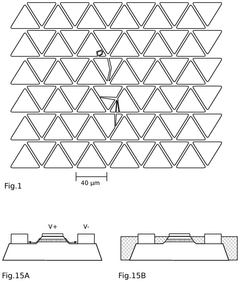
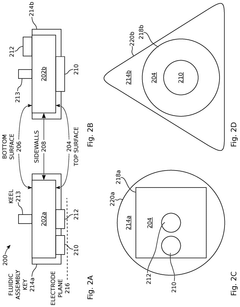
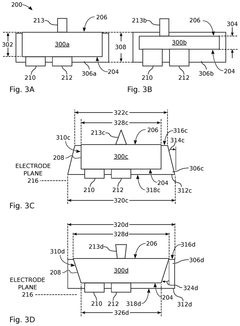
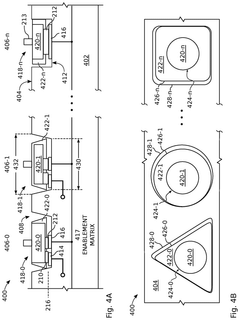
- The use of partially encapsulated semiconductor-based inorganic micro-LEDs with a patternable polymer encapsulant that protects the LEDs from collisions and optimizes their shape for efficient assembly, allowing for higher speed and yield while preventing defects, and enabling precise alignment of LED colors on a display substrate.
Power Efficiency Comparison
Power efficiency stands as a critical factor in wearable technology, directly impacting device runtime, charging frequency, and overall user experience. OLED (Organic Light Emitting Diode) technology has dominated the wearable display market primarily due to its power-efficient characteristics. OLED displays consume power only for illuminated pixels, resulting in significant energy savings when displaying darker content or utilizing dark mode interfaces—a common strategy in wearable UI design.
Quantitative measurements indicate that OLED displays in wearables typically consume between 0.1-0.3 watts during normal operation, with power consumption dropping by up to 60% when displaying predominantly black screens. This self-emissive property gives OLED a distinct advantage in battery-constrained wearable devices.
MicroLED technology, while relatively newer to commercial wearables, demonstrates promising power efficiency metrics that potentially surpass OLED capabilities. Laboratory tests show MicroLED displays achieving 30-50% greater power efficiency compared to equivalent OLED panels under similar brightness conditions. This efficiency stems from MicroLED's higher luminance efficiency and reduced current leakage.
The power consumption differential becomes particularly pronounced in high-brightness scenarios. When operating at 1000 nits brightness—often necessary for outdoor visibility—MicroLED displays maintain their efficiency advantage, whereas OLED displays experience exponential power consumption increases at higher brightness levels.
Thermal characteristics further differentiate these technologies. OLED displays generate more heat during operation, requiring additional power management systems that indirectly increase overall power consumption. MicroLED's superior thermal performance reduces this auxiliary power requirement, contributing to its efficiency advantage in extended usage scenarios.
Battery life implications are substantial: wearable devices utilizing MicroLED technology could theoretically extend operation time by 25-40% compared to OLED equivalents, assuming identical battery capacity. This translates to potentially extending a typical smartwatch's 1-2 day battery life to 1.5-3 days between charges.
However, current MicroLED implementation challenges partially offset these efficiency gains. The complex driving circuitry required for MicroLED displays currently consumes additional power compared to OLED driver systems. As manufacturing processes mature, this gap is expected to narrow, further enhancing MicroLED's efficiency advantage.
For always-on display features—increasingly standard in modern wearables—MicroLED offers particular promise. Its ability to operate efficiently at very low brightness levels while maintaining color accuracy could reduce the power consumption of always-on displays by up to 70% compared to current OLED implementations.
Quantitative measurements indicate that OLED displays in wearables typically consume between 0.1-0.3 watts during normal operation, with power consumption dropping by up to 60% when displaying predominantly black screens. This self-emissive property gives OLED a distinct advantage in battery-constrained wearable devices.
MicroLED technology, while relatively newer to commercial wearables, demonstrates promising power efficiency metrics that potentially surpass OLED capabilities. Laboratory tests show MicroLED displays achieving 30-50% greater power efficiency compared to equivalent OLED panels under similar brightness conditions. This efficiency stems from MicroLED's higher luminance efficiency and reduced current leakage.
The power consumption differential becomes particularly pronounced in high-brightness scenarios. When operating at 1000 nits brightness—often necessary for outdoor visibility—MicroLED displays maintain their efficiency advantage, whereas OLED displays experience exponential power consumption increases at higher brightness levels.
Thermal characteristics further differentiate these technologies. OLED displays generate more heat during operation, requiring additional power management systems that indirectly increase overall power consumption. MicroLED's superior thermal performance reduces this auxiliary power requirement, contributing to its efficiency advantage in extended usage scenarios.
Battery life implications are substantial: wearable devices utilizing MicroLED technology could theoretically extend operation time by 25-40% compared to OLED equivalents, assuming identical battery capacity. This translates to potentially extending a typical smartwatch's 1-2 day battery life to 1.5-3 days between charges.
However, current MicroLED implementation challenges partially offset these efficiency gains. The complex driving circuitry required for MicroLED displays currently consumes additional power compared to OLED driver systems. As manufacturing processes mature, this gap is expected to narrow, further enhancing MicroLED's efficiency advantage.
For always-on display features—increasingly standard in modern wearables—MicroLED offers particular promise. Its ability to operate efficiently at very low brightness levels while maintaining color accuracy could reduce the power consumption of always-on displays by up to 70% compared to current OLED implementations.
Manufacturing Scalability Assessment
Manufacturing scalability represents a critical factor in determining the commercial viability of display technologies for wearable devices. OLED manufacturing has reached significant maturity over the past decade, with established production lines and optimized processes that enable economies of scale. Major manufacturers like Samsung and LG Display have invested billions in OLED fabrication facilities, resulting in high yield rates exceeding 80% for small form factor displays suitable for wearables.
In contrast, MicroLED manufacturing remains in its nascent stages, facing considerable challenges in mass production. The primary bottleneck lies in the transfer process - moving millions of microscopic LED chips from the source wafer to the display substrate with perfect precision. Current pick-and-place methods are time-consuming and expensive, with transfer yields below 50% for ultra-high-resolution displays required in wearables.
Cost analysis reveals that OLED production costs have decreased by approximately 35% over the past five years due to manufacturing optimizations and increased yields. The average production cost for a small OLED display suitable for wearables ranges from $5-15 depending on specifications. MicroLED displays, however, currently cost 5-10 times more to manufacture at comparable volumes, primarily due to complex assembly processes and lower yields.
Equipment requirements also differ significantly between technologies. OLED manufacturing relies on established vapor deposition systems and encapsulation technologies, with equipment costs amortized across large production volumes. MicroLED requires specialized transfer equipment and inspection systems that remain prohibitively expensive for all but the largest manufacturers, creating a significant barrier to entry for smaller players.
Looking forward, several promising approaches may improve MicroLED manufacturing scalability. Mass transfer techniques using elastomer stamps or laser-assisted methods show potential for handling thousands of microLEDs simultaneously. Additionally, fluidic self-assembly approaches, where microLEDs self-align in predefined locations, could dramatically reduce assembly complexity and costs.
The timeline for manufacturing parity remains uncertain. Industry analysts project that MicroLED manufacturing costs for wearable-sized displays may approach OLED levels within 5-7 years, contingent upon significant breakthroughs in transfer technology and continued investment in production infrastructure. Until then, OLED will likely maintain its dominant position in the wearable display market due to its manufacturing maturity and cost advantages.
In contrast, MicroLED manufacturing remains in its nascent stages, facing considerable challenges in mass production. The primary bottleneck lies in the transfer process - moving millions of microscopic LED chips from the source wafer to the display substrate with perfect precision. Current pick-and-place methods are time-consuming and expensive, with transfer yields below 50% for ultra-high-resolution displays required in wearables.
Cost analysis reveals that OLED production costs have decreased by approximately 35% over the past five years due to manufacturing optimizations and increased yields. The average production cost for a small OLED display suitable for wearables ranges from $5-15 depending on specifications. MicroLED displays, however, currently cost 5-10 times more to manufacture at comparable volumes, primarily due to complex assembly processes and lower yields.
Equipment requirements also differ significantly between technologies. OLED manufacturing relies on established vapor deposition systems and encapsulation technologies, with equipment costs amortized across large production volumes. MicroLED requires specialized transfer equipment and inspection systems that remain prohibitively expensive for all but the largest manufacturers, creating a significant barrier to entry for smaller players.
Looking forward, several promising approaches may improve MicroLED manufacturing scalability. Mass transfer techniques using elastomer stamps or laser-assisted methods show potential for handling thousands of microLEDs simultaneously. Additionally, fluidic self-assembly approaches, where microLEDs self-align in predefined locations, could dramatically reduce assembly complexity and costs.
The timeline for manufacturing parity remains uncertain. Industry analysts project that MicroLED manufacturing costs for wearable-sized displays may approach OLED levels within 5-7 years, contingent upon significant breakthroughs in transfer technology and continued investment in production infrastructure. Until then, OLED will likely maintain its dominant position in the wearable display market due to its manufacturing maturity and cost advantages.
Unlock deeper insights with Patsnap Eureka Quick Research — get a full tech report to explore trends and direct your research. Try now!
Generate Your Research Report Instantly with AI Agent
Supercharge your innovation with Patsnap Eureka AI Agent Platform!