OLED vs MicroLED: Market Dynamics and Innovations
OCT 24, 20259 MIN READ
Generate Your Research Report Instantly with AI Agent
PatSnap Eureka helps you evaluate technical feasibility & market potential.
Display Technology Evolution and Objectives
Display technology has undergone remarkable evolution since the introduction of cathode ray tubes (CRTs) in the early 20th century. The progression from CRTs to liquid crystal displays (LCDs) marked the first major shift toward flatter, more energy-efficient screens. This transition established the foundation for subsequent innovations in display technology, setting expectations for continuous improvements in visual quality, form factor, and energy efficiency.
The emergence of organic light-emitting diode (OLED) technology in the late 1990s represented a paradigm shift in display capabilities. Unlike LCDs that require backlighting, OLED pixels emit their own light when electrical current passes through organic compounds. This self-emissive property enabled thinner displays, perfect blacks, and superior contrast ratios, revolutionizing both mobile device and television markets.
While OLED technology continues to mature, MicroLED has emerged as a promising next-generation display technology. Developed initially for specialized applications, MicroLED utilizes microscopic inorganic LED arrays that offer unprecedented brightness, energy efficiency, and longevity. The technology promises to overcome several limitations of OLED, particularly in terms of brightness capabilities and screen burn-in issues.
The technical objectives driving display technology evolution focus on several key parameters: visual performance (resolution, color gamut, contrast ratio), form factor (thickness, flexibility), energy efficiency, longevity, and manufacturing scalability. Both OLED and MicroLED technologies represent different approaches to addressing these objectives, with distinct advantages and challenges in each category.
Current technical goals in the display industry include achieving higher pixel densities exceeding 1000 PPI (pixels per inch), expanding color gamut coverage beyond 95% of Rec. 2020 standards, reducing power consumption while maintaining brightness levels, and developing manufacturing processes that enable cost-effective production at scale. Additionally, there is significant focus on enabling novel form factors such as foldable, rollable, and transparent displays.
The evolution trajectory suggests convergence toward displays that combine the best attributes of both technologies: the perfect blacks and wide viewing angles of OLED with the brightness, efficiency, and longevity of MicroLED. This convergence is driving research into hybrid approaches and alternative materials that might deliver superior performance across all parameters.
Understanding this evolutionary context is essential for evaluating the current competitive dynamics between OLED and MicroLED technologies, as well as for predicting future innovation pathways that might disrupt the established trajectory. The technical objectives established through this evolution continue to guide research priorities and market positioning strategies for display manufacturers worldwide.
The emergence of organic light-emitting diode (OLED) technology in the late 1990s represented a paradigm shift in display capabilities. Unlike LCDs that require backlighting, OLED pixels emit their own light when electrical current passes through organic compounds. This self-emissive property enabled thinner displays, perfect blacks, and superior contrast ratios, revolutionizing both mobile device and television markets.
While OLED technology continues to mature, MicroLED has emerged as a promising next-generation display technology. Developed initially for specialized applications, MicroLED utilizes microscopic inorganic LED arrays that offer unprecedented brightness, energy efficiency, and longevity. The technology promises to overcome several limitations of OLED, particularly in terms of brightness capabilities and screen burn-in issues.
The technical objectives driving display technology evolution focus on several key parameters: visual performance (resolution, color gamut, contrast ratio), form factor (thickness, flexibility), energy efficiency, longevity, and manufacturing scalability. Both OLED and MicroLED technologies represent different approaches to addressing these objectives, with distinct advantages and challenges in each category.
Current technical goals in the display industry include achieving higher pixel densities exceeding 1000 PPI (pixels per inch), expanding color gamut coverage beyond 95% of Rec. 2020 standards, reducing power consumption while maintaining brightness levels, and developing manufacturing processes that enable cost-effective production at scale. Additionally, there is significant focus on enabling novel form factors such as foldable, rollable, and transparent displays.
The evolution trajectory suggests convergence toward displays that combine the best attributes of both technologies: the perfect blacks and wide viewing angles of OLED with the brightness, efficiency, and longevity of MicroLED. This convergence is driving research into hybrid approaches and alternative materials that might deliver superior performance across all parameters.
Understanding this evolutionary context is essential for evaluating the current competitive dynamics between OLED and MicroLED technologies, as well as for predicting future innovation pathways that might disrupt the established trajectory. The technical objectives established through this evolution continue to guide research priorities and market positioning strategies for display manufacturers worldwide.
Market Analysis for OLED and MicroLED Displays
The display technology market is witnessing a significant shift as OLED (Organic Light Emitting Diode) and MicroLED technologies compete for dominance across various application segments. Currently, the global display market is valued at approximately $150 billion, with OLED displays accounting for around $40 billion of this total. This segment has been growing at a compound annual growth rate of 15% over the past five years, primarily driven by smartphone and premium television applications.
Consumer electronics remains the largest application sector for OLED technology, with smartphones representing nearly 70% of all OLED panel shipments. Samsung and Apple are the leading adopters, with Samsung Display controlling roughly 45% of the global OLED production capacity. The automotive display market is emerging as a high-growth segment for OLED, expected to expand at over 20% annually through 2027 as luxury vehicles increasingly incorporate these displays in dashboards and entertainment systems.
MicroLED technology, while still in its early commercialization phase, is projected to grow from its current market size of approximately $600 million to reach $10 billion by 2026. This represents an extraordinary CAGR of 75%, albeit from a much smaller base than OLED. The initial market penetration for MicroLED has focused on ultra-premium large-format displays and specialized applications where its superior brightness and efficiency justify the higher production costs.
Regional analysis reveals Asia-Pacific as the manufacturing powerhouse, with South Korea, Japan, and Taiwan collectively accounting for over 80% of global OLED production capacity. China is rapidly expanding its presence, with significant investments in both OLED and MicroLED manufacturing infrastructure. North America and Europe remain important markets for consumption but have limited production capabilities, primarily focused on specialized applications and R&D.
Price trends show OLED display costs declining at approximately 10-15% annually as manufacturing processes mature and yields improve. MicroLED displays currently command a substantial premium, costing 5-10 times more than equivalent OLED panels, though this gap is expected to narrow as production scales and manufacturing techniques advance.
Market forecasts indicate OLED technology will maintain its dominant position in mid-to-premium range devices through 2025, while MicroLED will gradually capture market share in ultra-premium segments where performance characteristics outweigh cost considerations. The overall display market is expected to reach $200 billion by 2027, with next-generation technologies including OLED and MicroLED accounting for an increasing proportion of this value.
Consumer electronics remains the largest application sector for OLED technology, with smartphones representing nearly 70% of all OLED panel shipments. Samsung and Apple are the leading adopters, with Samsung Display controlling roughly 45% of the global OLED production capacity. The automotive display market is emerging as a high-growth segment for OLED, expected to expand at over 20% annually through 2027 as luxury vehicles increasingly incorporate these displays in dashboards and entertainment systems.
MicroLED technology, while still in its early commercialization phase, is projected to grow from its current market size of approximately $600 million to reach $10 billion by 2026. This represents an extraordinary CAGR of 75%, albeit from a much smaller base than OLED. The initial market penetration for MicroLED has focused on ultra-premium large-format displays and specialized applications where its superior brightness and efficiency justify the higher production costs.
Regional analysis reveals Asia-Pacific as the manufacturing powerhouse, with South Korea, Japan, and Taiwan collectively accounting for over 80% of global OLED production capacity. China is rapidly expanding its presence, with significant investments in both OLED and MicroLED manufacturing infrastructure. North America and Europe remain important markets for consumption but have limited production capabilities, primarily focused on specialized applications and R&D.
Price trends show OLED display costs declining at approximately 10-15% annually as manufacturing processes mature and yields improve. MicroLED displays currently command a substantial premium, costing 5-10 times more than equivalent OLED panels, though this gap is expected to narrow as production scales and manufacturing techniques advance.
Market forecasts indicate OLED technology will maintain its dominant position in mid-to-premium range devices through 2025, while MicroLED will gradually capture market share in ultra-premium segments where performance characteristics outweigh cost considerations. The overall display market is expected to reach $200 billion by 2027, with next-generation technologies including OLED and MicroLED accounting for an increasing proportion of this value.
Technical Challenges and Development Status
OLED technology currently dominates the high-end display market, but faces significant technical challenges. Manufacturing yield rates remain problematic, particularly for larger panels, with complex processes leading to high defect rates and increased costs. OLED displays also suffer from limited lifespans, with blue organic materials degrading faster than red and green counterparts, causing color shift over time. This differential aging presents a major hurdle for applications requiring long-term color accuracy.
Burn-in issues persist despite mitigation efforts, especially in static interface elements. Power efficiency, while improved, still presents challenges at high brightness levels, impacting battery life in portable devices. OLED's organic nature also makes it vulnerable to moisture and oxygen, necessitating complex encapsulation techniques that add to production complexity and cost.
MicroLED technology, though promising, faces even more formidable manufacturing challenges. Mass transfer of millions of microscopic LED chips remains the primary bottleneck, with current pick-and-place methods proving too slow for commercial viability. Yield management is exceptionally difficult due to the "perfect yield" requirement—a single defective LED among millions creates a visible dead pixel.
Color consistency across millions of individual LEDs presents another significant challenge, requiring sophisticated binning and compensation techniques. MicroLED also faces integration challenges with driving circuits, particularly as pixel densities increase. The technology currently struggles with cost-effectiveness at scale, with estimates suggesting MicroLED displays cost 10-20 times more than equivalent OLED panels.
Globally, South Korea leads OLED development through Samsung and LG Display, while Taiwan and China are rapidly expanding capacity. For MicroLED, research centers in the United States, Taiwan, and South Korea are advancing the technology, with companies like Apple, Samsung, and Sony making significant investments.
The development status shows OLED as a mature technology with ongoing incremental improvements in manufacturing efficiency and material longevity. MicroLED remains primarily in the research and early commercialization phase, with limited product releases targeting premium segments. Industry experts project that MicroLED will require 3-5 more years of development before achieving broader market viability, particularly for consumer electronics applications requiring higher pixel densities and lower production costs.
Burn-in issues persist despite mitigation efforts, especially in static interface elements. Power efficiency, while improved, still presents challenges at high brightness levels, impacting battery life in portable devices. OLED's organic nature also makes it vulnerable to moisture and oxygen, necessitating complex encapsulation techniques that add to production complexity and cost.
MicroLED technology, though promising, faces even more formidable manufacturing challenges. Mass transfer of millions of microscopic LED chips remains the primary bottleneck, with current pick-and-place methods proving too slow for commercial viability. Yield management is exceptionally difficult due to the "perfect yield" requirement—a single defective LED among millions creates a visible dead pixel.
Color consistency across millions of individual LEDs presents another significant challenge, requiring sophisticated binning and compensation techniques. MicroLED also faces integration challenges with driving circuits, particularly as pixel densities increase. The technology currently struggles with cost-effectiveness at scale, with estimates suggesting MicroLED displays cost 10-20 times more than equivalent OLED panels.
Globally, South Korea leads OLED development through Samsung and LG Display, while Taiwan and China are rapidly expanding capacity. For MicroLED, research centers in the United States, Taiwan, and South Korea are advancing the technology, with companies like Apple, Samsung, and Sony making significant investments.
The development status shows OLED as a mature technology with ongoing incremental improvements in manufacturing efficiency and material longevity. MicroLED remains primarily in the research and early commercialization phase, with limited product releases targeting premium segments. Industry experts project that MicroLED will require 3-5 more years of development before achieving broader market viability, particularly for consumer electronics applications requiring higher pixel densities and lower production costs.
Current Implementation Approaches
01 OLED display technology advancements
OLED (Organic Light Emitting Diode) technology has seen significant advancements in recent years, offering superior display quality with deeper blacks, higher contrast ratios, and better energy efficiency compared to traditional LCD displays. These displays are thinner, lighter, and can be made flexible or transparent. Recent innovations focus on improving OLED lifespan, reducing power consumption, and enhancing color accuracy for applications in smartphones, televisions, and wearable devices.- OLED display technology advancements: Recent innovations in OLED (Organic Light Emitting Diode) display technology have led to significant improvements in display quality, energy efficiency, and form factor flexibility. These advancements include thinner panels, enhanced color accuracy, and improved brightness levels. OLED technology enables manufacturers to create flexible and foldable displays, opening new possibilities for device design and user interaction. The technology continues to evolve with focus on reducing power consumption while maintaining superior visual performance.
- MicroLED display innovations: MicroLED technology represents the next generation of display innovation, offering superior brightness, contrast ratios, and energy efficiency compared to traditional display technologies. These displays utilize microscopic LED arrays that are self-emissive, resulting in deeper blacks and more vibrant colors. Recent innovations focus on overcoming manufacturing challenges related to mass transfer of tiny LED components and improving yield rates. MicroLED displays promise longer lifespans, faster response times, and potential applications in various devices from smartphones to large-format displays.
- Market dynamics and competitive landscape: The display technology market is experiencing rapid transformation with OLED and MicroLED technologies competing for market share. While OLED has gained significant traction in premium smartphones and high-end televisions, MicroLED is positioned as a future competitor with superior technical specifications. Market analysis indicates growing consumer demand for higher resolution, energy-efficient displays with improved color accuracy. Regional manufacturing hubs in East Asia continue to dominate production, with significant investments in new manufacturing facilities to meet increasing demand.
- Integration with smart devices and IoT ecosystems: Advanced display technologies are increasingly being integrated with smart devices and Internet of Things (IoT) ecosystems. This integration enables enhanced user interfaces, ambient information display, and new interaction paradigms. Innovations include displays that can communicate with other connected devices, adaptive brightness based on environmental conditions, and context-aware content presentation. These advancements support the development of more intuitive and responsive user experiences across various applications including smart homes, wearable technology, and automotive displays.
- Energy efficiency and sustainability improvements: Recent innovations in both OLED and MicroLED technologies have focused on improving energy efficiency and sustainability aspects of display manufacturing and operation. These improvements include reduced power consumption during operation, more environmentally friendly production processes, and extended product lifespans. Manufacturers are developing displays that require less energy while maintaining or improving visual performance. Additionally, research is ongoing to reduce the use of rare earth elements and develop more recyclable display components to address environmental concerns in the electronics industry.
02 MicroLED display technology innovations
MicroLED displays represent the next generation of display technology, offering higher brightness, better energy efficiency, and longer lifespans than OLED. These displays use microscopic LED arrays that are self-emissive, providing pixel-level control similar to OLED but with superior performance characteristics. Recent innovations focus on manufacturing processes to reduce production costs, improve yield rates, and enable mass production of MicroLED displays for consumer electronics.Expand Specific Solutions03 Market dynamics and competitive landscape
The display technology market is experiencing rapid evolution with OLED and MicroLED technologies competing for market share. OLED currently dominates the premium segment, while MicroLED is positioned as the future technology. Market dynamics are influenced by factors such as manufacturing costs, supply chain constraints, and consumer preferences. Major electronics manufacturers are investing heavily in both technologies to secure competitive advantages in consumer electronics, automotive displays, and professional applications.Expand Specific Solutions04 Integration with smart devices and IoT
OLED and MicroLED display technologies are increasingly being integrated with smart devices and Internet of Things (IoT) ecosystems. These advanced displays enable new user interface paradigms, enhanced visual feedback, and improved user experiences in smart homes, wearables, and connected devices. Innovations focus on low-power operation modes, ambient light adaptation, and seamless integration with touch and gesture recognition technologies to create more intuitive and responsive user interfaces.Expand Specific Solutions05 Manufacturing processes and yield improvement
Significant innovations are occurring in manufacturing processes for both OLED and MicroLED displays to improve yield rates and reduce production costs. For OLED, advancements in vapor deposition techniques and encapsulation methods are extending display lifespans. For MicroLED, mass transfer techniques and inspection systems are being developed to enable efficient placement of millions of microscopic LEDs. These manufacturing innovations are critical for wider adoption of these advanced display technologies across various price segments.Expand Specific Solutions
Key Industry Players and Ecosystem
The OLED vs MicroLED market is currently in a transitional phase, with OLED technology reaching maturity while MicroLED remains in early commercialization. The global display market is projected to exceed $150 billion by 2025, with OLED dominating premium segments. Samsung and BOE Technology lead OLED production, while companies like Lumileds, Chengdu Vistar, and Samsung are advancing MicroLED technology. Chinese manufacturers including TCL China Star and BOE are rapidly expanding capacity, while established players like Applied Materials provide critical manufacturing equipment. The competitive landscape shows regional clustering with East Asian companies (particularly from China and South Korea) controlling significant market share in both technologies, though MicroLED presents opportunities for new entrants due to its nascent development stage.
BOE Technology Group Co., Ltd.
Technical Solution: BOE has developed a dual-track strategy in display technologies, advancing both OLED and MicroLED simultaneously. For OLED, BOE has established multiple production lines with a total capacity exceeding 100 million smartphone-sized panels annually. Their flexible OLED technology achieves pixel densities up to 700 PPI with HDR10+ certification. In the MicroLED space, BOE has pioneered chip-scale packaging technology that enables sub-40μm LED chips with 99.99% transfer yield rates. Their proprietary "active matrix driving architecture" allows for individual pixel control with 10-bit color depth across MicroLED displays ranging from smartphone-sized to large video walls. BOE has also developed a hybrid RGB+Mini LED backlight technology as a transitional solution, offering improved contrast ratios of 1,000,000:1 while their pure MicroLED displays achieve brightness levels exceeding 2,000 nits with power efficiency improvements of 30% compared to traditional LCD displays.
Strengths: Vertical integration across the supply chain gives BOE control over key components and manufacturing processes. Their massive production capacity enables economies of scale. Weaknesses: Their MicroLED technology still faces cost challenges for mass market adoption, with current costs approximately 5x higher than premium OLED displays.
Samsung Electronics Co., Ltd.
Technical Solution: Samsung has established itself as the global leader in both OLED and MicroLED technologies. Their OLED division produces over 300 million smartphone panels annually with their latest QD-OLED technology achieving 1,500 nits peak brightness and 0.0005 nits black levels. Samsung's MicroLED initiative centers around their modular "The Wall" technology, featuring LED chips smaller than 50μm that can be assembled into seamless displays of virtually any size. Their proprietary mass transfer process achieves placement accuracy within 1μm and yields exceeding 99.9%. Samsung has recently developed a breakthrough in MicroLED manufacturing using a new "nanorod LED" architecture that reduces production costs by approximately 40% while improving energy efficiency by 25%. Their latest MicroLED displays feature response times under 1ms, color gamut coverage of 140% DCI-P3, and lifespans rated for over 100,000 hours with minimal brightness degradation. Samsung's hybrid approach includes transitional technologies like their Neo QLED that incorporates Mini LED backlighting as a stepping stone toward full MicroLED adoption.
Strengths: Unmatched vertical integration from semiconductor fabrication to final display assembly gives Samsung complete control over the supply chain. Their massive R&D budget (over $15 billion annually) allows for rapid innovation. Weaknesses: Their premium MicroLED displays remain prohibitively expensive for consumer markets, with current costs approximately 10x higher than equivalent-sized premium TVs.
Patent Landscape and Technical Breakthroughs
Anisotropic conductive film and display device
PatentActiveUS20220102326A1
Innovation
- An anisotropic conductive film with a first region of discretely arranged conductive particles corresponding to electrode patterns and a second region with aggregated conductive particles acting as an alignment marker, facilitating easy alignment with the circuit substrate and reducing production costs by forming alignment markers through conductive particle dispersion.
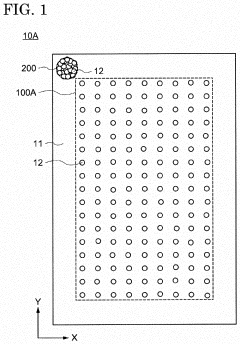
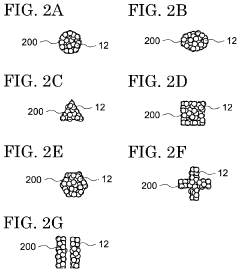
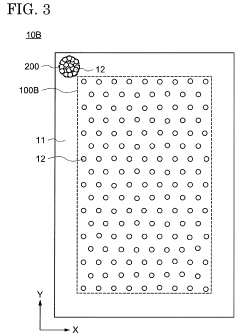
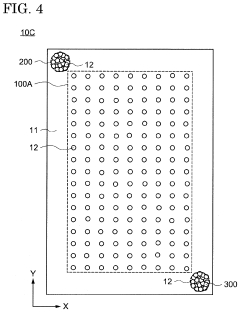
LED display and electronic device having same
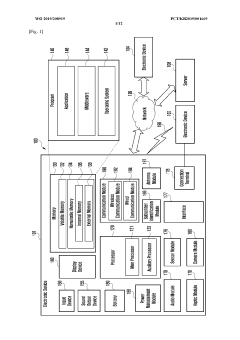
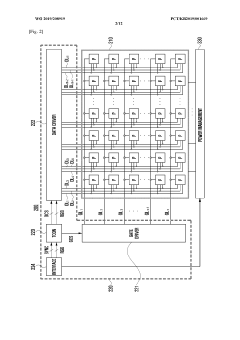
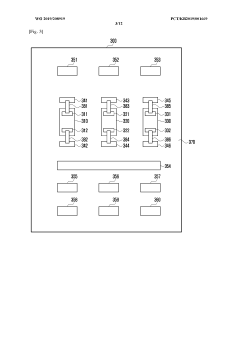
PatentWO2019208919A1
Innovation
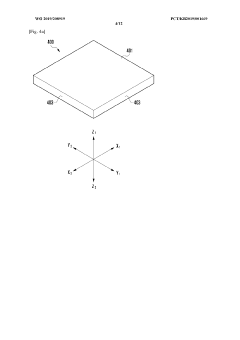
- The development of a micro-LED display with a bezel-less design and segmentation capabilities, allowing for flexible displays of various sizes, achieved through direct mounting of micro-LEDs on a substrate and innovative electrical connections using conductive patterns and wiring lines, enabling robust electrical connections and flexible display configurations.
Supply Chain Analysis
The OLED and MicroLED supply chains represent distinctly different ecosystems with varying levels of maturity and complexity. OLED manufacturing has established a relatively mature supply chain over the past decade, dominated by key players like Samsung Display, LG Display, and BOE Technology. These manufacturers have developed sophisticated production capabilities for both rigid and flexible OLED panels, with South Korea maintaining leadership in high-end applications while Chinese manufacturers rapidly expand capacity for mid-range markets.
The OLED supply chain faces ongoing challenges in materials sourcing, particularly for critical components like organic light-emitting materials and thin-film transistor backplanes. Companies like Universal Display Corporation and Merck have established strong positions in providing these specialized materials, creating potential bottlenecks and price dependencies for panel manufacturers.
In contrast, the MicroLED supply chain remains in its nascent stages, characterized by fragmentation and technological uncertainty. The production process requires expertise across multiple domains including LED epitaxy, mass transfer technologies, and backplane integration. This complexity has resulted in a diverse ecosystem of specialized players rather than end-to-end manufacturers.
Key MicroLED supply chain challenges include the mass transfer of millions of microscopic LED chips with near-perfect yield rates and the development of cost-effective inspection and repair processes. Companies like PlayNitride, JBD, and Plessey Semiconductors have emerged as important suppliers of MicroLED chips, while equipment manufacturers like ASM Pacific Technology and Kulicke & Soffa are developing specialized placement tools.
The geographical distribution of these supply chains also differs significantly. OLED manufacturing capacity is heavily concentrated in East Asia, particularly South Korea, China, and Japan. MicroLED development shows a more globally distributed pattern with significant research and production activities in North America, Europe, and Asia, reflecting its earlier stage of commercialization.
Both technologies face supply constraints in semiconductor materials, particularly as they compete with other industries for manufacturing capacity. However, MicroLED's reliance on gallium nitride substrates presents unique sourcing challenges compared to OLED's organic material requirements, potentially affecting scaling capabilities and production costs as market demand increases.
The OLED supply chain faces ongoing challenges in materials sourcing, particularly for critical components like organic light-emitting materials and thin-film transistor backplanes. Companies like Universal Display Corporation and Merck have established strong positions in providing these specialized materials, creating potential bottlenecks and price dependencies for panel manufacturers.
In contrast, the MicroLED supply chain remains in its nascent stages, characterized by fragmentation and technological uncertainty. The production process requires expertise across multiple domains including LED epitaxy, mass transfer technologies, and backplane integration. This complexity has resulted in a diverse ecosystem of specialized players rather than end-to-end manufacturers.
Key MicroLED supply chain challenges include the mass transfer of millions of microscopic LED chips with near-perfect yield rates and the development of cost-effective inspection and repair processes. Companies like PlayNitride, JBD, and Plessey Semiconductors have emerged as important suppliers of MicroLED chips, while equipment manufacturers like ASM Pacific Technology and Kulicke & Soffa are developing specialized placement tools.
The geographical distribution of these supply chains also differs significantly. OLED manufacturing capacity is heavily concentrated in East Asia, particularly South Korea, China, and Japan. MicroLED development shows a more globally distributed pattern with significant research and production activities in North America, Europe, and Asia, reflecting its earlier stage of commercialization.
Both technologies face supply constraints in semiconductor materials, particularly as they compete with other industries for manufacturing capacity. However, MicroLED's reliance on gallium nitride substrates presents unique sourcing challenges compared to OLED's organic material requirements, potentially affecting scaling capabilities and production costs as market demand increases.
Environmental Impact and Sustainability
The environmental footprint of display technologies has become increasingly important as sustainability concerns rise across industries. OLED and MicroLED technologies present distinct environmental profiles throughout their lifecycles, from raw material extraction to end-of-life disposal.
OLED displays generally consume less power than traditional LCD screens, particularly when displaying darker content, as individual pixels can be turned off completely. However, their production involves several environmentally challenging aspects. The manufacturing process requires rare earth elements and precious metals, whose extraction causes significant environmental degradation. Additionally, OLED production utilizes organic solvents and chemicals that can be hazardous if not properly managed.
MicroLED technology offers potentially superior environmental credentials in the usage phase. These displays demonstrate exceptional energy efficiency across all brightness levels, with some studies suggesting up to 30% lower power consumption compared to OLEDs when displaying mixed content. This efficiency translates to reduced carbon emissions over the product lifetime, particularly for large-format displays and digital signage applications.
The manufacturing environmental impact of MicroLED remains substantial, however. The production process is highly complex, requiring precision equipment and clean room environments that consume significant energy. The technology also relies on gallium nitride semiconductors, which involve energy-intensive production methods. Current manufacturing yields for MicroLED remain lower than established technologies, resulting in material waste that compounds environmental concerns.
Recycling presents challenges for both technologies. OLED panels contain organic compounds that degrade over time and are difficult to recycle effectively. MicroLED displays, while containing valuable recoverable materials, present recycling complexities due to their miniaturized components and integrated design. The industry has yet to develop cost-effective recycling processes for either technology at scale.
Several manufacturers are addressing these sustainability challenges. Samsung and LG have implemented closed-loop manufacturing systems for their display technologies, while Apple has committed to using recycled rare earth elements in their display components. Industry consortiums are also developing standardized approaches to display recycling to improve end-of-life management.
Regulatory frameworks increasingly influence environmental considerations in display technology. The European Union's Restriction of Hazardous Substances (RoHS) directive and similar regulations worldwide have pushed manufacturers toward less toxic materials and more sustainable production methods. Carbon pricing mechanisms in various markets are also incentivizing energy efficiency improvements throughout the display supply chain.
OLED displays generally consume less power than traditional LCD screens, particularly when displaying darker content, as individual pixels can be turned off completely. However, their production involves several environmentally challenging aspects. The manufacturing process requires rare earth elements and precious metals, whose extraction causes significant environmental degradation. Additionally, OLED production utilizes organic solvents and chemicals that can be hazardous if not properly managed.
MicroLED technology offers potentially superior environmental credentials in the usage phase. These displays demonstrate exceptional energy efficiency across all brightness levels, with some studies suggesting up to 30% lower power consumption compared to OLEDs when displaying mixed content. This efficiency translates to reduced carbon emissions over the product lifetime, particularly for large-format displays and digital signage applications.
The manufacturing environmental impact of MicroLED remains substantial, however. The production process is highly complex, requiring precision equipment and clean room environments that consume significant energy. The technology also relies on gallium nitride semiconductors, which involve energy-intensive production methods. Current manufacturing yields for MicroLED remain lower than established technologies, resulting in material waste that compounds environmental concerns.
Recycling presents challenges for both technologies. OLED panels contain organic compounds that degrade over time and are difficult to recycle effectively. MicroLED displays, while containing valuable recoverable materials, present recycling complexities due to their miniaturized components and integrated design. The industry has yet to develop cost-effective recycling processes for either technology at scale.
Several manufacturers are addressing these sustainability challenges. Samsung and LG have implemented closed-loop manufacturing systems for their display technologies, while Apple has committed to using recycled rare earth elements in their display components. Industry consortiums are also developing standardized approaches to display recycling to improve end-of-life management.
Regulatory frameworks increasingly influence environmental considerations in display technology. The European Union's Restriction of Hazardous Substances (RoHS) directive and similar regulations worldwide have pushed manufacturers toward less toxic materials and more sustainable production methods. Carbon pricing mechanisms in various markets are also incentivizing energy efficiency improvements throughout the display supply chain.
Unlock deeper insights with PatSnap Eureka Quick Research — get a full tech report to explore trends and direct your research. Try now!
Generate Your Research Report Instantly with AI Agent
Supercharge your innovation with PatSnap Eureka AI Agent Platform!