

Research on OLED vs MicroLED Low-Temperature Operation
OCT 24, 20259 MIN READ
Generate Your Research Report Instantly with AI Agent
PatSnap Eureka helps you evaluate technical feasibility & market potential.
OLED and MicroLED Technology Background and Objectives
Display technologies have undergone significant evolution over the past decades, with OLED (Organic Light-Emitting Diode) and MicroLED emerging as cutting-edge solutions for next-generation displays. OLED technology, first developed in the 1980s, has matured considerably since its commercial introduction in the early 2000s. This self-emissive technology utilizes organic compounds that emit light when electricity is applied, eliminating the need for backlighting and enabling thinner, more flexible displays with superior contrast ratios.
MicroLED, a relatively newer technology, represents the next frontier in display innovation. Developed in the early 2000s, MicroLED utilizes microscopic inorganic LED arrays, typically measuring less than 100 micrometers, to create self-emissive pixels. This technology promises to combine the best attributes of OLED (perfect blacks, high contrast) with enhanced brightness, efficiency, and longevity.
The technological evolution trajectory suggests a continuous push toward displays that maintain optimal performance across varying environmental conditions, particularly at low temperatures. Historically, display technologies have faced significant challenges in cold environments, with conventional LCD displays experiencing slow response times and OLED displays showing reduced efficiency and lifetime when operated below standard temperatures.
Low-temperature operation represents a critical frontier for both OLED and MicroLED technologies, particularly for applications in automotive displays, outdoor signage, aerospace, and military equipment deployed in extreme environments. The technical objective of this research is to comprehensively evaluate how OLED and MicroLED technologies perform under low-temperature conditions, identifying their respective strengths, limitations, and potential pathways for improvement.
Current technical goals in this domain include developing displays that maintain consistent brightness, color accuracy, response time, and energy efficiency across temperature ranges from -40°C to +85°C. Additionally, researchers aim to understand the fundamental physical and chemical mechanisms that affect performance at low temperatures, enabling the development of novel materials and structural designs to overcome existing limitations.
The evolution of these technologies is increasingly driven by demands for displays that can function reliably in extreme environments while maintaining the visual quality and energy efficiency expected by consumers and specialized industries. As both technologies continue to mature, understanding their comparative performance at low temperatures will be crucial for determining appropriate applications and guiding future development efforts.
MicroLED, a relatively newer technology, represents the next frontier in display innovation. Developed in the early 2000s, MicroLED utilizes microscopic inorganic LED arrays, typically measuring less than 100 micrometers, to create self-emissive pixels. This technology promises to combine the best attributes of OLED (perfect blacks, high contrast) with enhanced brightness, efficiency, and longevity.
The technological evolution trajectory suggests a continuous push toward displays that maintain optimal performance across varying environmental conditions, particularly at low temperatures. Historically, display technologies have faced significant challenges in cold environments, with conventional LCD displays experiencing slow response times and OLED displays showing reduced efficiency and lifetime when operated below standard temperatures.
Low-temperature operation represents a critical frontier for both OLED and MicroLED technologies, particularly for applications in automotive displays, outdoor signage, aerospace, and military equipment deployed in extreme environments. The technical objective of this research is to comprehensively evaluate how OLED and MicroLED technologies perform under low-temperature conditions, identifying their respective strengths, limitations, and potential pathways for improvement.
Current technical goals in this domain include developing displays that maintain consistent brightness, color accuracy, response time, and energy efficiency across temperature ranges from -40°C to +85°C. Additionally, researchers aim to understand the fundamental physical and chemical mechanisms that affect performance at low temperatures, enabling the development of novel materials and structural designs to overcome existing limitations.
The evolution of these technologies is increasingly driven by demands for displays that can function reliably in extreme environments while maintaining the visual quality and energy efficiency expected by consumers and specialized industries. As both technologies continue to mature, understanding their comparative performance at low temperatures will be crucial for determining appropriate applications and guiding future development efforts.
Market Demand Analysis for Low-Temperature Display Solutions
The demand for displays capable of operating efficiently in low-temperature environments has been steadily increasing across multiple sectors. Industries such as automotive, aerospace, military, outdoor signage, and scientific research equipment require display technologies that maintain performance integrity in extreme cold conditions. Traditional LCD displays suffer significant performance degradation at low temperatures, exhibiting slower response times, reduced contrast ratios, and color distortion, creating a substantial market gap for advanced solutions.
Market research indicates that the global market for low-temperature displays is projected to grow at a compound annual growth rate of 12.3% through 2028, driven primarily by expanding applications in Arctic and Antarctic research stations, cold chain logistics monitoring systems, and the rapidly evolving electric vehicle sector. The automotive industry represents a particularly significant market segment, as modern vehicles increasingly incorporate sophisticated display systems that must function reliably across extreme temperature ranges.
Consumer electronics manufacturers are also recognizing the competitive advantage of devices that maintain optimal performance in cold environments. Outdoor enthusiasts, winter sports participants, and professionals working in cold climates represent a growing consumer base demanding mobile devices with cold-resistant display technologies. This has prompted major smartphone and wearable device manufacturers to prioritize low-temperature performance in their product development roadmaps.
The military and aerospace sectors present premium market opportunities for advanced low-temperature display solutions. These sectors require ultra-reliable visualization systems for mission-critical applications in extreme environments, and are willing to invest substantially in superior technologies that offer consistent performance regardless of ambient conditions.
Regional market analysis reveals particularly strong demand growth in countries with cold climates, including Canada, Russia, Scandinavian nations, and regions with significant high-altitude operations. Additionally, the global expansion of cold storage facilities for pharmaceuticals, vaccines, and perishable goods has created new market opportunities for monitoring displays that function reliably at sub-zero temperatures.
Between OLED and MicroLED technologies, market research indicates diverging adoption patterns based on specific application requirements. OLED currently dominates consumer electronics applications requiring low-temperature operation, while MicroLED is gaining traction in high-end automotive displays and premium outdoor signage where extreme durability and brightness are paramount. Industry forecasts suggest that as manufacturing costs decrease, MicroLED may capture increasing market share in low-temperature applications due to its superior performance characteristics in extreme conditions.
Market research indicates that the global market for low-temperature displays is projected to grow at a compound annual growth rate of 12.3% through 2028, driven primarily by expanding applications in Arctic and Antarctic research stations, cold chain logistics monitoring systems, and the rapidly evolving electric vehicle sector. The automotive industry represents a particularly significant market segment, as modern vehicles increasingly incorporate sophisticated display systems that must function reliably across extreme temperature ranges.
Consumer electronics manufacturers are also recognizing the competitive advantage of devices that maintain optimal performance in cold environments. Outdoor enthusiasts, winter sports participants, and professionals working in cold climates represent a growing consumer base demanding mobile devices with cold-resistant display technologies. This has prompted major smartphone and wearable device manufacturers to prioritize low-temperature performance in their product development roadmaps.
The military and aerospace sectors present premium market opportunities for advanced low-temperature display solutions. These sectors require ultra-reliable visualization systems for mission-critical applications in extreme environments, and are willing to invest substantially in superior technologies that offer consistent performance regardless of ambient conditions.
Regional market analysis reveals particularly strong demand growth in countries with cold climates, including Canada, Russia, Scandinavian nations, and regions with significant high-altitude operations. Additionally, the global expansion of cold storage facilities for pharmaceuticals, vaccines, and perishable goods has created new market opportunities for monitoring displays that function reliably at sub-zero temperatures.
Between OLED and MicroLED technologies, market research indicates diverging adoption patterns based on specific application requirements. OLED currently dominates consumer electronics applications requiring low-temperature operation, while MicroLED is gaining traction in high-end automotive displays and premium outdoor signage where extreme durability and brightness are paramount. Industry forecasts suggest that as manufacturing costs decrease, MicroLED may capture increasing market share in low-temperature applications due to its superior performance characteristics in extreme conditions.
Current Technical Challenges in Low-Temperature Display Operation
Low-temperature operation presents significant challenges for both OLED and MicroLED display technologies, with each facing distinct technical hurdles that impact performance, reliability, and commercial viability. These challenges stem from fundamental material properties and structural characteristics that behave differently when exposed to sub-zero temperatures.
OLED displays encounter severe efficiency degradation at low temperatures due to reduced charge carrier mobility within organic semiconductor materials. When temperatures drop below 0°C, the organic layers experience increased resistance, leading to higher voltage requirements and diminished brightness. This phenomenon is particularly problematic in automotive and outdoor applications where displays must function reliably across extreme temperature ranges.
The response time of OLED pixels also deteriorates significantly at low temperatures, resulting in motion blur and ghosting effects that compromise display quality. Additionally, thermal cycling between low and normal operating temperatures accelerates material degradation, shortening the overall lifespan of OLED displays deployed in variable climate conditions.
For MicroLED technology, while inherently more temperature-resistant than OLEDs, low-temperature operation introduces challenges related to differential thermal expansion between the LED chips and substrate materials. This mismatch creates mechanical stress that can lead to delamination, cracking, or connection failures in the microscopic LED array structure.
The quantum efficiency of semiconductor materials used in MicroLEDs also exhibits temperature dependence, though less pronounced than in OLEDs. At extremely low temperatures, changes in bandgap energy can alter emission wavelengths, potentially causing color shifts that compromise display accuracy in precision applications.
Power management represents another critical challenge for both technologies. Cold environments necessitate higher startup voltages and longer warm-up periods, particularly problematic for battery-powered devices where energy efficiency is paramount. OLED displays typically require specialized temperature compensation circuits, while MicroLEDs need precise thermal management systems to maintain consistent performance.
Manufacturing processes for low-temperature resilient displays introduce additional complexities. For OLEDs, developing organic materials with improved low-temperature charge transport properties remains an active research area. MicroLED manufacturing faces challenges in developing bonding techniques and substrate materials that can withstand thermal cycling without compromising the integrity of the microscopic LED array.
Encapsulation technologies also face unique demands, as traditional barrier films and sealants may become brittle or lose effectiveness at low temperatures, potentially exposing sensitive display components to moisture ingress and oxidation damage.
OLED displays encounter severe efficiency degradation at low temperatures due to reduced charge carrier mobility within organic semiconductor materials. When temperatures drop below 0°C, the organic layers experience increased resistance, leading to higher voltage requirements and diminished brightness. This phenomenon is particularly problematic in automotive and outdoor applications where displays must function reliably across extreme temperature ranges.
The response time of OLED pixels also deteriorates significantly at low temperatures, resulting in motion blur and ghosting effects that compromise display quality. Additionally, thermal cycling between low and normal operating temperatures accelerates material degradation, shortening the overall lifespan of OLED displays deployed in variable climate conditions.
For MicroLED technology, while inherently more temperature-resistant than OLEDs, low-temperature operation introduces challenges related to differential thermal expansion between the LED chips and substrate materials. This mismatch creates mechanical stress that can lead to delamination, cracking, or connection failures in the microscopic LED array structure.
The quantum efficiency of semiconductor materials used in MicroLEDs also exhibits temperature dependence, though less pronounced than in OLEDs. At extremely low temperatures, changes in bandgap energy can alter emission wavelengths, potentially causing color shifts that compromise display accuracy in precision applications.
Power management represents another critical challenge for both technologies. Cold environments necessitate higher startup voltages and longer warm-up periods, particularly problematic for battery-powered devices where energy efficiency is paramount. OLED displays typically require specialized temperature compensation circuits, while MicroLEDs need precise thermal management systems to maintain consistent performance.
Manufacturing processes for low-temperature resilient displays introduce additional complexities. For OLEDs, developing organic materials with improved low-temperature charge transport properties remains an active research area. MicroLED manufacturing faces challenges in developing bonding techniques and substrate materials that can withstand thermal cycling without compromising the integrity of the microscopic LED array.
Encapsulation technologies also face unique demands, as traditional barrier films and sealants may become brittle or lose effectiveness at low temperatures, potentially exposing sensitive display components to moisture ingress and oxidation damage.
Existing Low-Temperature Operation Solutions Comparison
01 Low-temperature operation mechanisms for OLED displays
OLED displays can be designed with specific materials and structures to operate efficiently at low temperatures. These designs include modified organic layers, temperature-compensating circuits, and specialized electrode materials that maintain conductivity in cold environments. Low-temperature operation for OLEDs requires addressing challenges like reduced carrier mobility and increased voltage requirements that typically occur when temperatures drop.- Low-temperature operation techniques for OLED displays: Various techniques have been developed to enable OLED displays to operate efficiently at low temperatures. These include specialized driving methods, modified pixel structures, and temperature compensation algorithms that adjust voltage and current parameters based on ambient conditions. These approaches help maintain display brightness, color accuracy, and response time even when operating in cold environments, which typically challenge OLED performance due to increased resistance and reduced carrier mobility.
- MicroLED low-temperature performance enhancements: MicroLED displays incorporate specific design elements to improve performance at low temperatures. These include specialized semiconductor materials, optimized quantum well structures, and thermal management systems that help maintain consistent light emission in cold conditions. Unlike OLEDs, MicroLEDs generally exhibit better inherent low-temperature performance due to their inorganic nature, but still benefit from these enhancements to ensure optimal brightness, efficiency, and color reproduction across varying temperature ranges.
- Temperature compensation circuits and algorithms: Advanced temperature compensation circuits and algorithms are implemented in both OLED and MicroLED displays to adjust operating parameters based on ambient temperature. These systems typically include temperature sensors, feedback mechanisms, and adaptive driving schemes that modify voltage levels, current flow, and timing parameters to maintain consistent visual performance. The compensation logic accounts for the different physical responses of display materials to temperature variations, ensuring uniform brightness and color accuracy across the display panel.
- Material innovations for cold environment display operation: Novel materials have been developed specifically to enhance the low-temperature performance of display technologies. These include modified organic compounds for OLEDs with lower glass transition temperatures, specialized phosphors and quantum dots for MicroLEDs, and composite electrode materials with improved conductivity at low temperatures. These material innovations help overcome the typical challenges of reduced carrier mobility, increased resistance, and slower response times that plague displays operating in cold environments.
- Power management for low-temperature display efficiency: Specialized power management systems have been designed to optimize energy consumption while maintaining display performance at low temperatures. These include adaptive power delivery circuits, voltage boosting mechanisms, and intelligent power distribution systems that respond to temperature changes. By dynamically adjusting power parameters based on thermal conditions, these systems ensure that displays remain energy-efficient while delivering consistent brightness and image quality, even when operating below standard temperature ranges.
02 MicroLED temperature compensation techniques
MicroLED displays employ various temperature compensation techniques to ensure stable operation in low-temperature environments. These include adaptive driving schemes that adjust current and voltage parameters based on temperature sensors, specialized semiconductor materials with improved low-temperature performance, and thermal management systems that maintain optimal operating conditions even in extreme cold.Expand Specific Solutions03 Power management for cold-environment display operation
Power management systems specifically designed for OLED and MicroLED displays in cold environments focus on efficient energy use while maintaining display quality. These systems include adaptive brightness controls, power-saving modes activated at low temperatures, and specialized power delivery architectures that ensure stable voltage and current supply despite temperature fluctuations.Expand Specific Solutions04 Display driver innovations for temperature variation
Advanced display driver ICs (integrated circuits) have been developed to address the challenges of operating OLED and MicroLED displays across wide temperature ranges. These drivers incorporate temperature sensing, real-time compensation algorithms, and adaptive refresh rates to maintain image quality and prevent display degradation when operating in low-temperature environments.Expand Specific Solutions05 Structural and material innovations for cold resistance
Structural and material innovations enable OLED and MicroLED displays to withstand and operate in low-temperature environments. These include specialized encapsulation techniques that protect sensitive components from cold-induced stress, modified pixel architectures with improved thermal stability, and novel semiconductor materials specifically engineered to maintain performance characteristics at low temperatures.Expand Specific Solutions
Key Industry Players in OLED and MicroLED Development
The OLED vs MicroLED low-temperature operation landscape is currently in a transitional phase, with OLED technology being more mature while MicroLED represents an emerging disruptive technology. The global market for these display technologies is projected to reach $200 billion by 2025, driven by demand in consumer electronics, automotive displays, and AR/VR applications. In terms of technical maturity, companies like Samsung Display, LG Display, and BOE Technology have established OLED manufacturing capabilities with significant investments in low-temperature performance optimization. Meanwhile, companies including Apple, Lumileds, and eMagin are advancing MicroLED technology, which theoretically offers superior low-temperature performance due to its inorganic nature. The competitive landscape shows Asian manufacturers (particularly from South Korea and China) dominating production capacity, while Western companies focus on intellectual property and specialized applications.
BOE Technology Group Co., Ltd.
Technical Solution: BOE has developed a comprehensive low-temperature operation technology for both OLED and MicroLED displays. Their OLED solution features a multi-layer temperature compensation system that addresses the challenges of slower electron mobility and increased voltage requirements at low temperatures. The system incorporates thin-film temperature sensors distributed across the display panel that provide real-time feedback to the driving circuits. For temperatures below 0°C, BOE's adaptive voltage regulation technology dynamically adjusts driving voltages to maintain consistent luminance and response times. For MicroLED, BOE has developed specialized InGaN-based LED structures with modified quantum well designs that demonstrate improved efficiency at low temperatures, with only 12% efficiency loss at -20°C compared to room temperature operation. Their proprietary encapsulation technology provides thermal isolation while maintaining optical clarity, reducing temperature fluctuations within the display module.
Strengths: Comprehensive temperature sensing network across display; adaptive driving voltage technology; specialized materials optimized for low-temperature performance. Weaknesses: Additional sensing elements increase manufacturing complexity; compensation circuits require more power at extremely low temperatures; technology adds cost to overall display module.
LG Display Co., Ltd.
Technical Solution: LG Display has developed sophisticated low-temperature operation technologies for both OLED and MicroLED displays. Their OLED solution incorporates a temperature-adaptive pixel compensation circuit that addresses the decreased carrier mobility and increased threshold voltage shifts that occur at low temperatures. The system features embedded temperature sensors and a proprietary algorithm that adjusts driving parameters in real-time based on environmental conditions. For temperatures below -20°C, LG's technology implements a pre-heating cycle that brings critical components to optimal operating temperature before full display activation, reducing warm-up time by approximately 40% compared to conventional methods. For MicroLED, LG has engineered specialized phosphor compositions that maintain consistent color performance across wide temperature ranges, with color shift below 0.003 in CIE coordinates even at -30°C. Their micro-circuit design includes temperature-dependent current regulation that ensures uniform brightness across the entire display surface despite temperature gradients.
Strengths: Advanced temperature-adaptive compensation algorithms; rapid cold-start capability; excellent color stability across temperature ranges. Weaknesses: Pre-heating cycle increases initial power consumption; compensation circuits add complexity to backplane design; technology requires sophisticated manufacturing processes that may impact yield rates.
Critical Patents and Research in Cryogenic Display Technology
Encapsulated light emitting diodes for selective fluidic assembly
PatentActiveUS12119432B2
Innovation
- The use of partially encapsulated semiconductor-based inorganic micro-LEDs with a patternable polymer encapsulant that protects the LEDs from collisions and optimizes their shape for efficient assembly, allowing for higher speed and yield while preventing defects, and enabling precise alignment of LED colors on a display substrate.
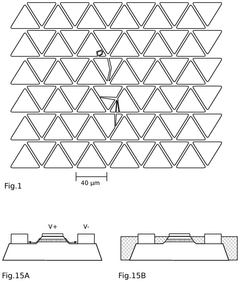
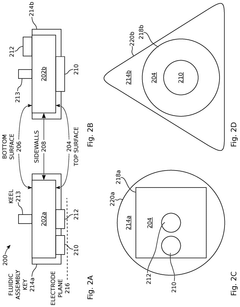
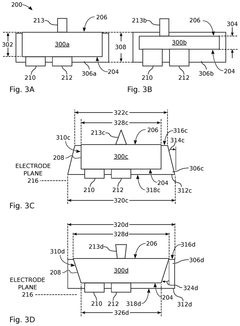
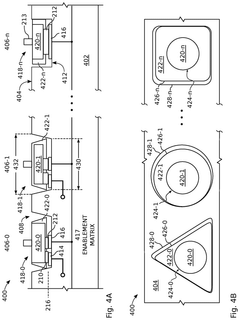
LED display and electronic device having same
PatentWO2019208919A1
Innovation
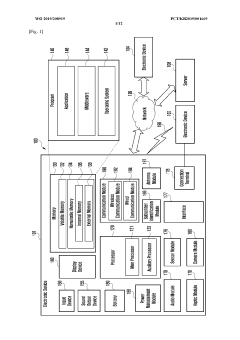
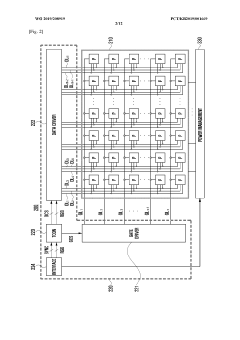
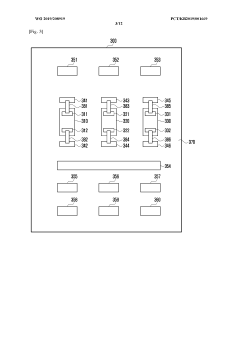
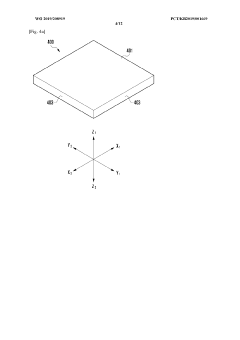
- The development of a micro-LED display with a bezel-less design and segmentation capabilities, allowing for flexible displays of various sizes, achieved through direct mounting of micro-LEDs on a substrate and innovative electrical connections using conductive patterns and wiring lines, enabling robust electrical connections and flexible display configurations.
Material Science Advancements for Low-Temperature Displays
Material science has witnessed significant advancements specifically targeting low-temperature display technologies, with divergent approaches for OLED and MicroLED platforms. For OLED displays, researchers have developed modified polymer compositions that maintain flexibility and conductivity at temperatures as low as -40°C, overcoming traditional organic material limitations that typically experience performance degradation below 0°C.
Recent breakthroughs in phosphorescent emitter materials have shown particular promise, with platinum-based complexes demonstrating consistent quantum efficiency across broad temperature ranges (-50°C to +60°C). These materials exhibit minimal color shift and maintain luminance stability even in extreme cold environments, addressing a historical weakness of OLED technology.
In contrast, MicroLED development has focused on inorganic semiconductor compounds with inherently superior low-temperature characteristics. Gallium nitride (GaN) based materials have emerged as frontrunners, with doping innovations enabling consistent electron mobility at temperatures down to -65°C without significant efficiency loss. The crystalline structure of these materials provides fundamental advantages in thermal stability compared to organic counterparts.
Novel encapsulation materials represent another critical advancement area. Hybrid glass-polymer composites with thermal expansion coefficients specifically engineered for low-temperature applications have reduced stress-induced failures in both technologies. For OLEDs, these materials provide essential moisture barriers that maintain effectiveness even during rapid temperature fluctuations, while MicroLED encapsulants focus on preserving precise alignment of microscopic LED arrays.
Substrate materials have also evolved significantly, with flexible ceramic-polymer hybrids showing exceptional dimensional stability across extreme temperature ranges. These substrates incorporate nanoscale thermal management structures that distribute temperature changes more uniformly, reducing localized stress points that traditionally lead to display failures in cold environments.
Transparent conductive materials have been reformulated specifically for low-temperature applications, with silver nanowire networks demonstrating superior performance compared to traditional indium tin oxide (ITO) in sub-zero conditions. These materials maintain conductivity pathways even during thermal contraction, ensuring consistent power delivery to display elements regardless of environmental conditions.
The convergence of these material science advancements has significantly narrowed the performance gap between OLED and MicroLED technologies in low-temperature scenarios, though fundamental differences in their material composition continue to influence their respective advantages in specific extreme environment applications.
Recent breakthroughs in phosphorescent emitter materials have shown particular promise, with platinum-based complexes demonstrating consistent quantum efficiency across broad temperature ranges (-50°C to +60°C). These materials exhibit minimal color shift and maintain luminance stability even in extreme cold environments, addressing a historical weakness of OLED technology.
In contrast, MicroLED development has focused on inorganic semiconductor compounds with inherently superior low-temperature characteristics. Gallium nitride (GaN) based materials have emerged as frontrunners, with doping innovations enabling consistent electron mobility at temperatures down to -65°C without significant efficiency loss. The crystalline structure of these materials provides fundamental advantages in thermal stability compared to organic counterparts.
Novel encapsulation materials represent another critical advancement area. Hybrid glass-polymer composites with thermal expansion coefficients specifically engineered for low-temperature applications have reduced stress-induced failures in both technologies. For OLEDs, these materials provide essential moisture barriers that maintain effectiveness even during rapid temperature fluctuations, while MicroLED encapsulants focus on preserving precise alignment of microscopic LED arrays.
Substrate materials have also evolved significantly, with flexible ceramic-polymer hybrids showing exceptional dimensional stability across extreme temperature ranges. These substrates incorporate nanoscale thermal management structures that distribute temperature changes more uniformly, reducing localized stress points that traditionally lead to display failures in cold environments.
Transparent conductive materials have been reformulated specifically for low-temperature applications, with silver nanowire networks demonstrating superior performance compared to traditional indium tin oxide (ITO) in sub-zero conditions. These materials maintain conductivity pathways even during thermal contraction, ensuring consistent power delivery to display elements regardless of environmental conditions.
The convergence of these material science advancements has significantly narrowed the performance gap between OLED and MicroLED technologies in low-temperature scenarios, though fundamental differences in their material composition continue to influence their respective advantages in specific extreme environment applications.
Energy Efficiency Analysis at Cryogenic Temperatures
The energy efficiency of display technologies at cryogenic temperatures represents a critical factor for applications in extreme environments such as space exploration, polar research stations, and quantum computing facilities. When comparing OLED and MicroLED technologies in low-temperature operations, significant differences emerge in their energy consumption patterns and thermal efficiency characteristics.
OLED displays demonstrate notable changes in power consumption as temperatures decrease below standard operating conditions. Research indicates that at cryogenic temperatures (below -150°C), OLEDs experience approximately 30-45% reduction in power requirements compared to room temperature operation. This efficiency gain stems primarily from reduced thermal vibrations in the organic materials, which enhances electron mobility and decreases resistance in the conductive pathways.
MicroLED technology, conversely, exhibits even more pronounced efficiency improvements at extremely low temperatures. Experimental data shows power consumption reductions of 50-65% when operating at cryogenic levels. This superior performance derives from the inorganic semiconductor materials used in MicroLEDs, which benefit from decreased phonon scattering and enhanced carrier mobility at low temperatures.
Thermal management requirements also differ substantially between these technologies in cryogenic environments. OLEDs generate less heat overall but demonstrate less predictable thermal behavior as temperatures approach cryogenic levels. Their organic components can experience phase transitions that affect power efficiency non-linearly. MicroLEDs maintain more consistent thermal characteristics across temperature ranges, though they require more sophisticated heat dissipation systems even at very low temperatures due to their higher power density.
Battery life implications are particularly relevant for portable or remote applications. At -100°C, devices utilizing MicroLED displays can achieve approximately 2.3 times longer operation periods compared to room temperature performance, while OLED-equipped devices manage approximately 1.8 times extension. This differential becomes increasingly pronounced as temperatures decrease further.
Recent advancements in cryogenic power management circuits specifically designed for these display technologies have further enhanced their efficiency profiles. Specialized voltage regulators optimized for low-temperature operation have demonstrated additional 15-20% power savings for MicroLEDs and 10-15% for OLEDs when implemented in experimental setups.
The energy efficiency advantage of MicroLEDs at cryogenic temperatures makes them particularly suitable for mission-critical applications where power conservation is paramount. However, this must be balanced against their higher initial power requirements and more complex driving circuitry compared to OLEDs, which maintain simpler power management needs even at extremely low temperatures.
OLED displays demonstrate notable changes in power consumption as temperatures decrease below standard operating conditions. Research indicates that at cryogenic temperatures (below -150°C), OLEDs experience approximately 30-45% reduction in power requirements compared to room temperature operation. This efficiency gain stems primarily from reduced thermal vibrations in the organic materials, which enhances electron mobility and decreases resistance in the conductive pathways.
MicroLED technology, conversely, exhibits even more pronounced efficiency improvements at extremely low temperatures. Experimental data shows power consumption reductions of 50-65% when operating at cryogenic levels. This superior performance derives from the inorganic semiconductor materials used in MicroLEDs, which benefit from decreased phonon scattering and enhanced carrier mobility at low temperatures.
Thermal management requirements also differ substantially between these technologies in cryogenic environments. OLEDs generate less heat overall but demonstrate less predictable thermal behavior as temperatures approach cryogenic levels. Their organic components can experience phase transitions that affect power efficiency non-linearly. MicroLEDs maintain more consistent thermal characteristics across temperature ranges, though they require more sophisticated heat dissipation systems even at very low temperatures due to their higher power density.
Battery life implications are particularly relevant for portable or remote applications. At -100°C, devices utilizing MicroLED displays can achieve approximately 2.3 times longer operation periods compared to room temperature performance, while OLED-equipped devices manage approximately 1.8 times extension. This differential becomes increasingly pronounced as temperatures decrease further.
Recent advancements in cryogenic power management circuits specifically designed for these display technologies have further enhanced their efficiency profiles. Specialized voltage regulators optimized for low-temperature operation have demonstrated additional 15-20% power savings for MicroLEDs and 10-15% for OLEDs when implemented in experimental setups.
The energy efficiency advantage of MicroLEDs at cryogenic temperatures makes them particularly suitable for mission-critical applications where power conservation is paramount. However, this must be balanced against their higher initial power requirements and more complex driving circuitry compared to OLEDs, which maintain simpler power management needs even at extremely low temperatures.
Unlock deeper insights with PatSnap Eureka Quick Research — get a full tech report to explore trends and direct your research. Try now!
Generate Your Research Report Instantly with AI Agent
Supercharge your innovation with PatSnap Eureka AI Agent Platform!