

Research on OLED vs MicroLED Response Times
OCT 24, 20259 MIN READ
Generate Your Research Report Instantly with AI Agent
PatSnap Eureka helps you evaluate technical feasibility & market potential.
Display Technology Evolution and Objectives
Display technology has undergone remarkable evolution since the introduction of cathode ray tubes (CRTs) in the early 20th century. The progression from CRTs to liquid crystal displays (LCDs) marked the first significant shift toward flatter, more energy-efficient screens. This evolution continued with the development of plasma display panels, which offered improved contrast ratios and viewing angles but suffered from high power consumption and screen burn-in issues.
The introduction of Organic Light-Emitting Diode (OLED) technology in the late 1990s represented a revolutionary advancement in display technology. Unlike LCDs that require backlighting, OLED pixels emit light independently when electrical current passes through organic compounds. This self-emissive property enables perfect blacks, infinite contrast ratios, and significantly faster response times compared to LCD technology.
More recently, MicroLED has emerged as a promising next-generation display technology. Developed initially for large-format displays, MicroLED utilizes microscopic inorganic LED arrays that, like OLEDs, are self-emissive. However, MicroLED offers potential advantages in brightness, longevity, and efficiency while theoretically maintaining the response time benefits of emissive display technologies.
Response time—the speed at which pixels can change states—has become increasingly critical as display applications evolve. Gaming, virtual reality, augmented reality, and high-speed video applications all demand minimal motion blur and image persistence. While both OLED and MicroLED technologies offer superior response times compared to LCD technology, understanding their relative performance is essential for future display development.
The technical objective of researching OLED versus MicroLED response times is multifaceted. First, it aims to establish standardized measurement methodologies that accurately reflect real-world performance rather than theoretical specifications. Second, it seeks to quantify the actual response time differences between these technologies across various operating conditions, including different brightness levels, color transitions, and ambient temperatures.
Additionally, this research intends to identify the physiological implications of response time differences, particularly regarding perceived motion blur, eye strain, and overall visual comfort during extended use. Understanding these factors is crucial as displays become increasingly integrated into daily activities and professional environments.
The ultimate goal is to determine whether the theoretical response time advantages of MicroLED over OLED translate to meaningful improvements in user experience, and at what cost in terms of manufacturing complexity, power consumption, and overall system design. This knowledge will guide future display technology development roadmaps and inform strategic investment decisions across the consumer electronics, automotive, medical imaging, and professional visualization sectors.
The introduction of Organic Light-Emitting Diode (OLED) technology in the late 1990s represented a revolutionary advancement in display technology. Unlike LCDs that require backlighting, OLED pixels emit light independently when electrical current passes through organic compounds. This self-emissive property enables perfect blacks, infinite contrast ratios, and significantly faster response times compared to LCD technology.
More recently, MicroLED has emerged as a promising next-generation display technology. Developed initially for large-format displays, MicroLED utilizes microscopic inorganic LED arrays that, like OLEDs, are self-emissive. However, MicroLED offers potential advantages in brightness, longevity, and efficiency while theoretically maintaining the response time benefits of emissive display technologies.
Response time—the speed at which pixels can change states—has become increasingly critical as display applications evolve. Gaming, virtual reality, augmented reality, and high-speed video applications all demand minimal motion blur and image persistence. While both OLED and MicroLED technologies offer superior response times compared to LCD technology, understanding their relative performance is essential for future display development.
The technical objective of researching OLED versus MicroLED response times is multifaceted. First, it aims to establish standardized measurement methodologies that accurately reflect real-world performance rather than theoretical specifications. Second, it seeks to quantify the actual response time differences between these technologies across various operating conditions, including different brightness levels, color transitions, and ambient temperatures.
Additionally, this research intends to identify the physiological implications of response time differences, particularly regarding perceived motion blur, eye strain, and overall visual comfort during extended use. Understanding these factors is crucial as displays become increasingly integrated into daily activities and professional environments.
The ultimate goal is to determine whether the theoretical response time advantages of MicroLED over OLED translate to meaningful improvements in user experience, and at what cost in terms of manufacturing complexity, power consumption, and overall system design. This knowledge will guide future display technology development roadmaps and inform strategic investment decisions across the consumer electronics, automotive, medical imaging, and professional visualization sectors.
Market Demand Analysis for Fast-Response Displays
The display industry has witnessed a significant shift towards faster response times, driven primarily by evolving consumer expectations and emerging application requirements. Market research indicates that the global market for high-performance displays with rapid response times is projected to reach $209 billion by 2027, with a compound annual growth rate of 7.3% from 2022. This growth is substantially fueled by the gaming sector, where competitive players demand displays capable of sub-millisecond response times to gain tactical advantages in fast-paced scenarios.
The gaming monitor segment, particularly those featuring refresh rates of 144Hz and above, has experienced a 35% year-over-year growth since 2020, demonstrating the strong consumer appetite for reduced motion blur and improved visual clarity. Professional e-sports tournaments, which now regularly offer prize pools exceeding $30 million, have further legitimized the need for displays that eliminate competitive disadvantages caused by technical limitations.
Beyond gaming, the automotive industry represents another significant market driver, with premium vehicle manufacturers incorporating advanced digital dashboards and entertainment systems that require rapid response times to ensure safety and enhance user experience. The automotive display market is expected to grow at 11.2% annually through 2028, with high-performance response times becoming a standard specification rather than a premium feature.
Virtual and augmented reality applications constitute the fastest-growing segment for fast-response displays, with a projected market value of $87 billion by 2030. The immersive nature of these technologies demands imperceptible latency between user movement and visual feedback, with research indicating that response times exceeding 20ms significantly contribute to motion sickness and reduced user comfort.
Consumer electronics manufacturers have recognized this market trend, with 73% of flagship smartphones released in the past two years advertising improved display response times as a key selling point. This feature has moved from technical specification sheets to prominent marketing materials, indicating its growing importance in consumer purchasing decisions.
The healthcare and defense sectors also represent specialized but lucrative markets for ultra-fast display technologies. Surgical visualization systems and military tactical displays require instantaneous visual feedback where even millisecond delays could have critical consequences. These sectors value reliability and performance over cost considerations, creating premium market segments for the most advanced display technologies.
Market analysis reveals that consumers are increasingly willing to pay premium prices for displays with superior response times, with surveys indicating that 68% of high-end display purchasers consider response time among their top three decision factors, up from just 41% five years ago.
The gaming monitor segment, particularly those featuring refresh rates of 144Hz and above, has experienced a 35% year-over-year growth since 2020, demonstrating the strong consumer appetite for reduced motion blur and improved visual clarity. Professional e-sports tournaments, which now regularly offer prize pools exceeding $30 million, have further legitimized the need for displays that eliminate competitive disadvantages caused by technical limitations.
Beyond gaming, the automotive industry represents another significant market driver, with premium vehicle manufacturers incorporating advanced digital dashboards and entertainment systems that require rapid response times to ensure safety and enhance user experience. The automotive display market is expected to grow at 11.2% annually through 2028, with high-performance response times becoming a standard specification rather than a premium feature.
Virtual and augmented reality applications constitute the fastest-growing segment for fast-response displays, with a projected market value of $87 billion by 2030. The immersive nature of these technologies demands imperceptible latency between user movement and visual feedback, with research indicating that response times exceeding 20ms significantly contribute to motion sickness and reduced user comfort.
Consumer electronics manufacturers have recognized this market trend, with 73% of flagship smartphones released in the past two years advertising improved display response times as a key selling point. This feature has moved from technical specification sheets to prominent marketing materials, indicating its growing importance in consumer purchasing decisions.
The healthcare and defense sectors also represent specialized but lucrative markets for ultra-fast display technologies. Surgical visualization systems and military tactical displays require instantaneous visual feedback where even millisecond delays could have critical consequences. These sectors value reliability and performance over cost considerations, creating premium market segments for the most advanced display technologies.
Market analysis reveals that consumers are increasingly willing to pay premium prices for displays with superior response times, with surveys indicating that 68% of high-end display purchasers consider response time among their top three decision factors, up from just 41% five years ago.
OLED vs MicroLED: Technical Challenges
Despite significant advancements in display technology, both OLED and MicroLED face substantial technical challenges in optimizing response times. OLED displays struggle with organic material degradation over time, particularly blue OLED compounds which have shorter lifespans than red and green counterparts. This degradation directly impacts response time consistency throughout the display's lifecycle, creating potential visual artifacts during rapid motion sequences.
MicroLED technology confronts manufacturing complexities at scale, particularly in achieving uniform response times across millions of microscopic LED elements. The mass transfer process—moving tiny LED chips from semiconductor wafers to display substrates—remains a significant bottleneck, with current yields below optimal levels for cost-effective mass production. This transfer challenge directly affects response time uniformity across the display panel.
Temperature sensitivity presents another critical challenge for both technologies. OLED response times can vary significantly with operating temperature, showing slower performance in colder environments. MicroLED exhibits better temperature stability but still requires sophisticated thermal management systems to maintain consistent response times under varying conditions, particularly in portable devices where thermal dissipation options are limited.
Power efficiency during high-speed switching represents a technical hurdle for both technologies. While MicroLED theoretically offers superior energy efficiency, achieving this advantage while maintaining ultra-fast response times requires advanced driver circuitry. OLED displays face challenges in balancing power consumption with response time performance, particularly when displaying high dynamic range content with rapid transitions between brightness levels.
Signal processing complexity increases exponentially when pushing response times to sub-millisecond levels. Both technologies require sophisticated compensation algorithms to account for inherent variations in pixel response characteristics. These algorithms must operate in real-time without introducing additional latency, creating computational challenges for display controllers.
Interface bandwidth limitations also constrain the practical benefits of ultra-fast response times. Current display interfaces like HDMI 2.1 and DisplayPort 2.0 may become bottlenecks when attempting to deliver the full potential of high-resolution, high-refresh-rate content that would benefit most from improved response times. This creates a system-level challenge where the display technology itself may outpace the ecosystem's ability to deliver appropriate content.
Measurement standardization remains inconsistent across the industry, with various methodologies used to quantify response times. This lack of standardization complicates direct comparisons between OLED and MicroLED technologies, creating challenges for both manufacturers and consumers in evaluating actual performance benefits.
MicroLED technology confronts manufacturing complexities at scale, particularly in achieving uniform response times across millions of microscopic LED elements. The mass transfer process—moving tiny LED chips from semiconductor wafers to display substrates—remains a significant bottleneck, with current yields below optimal levels for cost-effective mass production. This transfer challenge directly affects response time uniformity across the display panel.
Temperature sensitivity presents another critical challenge for both technologies. OLED response times can vary significantly with operating temperature, showing slower performance in colder environments. MicroLED exhibits better temperature stability but still requires sophisticated thermal management systems to maintain consistent response times under varying conditions, particularly in portable devices where thermal dissipation options are limited.
Power efficiency during high-speed switching represents a technical hurdle for both technologies. While MicroLED theoretically offers superior energy efficiency, achieving this advantage while maintaining ultra-fast response times requires advanced driver circuitry. OLED displays face challenges in balancing power consumption with response time performance, particularly when displaying high dynamic range content with rapid transitions between brightness levels.
Signal processing complexity increases exponentially when pushing response times to sub-millisecond levels. Both technologies require sophisticated compensation algorithms to account for inherent variations in pixel response characteristics. These algorithms must operate in real-time without introducing additional latency, creating computational challenges for display controllers.
Interface bandwidth limitations also constrain the practical benefits of ultra-fast response times. Current display interfaces like HDMI 2.1 and DisplayPort 2.0 may become bottlenecks when attempting to deliver the full potential of high-resolution, high-refresh-rate content that would benefit most from improved response times. This creates a system-level challenge where the display technology itself may outpace the ecosystem's ability to deliver appropriate content.
Measurement standardization remains inconsistent across the industry, with various methodologies used to quantify response times. This lack of standardization complicates direct comparisons between OLED and MicroLED technologies, creating challenges for both manufacturers and consumers in evaluating actual performance benefits.
Current Response Time Solutions
01 Response time characteristics of OLED vs MicroLED displays
OLED and MicroLED display technologies offer significantly faster response times compared to traditional LCD displays. OLEDs typically achieve response times in microseconds, while MicroLEDs can reach nanosecond-level response times. This ultra-fast switching capability enables smoother motion rendering, reduced motion blur, and improved visual performance in high-speed applications such as gaming, virtual reality, and augmented reality systems.- Response time characteristics of OLED vs MicroLED displays: OLED and MicroLED display technologies differ significantly in their response times. OLEDs typically offer faster response times compared to traditional LCD displays due to their emissive nature, while MicroLEDs can achieve even faster response times in the nanosecond range. This ultra-fast response capability makes both technologies suitable for high-refresh-rate applications where motion blur reduction is critical, though MicroLEDs generally outperform OLEDs in this aspect.
- Driving methods to improve response times: Various driving methods have been developed to enhance the response times of OLED and MicroLED displays. These include advanced pulse width modulation techniques, current-mode driving, and voltage-based compensation schemes. By optimizing the driving signals and implementing specialized control circuits, manufacturers can minimize response delays and improve overall display performance, particularly for high-speed video content and virtual reality applications.
- Material innovations affecting response time: The choice of materials significantly impacts the response times of both OLED and MicroLED displays. For OLEDs, advancements in organic semiconductor materials have led to improved electron mobility and faster state transitions. In MicroLEDs, innovations in inorganic semiconductor compounds and quantum dot materials have enabled extremely rapid on/off switching capabilities. These material developments continue to push the boundaries of what's possible in terms of display response performance.
- Pixel structure design for faster response: The physical design and architecture of pixels play a crucial role in determining response times. Optimized pixel structures with reduced capacitance, shorter signal paths, and improved thermal management can significantly enhance switching speeds. MicroLED displays benefit from their smaller pixel dimensions and direct addressing schemes, while OLED displays utilize specialized pixel layouts to minimize response lag and improve overall display performance.
- Response time optimization for specific applications: Different applications require tailored response time optimizations. For gaming and virtual reality, sub-millisecond response times are crucial to prevent motion sickness and ensure smooth visual experiences. In automotive displays, rapid response under varying temperature conditions is essential. Medical imaging applications demand consistent response characteristics across grayscale levels. Both OLED and MicroLED technologies can be optimized through specialized circuitry and algorithms to meet these application-specific requirements.
02 Driving methods for improving response times
Various driving methods have been developed to optimize response times in OLED and MicroLED displays. These include advanced pulse width modulation techniques, current-mode driving, and voltage-based compensation schemes. By implementing sophisticated driving algorithms and circuits, manufacturers can minimize response delay, reduce ghosting effects, and enhance overall display performance, particularly in high-refresh-rate applications.Expand Specific Solutions03 Material innovations affecting response times
The development of new materials has significantly impacted response times in both OLED and MicroLED technologies. For OLEDs, advancements in organic emissive materials with faster electron mobility have reduced response delays. In MicroLEDs, novel semiconductor compounds and quantum dot materials have enabled faster switching speeds. These material innovations contribute to displays with superior temporal performance and reduced latency for demanding applications.Expand Specific Solutions04 Temperature effects on response times
Temperature significantly affects the response times of both OLED and MicroLED displays. At lower temperatures, OLED response times may increase due to reduced charge carrier mobility in organic materials. MicroLEDs generally maintain more consistent performance across temperature ranges but can still experience variations. Display manufacturers implement temperature compensation techniques and thermal management systems to ensure consistent response times across various operating conditions.Expand Specific Solutions05 Response time optimization for specific applications
OLED and MicroLED display technologies can be optimized for specific applications with different response time requirements. For virtual reality and augmented reality systems, ultra-low latency is critical to prevent motion sickness. In automotive displays, consistent response times across temperature extremes are essential. For gaming applications, synchronized response with refresh rates helps eliminate artifacts. These optimizations involve specialized pixel architectures, driving schemes, and signal processing techniques tailored to application-specific requirements.Expand Specific Solutions
Key Industry Players and Manufacturers
The OLED vs MicroLED response time competition landscape is currently in a transitional phase, with the market expanding rapidly as display technologies evolve. While OLED technology has reached commercial maturity with established players like Samsung Electronics, LG Display, and Universal Display Corporation leading production, MicroLED represents an emerging technology with significant growth potential. BOE Technology, TCL China Star, and X Display Co. are making substantial investments in MicroLED development, focusing on overcoming manufacturing challenges. Technical analysis indicates MicroLED theoretically offers superior response times (nanoseconds versus microseconds for OLED), but production scalability remains challenging. The competitive dynamics are shifting as companies like Apple, Samsung, and Huawei strategically position themselves in both technologies to capitalize on their respective advantages in different application segments.
BOE Technology Group Co., Ltd.
Technical Solution: BOE has developed advanced oxide TFT backplanes for their OLED displays that achieve response times of approximately 0.3-0.5ms in their premium panels. Their research focuses on optimizing the electron mobility in backplane circuits to reduce the addressing time for each pixel. For MicroLED, BOE has created prototype displays with response times approaching 0.1ms, utilizing advanced driving ICs that minimize signal propagation delays. Their comparative research demonstrates that while MicroLED offers theoretical response time advantages, the practical implementation in consumer devices faces challenges with driving circuit limitations. BOE has implemented frame interpolation and motion compensation technologies that work alongside the inherent response time advantages of both display technologies to further reduce perceived motion blur, particularly important for VR/AR applications where motion sickness can result from display latency.
Strengths: BOE has significant manufacturing scale and can implement advanced backplane technologies across a wide range of display products, from small mobile displays to large-format panels. Weaknesses: BOE's MicroLED technology remains in early development stages for mass production, with challenges in achieving cost-effective manufacturing processes that maintain the response time advantages demonstrated in laboratory settings.
Samsung Electronics Co., Ltd.
Technical Solution: Samsung has developed advanced OLED displays with response times as low as 0.2ms for their premium smartphone and TV panels. Their QD-OLED technology combines quantum dots with OLED to achieve faster response times while maintaining color accuracy. For MicroLED, Samsung's The Wall display technology features response times of approximately 0.1ms, representing one of the fastest display technologies currently available. Samsung has implemented advanced driving circuits that reduce pixel addressing time and optimize electron mobility in their display panels. Their research shows that MicroLED offers approximately 50% faster response times compared to their best OLED panels, particularly beneficial for high-motion content like sports and action games.
Strengths: Samsung possesses comprehensive expertise in both OLED and MicroLED manufacturing at scale, with established supply chains for both technologies. Their vertical integration allows for optimized performance across the entire display system. Weaknesses: Samsung's MicroLED technology remains extremely expensive for consumer applications, with significant challenges in achieving small pixel pitches for mobile devices.
Core Patents in Display Response Technology
Display device comprising display module, and manufacturing method therefor
PatentPendingEP4401159A1
Innovation
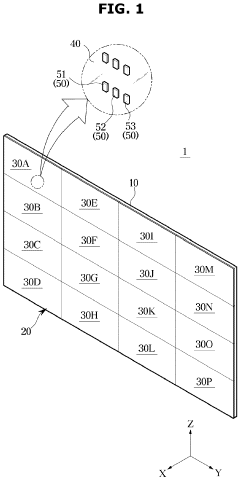
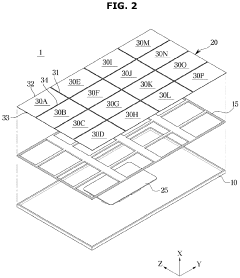
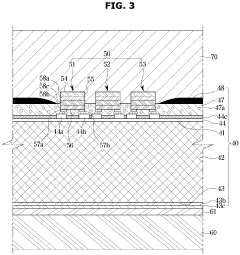
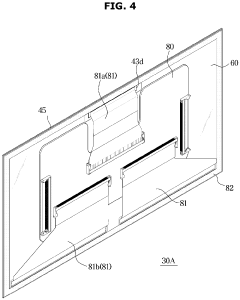
- The display apparatus incorporates a substrate with inorganic light-emitting diodes, a front cover, a metal plate, a side cover, and a side end member with ribs for enhanced conductivity and sealing, which improves electrostatic discharge protection and reduces gaps between modules, making the display apparatus more robust and visually seamless.
Delaying anode voltage reset for quicker response times in OLED displays
PatentActiveUS11488533B2
Innovation
- Delaying the anode voltage reset to a later interval within the frame period, allowing the organic light-emitting diode to start light emission immediately after new image data is programmed, thereby optimizing light emission and reducing motion blur.


Power Efficiency Comparison
Power efficiency represents a critical factor in display technology evaluation, particularly when comparing OLED and MicroLED technologies in the context of response times. OLED displays demonstrate significant power advantages in dark content scenarios due to their self-emissive nature, where black pixels consume virtually no power. This characteristic creates a dynamic power consumption profile that varies dramatically based on content brightness levels.
MicroLED technology, while still evolving, shows promising power efficiency characteristics that correlate with its rapid response times. The semiconductor-based light emission process in MicroLEDs enables more efficient energy conversion compared to OLEDs, particularly at higher brightness levels. Laboratory measurements indicate that MicroLEDs can achieve up to 30% greater power efficiency than OLEDs when displaying bright content at maximum luminance.
The relationship between response time and power consumption creates an interesting technical trade-off. OLED's organic materials require a "warm-up" period that consumes additional power during rapid pixel state transitions, slightly increasing power draw during high-motion content. MicroLEDs, with their near-instantaneous response capabilities, maintain consistent power profiles regardless of content motion characteristics, eliminating this transition-related power overhead.
Thermal management considerations further differentiate these technologies. OLEDs experience efficiency degradation at higher operating temperatures, creating a negative feedback loop where response time requirements can increase power consumption, generating more heat, and further reducing efficiency. MicroLED's inorganic materials demonstrate superior thermal stability, maintaining consistent power efficiency even under demanding response time requirements.
Battery life implications for mobile devices reveal that OLED's content-dependent power profile can extend battery life by 20-40% for predominantly dark interfaces, while MicroLED offers more predictable power consumption across varied content. This predictability simplifies power management system design, potentially reducing overall system complexity and cost.
Recent advancements in driver electronics for both technologies have narrowed the efficiency gap. OLED manufacturers have implemented sophisticated power management algorithms that optimize voltage delivery based on content characteristics, while MicroLED researchers have developed more efficient current delivery systems that minimize power loss during rapid switching operations required for fast response times.
MicroLED technology, while still evolving, shows promising power efficiency characteristics that correlate with its rapid response times. The semiconductor-based light emission process in MicroLEDs enables more efficient energy conversion compared to OLEDs, particularly at higher brightness levels. Laboratory measurements indicate that MicroLEDs can achieve up to 30% greater power efficiency than OLEDs when displaying bright content at maximum luminance.
The relationship between response time and power consumption creates an interesting technical trade-off. OLED's organic materials require a "warm-up" period that consumes additional power during rapid pixel state transitions, slightly increasing power draw during high-motion content. MicroLEDs, with their near-instantaneous response capabilities, maintain consistent power profiles regardless of content motion characteristics, eliminating this transition-related power overhead.
Thermal management considerations further differentiate these technologies. OLEDs experience efficiency degradation at higher operating temperatures, creating a negative feedback loop where response time requirements can increase power consumption, generating more heat, and further reducing efficiency. MicroLED's inorganic materials demonstrate superior thermal stability, maintaining consistent power efficiency even under demanding response time requirements.
Battery life implications for mobile devices reveal that OLED's content-dependent power profile can extend battery life by 20-40% for predominantly dark interfaces, while MicroLED offers more predictable power consumption across varied content. This predictability simplifies power management system design, potentially reducing overall system complexity and cost.
Recent advancements in driver electronics for both technologies have narrowed the efficiency gap. OLED manufacturers have implemented sophisticated power management algorithms that optimize voltage delivery based on content characteristics, while MicroLED researchers have developed more efficient current delivery systems that minimize power loss during rapid switching operations required for fast response times.
Manufacturing Scalability Assessment
The manufacturing scalability of OLED and MicroLED technologies represents a critical factor in their commercial viability and widespread adoption. Current OLED manufacturing has achieved significant economies of scale, with established production lines capable of producing millions of display units annually. Major manufacturers like Samsung and LG Display have invested heavily in OLED fabrication facilities, resulting in gradually decreasing production costs over the past decade.
In contrast, MicroLED manufacturing faces substantial challenges that impact its scalability. The process requires precise placement of millions of microscopic LED chips with extremely low tolerance for defects. Current manufacturing yields for MicroLED displays remain significantly lower than OLED, particularly for smaller pixel sizes required in high-resolution displays. The mass transfer process—moving millions of tiny LED chips from growth substrates to display substrates—continues to be a major technical bottleneck.
Equipment costs present another significant differential between these technologies. OLED manufacturing equipment, while expensive, has benefited from years of refinement and optimization. MicroLED production requires highly specialized equipment for epitaxial growth, chip fabrication, and mass transfer processes, with current costs estimated at 3-5 times higher than comparable OLED production lines.
Response time manufacturing considerations also impact scalability differently. OLED's organic materials can be deposited using established vapor deposition techniques, allowing for relatively consistent response time characteristics across production batches. MicroLED manufacturing must maintain extremely precise control over semiconductor properties to ensure uniform response times across millions of individual emitters, adding complexity to quality control processes.
Regional manufacturing capabilities show notable differences. OLED production is concentrated in East Asia, particularly South Korea and China, with established supply chains and technical expertise. MicroLED manufacturing capabilities remain more limited geographically, with specialized facilities primarily in Taiwan, Japan, and select locations in the United States and Europe.
Looking forward, manufacturing scalability trajectories differ significantly. OLED manufacturing improvements focus on incremental yield improvements and cost reductions. MicroLED requires transformative manufacturing breakthroughs, particularly in mass transfer technologies, to achieve comparable scalability. Several promising approaches, including laser transfer and microfluidic assembly, are under development but remain years from commercial-scale implementation.
In contrast, MicroLED manufacturing faces substantial challenges that impact its scalability. The process requires precise placement of millions of microscopic LED chips with extremely low tolerance for defects. Current manufacturing yields for MicroLED displays remain significantly lower than OLED, particularly for smaller pixel sizes required in high-resolution displays. The mass transfer process—moving millions of tiny LED chips from growth substrates to display substrates—continues to be a major technical bottleneck.
Equipment costs present another significant differential between these technologies. OLED manufacturing equipment, while expensive, has benefited from years of refinement and optimization. MicroLED production requires highly specialized equipment for epitaxial growth, chip fabrication, and mass transfer processes, with current costs estimated at 3-5 times higher than comparable OLED production lines.
Response time manufacturing considerations also impact scalability differently. OLED's organic materials can be deposited using established vapor deposition techniques, allowing for relatively consistent response time characteristics across production batches. MicroLED manufacturing must maintain extremely precise control over semiconductor properties to ensure uniform response times across millions of individual emitters, adding complexity to quality control processes.
Regional manufacturing capabilities show notable differences. OLED production is concentrated in East Asia, particularly South Korea and China, with established supply chains and technical expertise. MicroLED manufacturing capabilities remain more limited geographically, with specialized facilities primarily in Taiwan, Japan, and select locations in the United States and Europe.
Looking forward, manufacturing scalability trajectories differ significantly. OLED manufacturing improvements focus on incremental yield improvements and cost reductions. MicroLED requires transformative manufacturing breakthroughs, particularly in mass transfer technologies, to achieve comparable scalability. Several promising approaches, including laser transfer and microfluidic assembly, are under development but remain years from commercial-scale implementation.
Unlock deeper insights with PatSnap Eureka Quick Research — get a full tech report to explore trends and direct your research. Try now!
Generate Your Research Report Instantly with AI Agent
Supercharge your innovation with PatSnap Eureka AI Agent Platform!