Study on Flexible OLED Encapsulation: Challenges and Solutions
SEP 28, 20259 MIN READ
Generate Your Research Report Instantly with AI Agent
Patsnap Eureka helps you evaluate technical feasibility & market potential.
Flexible OLED Encapsulation Background and Objectives
Flexible OLED (Organic Light-Emitting Diode) technology has emerged as a revolutionary advancement in display technology over the past two decades. The evolution of this technology began in the early 2000s with rudimentary flexible displays, progressing through significant milestones including the development of plastic substrates, thin-film encapsulation methods, and barrier layer technologies. This technological trajectory has been driven by the increasing demand for bendable, foldable, and rollable display solutions across consumer electronics, automotive interfaces, and wearable devices.
The encapsulation of flexible OLEDs represents a critical aspect of this technology, as it directly impacts device longevity, performance, and mechanical flexibility. Traditional rigid glass encapsulation methods, while effective for conventional displays, proved incompatible with the flexibility requirements of next-generation OLEDs. This incompatibility catalyzed research into alternative encapsulation approaches that could maintain impermeability to oxygen and moisture while accommodating mechanical deformation.
Current technological trends indicate a shift toward multi-layer thin-film encapsulation (TFE) systems, atomic layer deposition (ALD) techniques, and hybrid organic-inorganic barrier structures. These approaches aim to achieve the delicate balance between flexibility and barrier performance that is essential for commercial viability. The industry is witnessing an acceleration in patent filings and research publications focused on novel materials and processes for flexible encapsulation, signaling the strategic importance of this technological domain.
The primary technical objectives in flexible OLED encapsulation research include achieving water vapor transmission rates (WVTR) below 10^-6 g/m²/day, developing encapsulation layers with bending radii under 1mm without performance degradation, extending operational lifetimes beyond 10,000 hours under standard conditions, and establishing manufacturing processes compatible with high-volume production economics.
Additionally, researchers aim to reduce the thickness of encapsulation structures to below 10μm while maintaining barrier integrity, develop self-healing mechanisms to address microcracks formed during repeated flexing, and create environmentally sustainable encapsulation materials with reduced reliance on rare earth elements and hazardous compounds.
The evolution of flexible OLED encapsulation technology is expected to continue along several parallel paths, including the exploration of 2D materials like graphene as ultra-thin barriers, the integration of nanocomposite materials with enhanced barrier properties, and the development of advanced deposition techniques enabling precise control over layer formation at the atomic scale. These technological trajectories collectively aim to overcome the fundamental challenges of protecting highly sensitive organic materials from environmental degradation while maintaining the mechanical flexibility that defines next-generation display technologies.
The encapsulation of flexible OLEDs represents a critical aspect of this technology, as it directly impacts device longevity, performance, and mechanical flexibility. Traditional rigid glass encapsulation methods, while effective for conventional displays, proved incompatible with the flexibility requirements of next-generation OLEDs. This incompatibility catalyzed research into alternative encapsulation approaches that could maintain impermeability to oxygen and moisture while accommodating mechanical deformation.
Current technological trends indicate a shift toward multi-layer thin-film encapsulation (TFE) systems, atomic layer deposition (ALD) techniques, and hybrid organic-inorganic barrier structures. These approaches aim to achieve the delicate balance between flexibility and barrier performance that is essential for commercial viability. The industry is witnessing an acceleration in patent filings and research publications focused on novel materials and processes for flexible encapsulation, signaling the strategic importance of this technological domain.
The primary technical objectives in flexible OLED encapsulation research include achieving water vapor transmission rates (WVTR) below 10^-6 g/m²/day, developing encapsulation layers with bending radii under 1mm without performance degradation, extending operational lifetimes beyond 10,000 hours under standard conditions, and establishing manufacturing processes compatible with high-volume production economics.
Additionally, researchers aim to reduce the thickness of encapsulation structures to below 10μm while maintaining barrier integrity, develop self-healing mechanisms to address microcracks formed during repeated flexing, and create environmentally sustainable encapsulation materials with reduced reliance on rare earth elements and hazardous compounds.
The evolution of flexible OLED encapsulation technology is expected to continue along several parallel paths, including the exploration of 2D materials like graphene as ultra-thin barriers, the integration of nanocomposite materials with enhanced barrier properties, and the development of advanced deposition techniques enabling precise control over layer formation at the atomic scale. These technological trajectories collectively aim to overcome the fundamental challenges of protecting highly sensitive organic materials from environmental degradation while maintaining the mechanical flexibility that defines next-generation display technologies.
Market Demand Analysis for Flexible Display Technologies
The flexible display market has witnessed exponential growth over the past decade, driven primarily by consumer electronics applications. Market research indicates that the global flexible display market is projected to reach $42 billion by 2027, with a compound annual growth rate (CAGR) of approximately 28% from 2022 to 2027. This remarkable growth trajectory underscores the significant market potential for flexible OLED technologies and their encapsulation solutions.
Consumer electronics remains the dominant application sector, accounting for over 65% of the flexible display market. Smartphones represent the largest segment within consumer electronics, with major manufacturers like Samsung, Apple, and Huawei increasingly incorporating flexible OLED displays into their flagship devices. The foldable smartphone segment alone is expected to grow at a CAGR of 35% through 2026, creating substantial demand for advanced encapsulation technologies that can withstand repeated folding and unfolding actions.
Beyond smartphones, wearable devices constitute another rapidly expanding market segment. Smartwatches, fitness trackers, and emerging form factors like smart rings and clothing-integrated displays collectively represent a market valued at $8.3 billion in 2022, with projections indicating this could more than double by 2027. These applications demand encapsulation solutions that are not only flexible but also extremely thin and lightweight.
Automotive displays represent an emerging high-value market for flexible OLED technology. Premium vehicle manufacturers are increasingly incorporating curved and flexible displays into dashboards, center consoles, and entertainment systems. This segment is projected to grow at a CAGR of 24% through 2027, with particular emphasis on displays that can maintain performance integrity in harsh automotive environments.
Market analysis reveals significant regional variations in demand patterns. Asia-Pacific dominates manufacturing capacity, with South Korea and China leading production volumes. However, North America and Europe represent premium markets with higher profit margins, particularly for specialized applications in automotive, aerospace, and medical devices.
Consumer preference surveys indicate strong market pull for devices with larger display areas without corresponding increases in device size, driving demand for foldable and rollable form factors. Additionally, durability concerns remain paramount among consumers, with 78% of potential buyers citing concerns about screen damage as a primary hesitation factor when considering flexible display devices. This directly highlights the critical importance of effective encapsulation technologies that can provide robust protection while maintaining flexibility.
Consumer electronics remains the dominant application sector, accounting for over 65% of the flexible display market. Smartphones represent the largest segment within consumer electronics, with major manufacturers like Samsung, Apple, and Huawei increasingly incorporating flexible OLED displays into their flagship devices. The foldable smartphone segment alone is expected to grow at a CAGR of 35% through 2026, creating substantial demand for advanced encapsulation technologies that can withstand repeated folding and unfolding actions.
Beyond smartphones, wearable devices constitute another rapidly expanding market segment. Smartwatches, fitness trackers, and emerging form factors like smart rings and clothing-integrated displays collectively represent a market valued at $8.3 billion in 2022, with projections indicating this could more than double by 2027. These applications demand encapsulation solutions that are not only flexible but also extremely thin and lightweight.
Automotive displays represent an emerging high-value market for flexible OLED technology. Premium vehicle manufacturers are increasingly incorporating curved and flexible displays into dashboards, center consoles, and entertainment systems. This segment is projected to grow at a CAGR of 24% through 2027, with particular emphasis on displays that can maintain performance integrity in harsh automotive environments.
Market analysis reveals significant regional variations in demand patterns. Asia-Pacific dominates manufacturing capacity, with South Korea and China leading production volumes. However, North America and Europe represent premium markets with higher profit margins, particularly for specialized applications in automotive, aerospace, and medical devices.
Consumer preference surveys indicate strong market pull for devices with larger display areas without corresponding increases in device size, driving demand for foldable and rollable form factors. Additionally, durability concerns remain paramount among consumers, with 78% of potential buyers citing concerns about screen damage as a primary hesitation factor when considering flexible display devices. This directly highlights the critical importance of effective encapsulation technologies that can provide robust protection while maintaining flexibility.
Current Encapsulation Technologies and Barriers
Flexible OLED encapsulation technology has evolved significantly over the past decade, with several approaches currently dominating the industry. Thin-film encapsulation (TFE) represents the most widely adopted solution, typically employing alternating layers of inorganic and organic materials. The inorganic layers (commonly silicon nitride or aluminum oxide) provide excellent barrier properties against moisture and oxygen, while the organic layers (often based on polyacrylate materials) offer flexibility and stress relief during bending. This multi-layer approach creates a tortuous path for permeating molecules, significantly extending diffusion time.
Atomic Layer Deposition (ALD) has emerged as a critical technique for depositing high-quality inorganic barrier layers with precise thickness control down to the atomic level. ALD enables the formation of ultra-thin, pinhole-free films that maintain excellent barrier properties even at thicknesses below 20nm. However, the relatively slow deposition rate of ALD presents challenges for high-volume manufacturing environments.
Hybrid encapsulation solutions combining thin glass with adhesive polymers have gained traction for certain applications. These systems utilize ultra-thin flexible glass (UTG) with thicknesses ranging from 30-100μm bonded to the OLED device using optically clear adhesives. While offering excellent barrier properties, the brittleness of glass remains a significant limitation for highly flexible or foldable displays.
Despite these technological advances, current encapsulation solutions face several critical barriers. Water vapor transmission rate (WVTR) requirements for flexible OLEDs remain extremely demanding, typically requiring values below 10^-6 g/m²/day - several orders of magnitude better than conventional packaging materials. Achieving this level of performance while maintaining flexibility presents a fundamental materials science challenge.
Edge sealing represents another significant barrier, as the perimeter of the encapsulation layer often becomes the weakest point for moisture ingress. Current edge sealing technologies struggle to provide the same level of protection as the main encapsulation area, creating vulnerability at the device boundaries.
Manufacturing scalability poses additional challenges, particularly for ALD processes that require precise control of deposition parameters across large substrate areas. The industry continues to seek solutions that balance barrier performance with production throughput and cost-effectiveness.
Mechanical durability during repeated bending or folding cycles remains problematic for many encapsulation systems. Inorganic layers, while providing excellent barrier properties, tend to develop microcracks under mechanical stress, compromising their protective function. This limitation becomes particularly acute for foldable displays that must withstand thousands of folding cycles while maintaining barrier integrity.
Atomic Layer Deposition (ALD) has emerged as a critical technique for depositing high-quality inorganic barrier layers with precise thickness control down to the atomic level. ALD enables the formation of ultra-thin, pinhole-free films that maintain excellent barrier properties even at thicknesses below 20nm. However, the relatively slow deposition rate of ALD presents challenges for high-volume manufacturing environments.
Hybrid encapsulation solutions combining thin glass with adhesive polymers have gained traction for certain applications. These systems utilize ultra-thin flexible glass (UTG) with thicknesses ranging from 30-100μm bonded to the OLED device using optically clear adhesives. While offering excellent barrier properties, the brittleness of glass remains a significant limitation for highly flexible or foldable displays.
Despite these technological advances, current encapsulation solutions face several critical barriers. Water vapor transmission rate (WVTR) requirements for flexible OLEDs remain extremely demanding, typically requiring values below 10^-6 g/m²/day - several orders of magnitude better than conventional packaging materials. Achieving this level of performance while maintaining flexibility presents a fundamental materials science challenge.
Edge sealing represents another significant barrier, as the perimeter of the encapsulation layer often becomes the weakest point for moisture ingress. Current edge sealing technologies struggle to provide the same level of protection as the main encapsulation area, creating vulnerability at the device boundaries.
Manufacturing scalability poses additional challenges, particularly for ALD processes that require precise control of deposition parameters across large substrate areas. The industry continues to seek solutions that balance barrier performance with production throughput and cost-effectiveness.
Mechanical durability during repeated bending or folding cycles remains problematic for many encapsulation systems. Inorganic layers, while providing excellent barrier properties, tend to develop microcracks under mechanical stress, compromising their protective function. This limitation becomes particularly acute for foldable displays that must withstand thousands of folding cycles while maintaining barrier integrity.
Current Technical Solutions for Moisture and Oxygen Barriers
01 Multilayer encapsulation structures for flexible OLEDs
Multilayer encapsulation structures combine inorganic barrier layers with organic buffer layers to achieve both effective moisture/oxygen blocking and mechanical flexibility. The inorganic layers (typically silicon nitride, aluminum oxide, or silicon oxide) provide excellent barrier properties, while the organic layers (often polymers or resins) absorb mechanical stress during bending. This alternating structure prevents crack propagation through the entire encapsulation system, maintaining barrier performance even when the device is flexed.- Multilayer encapsulation structures for flexible OLEDs: Multilayer encapsulation structures are used to enhance the flexibility of OLED devices while maintaining effective barrier properties against moisture and oxygen. These structures typically consist of alternating inorganic and organic layers, where the inorganic layers provide barrier properties and the organic layers accommodate bending stress. The combination allows for improved flexibility without compromising the encapsulation performance, which is crucial for extending the lifespan of flexible OLED displays.
- Thin-film encapsulation techniques for flexibility: Thin-film encapsulation (TFE) techniques are employed to achieve high flexibility in OLED devices. These techniques involve depositing ultra-thin barrier films directly onto the OLED, eliminating the need for rigid glass encapsulation. The reduced thickness of these films allows for greater bending capability while maintaining barrier properties. Advanced deposition methods such as atomic layer deposition (ALD) are used to create uniform, defect-free thin films that can withstand repeated bending cycles.
- Stress-relief structures in encapsulation layers: Specialized stress-relief structures are incorporated into encapsulation layers to improve flexibility and prevent cracking during bending. These structures include micro-patterns, grid structures, or island-like configurations that can distribute and absorb mechanical stress. By strategically designing these stress-relief features, the encapsulation layers can accommodate deformation without developing cracks or delamination, thus maintaining barrier properties even when the OLED device is repeatedly bent or folded.
- Flexible barrier materials and compositions: Novel barrier materials and compositions are developed specifically for flexible OLED encapsulation. These materials include modified polymers with enhanced barrier properties, hybrid organic-inorganic composites, and nanocomposite materials. The materials are engineered to combine flexibility with excellent barrier properties against moisture and oxygen penetration. Some compositions also incorporate self-healing capabilities to repair minor defects that may occur during bending, further enhancing the reliability of flexible OLED devices.
- Edge sealing techniques for flexible encapsulation: Specialized edge sealing techniques are employed to enhance the flexibility and reliability of OLED encapsulation. These techniques focus on the vulnerable edges of the device where delamination and moisture ingress often begin. Methods include flexible adhesive systems, gradient-property edge seals, and reinforced perimeter structures that can accommodate bending stress while maintaining a hermetic seal. Proper edge sealing is critical for preventing the lateral diffusion of moisture and oxygen into the active areas of flexible OLED devices.
02 Thin-film encapsulation techniques for flexibility
Thin-film encapsulation (TFE) techniques deposit ultra-thin barrier layers directly onto OLED devices, eliminating the need for rigid glass encapsulation. These techniques include atomic layer deposition (ALD), plasma-enhanced chemical vapor deposition (PECVD), and sputtering to create nanometer-scale barrier films. The extremely thin nature of these films allows for significant bending without compromising barrier properties, making them ideal for flexible display applications. The thinness also contributes to overall device thinness and lighter weight.Expand Specific Solutions03 Stress-relief patterns and structures in encapsulation layers
Incorporating specific patterns or structures within encapsulation layers can significantly improve flexibility. These include micro-patterns, mesh structures, island structures, or intentional discontinuities that act as stress-relief points during bending. By strategically designing these features, mechanical stress can be distributed more evenly throughout the encapsulation layer, preventing catastrophic failure at any single point and allowing for greater bending radii without compromising barrier performance.Expand Specific Solutions04 Flexible inorganic-organic hybrid materials
Novel hybrid materials combining inorganic and organic components at the molecular or nanoscale level offer enhanced flexibility while maintaining barrier properties. These include organically modified ceramics (ORMOCERs), polymer-nanoparticle composites, and sol-gel derived hybrid materials. The organic components provide flexibility and crack resistance, while the inorganic components maintain barrier properties against moisture and oxygen. These materials can be applied as single layers or in multilayer structures to achieve optimal performance for flexible OLED applications.Expand Specific Solutions05 Edge sealing and mechanical reinforcement techniques
Special attention to edge sealing and mechanical reinforcement is critical for flexible OLED encapsulation. Edge areas are particularly vulnerable to moisture ingress and mechanical stress during bending. Techniques include applying additional barrier materials at edges, creating stepped structures to extend moisture diffusion paths, using specialized adhesives with both barrier and flexibility properties, and incorporating mechanical reinforcement structures that prevent delamination while allowing for bending. These approaches ensure that the entire perimeter of the device remains sealed even under repeated flexing conditions.Expand Specific Solutions
Key Industry Players in Flexible OLED Encapsulation
The flexible OLED encapsulation market is currently in a growth phase, with an estimated market size exceeding $2 billion and projected to expand significantly as flexible display adoption increases. The technology maturity varies across different encapsulation approaches, with major players demonstrating varying levels of expertise. Samsung Display and LG Display lead with advanced thin-film encapsulation technologies, while BOE Technology and TCL China Star Optoelectronics are rapidly closing the gap through significant R&D investments. Companies like Applied Materials and 3M Innovative Properties contribute critical materials and equipment solutions. Visionox and Kunshan Govisionox have made notable progress in flexible barrier technologies, while newer entrants like Zhejiang Heqing Flexible Electronic Technology are focusing on innovative encapsulation methods to address persistent challenges of moisture permeation and mechanical durability.
BOE Technology Group Co., Ltd.
Technical Solution: BOE has developed a proprietary "Ultra Barrier Multilayer" (UBM) encapsulation technology for flexible OLEDs. Their approach utilizes alternating layers of inorganic barriers (primarily SiOx and Al2O3) deposited via plasma-enhanced ALD and organic buffer layers applied through vapor deposition techniques. This structure achieves water vapor transmission rates below 10^-5 g/m²/day while maintaining flexibility at bending radii of 3mm. BOE's innovation includes a gradient-composition barrier where the inorganic layer composition gradually changes throughout its thickness, reducing internal stress and improving adhesion between layers. Their encapsulation process incorporates in-situ plasma treatment of interfaces to enhance adhesion and barrier properties. BOE has also developed specialized edge sealing technology using UV-curable resins with nanoparticle additives that maintain flexibility while providing robust edge protection. Recent advancements include the integration of graphene oxide layers as ultra-thin, flexible moisture barriers that contribute minimal thickness to the overall encapsulation structure.
Strengths: Cost-effective manufacturing process suitable for large-scale production; good balance between barrier performance and flexibility; innovative edge sealing technology; compatibility with various substrate materials including ultra-thin glass. Weaknesses: Barrier performance slightly lower than industry leaders; limited bending radius compared to most advanced competitors; challenges with long-term reliability under repeated bending cycles.
SAMSUNG DISPLAY CO LTD
Technical Solution: Samsung Display has pioneered advanced thin-film encapsulation (TFE) technology for flexible OLEDs, employing a multi-layer structure that alternates inorganic (SiNx, Al2O3) and organic layers. Their proprietary technology utilizes plasma-enhanced chemical vapor deposition (PECVD) for inorganic layers and inkjet printing for organic layers, achieving total thickness below 10μm while maintaining excellent barrier properties with water vapor transmission rates (WVTR) below 10^-6 g/m²/day. Samsung has also developed a hybrid encapsulation approach combining atomic layer deposition (ALD) for ultrathin barrier films with proprietary stress-relief mechanisms to withstand repeated bending (>200,000 cycles at 1.5mm radius). Their latest innovation incorporates nanocomposite materials with self-healing properties to address microcracks formed during flexing, significantly extending device lifetime in commercial products.
Strengths: Industry-leading barrier performance with extremely low WVTR; excellent mechanical durability under repeated bending; mass production capability with high yield rates; proprietary self-healing materials. Weaknesses: Higher manufacturing costs compared to rigid encapsulation; complex multi-step deposition process requiring precise control; potential for defects at extreme bending angles.
Critical Patents and Innovations in Thin-Film Encapsulation
Flexible organic light-emitting diode (OLED) device of reduced stess at bending place and fabrication method thereof
PatentActiveUS11258038B2
Innovation
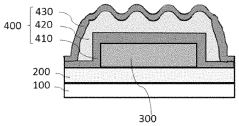
- A novel encapsulation layer configuration with a first and second inorganic layer and an organic layer, where the second inorganic layer has a continuous wavy curved configuration, formed by thermal stress differences, increasing contact area and reducing stress on the outer inorganic layer, and an optically clear adhesive is used to level the configuration.
Flexible OLED substrate and encapsulation method thereof
PatentActiveUS20230200111A1
Innovation
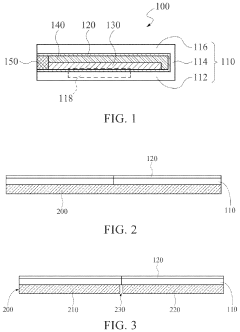
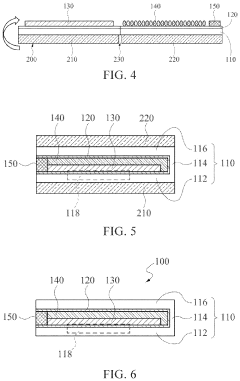
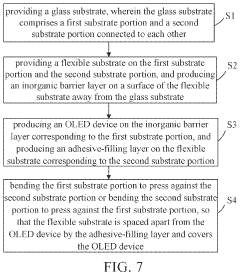
- A flexible OLED substrate with an inorganic barrier layer and an adhesive-filling layer, along with a border adhesive, is used to enclose the OLED device, where the inorganic barrier layer is made of materials like aluminum oxide or silicon oxide, and the adhesive-filling and border adhesives provide additional water-resistant properties, simplifying the encapsulation process and enhancing protection.
Material Science Advancements for Barrier Films
The evolution of barrier films for flexible OLED encapsulation represents a critical frontier in material science. Traditional glass encapsulation, while effective for rigid displays, cannot meet the demanding requirements of flexible OLEDs. This has catalyzed intensive research into advanced barrier materials that can provide sufficient protection against moisture and oxygen permeation while maintaining flexibility.
Multi-layer barrier films have emerged as a promising solution, typically consisting of alternating organic and inorganic layers. The inorganic layers, often composed of metal oxides such as Al2O3, SiO2, or ZnO, provide excellent barrier properties but are prone to defects when flexed. The organic layers serve as defect decouplers, preventing the propagation of defects through the entire barrier structure while adding flexibility to the system.
Atomic Layer Deposition (ALD) has revolutionized the fabrication of high-quality barrier films by enabling the deposition of ultra-thin, highly uniform inorganic layers with precise thickness control. This technique has allowed for the creation of barrier films with water vapor transmission rates (WVTR) below 10^-6 g/m²/day, approaching the stringent requirements for OLED protection.
Recent advancements include the development of nanocomposite materials that incorporate nanoparticles into polymer matrices. These materials can achieve enhanced barrier properties through tortuous path effects, where permeating molecules must navigate a complex path around impermeable nanoparticles. Graphene and other 2D materials have also shown exceptional promise as barrier materials due to their impermeability to gases and remarkable mechanical properties.
Self-healing materials represent another frontier in barrier film technology. These innovative materials can autonomously repair damage through various mechanisms, including encapsulated healing agents that release upon damage or reversible chemical bonds that reform after being broken. This capability is particularly valuable for flexible displays that undergo repeated bending and folding.
Surface modification techniques have been employed to enhance the adhesion between different layers in multi-layer barriers and improve overall barrier performance. Plasma treatment, chemical functionalization, and the application of coupling agents have all demonstrated effectiveness in optimizing interfacial properties.
The integration of barrier films with other functional layers, such as touch sensors and polarizers, presents both challenges and opportunities. Researchers are exploring ways to reduce the total thickness of the display stack while maintaining or enhancing barrier performance, potentially through multifunctional materials that serve multiple purposes simultaneously.
Multi-layer barrier films have emerged as a promising solution, typically consisting of alternating organic and inorganic layers. The inorganic layers, often composed of metal oxides such as Al2O3, SiO2, or ZnO, provide excellent barrier properties but are prone to defects when flexed. The organic layers serve as defect decouplers, preventing the propagation of defects through the entire barrier structure while adding flexibility to the system.
Atomic Layer Deposition (ALD) has revolutionized the fabrication of high-quality barrier films by enabling the deposition of ultra-thin, highly uniform inorganic layers with precise thickness control. This technique has allowed for the creation of barrier films with water vapor transmission rates (WVTR) below 10^-6 g/m²/day, approaching the stringent requirements for OLED protection.
Recent advancements include the development of nanocomposite materials that incorporate nanoparticles into polymer matrices. These materials can achieve enhanced barrier properties through tortuous path effects, where permeating molecules must navigate a complex path around impermeable nanoparticles. Graphene and other 2D materials have also shown exceptional promise as barrier materials due to their impermeability to gases and remarkable mechanical properties.
Self-healing materials represent another frontier in barrier film technology. These innovative materials can autonomously repair damage through various mechanisms, including encapsulated healing agents that release upon damage or reversible chemical bonds that reform after being broken. This capability is particularly valuable for flexible displays that undergo repeated bending and folding.
Surface modification techniques have been employed to enhance the adhesion between different layers in multi-layer barriers and improve overall barrier performance. Plasma treatment, chemical functionalization, and the application of coupling agents have all demonstrated effectiveness in optimizing interfacial properties.
The integration of barrier films with other functional layers, such as touch sensors and polarizers, presents both challenges and opportunities. Researchers are exploring ways to reduce the total thickness of the display stack while maintaining or enhancing barrier performance, potentially through multifunctional materials that serve multiple purposes simultaneously.
Environmental Impact and Sustainability Considerations
The environmental footprint of flexible OLED encapsulation technologies represents a critical consideration in the sustainable development of next-generation display technologies. Traditional encapsulation methods often rely on energy-intensive processes and environmentally problematic materials, including rare earth elements and toxic compounds that pose significant end-of-life disposal challenges. The thin-film encapsulation (TFE) processes typically require high vacuum conditions and elevated temperatures, resulting in substantial energy consumption during manufacturing.
Material selection for encapsulation layers presents both challenges and opportunities for environmental improvement. Conventional barrier materials like aluminum oxide and silicon nitride, while effective for moisture protection, often involve resource-intensive extraction and processing. The multi-layer structure of most encapsulation solutions further compounds material usage concerns, as each additional layer increases the environmental burden of the final product.
Emerging eco-friendly alternatives show promising developments in sustainable encapsulation. Bio-based polymers and naturally derived barrier materials are being investigated as replacements for petroleum-based compounds. Research into water-based deposition methods and low-temperature processing techniques demonstrates potential for reducing energy requirements by 30-45% compared to conventional approaches, significantly lowering the carbon footprint of production.
The recyclability of flexible OLED devices remains problematic due to the complex integration of encapsulation layers with other device components. Current end-of-life scenarios typically result in downcycling or incineration rather than true material recovery. Innovative design approaches focusing on modular construction and material separation could facilitate more effective recycling processes, though these remain largely conceptual rather than commercially implemented.
Regulatory frameworks worldwide are increasingly addressing the environmental aspects of electronic components, with particular attention to hazardous substance restrictions and extended producer responsibility. The EU's Restriction of Hazardous Substances (RoHS) directive and similar regulations in other regions are driving manufacturers toward more environmentally benign encapsulation solutions, accelerating research into compliant alternatives.
Life cycle assessment (LCA) studies indicate that the environmental impact of encapsulation technologies extends beyond manufacturing to include operational energy efficiency. Advanced encapsulation solutions that extend device lifespan effectively distribute the initial environmental investment over longer periods, potentially reducing overall impact despite higher initial material or energy inputs during production.
Material selection for encapsulation layers presents both challenges and opportunities for environmental improvement. Conventional barrier materials like aluminum oxide and silicon nitride, while effective for moisture protection, often involve resource-intensive extraction and processing. The multi-layer structure of most encapsulation solutions further compounds material usage concerns, as each additional layer increases the environmental burden of the final product.
Emerging eco-friendly alternatives show promising developments in sustainable encapsulation. Bio-based polymers and naturally derived barrier materials are being investigated as replacements for petroleum-based compounds. Research into water-based deposition methods and low-temperature processing techniques demonstrates potential for reducing energy requirements by 30-45% compared to conventional approaches, significantly lowering the carbon footprint of production.
The recyclability of flexible OLED devices remains problematic due to the complex integration of encapsulation layers with other device components. Current end-of-life scenarios typically result in downcycling or incineration rather than true material recovery. Innovative design approaches focusing on modular construction and material separation could facilitate more effective recycling processes, though these remain largely conceptual rather than commercially implemented.
Regulatory frameworks worldwide are increasingly addressing the environmental aspects of electronic components, with particular attention to hazardous substance restrictions and extended producer responsibility. The EU's Restriction of Hazardous Substances (RoHS) directive and similar regulations in other regions are driving manufacturers toward more environmentally benign encapsulation solutions, accelerating research into compliant alternatives.
Life cycle assessment (LCA) studies indicate that the environmental impact of encapsulation technologies extends beyond manufacturing to include operational energy efficiency. Advanced encapsulation solutions that extend device lifespan effectively distribute the initial environmental investment over longer periods, potentially reducing overall impact despite higher initial material or energy inputs during production.
Unlock deeper insights with Patsnap Eureka Quick Research — get a full tech report to explore trends and direct your research. Try now!
Generate Your Research Report Instantly with AI Agent
Supercharge your innovation with Patsnap Eureka AI Agent Platform!