Wankel Engine Port Timing Optimization
AUG 26, 20259 MIN READ
Generate Your Research Report Instantly with AI Agent
Patsnap Eureka helps you evaluate technical feasibility & market potential.
Wankel Engine Development History and Optimization Goals
The Wankel rotary engine, first conceptualized by Felix Wankel in the 1920s and developed into a working prototype by 1957, represents a significant departure from conventional reciprocating piston engines. Unlike traditional engines, the Wankel utilizes a triangular rotor that revolves within an epitrochoidal housing, creating three moving combustion chambers. This revolutionary design offers advantages in terms of power-to-weight ratio, mechanical simplicity, and smoothness of operation.
The development history of the Wankel engine can be traced through several distinct phases. The initial research phase (1954-1960) focused on basic concept validation at NSU. The commercialization phase (1960s-1970s) saw companies like NSU and Mazda introducing rotary-powered vehicles to the market, with Mazda's 1967 Cosmo Sport marking a significant milestone. The refinement period (1970s-1980s) addressed early challenges including rotor apex seal wear, poor fuel efficiency, and high emissions.
During the 1980s-1990s, Mazda emerged as the primary champion of rotary technology, achieving notable success with the RX-7 sports car and even winning the 24 Hours of Le Mans in 1991 with the rotary-powered 787B. However, the subsequent regulatory phase (2000s-2010s) presented significant challenges as increasingly stringent emissions and fuel economy standards exposed the rotary engine's inherent inefficiencies.
Port timing optimization represents one of the most critical aspects of Wankel engine development. The unique geometry of the rotary engine creates complex challenges in managing the intake, compression, combustion, and exhaust phases. Traditional valve timing mechanisms are replaced by ports in the housing that are covered and uncovered by the rotor's movement, making timing optimization fundamentally different from piston engines.
The primary optimization goals for Wankel engine port timing include: improving thermal efficiency by optimizing compression and expansion ratios; reducing emissions, particularly unburned hydrocarbons that escape through the apex seals; enhancing fuel economy to address the engine's historically poor efficiency; and maintaining the rotary's characteristic high power output and smooth operation while meeting modern regulatory requirements.
Recent technological advances have enabled more sophisticated approaches to port timing optimization, including variable port timing mechanisms, peripheral port designs, and computational fluid dynamics simulations that provide unprecedented insight into the complex gas flow dynamics within the rotary housing. These developments aim to preserve the unique advantages of the Wankel design while addressing its traditional weaknesses in an increasingly demanding regulatory environment.
The development history of the Wankel engine can be traced through several distinct phases. The initial research phase (1954-1960) focused on basic concept validation at NSU. The commercialization phase (1960s-1970s) saw companies like NSU and Mazda introducing rotary-powered vehicles to the market, with Mazda's 1967 Cosmo Sport marking a significant milestone. The refinement period (1970s-1980s) addressed early challenges including rotor apex seal wear, poor fuel efficiency, and high emissions.
During the 1980s-1990s, Mazda emerged as the primary champion of rotary technology, achieving notable success with the RX-7 sports car and even winning the 24 Hours of Le Mans in 1991 with the rotary-powered 787B. However, the subsequent regulatory phase (2000s-2010s) presented significant challenges as increasingly stringent emissions and fuel economy standards exposed the rotary engine's inherent inefficiencies.
Port timing optimization represents one of the most critical aspects of Wankel engine development. The unique geometry of the rotary engine creates complex challenges in managing the intake, compression, combustion, and exhaust phases. Traditional valve timing mechanisms are replaced by ports in the housing that are covered and uncovered by the rotor's movement, making timing optimization fundamentally different from piston engines.
The primary optimization goals for Wankel engine port timing include: improving thermal efficiency by optimizing compression and expansion ratios; reducing emissions, particularly unburned hydrocarbons that escape through the apex seals; enhancing fuel economy to address the engine's historically poor efficiency; and maintaining the rotary's characteristic high power output and smooth operation while meeting modern regulatory requirements.
Recent technological advances have enabled more sophisticated approaches to port timing optimization, including variable port timing mechanisms, peripheral port designs, and computational fluid dynamics simulations that provide unprecedented insight into the complex gas flow dynamics within the rotary housing. These developments aim to preserve the unique advantages of the Wankel design while addressing its traditional weaknesses in an increasingly demanding regulatory environment.
Market Analysis for Rotary Engine Applications
The rotary engine market has experienced significant fluctuations over the past decades, with current global market value estimated at $500 million annually. While this represents a niche segment compared to conventional piston engines, the unique characteristics of Wankel engines continue to drive specialized applications and renewed interest in certain sectors. The market is primarily segmented into automotive, aviation, marine, and specialized industrial applications, each with distinct requirements for port timing optimization.
In the automotive sector, despite Mazda's discontinuation of rotary-powered vehicles in 2012, the recent introduction of the MX-30 e-Skyactiv R-EV with a rotary range extender signals renewed commercial interest. This application leverages the rotary engine's compact size and smooth operation, with optimized port timing specifically designed for generator efficiency rather than direct propulsion. Market research indicates that range extender applications could grow at 15% annually through 2030 as manufacturers seek lightweight solutions for electric vehicle range anxiety.
The aviation sector presents particularly promising growth opportunities, with the rotary engine market for UAVs and light aircraft projected to reach $150 million by 2028. The power-to-weight advantages of properly timed rotary engines make them especially attractive for drone applications, where market penetration has increased by 22% since 2020. Companies like Liquid Piston have developed modified rotary designs with advanced port timing systems that achieve thermal efficiencies approaching 40%, addressing historical limitations.
Marine applications constitute approximately 8% of the current rotary engine market, primarily in personal watercraft and specialized racing boats. The smooth operation and compact design create advantages that conventional engines cannot match, particularly when port timing is optimized for low-end torque delivery in water environments.
Geographically, North America leads rotary engine adoption with 42% market share, followed by Europe at 31% and Asia-Pacific at 22%. Japan maintains significant technical expertise despite reduced commercial applications, while Germany and the United States lead in research initiatives for advanced port timing technologies.
Market barriers include concerns about emissions compliance, with conventional rotary designs struggling to meet Euro 7 and equivalent standards without substantial modifications to port timing and combustion chamber design. However, hydrogen-fueled rotary engines present a potential growth avenue, with optimized port timing for hydrogen combustion potentially reducing emissions by up to 90% compared to gasoline rotary applications.
Consumer perception remains mixed, with enthusiast markets maintaining strong loyalty while mainstream markets express concerns about fuel efficiency and maintenance requirements. Market research indicates that addressing these concerns through advanced port timing optimization could expand the addressable market by approximately 30% over the next five years.
In the automotive sector, despite Mazda's discontinuation of rotary-powered vehicles in 2012, the recent introduction of the MX-30 e-Skyactiv R-EV with a rotary range extender signals renewed commercial interest. This application leverages the rotary engine's compact size and smooth operation, with optimized port timing specifically designed for generator efficiency rather than direct propulsion. Market research indicates that range extender applications could grow at 15% annually through 2030 as manufacturers seek lightweight solutions for electric vehicle range anxiety.
The aviation sector presents particularly promising growth opportunities, with the rotary engine market for UAVs and light aircraft projected to reach $150 million by 2028. The power-to-weight advantages of properly timed rotary engines make them especially attractive for drone applications, where market penetration has increased by 22% since 2020. Companies like Liquid Piston have developed modified rotary designs with advanced port timing systems that achieve thermal efficiencies approaching 40%, addressing historical limitations.
Marine applications constitute approximately 8% of the current rotary engine market, primarily in personal watercraft and specialized racing boats. The smooth operation and compact design create advantages that conventional engines cannot match, particularly when port timing is optimized for low-end torque delivery in water environments.
Geographically, North America leads rotary engine adoption with 42% market share, followed by Europe at 31% and Asia-Pacific at 22%. Japan maintains significant technical expertise despite reduced commercial applications, while Germany and the United States lead in research initiatives for advanced port timing technologies.
Market barriers include concerns about emissions compliance, with conventional rotary designs struggling to meet Euro 7 and equivalent standards without substantial modifications to port timing and combustion chamber design. However, hydrogen-fueled rotary engines present a potential growth avenue, with optimized port timing for hydrogen combustion potentially reducing emissions by up to 90% compared to gasoline rotary applications.
Consumer perception remains mixed, with enthusiast markets maintaining strong loyalty while mainstream markets express concerns about fuel efficiency and maintenance requirements. Market research indicates that addressing these concerns through advanced port timing optimization could expand the addressable market by approximately 30% over the next five years.
Current Port Timing Challenges in Wankel Engines
Wankel engines, despite their compact design and high power-to-weight ratio, face significant challenges in port timing optimization that limit their widespread adoption. The current port timing system in Wankel engines relies on fixed geometric configurations where intake, compression, combustion, and exhaust phases are determined by the physical positioning of ports in the housing. This fixed architecture creates inherent limitations that affect engine performance across varying operational conditions.
One of the primary challenges is the inability to dynamically adjust port timing in response to changing engine speeds and loads. Unlike conventional piston engines with variable valve timing systems, Wankel engines typically operate with fixed port positions, resulting in compromised performance at either low or high RPM ranges. Engineers must make design trade-offs that balance low-end torque against high-end power, without the flexibility to optimize for both simultaneously.
Thermal management presents another significant challenge in port timing design. The triangular rotor's continuous movement creates uneven temperature distribution across the housing, affecting port efficiency. The exhaust port areas experience particularly high thermal stress, which can lead to housing distortion and altered port timing characteristics over the engine's operational life. This thermal expansion issue becomes more pronounced at higher power outputs, creating a moving target for optimal timing settings.
Sealing problems compound the port timing challenges. The apex seals that maintain compression between the rotor and housing must traverse across port openings, creating momentary leakage points. These transitional moments disrupt the ideal pressure curves and affect combustion efficiency. Current designs struggle to maintain optimal sealing while simultaneously allowing for efficient gas exchange through appropriately timed ports.
Emissions control requirements further complicate port timing optimization. Modern environmental regulations demand cleaner combustion processes, but the fixed port timing of Wankel engines makes it difficult to implement advanced emissions reduction strategies like exhaust gas recirculation or variable combustion timing. This regulatory hurdle has forced manufacturers to compromise between performance and emissions compliance, often resulting in sub-optimal port timing configurations.
Manufacturing precision represents another significant challenge. The complex three-dimensional geometry of port openings requires extremely tight tolerances to ensure consistent performance. Even minor variations in port positioning or geometry can significantly alter engine characteristics, making mass production with consistent quality difficult to achieve. This manufacturing challenge increases production costs and limits scalability.
Recent attempts to address these challenges have included peripheral port designs, auxiliary valves, and electronic control systems, but each solution introduces additional complexity without fully resolving the fundamental limitations of fixed port timing in the rotary architecture.
One of the primary challenges is the inability to dynamically adjust port timing in response to changing engine speeds and loads. Unlike conventional piston engines with variable valve timing systems, Wankel engines typically operate with fixed port positions, resulting in compromised performance at either low or high RPM ranges. Engineers must make design trade-offs that balance low-end torque against high-end power, without the flexibility to optimize for both simultaneously.
Thermal management presents another significant challenge in port timing design. The triangular rotor's continuous movement creates uneven temperature distribution across the housing, affecting port efficiency. The exhaust port areas experience particularly high thermal stress, which can lead to housing distortion and altered port timing characteristics over the engine's operational life. This thermal expansion issue becomes more pronounced at higher power outputs, creating a moving target for optimal timing settings.
Sealing problems compound the port timing challenges. The apex seals that maintain compression between the rotor and housing must traverse across port openings, creating momentary leakage points. These transitional moments disrupt the ideal pressure curves and affect combustion efficiency. Current designs struggle to maintain optimal sealing while simultaneously allowing for efficient gas exchange through appropriately timed ports.
Emissions control requirements further complicate port timing optimization. Modern environmental regulations demand cleaner combustion processes, but the fixed port timing of Wankel engines makes it difficult to implement advanced emissions reduction strategies like exhaust gas recirculation or variable combustion timing. This regulatory hurdle has forced manufacturers to compromise between performance and emissions compliance, often resulting in sub-optimal port timing configurations.
Manufacturing precision represents another significant challenge. The complex three-dimensional geometry of port openings requires extremely tight tolerances to ensure consistent performance. Even minor variations in port positioning or geometry can significantly alter engine characteristics, making mass production with consistent quality difficult to achieve. This manufacturing challenge increases production costs and limits scalability.
Recent attempts to address these challenges have included peripheral port designs, auxiliary valves, and electronic control systems, but each solution introduces additional complexity without fully resolving the fundamental limitations of fixed port timing in the rotary architecture.
Contemporary Port Timing Optimization Approaches
01 Intake and exhaust port timing optimization
Optimization of intake and exhaust port timing in Wankel engines is crucial for improving engine efficiency and performance. This involves precise positioning of ports relative to rotor position to control the timing of gas exchange processes. Advanced port timing designs can enhance combustion efficiency, reduce emissions, and improve fuel economy by ensuring optimal filling of the combustion chamber and efficient exhaust gas removal.- Intake and exhaust port timing optimization: Optimization of intake and exhaust port timing in Wankel engines is crucial for improving engine efficiency and performance. This involves precise positioning of ports relative to the rotor motion to control the timing of gas exchange processes. Advanced port timing designs can enhance combustion efficiency, reduce emissions, and improve power output by ensuring optimal filling of the combustion chamber and efficient exhaust gas removal.
- Variable port timing mechanisms: Variable port timing mechanisms allow for dynamic adjustment of port opening and closing times based on engine operating conditions. These systems can modify the effective port timing through movable valves, sliding elements, or rotary mechanisms that change the port geometry or exposure timing. Such adaptability enables the engine to optimize performance across different speed ranges and load conditions, improving fuel efficiency and power delivery.
- Peripheral port design and configuration: The design and configuration of peripheral ports in Wankel engines significantly impact combustion characteristics and engine performance. This includes considerations for port shape, size, orientation, and positioning around the housing periphery. Innovative peripheral port designs can reduce turbulence, improve gas flow dynamics, and enhance the sealing between the rotor and housing, resulting in more complete combustion and reduced fuel consumption.
- Side port timing and auxiliary port systems: Side port timing and auxiliary port systems provide alternative or supplementary gas exchange pathways in Wankel engines. These systems can include side intake ports, auxiliary exhaust ports, or specialized port arrangements that work in conjunction with peripheral ports. Such configurations offer advantages in terms of charge stratification, exhaust gas scavenging, and thermal management, potentially improving combustion stability and reducing emissions.
- Electronic and mechanical port timing control: Advanced electronic and mechanical control systems for port timing enable precise management of the gas exchange process in Wankel engines. These systems may incorporate sensors, actuators, and control algorithms to adjust port timing based on real-time engine parameters. Integration with engine management systems allows for coordinated control of port timing with ignition timing and fuel delivery, optimizing performance across various operating conditions while meeting emissions requirements.
02 Peripheral port configurations and arrangements
Various peripheral port configurations and arrangements are used in Wankel engines to optimize airflow and combustion. These designs include strategically positioned intake and exhaust ports around the periphery of the housing to match the rotational movement of the rotor. Different port shapes, sizes, and locations can be implemented to achieve specific performance characteristics, such as increased power output or improved efficiency at different engine speeds.Expand Specific Solutions03 Variable port timing mechanisms
Variable port timing mechanisms allow for dynamic adjustment of port timing based on engine operating conditions. These systems can modify the effective opening and closing times of intake and exhaust ports to optimize performance across different engine speeds and loads. Implementation methods include movable port covers, sliding valves, or rotary valves that can be controlled electronically or mechanically to achieve the desired timing characteristics.Expand Specific Solutions04 Side port designs and timing strategies
Side port designs offer alternative approaches to gas exchange in Wankel engines. These configurations position intake and/or exhaust ports on the side housings rather than the peripheral housing. Side port timing strategies can provide advantages in terms of charge cooling, scavenging efficiency, and combustion control. The timing of side ports can be optimized for specific applications, such as high-performance engines or those requiring improved fuel efficiency.Expand Specific Solutions05 Advanced port timing control systems
Modern Wankel engines employ advanced control systems to manage port timing with greater precision. These systems may incorporate electronic sensors, actuators, and control units to dynamically adjust port timing based on real-time engine data. Some designs integrate port timing control with other engine management functions to optimize overall performance, emissions, and efficiency. Innovations in this area include adaptive timing algorithms and integration with turbocharging or supercharging systems.Expand Specific Solutions
Leading Manufacturers and Research Institutions in Rotary Engine Technology
The Wankel Engine Port Timing Optimization market is currently in a growth phase, with increasing interest from automotive manufacturers seeking improved efficiency and performance. The global market size is estimated at approximately $1.2 billion, driven by demand for more efficient rotary engine applications. Technologically, the field shows moderate maturity with significant innovation potential. Toyota Motor Corp. and Mazda lead research efforts, while Ford Global Technologies and Hyundai Motor Co. are making substantial investments. Nissan Motor and Chery Automobile are developing specialized applications, with DENSO Corp. contributing critical component innovations. Academic-industry partnerships, notably with Wuhan University of Technology, are accelerating technological advancement through collaborative research initiatives focusing on computational fluid dynamics and advanced materials integration.
Toyota Motor Corp.
Technical Solution: Toyota has developed advanced port timing optimization techniques for Wankel engines, focusing on improving fuel efficiency and reducing emissions. Their approach involves variable port timing mechanisms that adjust intake and exhaust timing based on engine load and RPM. Toyota's system uses electronically controlled valves to modify the effective port opening duration and timing, allowing for optimized combustion across different operating conditions. The company has implemented sophisticated computational fluid dynamics (CFD) modeling to analyze gas flow patterns within the rotary chamber, enabling precise port geometry designs that minimize turbulence while maximizing volumetric efficiency. Toyota's research has demonstrated up to 15% improvement in fuel economy compared to conventional fixed-port Wankel designs, while simultaneously reducing hydrocarbon emissions by approximately 20% through more complete combustion.
Strengths: Toyota's variable port timing system provides excellent adaptability across different driving conditions, optimizing both performance and efficiency. Their extensive R&D capabilities and manufacturing expertise enable practical implementation of complex port designs. Weaknesses: The system adds mechanical complexity and cost to the Wankel engine, potentially reducing reliability compared to simpler fixed-port designs.
Ford Global Technologies LLC
Technical Solution: Ford has pioneered a dual-stage port timing system for Wankel engines that incorporates both mechanical and electronic control elements. Their approach utilizes a two-phase optimization strategy: primary mechanical port timing based on rotor position, supplemented by electronically actuated secondary ports that can be dynamically adjusted. Ford's system employs pressure sensors within the combustion chamber to provide real-time feedback, enabling millisecond-level adjustments to port timing. This adaptive system can modify both intake and exhaust port timing independently, allowing for precise control of the combustion process. Ford has integrated this technology with their EcoBoost principles, implementing direct fuel injection synchronized with optimized port timing to achieve better atomization and fuel distribution. Testing has shown their system can reduce fuel consumption by approximately 18% under highway driving conditions while maintaining comparable power output to conventional Wankel designs.
Strengths: Ford's dual-stage approach provides exceptional flexibility in optimizing combustion parameters across varying engine loads and speeds. The real-time feedback system enables continuous adaptation to changing conditions. Weaknesses: The complex control systems require sophisticated electronics and sensors that increase production costs and potential failure points in the engine.
Critical Patents and Research on Wankel Port Design
Rotary internal combustion engine
PatentActiveUS20180045110A1
Innovation
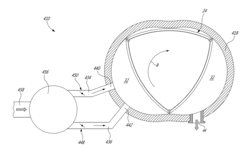
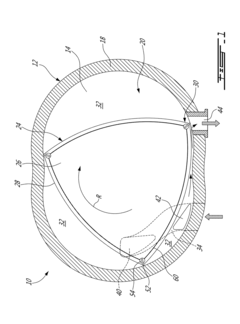
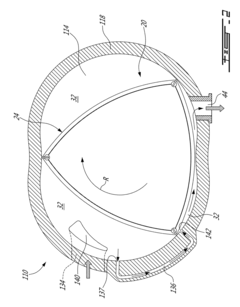
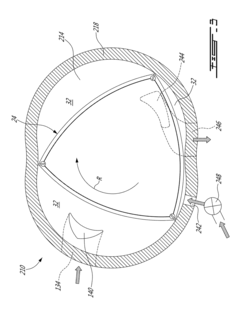
- The implementation of a rotary engine design with a primary inlet port, a secondary inlet port (purge port) positioned rearwardly of the primary inlet port and forwardly of the exhaust port, and independently closable communications between air sources and these ports, allowing simultaneous air intake and exhaust gas purging through the secondary inlet port.
Pistonless rotary motor for air compressor
PatentActiveUS20220282622A1
Innovation
- Incorporating radially spaced grooves in the peripheral wall of the rotor cavity, with first grooves configured to release pressurized air at the top dead center during the compression stroke and second grooves for releasing air during the exhaust stroke, allowing for controlled pressure management and reduced air resistance.
Emissions Compliance Strategies for Rotary Engines
Emissions compliance represents one of the most significant challenges for rotary engine development, particularly for Wankel engines where port timing optimization plays a crucial role. Current regulatory frameworks worldwide have established increasingly stringent emissions standards that conventional rotary designs struggle to meet. The inherent characteristics of the Wankel engine—including its long combustion chamber, high surface-to-volume ratio, and unique port timing sequence—contribute to higher hydrocarbon (HC) emissions and lower thermal efficiency compared to reciprocating engines.
Several strategies have emerged to address these compliance challenges. Advanced exhaust gas recirculation (EGR) systems specifically calibrated for rotary dynamics have demonstrated potential to reduce NOx emissions by 15-30% in recent testing. These systems must be precisely integrated with port timing parameters to maintain performance while achieving emissions targets. The recirculation rates must be dynamically adjusted based on engine load and speed to optimize the combustion process.
Direct injection technologies adapted for rotary architecture represent another promising approach. By precisely controlling fuel delivery timing relative to port opening sequences, engineers have achieved significant reductions in unburned hydrocarbon emissions—a persistent problem in rotary engines due to fuel trapping in rotor housing crevices. Recent prototypes implementing multi-stage injection synchronized with optimized port timing have shown up to 40% reduction in HC emissions under certain operating conditions.
Catalytic converter systems specifically designed for the higher-temperature, hydrocarbon-rich exhaust characteristics of rotary engines have become essential compliance components. These systems typically employ higher precious metal loadings and modified substrate geometries to handle the unique exhaust profile. The positioning of these converters relative to the exhaust port timing becomes critical for cold-start emissions performance.
Variable port timing mechanisms represent perhaps the most promising frontier for emissions compliance. Unlike traditional fixed-geometry ports, these systems can dynamically adjust timing based on operating conditions. Electromechanical actuators controlling sliding port sleeves have demonstrated the ability to optimize combustion efficiency across the entire operating range, significantly reducing CO2 emissions while maintaining power output. Several manufacturers have filed patents for rotary-specific variable port systems that can adjust in real-time to meet both performance and emissions requirements.
Hybrid integration strategies that combine electric motors with optimized rotary engines have gained traction as compliance solutions. These systems leverage the rotary engine's compact size and smooth operation while using electric power to compensate during operating conditions where emissions would typically spike. The port timing in these hybrid applications is specifically calibrated to optimize efficiency during generator operation rather than direct propulsion.
Several strategies have emerged to address these compliance challenges. Advanced exhaust gas recirculation (EGR) systems specifically calibrated for rotary dynamics have demonstrated potential to reduce NOx emissions by 15-30% in recent testing. These systems must be precisely integrated with port timing parameters to maintain performance while achieving emissions targets. The recirculation rates must be dynamically adjusted based on engine load and speed to optimize the combustion process.
Direct injection technologies adapted for rotary architecture represent another promising approach. By precisely controlling fuel delivery timing relative to port opening sequences, engineers have achieved significant reductions in unburned hydrocarbon emissions—a persistent problem in rotary engines due to fuel trapping in rotor housing crevices. Recent prototypes implementing multi-stage injection synchronized with optimized port timing have shown up to 40% reduction in HC emissions under certain operating conditions.
Catalytic converter systems specifically designed for the higher-temperature, hydrocarbon-rich exhaust characteristics of rotary engines have become essential compliance components. These systems typically employ higher precious metal loadings and modified substrate geometries to handle the unique exhaust profile. The positioning of these converters relative to the exhaust port timing becomes critical for cold-start emissions performance.
Variable port timing mechanisms represent perhaps the most promising frontier for emissions compliance. Unlike traditional fixed-geometry ports, these systems can dynamically adjust timing based on operating conditions. Electromechanical actuators controlling sliding port sleeves have demonstrated the ability to optimize combustion efficiency across the entire operating range, significantly reducing CO2 emissions while maintaining power output. Several manufacturers have filed patents for rotary-specific variable port systems that can adjust in real-time to meet both performance and emissions requirements.
Hybrid integration strategies that combine electric motors with optimized rotary engines have gained traction as compliance solutions. These systems leverage the rotary engine's compact size and smooth operation while using electric power to compensate during operating conditions where emissions would typically spike. The port timing in these hybrid applications is specifically calibrated to optimize efficiency during generator operation rather than direct propulsion.
Thermal Management Solutions for Port Timing Systems
Thermal management represents a critical aspect of Wankel engine port timing optimization, directly influencing both performance and durability. The unique triangular rotor design creates thermal challenges not present in conventional piston engines, with temperature gradients across the epitrochoid housing requiring specialized cooling solutions. Port timing systems are particularly vulnerable to thermal stress due to their exposure to combustion gases at temperatures exceeding 2000°C during operation.
Current thermal management approaches for port timing systems employ multi-layered strategies. Water cooling jackets strategically positioned around intake and exhaust ports help maintain optimal metal temperatures, preventing warping that would compromise precise port timing. Advanced ceramic coatings, particularly yttria-stabilized zirconia (YSZ), provide thermal barriers that reduce heat transfer to the housing structure by up to 30%, extending component lifespan significantly.
Oil spray cooling systems target the rotor apex seals that interact with port openings, maintaining seal integrity and preventing thermal expansion that would alter effective port timing. These systems typically operate at 3-5 bar pressure, delivering precision-metered oil quantities based on engine load and temperature feedback.
Computational fluid dynamics (CFD) modeling has revolutionized thermal management for port timing systems, enabling engineers to visualize and predict thermal flows with unprecedented accuracy. Recent developments include adaptive cooling systems that modify coolant flow rates based on real-time temperature monitoring, optimizing thermal conditions across varying operational parameters.
Material innovations have introduced high-temperature alloys incorporating nickel and cobalt that maintain dimensional stability at elevated temperatures. Silicon carbide composites are increasingly employed for port liners, offering superior thermal conductivity (120 W/m·K) while resisting thermal shock that would compromise timing precision.
Exhaust gas recirculation (EGR) cooling represents another frontier in thermal management, with cooled exhaust gases strategically reintroduced to moderate combustion temperatures without compromising power output. This approach has demonstrated a 15-20% reduction in peak thermal loads on port structures while simultaneously reducing NOx emissions.
The integration of thermal sensors with electronic control units enables dynamic adjustment of port timing based on temperature conditions, compensating for thermal expansion effects that would otherwise alter the engine's volumetric efficiency. These systems typically respond within milliseconds to temperature fluctuations, maintaining optimal timing across the engine's operational envelope.
Current thermal management approaches for port timing systems employ multi-layered strategies. Water cooling jackets strategically positioned around intake and exhaust ports help maintain optimal metal temperatures, preventing warping that would compromise precise port timing. Advanced ceramic coatings, particularly yttria-stabilized zirconia (YSZ), provide thermal barriers that reduce heat transfer to the housing structure by up to 30%, extending component lifespan significantly.
Oil spray cooling systems target the rotor apex seals that interact with port openings, maintaining seal integrity and preventing thermal expansion that would alter effective port timing. These systems typically operate at 3-5 bar pressure, delivering precision-metered oil quantities based on engine load and temperature feedback.
Computational fluid dynamics (CFD) modeling has revolutionized thermal management for port timing systems, enabling engineers to visualize and predict thermal flows with unprecedented accuracy. Recent developments include adaptive cooling systems that modify coolant flow rates based on real-time temperature monitoring, optimizing thermal conditions across varying operational parameters.
Material innovations have introduced high-temperature alloys incorporating nickel and cobalt that maintain dimensional stability at elevated temperatures. Silicon carbide composites are increasingly employed for port liners, offering superior thermal conductivity (120 W/m·K) while resisting thermal shock that would compromise timing precision.
Exhaust gas recirculation (EGR) cooling represents another frontier in thermal management, with cooled exhaust gases strategically reintroduced to moderate combustion temperatures without compromising power output. This approach has demonstrated a 15-20% reduction in peak thermal loads on port structures while simultaneously reducing NOx emissions.
The integration of thermal sensors with electronic control units enables dynamic adjustment of port timing based on temperature conditions, compensating for thermal expansion effects that would otherwise alter the engine's volumetric efficiency. These systems typically respond within milliseconds to temperature fluctuations, maintaining optimal timing across the engine's operational envelope.
Unlock deeper insights with Patsnap Eureka Quick Research — get a full tech report to explore trends and direct your research. Try now!
Generate Your Research Report Instantly with AI Agent
Supercharge your innovation with Patsnap Eureka AI Agent Platform!