
What Drives OLED vs MicroLED Market Evolution
OCT 24, 20259 MIN READ
Generate Your Research Report Instantly with AI Agent
Patsnap Eureka helps you evaluate technical feasibility & market potential.
OLED and MicroLED Technology Background and Evolution
Display technology has undergone significant evolution over the past decades, with OLED (Organic Light-Emitting Diode) and MicroLED emerging as two pivotal technologies poised to dominate next-generation displays. OLED technology, first conceptualized in the 1950s, saw practical development in the 1980s by Eastman Kodak, with commercial applications beginning in the early 2000s. The technology utilizes organic compounds that emit light when electricity is applied, eliminating the need for backlighting.
MicroLED, a more recent innovation, represents the convergence of LED and semiconductor technologies. Developed in the early 2000s, MicroLED utilizes microscopic LED arrays measuring less than 100 micrometers, with each pixel capable of self-emission. This technology has gained significant momentum since 2010, with major investments from industry leaders like Samsung, Apple, and Sony.
The evolution of these technologies has been driven by market demands for higher resolution, improved energy efficiency, and enhanced form factors. OLED has established dominance in premium smartphones and high-end televisions due to its perfect blacks, wide color gamut, and flexibility. The technology has evolved from passive-matrix to active-matrix configurations, with significant improvements in efficiency, lifespan, and manufacturing processes.
MicroLED represents the next frontier, promising advantages over OLED including higher brightness, longer lifespan, better energy efficiency, and immunity to burn-in issues. However, its complex manufacturing process and associated costs have limited widespread adoption. The technology evolution path shows progressive miniaturization of LED chips and development of mass transfer techniques to enable viable production.
Both technologies continue to evolve along parallel but distinct trajectories. OLED development focuses on addressing inherent limitations such as blue pixel degradation, manufacturing yield improvements, and cost reduction. Meanwhile, MicroLED research concentrates on overcoming mass production challenges, improving pixel density, and reducing manufacturing costs.
The technological evolution has been marked by significant patent activities, with companies like Samsung, LG Display, and Apple securing strategic intellectual property positions. Academic research has also contributed substantially to both technologies, with universities and research institutions developing novel materials and manufacturing processes that continue to push the boundaries of what's possible in display technology.
MicroLED, a more recent innovation, represents the convergence of LED and semiconductor technologies. Developed in the early 2000s, MicroLED utilizes microscopic LED arrays measuring less than 100 micrometers, with each pixel capable of self-emission. This technology has gained significant momentum since 2010, with major investments from industry leaders like Samsung, Apple, and Sony.
The evolution of these technologies has been driven by market demands for higher resolution, improved energy efficiency, and enhanced form factors. OLED has established dominance in premium smartphones and high-end televisions due to its perfect blacks, wide color gamut, and flexibility. The technology has evolved from passive-matrix to active-matrix configurations, with significant improvements in efficiency, lifespan, and manufacturing processes.
MicroLED represents the next frontier, promising advantages over OLED including higher brightness, longer lifespan, better energy efficiency, and immunity to burn-in issues. However, its complex manufacturing process and associated costs have limited widespread adoption. The technology evolution path shows progressive miniaturization of LED chips and development of mass transfer techniques to enable viable production.
Both technologies continue to evolve along parallel but distinct trajectories. OLED development focuses on addressing inherent limitations such as blue pixel degradation, manufacturing yield improvements, and cost reduction. Meanwhile, MicroLED research concentrates on overcoming mass production challenges, improving pixel density, and reducing manufacturing costs.
The technological evolution has been marked by significant patent activities, with companies like Samsung, LG Display, and Apple securing strategic intellectual property positions. Academic research has also contributed substantially to both technologies, with universities and research institutions developing novel materials and manufacturing processes that continue to push the boundaries of what's possible in display technology.
Display Market Demand Analysis and Trends
The display technology market is witnessing a significant shift as consumer preferences evolve toward more immersive, energy-efficient, and versatile visual experiences. OLED (Organic Light Emitting Diode) technology has established a strong foothold in premium smartphones, high-end televisions, and wearable devices, with the global OLED market valued at approximately $38.4 billion in 2022 and projected to grow at a CAGR of 14.5% through 2028.
This growth is primarily driven by increasing demand for superior picture quality, thinner form factors, and flexible display options. Smartphone manufacturers continue to be the largest adopters of OLED technology, accounting for nearly 50% of the total OLED panel consumption, followed by television manufacturers at approximately 30%. The flexibility of OLED panels has enabled innovative product designs such as foldable smartphones and rollable displays, creating new market segments and consumer interest.
Meanwhile, MicroLED technology is emerging as a promising alternative, particularly for large-format displays and specialized applications requiring exceptional brightness and durability. Though currently representing a smaller market share of about $2.7 billion, MicroLED is expected to grow at a faster rate of 80% annually over the next five years as manufacturing costs decrease and production yields improve.
The automotive industry has become a significant growth driver for both technologies, with premium vehicle manufacturers incorporating advanced displays in dashboards, entertainment systems, and heads-up displays. OLED currently dominates this segment due to its maturity and cost advantages, but MicroLED is gaining traction for its superior brightness in high-ambient light conditions.
Regional analysis reveals that East Asia continues to lead in display technology adoption and production, with South Korea, Japan, and China accounting for over 70% of global manufacturing capacity. North America and Europe represent major consumption markets, particularly for premium display products, while emerging economies in Southeast Asia and India are experiencing the fastest growth rates in display technology adoption.
Consumer behavior trends indicate increasing willingness to pay premium prices for superior display quality, with 65% of high-end smartphone buyers citing display quality as a critical purchase factor. Additionally, environmental considerations are becoming more prominent, with energy efficiency and recyclability influencing purchasing decisions, particularly in European markets where regulatory pressures regarding electronic waste and energy consumption are more stringent.
The COVID-19 pandemic accelerated certain market trends, including increased demand for larger home entertainment displays and work-from-home setups requiring multiple high-quality monitors. This shift has created sustained demand even as pandemic restrictions have eased, suggesting a permanent change in consumer expectations regarding display quality and functionality.
This growth is primarily driven by increasing demand for superior picture quality, thinner form factors, and flexible display options. Smartphone manufacturers continue to be the largest adopters of OLED technology, accounting for nearly 50% of the total OLED panel consumption, followed by television manufacturers at approximately 30%. The flexibility of OLED panels has enabled innovative product designs such as foldable smartphones and rollable displays, creating new market segments and consumer interest.
Meanwhile, MicroLED technology is emerging as a promising alternative, particularly for large-format displays and specialized applications requiring exceptional brightness and durability. Though currently representing a smaller market share of about $2.7 billion, MicroLED is expected to grow at a faster rate of 80% annually over the next five years as manufacturing costs decrease and production yields improve.
The automotive industry has become a significant growth driver for both technologies, with premium vehicle manufacturers incorporating advanced displays in dashboards, entertainment systems, and heads-up displays. OLED currently dominates this segment due to its maturity and cost advantages, but MicroLED is gaining traction for its superior brightness in high-ambient light conditions.
Regional analysis reveals that East Asia continues to lead in display technology adoption and production, with South Korea, Japan, and China accounting for over 70% of global manufacturing capacity. North America and Europe represent major consumption markets, particularly for premium display products, while emerging economies in Southeast Asia and India are experiencing the fastest growth rates in display technology adoption.
Consumer behavior trends indicate increasing willingness to pay premium prices for superior display quality, with 65% of high-end smartphone buyers citing display quality as a critical purchase factor. Additionally, environmental considerations are becoming more prominent, with energy efficiency and recyclability influencing purchasing decisions, particularly in European markets where regulatory pressures regarding electronic waste and energy consumption are more stringent.
The COVID-19 pandemic accelerated certain market trends, including increased demand for larger home entertainment displays and work-from-home setups requiring multiple high-quality monitors. This shift has created sustained demand even as pandemic restrictions have eased, suggesting a permanent change in consumer expectations regarding display quality and functionality.
Current Technical Challenges and Limitations
Despite significant advancements in both OLED and MicroLED technologies, several technical challenges continue to impede their widespread adoption and market evolution. For OLED displays, material degradation remains a persistent issue, particularly with blue organic compounds which typically have shorter lifespans compared to red and green counterparts. This differential aging leads to color shifts over time, affecting display quality and consistency. Additionally, OLED panels remain susceptible to burn-in effects when static images are displayed for extended periods, limiting their application in certain professional environments.
Manufacturing scalability presents another significant hurdle for OLED technology. While manufacturers have made substantial progress in reducing production costs, the yield rates for larger panels remain suboptimal, contributing to higher prices for large-format OLED displays. The complex vapor deposition processes required for OLED production demand extremely controlled environments, further increasing manufacturing complexity and costs.
For MicroLED technology, mass transfer remains the most formidable technical challenge. The process of precisely placing millions of microscopic LED chips onto a substrate with near-perfect accuracy has proven exceptionally difficult to scale. Current pick-and-place methods are time-consuming and prone to defects, significantly impacting production efficiency and yield rates. This challenge becomes exponentially more complex as display resolution increases, requiring even smaller LED elements and more precise placement.
Thermal management represents another critical limitation for MicroLED displays. The concentrated power in these miniaturized components generates substantial heat that must be effectively dissipated to prevent performance degradation and ensure longevity. Current thermal management solutions add complexity, weight, and cost to MicroLED display systems.
Both technologies face challenges related to power efficiency, though in different ways. While OLEDs offer excellent power efficiency for dark content due to their emissive nature, they consume more power when displaying bright content. Conversely, MicroLEDs promise superior overall efficiency but currently struggle to maintain this advantage at smaller pixel sizes due to efficiency droop phenomena.
Color consistency and uniformity present ongoing challenges for both technologies. For OLEDs, maintaining consistent color reproduction across the panel and throughout the display's lifetime requires sophisticated compensation algorithms. MicroLED displays face similar uniformity challenges, compounded by the difficulty of ensuring consistent performance across millions of individual LED elements from different semiconductor wafers.
These technical limitations significantly influence market adoption trajectories and investment priorities, with different manufacturers pursuing varied approaches to overcome these obstacles based on their technological expertise and market positioning.
Manufacturing scalability presents another significant hurdle for OLED technology. While manufacturers have made substantial progress in reducing production costs, the yield rates for larger panels remain suboptimal, contributing to higher prices for large-format OLED displays. The complex vapor deposition processes required for OLED production demand extremely controlled environments, further increasing manufacturing complexity and costs.
For MicroLED technology, mass transfer remains the most formidable technical challenge. The process of precisely placing millions of microscopic LED chips onto a substrate with near-perfect accuracy has proven exceptionally difficult to scale. Current pick-and-place methods are time-consuming and prone to defects, significantly impacting production efficiency and yield rates. This challenge becomes exponentially more complex as display resolution increases, requiring even smaller LED elements and more precise placement.
Thermal management represents another critical limitation for MicroLED displays. The concentrated power in these miniaturized components generates substantial heat that must be effectively dissipated to prevent performance degradation and ensure longevity. Current thermal management solutions add complexity, weight, and cost to MicroLED display systems.
Both technologies face challenges related to power efficiency, though in different ways. While OLEDs offer excellent power efficiency for dark content due to their emissive nature, they consume more power when displaying bright content. Conversely, MicroLEDs promise superior overall efficiency but currently struggle to maintain this advantage at smaller pixel sizes due to efficiency droop phenomena.
Color consistency and uniformity present ongoing challenges for both technologies. For OLEDs, maintaining consistent color reproduction across the panel and throughout the display's lifetime requires sophisticated compensation algorithms. MicroLED displays face similar uniformity challenges, compounded by the difficulty of ensuring consistent performance across millions of individual LED elements from different semiconductor wafers.
These technical limitations significantly influence market adoption trajectories and investment priorities, with different manufacturers pursuing varied approaches to overcome these obstacles based on their technological expertise and market positioning.
Current OLED and MicroLED Implementation Solutions
01 MicroLED display technology advancements
MicroLED displays represent a significant advancement in display technology, offering superior brightness, energy efficiency, and color accuracy compared to traditional displays. These displays utilize microscopic LED arrays that are self-emissive, eliminating the need for backlighting. Recent technological developments have focused on improving manufacturing processes to reduce production costs and increase yield rates, making MicroLED displays more commercially viable for various applications including smartphones, televisions, and wearable devices.- OLED display technology advancements: Organic Light Emitting Diode (OLED) technology has evolved significantly in the display market, offering advantages such as flexibility, thinness, and superior color reproduction. Recent advancements include improvements in OLED materials, manufacturing processes, and integration with other technologies. These developments have expanded OLED applications in various consumer electronics, particularly in smartphones, televisions, and wearable devices, contributing to its growing market share in the display industry.
- MicroLED display innovations: MicroLED technology represents the next generation of display technology, offering higher brightness, better energy efficiency, and longer lifespan compared to traditional display technologies. Recent innovations focus on overcoming manufacturing challenges, reducing production costs, and improving pixel density. MicroLED displays are being developed for various applications including smartwatches, AR/VR devices, and large-format displays, positioning this technology as a strong competitor in the premium display market segment.
- Hybrid and transitional display technologies: The market is seeing the emergence of hybrid display technologies that combine elements of OLED and MicroLED, as well as transitional technologies that bridge the gap between current and future display solutions. These hybrid approaches aim to leverage the strengths of multiple technologies while mitigating their individual limitations. Developments in this area include new material compositions, novel manufacturing techniques, and innovative device architectures that enable improved performance characteristics across various display applications.
- Market trends and competitive landscape: The display technology market is experiencing rapid evolution with OLED and MicroLED technologies competing for market share. Current trends indicate a shift from traditional LCD displays toward these newer technologies, with different adoption rates across various device categories. The competitive landscape features established electronics manufacturers expanding their display technology portfolios, alongside specialized display technology companies focusing on specific innovations. Regional market dynamics, consumer preferences, and application-specific requirements are shaping the overall market evolution.
- Manufacturing processes and scalability solutions: A critical aspect of OLED and MicroLED market evolution involves advancements in manufacturing processes and scalability solutions. Innovations in this area include improved transfer techniques for MicroLED, enhanced deposition methods for OLED materials, and novel approaches to quality control and yield management. These manufacturing advancements are essential for reducing production costs, increasing output capacity, and enabling mass-market adoption of these advanced display technologies across a wider range of consumer and professional applications.
02 OLED display innovations and market growth
OLED (Organic Light Emitting Diode) technology continues to evolve with innovations in materials, manufacturing processes, and device structures. Recent advancements include flexible and foldable OLED displays, transparent OLEDs, and improved color gamut and energy efficiency. The OLED market has experienced significant growth due to increasing adoption in smartphones, televisions, and other consumer electronics. Manufacturers are focusing on addressing challenges such as blue OLED lifetime and reducing production costs to maintain competitive advantage in the display market.Expand Specific Solutions03 Comparative market positioning of OLED and MicroLED technologies
The display market is witnessing a strategic positioning between OLED and MicroLED technologies, each with distinct advantages and target applications. While OLED currently dominates in smartphones and premium televisions due to manufacturing maturity and cost advantages, MicroLED is emerging as a potential successor in high-end markets where performance metrics like brightness, longevity, and energy efficiency are prioritized. Market analysis indicates a gradual shift as MicroLED manufacturing challenges are overcome, with both technologies expected to coexist in different market segments based on specific application requirements and price points.Expand Specific Solutions04 Manufacturing innovations and cost reduction strategies
Significant innovations in manufacturing processes are driving the evolution of both OLED and MicroLED display markets. These include mass transfer techniques for MicroLED, improved deposition methods for OLED materials, and novel approaches to quality control and testing. Cost reduction strategies focus on increasing yield rates, developing more efficient production equipment, and exploring alternative materials. These manufacturing advancements are critical for wider market adoption, particularly for MicroLED technology which currently faces higher production costs compared to established display technologies.Expand Specific Solutions05 Integration of display technologies in emerging applications
Both OLED and MicroLED display technologies are finding applications beyond traditional consumer electronics. These include automotive displays, augmented and virtual reality devices, smart home appliances, and digital signage. The unique properties of each technology, such as OLED's flexibility and MicroLED's brightness and durability, are enabling new use cases and form factors. Market evolution is increasingly driven by these emerging applications, which often have specialized requirements that can leverage the specific advantages of either OLED or MicroLED technology.Expand Specific Solutions
Key Industry Players and Competitive Landscape
The OLED vs MicroLED market is evolving through distinct competitive dynamics, currently positioned in different maturity phases. OLED technology, championed by established players like Samsung Electronics, BOE Technology Group, and Japan Display, has reached commercial maturity with significant market penetration in consumer electronics. Meanwhile, MicroLED remains in early commercialization, with companies like Lumileds, Apple, and Samsung pursuing this emerging technology for its superior brightness and efficiency. The global display market is projected to exceed $200 billion by 2025, with OLED currently dominating but MicroLED growing rapidly from a smaller base. Technical challenges in MicroLED mass production are being addressed by specialized firms like Chengdu Vistar Optoelectronics and Applied Materials, while OLED manufacturers focus on improving efficiency and reducing costs.
BOE Technology Group Co., Ltd.
Technical Solution: BOE has emerged as a dominant force in display technology, particularly challenging Samsung's OLED leadership. Their OLED strategy focuses on flexible displays using AMOLED technology with oxide backplanes that improve electron mobility and stability. BOE has invested over $6.8 billion in OLED production lines since 2017, establishing multiple Gen 6 flexible OLED production facilities with monthly capacity exceeding 144,000 substrates. For MicroLED, BOE employs a hybrid approach combining traditional LED manufacturing with advanced transfer techniques. Their proprietary "active matrix driving technology" enables individual pixel control for MicroLED displays, and they've demonstrated ultra-high brightness exceeding 10,000 nits. BOE's glass substrate approach for MicroLED differs from competitors' silicon substrates, potentially offering cost advantages at scale. Their recent demonstrations include a 75-inch 8K MicroLED display with 99.8% color uniformity and response times under 1 microsecond.
Strengths: Rapidly expanding production capacity for both technologies; strong government backing providing financial stability; vertical integration from materials to modules. Weaknesses: Still catching up to Samsung and LG in high-end OLED quality; MicroLED mass production capabilities remain limited; higher defect rates in cutting-edge display technologies compared to industry leaders.
Japan Display, Inc.
Technical Solution: Japan Display Inc. (JDI) has developed distinctive approaches to both OLED and MicroLED technologies. For OLED, JDI's "eLEAP" (enhanced Light Emitting Active Pixel) technology employs a unique top-emission structure with color filters directly integrated onto the OLED elements, achieving higher aperture ratios and improved power efficiency. Their proprietary "LTPS-OLED" backplane technology delivers electron mobility exceeding 100 cm²/Vs, enabling higher refresh rates while maintaining power efficiency. JDI has focused on high-resolution OLED displays for VR/AR applications, achieving pixel densities over 1000 PPI. In the MicroLED space, JDI leverages their "LTPS-on-glass" expertise to develop backplanes specifically optimized for MicroLED integration. Their approach uses a proprietary "micro-IC" architecture where driver ICs are directly bonded to glass substrates, reducing interconnection complexity. JDI has demonstrated transparent MicroLED displays with over 80% transparency, targeting automotive HUD and AR applications. Their recent prototypes feature sub-5μm LED chips with specialized phosphor technology for improved color performance.
Strengths: Superior technical expertise in high-resolution displays; established relationships with premium device manufacturers; advanced manufacturing capabilities for specialized display applications. Weaknesses: Financial constraints limiting large-scale investment capacity; smaller production scale compared to Korean and Chinese competitors; slower transition from LCD to next-generation technologies.
Core Patents and Technical Innovations Analysis
Anisotropic conductive film and display device
PatentActiveUS20220102326A1
Innovation
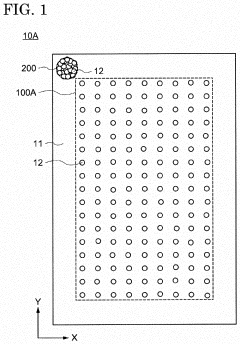
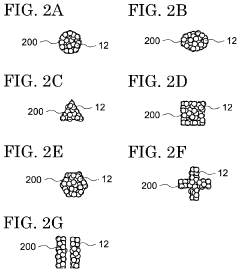
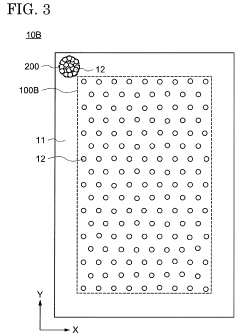
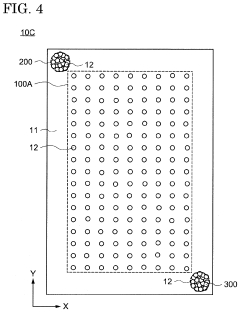
- An anisotropic conductive film with a first region of discretely arranged conductive particles corresponding to electrode patterns and a second region with aggregated conductive particles acting as an alignment marker, facilitating easy alignment with the circuit substrate and reducing production costs by forming alignment markers through conductive particle dispersion.
LED display and electronic device having same
PatentWO2019208919A1
Innovation
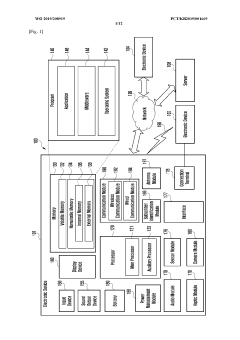
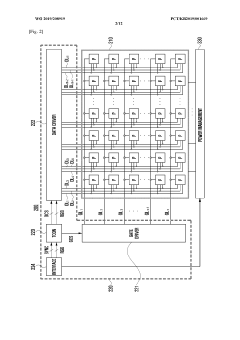
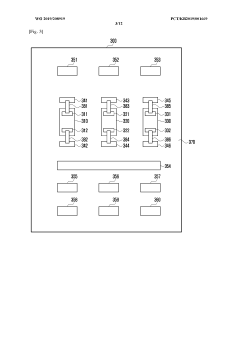
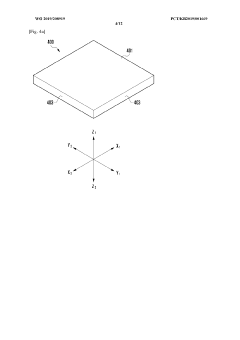
- The development of a micro-LED display with a bezel-less design and segmentation capabilities, allowing for flexible displays of various sizes, achieved through direct mounting of micro-LEDs on a substrate and innovative electrical connections using conductive patterns and wiring lines, enabling robust electrical connections and flexible display configurations.
Manufacturing Process Comparison and Scalability
The manufacturing processes for OLED and MicroLED technologies represent a critical factor in their respective market trajectories. OLED manufacturing has matured significantly over the past decade, with established production methods that have enabled economies of scale. The process typically involves vapor deposition of organic materials onto substrates, followed by encapsulation to protect against moisture and oxygen. This relatively streamlined process has allowed manufacturers like Samsung and LG Display to achieve high-volume production, particularly for small and medium-sized displays.
In contrast, MicroLED manufacturing remains complex and challenging. The process requires precise placement of millions of microscopic LED chips, each measuring less than 100 micrometers. Current manufacturing approaches include mass transfer techniques, where tiny LED chips are transferred from a donor substrate to a display backplane. This process demands extraordinary precision, with placement accuracy requirements in the micrometer range.
The yield rates further illustrate the manufacturing disparity. OLED production yields have improved dramatically, now exceeding 90% for established manufacturers. MicroLED yields remain significantly lower, often below 70%, particularly for high-resolution displays. Each defective MicroLED chip requires individual repair, substantially increasing production costs and time.
Scalability presents another crucial distinction. OLED manufacturing has successfully scaled to Gen 8.5 and larger substrates, enabling cost-effective production of large panels. The industry has established clear pathways for further scaling, with investments in larger fabs continuing. MicroLED scaling faces fundamental challenges related to transfer processes, inspection, and repair technologies that become exponentially more difficult as display sizes increase and pixel densities rise.
Equipment costs reflect these differences, with OLED production lines requiring approximately $200-400 million for a medium-capacity facility. MicroLED manufacturing equipment costs remain significantly higher, with estimates suggesting that comparable capacity would require investments 3-5 times greater than OLED facilities. This cost differential creates substantial barriers to entry for new manufacturers and limits production volume expansion.
Energy consumption during manufacturing also differs markedly. OLED production is relatively energy-efficient, while MicroLED manufacturing requires more energy-intensive processes, particularly for the precise placement and testing phases. This factor impacts not only production costs but also the environmental footprint of each technology.
In contrast, MicroLED manufacturing remains complex and challenging. The process requires precise placement of millions of microscopic LED chips, each measuring less than 100 micrometers. Current manufacturing approaches include mass transfer techniques, where tiny LED chips are transferred from a donor substrate to a display backplane. This process demands extraordinary precision, with placement accuracy requirements in the micrometer range.
The yield rates further illustrate the manufacturing disparity. OLED production yields have improved dramatically, now exceeding 90% for established manufacturers. MicroLED yields remain significantly lower, often below 70%, particularly for high-resolution displays. Each defective MicroLED chip requires individual repair, substantially increasing production costs and time.
Scalability presents another crucial distinction. OLED manufacturing has successfully scaled to Gen 8.5 and larger substrates, enabling cost-effective production of large panels. The industry has established clear pathways for further scaling, with investments in larger fabs continuing. MicroLED scaling faces fundamental challenges related to transfer processes, inspection, and repair technologies that become exponentially more difficult as display sizes increase and pixel densities rise.
Equipment costs reflect these differences, with OLED production lines requiring approximately $200-400 million for a medium-capacity facility. MicroLED manufacturing equipment costs remain significantly higher, with estimates suggesting that comparable capacity would require investments 3-5 times greater than OLED facilities. This cost differential creates substantial barriers to entry for new manufacturers and limits production volume expansion.
Energy consumption during manufacturing also differs markedly. OLED production is relatively energy-efficient, while MicroLED manufacturing requires more energy-intensive processes, particularly for the precise placement and testing phases. This factor impacts not only production costs but also the environmental footprint of each technology.
Energy Efficiency and Environmental Impact Assessment
Energy efficiency has emerged as a critical factor in the competitive landscape between OLED and MicroLED display technologies. OLED displays currently demonstrate variable energy efficiency profiles depending on content displayed, with dark content consuming significantly less power due to their emissive nature where black pixels remain unlit. This characteristic makes OLEDs particularly energy-efficient for mobile applications and dark-mode interfaces.
MicroLED technology, while still evolving, promises superior energy efficiency at scale. Initial measurements indicate potential energy savings of 30-50% compared to conventional LCD displays and up to 20% improvement over current OLED implementations when displaying mixed content. This efficiency stems from MicroLED's higher luminous efficacy and more precise light emission control at the pixel level.
Manufacturing processes for both technologies present distinct environmental considerations. OLED production involves organic materials and solvents that require careful handling and disposal protocols. The industry has made significant strides in reducing harmful chemicals, with major manufacturers reporting 40-60% reductions in hazardous waste over the past five years.
MicroLED manufacturing currently demands more energy-intensive processes, particularly in the precise placement of microscopic LED elements. However, the longer theoretical lifespan of MicroLED displays (potentially exceeding 100,000 hours versus 30,000-50,000 for OLEDs) may offset initial production impacts through reduced replacement frequency and electronic waste generation.
Life cycle assessments reveal that power consumption during use represents 70-80% of total environmental impact for both technologies. As energy grids globally transition toward renewable sources, the carbon footprint differential between these technologies may narrow, shifting focus to manufacturing impacts and end-of-life considerations.
Recycling capabilities present another environmental dimension. OLED panels contain valuable but difficult-to-separate materials, with current recovery rates below 20% for critical elements. MicroLED recycling processes remain largely theoretical but may benefit from the inorganic nature of their components, potentially allowing higher material recovery rates once commercial-scale recycling systems are developed.
Regulatory frameworks increasingly influence market dynamics, with the EU's Ecodesign Directive and similar initiatives in Asia setting progressively stringent energy efficiency requirements. These regulations may accelerate innovation in both technologies while potentially favoring MicroLED's theoretical efficiency advantages in the long term.
MicroLED technology, while still evolving, promises superior energy efficiency at scale. Initial measurements indicate potential energy savings of 30-50% compared to conventional LCD displays and up to 20% improvement over current OLED implementations when displaying mixed content. This efficiency stems from MicroLED's higher luminous efficacy and more precise light emission control at the pixel level.
Manufacturing processes for both technologies present distinct environmental considerations. OLED production involves organic materials and solvents that require careful handling and disposal protocols. The industry has made significant strides in reducing harmful chemicals, with major manufacturers reporting 40-60% reductions in hazardous waste over the past five years.
MicroLED manufacturing currently demands more energy-intensive processes, particularly in the precise placement of microscopic LED elements. However, the longer theoretical lifespan of MicroLED displays (potentially exceeding 100,000 hours versus 30,000-50,000 for OLEDs) may offset initial production impacts through reduced replacement frequency and electronic waste generation.
Life cycle assessments reveal that power consumption during use represents 70-80% of total environmental impact for both technologies. As energy grids globally transition toward renewable sources, the carbon footprint differential between these technologies may narrow, shifting focus to manufacturing impacts and end-of-life considerations.
Recycling capabilities present another environmental dimension. OLED panels contain valuable but difficult-to-separate materials, with current recovery rates below 20% for critical elements. MicroLED recycling processes remain largely theoretical but may benefit from the inorganic nature of their components, potentially allowing higher material recovery rates once commercial-scale recycling systems are developed.
Regulatory frameworks increasingly influence market dynamics, with the EU's Ecodesign Directive and similar initiatives in Asia setting progressively stringent energy efficiency requirements. These regulations may accelerate innovation in both technologies while potentially favoring MicroLED's theoretical efficiency advantages in the long term.
Unlock deeper insights with Patsnap Eureka Quick Research — get a full tech report to explore trends and direct your research. Try now!
Generate Your Research Report Instantly with AI Agent
Supercharge your innovation with Patsnap Eureka AI Agent Platform!