
Why OLED vs MicroLED Matter in Display Technologies
OCT 24, 20259 MIN READ
Generate Your Research Report Instantly with AI Agent
Patsnap Eureka helps you evaluate technical feasibility & market potential.
Display Technology Evolution and Objectives
Display technologies have undergone remarkable evolution since the introduction of cathode ray tubes (CRTs) in the early 20th century. The progression from CRTs to liquid crystal displays (LCDs) marked the first major shift, enabling thinner, more energy-efficient screens. This evolution continued with the development of plasma display panels, which offered improved contrast ratios and viewing angles but suffered from high power consumption and screen burn-in issues.
The introduction of OLED (Organic Light-Emitting Diode) technology in the early 2000s represented a significant leap forward. Unlike LCDs that require backlighting, OLED pixels emit their own light when electrical current passes through organic compounds. This self-emissive property enables perfect blacks, infinite contrast ratios, and thinner form factors, revolutionizing display quality in smartphones, televisions, and other devices.
Most recently, MicroLED has emerged as a promising next-generation display technology. Developed initially for large-format displays, MicroLED utilizes microscopic inorganic LED arrays that, like OLED, are self-emissive. However, MicroLED offers several theoretical advantages over OLED, including higher brightness, longer lifespan, and improved energy efficiency without the organic material degradation issues that plague OLED panels.
The technical objectives driving display technology evolution center around several key parameters: visual performance (resolution, contrast, color gamut), energy efficiency, form factor, durability, and manufacturing scalability. The industry continues to pursue higher pixel densities, with 4K and 8K resolutions becoming standard in premium segments, while simultaneously working to reduce power consumption—a critical factor for mobile devices.
Another significant objective is the development of flexible and foldable displays. OLED technology has enabled the first generation of foldable smartphones, but durability remains a challenge. The industry aims to create displays that can withstand hundreds of thousands of fold cycles without degradation, potentially opening new device form factors and use cases.
The competition between OLED and MicroLED represents the current technological frontier in display technologies. While OLED dominates the premium smartphone and high-end television markets, MicroLED promises superior performance characteristics that could eventually disrupt OLED's position. The technical objectives for both technologies include reducing manufacturing costs, improving yield rates, and enhancing color accuracy and brightness while minimizing power consumption.
Understanding the evolution trajectory and technical objectives of display technologies provides crucial context for evaluating the strategic importance of OLED versus MicroLED in various market segments and applications, from consumer electronics to automotive displays and professional visualization systems.
The introduction of OLED (Organic Light-Emitting Diode) technology in the early 2000s represented a significant leap forward. Unlike LCDs that require backlighting, OLED pixels emit their own light when electrical current passes through organic compounds. This self-emissive property enables perfect blacks, infinite contrast ratios, and thinner form factors, revolutionizing display quality in smartphones, televisions, and other devices.
Most recently, MicroLED has emerged as a promising next-generation display technology. Developed initially for large-format displays, MicroLED utilizes microscopic inorganic LED arrays that, like OLED, are self-emissive. However, MicroLED offers several theoretical advantages over OLED, including higher brightness, longer lifespan, and improved energy efficiency without the organic material degradation issues that plague OLED panels.
The technical objectives driving display technology evolution center around several key parameters: visual performance (resolution, contrast, color gamut), energy efficiency, form factor, durability, and manufacturing scalability. The industry continues to pursue higher pixel densities, with 4K and 8K resolutions becoming standard in premium segments, while simultaneously working to reduce power consumption—a critical factor for mobile devices.
Another significant objective is the development of flexible and foldable displays. OLED technology has enabled the first generation of foldable smartphones, but durability remains a challenge. The industry aims to create displays that can withstand hundreds of thousands of fold cycles without degradation, potentially opening new device form factors and use cases.
The competition between OLED and MicroLED represents the current technological frontier in display technologies. While OLED dominates the premium smartphone and high-end television markets, MicroLED promises superior performance characteristics that could eventually disrupt OLED's position. The technical objectives for both technologies include reducing manufacturing costs, improving yield rates, and enhancing color accuracy and brightness while minimizing power consumption.
Understanding the evolution trajectory and technical objectives of display technologies provides crucial context for evaluating the strategic importance of OLED versus MicroLED in various market segments and applications, from consumer electronics to automotive displays and professional visualization systems.
Market Demand Analysis for Advanced Display Technologies
The global display technology market is witnessing a significant shift towards advanced solutions, with OLED and MicroLED emerging as frontrunners in next-generation display technologies. Market research indicates that the advanced display market is projected to reach $167 billion by 2025, growing at a CAGR of 8.4% from 2020. This growth is primarily driven by increasing consumer demand for superior visual experiences across multiple device categories.
Consumer electronics represents the largest application segment for advanced display technologies, with smartphones accounting for approximately 40% of the total market share. The demand for OLED displays in premium smartphones has seen remarkable growth, with major manufacturers like Samsung, Apple, and Huawei incorporating this technology into their flagship devices. This trend is expected to continue as consumers increasingly prioritize display quality when making purchasing decisions.
Television represents another significant market segment, where both OLED and MicroLED are competing for dominance. The premium TV market has embraced OLED technology, with global OLED TV shipments growing by 62% in 2021. Meanwhile, MicroLED is gaining traction in the ultra-premium segment, with major brands introducing MicroLED TVs despite their currently prohibitive costs.
Commercial applications present substantial growth opportunities for advanced display technologies. Digital signage, automotive displays, and augmented/virtual reality devices are rapidly adopting OLED and exploring MicroLED solutions. The automotive display market alone is expected to grow at 12.3% CAGR through 2026, with OLED gaining significant market share due to its flexibility and energy efficiency advantages.
Regional analysis reveals that Asia-Pacific dominates the advanced display market, accounting for over 60% of global production capacity. North America and Europe follow as major consumption markets, particularly for premium display products. China has emerged as a critical player, with substantial investments in domestic OLED manufacturing capabilities and growing research focus on MicroLED technology.
Consumer preference surveys indicate that display quality now ranks among the top three purchasing factors for smartphones and televisions. Key demand drivers include higher resolution, improved color accuracy, better contrast ratios, and reduced power consumption. OLED currently satisfies many of these requirements, while MicroLED promises to address existing limitations in brightness and longevity.
Market forecasts suggest that while OLED will maintain its dominant position in the medium term, MicroLED is expected to capture significant market share by 2028 as manufacturing costs decrease and production yields improve. This transition will likely be accelerated by increasing demand for larger display sizes and higher brightness levels in both consumer and commercial applications.
Consumer electronics represents the largest application segment for advanced display technologies, with smartphones accounting for approximately 40% of the total market share. The demand for OLED displays in premium smartphones has seen remarkable growth, with major manufacturers like Samsung, Apple, and Huawei incorporating this technology into their flagship devices. This trend is expected to continue as consumers increasingly prioritize display quality when making purchasing decisions.
Television represents another significant market segment, where both OLED and MicroLED are competing for dominance. The premium TV market has embraced OLED technology, with global OLED TV shipments growing by 62% in 2021. Meanwhile, MicroLED is gaining traction in the ultra-premium segment, with major brands introducing MicroLED TVs despite their currently prohibitive costs.
Commercial applications present substantial growth opportunities for advanced display technologies. Digital signage, automotive displays, and augmented/virtual reality devices are rapidly adopting OLED and exploring MicroLED solutions. The automotive display market alone is expected to grow at 12.3% CAGR through 2026, with OLED gaining significant market share due to its flexibility and energy efficiency advantages.
Regional analysis reveals that Asia-Pacific dominates the advanced display market, accounting for over 60% of global production capacity. North America and Europe follow as major consumption markets, particularly for premium display products. China has emerged as a critical player, with substantial investments in domestic OLED manufacturing capabilities and growing research focus on MicroLED technology.
Consumer preference surveys indicate that display quality now ranks among the top three purchasing factors for smartphones and televisions. Key demand drivers include higher resolution, improved color accuracy, better contrast ratios, and reduced power consumption. OLED currently satisfies many of these requirements, while MicroLED promises to address existing limitations in brightness and longevity.
Market forecasts suggest that while OLED will maintain its dominant position in the medium term, MicroLED is expected to capture significant market share by 2028 as manufacturing costs decrease and production yields improve. This transition will likely be accelerated by increasing demand for larger display sizes and higher brightness levels in both consumer and commercial applications.
OLED vs MicroLED: Current Status and Technical Challenges
OLED (Organic Light Emitting Diode) and MicroLED technologies represent the cutting edge of display innovation, each with distinct technological characteristics and development trajectories. Currently, OLED dominates the premium display market with widespread commercial adoption across smartphones, televisions, and wearable devices. Its maturity is evidenced by established manufacturing processes and supply chains, particularly led by South Korean manufacturers like Samsung and LG Display.
The primary technical advantages of OLED include self-emissive pixels that eliminate the need for backlighting, resulting in perfect blacks, infinite contrast ratios, and reduced power consumption when displaying darker content. OLED displays also offer exceptional color accuracy, wide viewing angles, and the ability to be manufactured on flexible substrates, enabling innovative form factors like foldable and rollable displays.
However, OLED technology faces persistent challenges. Organic materials suffer from degradation over time, particularly blue subpixels, leading to burn-in issues and limited lifespan. Manufacturing yields remain problematic for larger panels, contributing to higher production costs. Additionally, OLED displays struggle with peak brightness levels compared to competing technologies, limiting their performance in high ambient light conditions.
MicroLED, while less commercially established, represents the next potential paradigm shift in display technology. These displays utilize microscopic inorganic LED arrays, typically measuring less than 50 micrometers, as individual pixel elements. The technology promises significant advantages including superior brightness (up to 30 times brighter than OLED), exceptional energy efficiency, near-infinite contrast ratios, and substantially longer lifespans without degradation concerns.
The primary technical hurdles for MicroLED commercialization center around manufacturing complexity. Mass transfer of millions of microscopic LEDs with precise placement remains extraordinarily challenging, with current defect rates too high for cost-effective production. The industry is actively developing innovative approaches including stamp transfer, laser transfer, and fluid assembly techniques to overcome these limitations.
Color uniformity presents another significant challenge for MicroLED, as variations in individual LED performance can create visible inconsistencies across the display. Additionally, achieving pixel densities comparable to current OLED displays requires further miniaturization of LED elements while maintaining electrical and optical performance.
Geographically, OLED development and production remain concentrated in East Asia, particularly South Korea and Japan, with emerging capacity in China. MicroLED research shows a more distributed pattern, with significant innovation occurring in North America (particularly among technology giants like Apple and Samsung), Taiwan, and European research institutions, creating a more globally diverse development ecosystem.
The primary technical advantages of OLED include self-emissive pixels that eliminate the need for backlighting, resulting in perfect blacks, infinite contrast ratios, and reduced power consumption when displaying darker content. OLED displays also offer exceptional color accuracy, wide viewing angles, and the ability to be manufactured on flexible substrates, enabling innovative form factors like foldable and rollable displays.
However, OLED technology faces persistent challenges. Organic materials suffer from degradation over time, particularly blue subpixels, leading to burn-in issues and limited lifespan. Manufacturing yields remain problematic for larger panels, contributing to higher production costs. Additionally, OLED displays struggle with peak brightness levels compared to competing technologies, limiting their performance in high ambient light conditions.
MicroLED, while less commercially established, represents the next potential paradigm shift in display technology. These displays utilize microscopic inorganic LED arrays, typically measuring less than 50 micrometers, as individual pixel elements. The technology promises significant advantages including superior brightness (up to 30 times brighter than OLED), exceptional energy efficiency, near-infinite contrast ratios, and substantially longer lifespans without degradation concerns.
The primary technical hurdles for MicroLED commercialization center around manufacturing complexity. Mass transfer of millions of microscopic LEDs with precise placement remains extraordinarily challenging, with current defect rates too high for cost-effective production. The industry is actively developing innovative approaches including stamp transfer, laser transfer, and fluid assembly techniques to overcome these limitations.
Color uniformity presents another significant challenge for MicroLED, as variations in individual LED performance can create visible inconsistencies across the display. Additionally, achieving pixel densities comparable to current OLED displays requires further miniaturization of LED elements while maintaining electrical and optical performance.
Geographically, OLED development and production remain concentrated in East Asia, particularly South Korea and Japan, with emerging capacity in China. MicroLED research shows a more distributed pattern, with significant innovation occurring in North America (particularly among technology giants like Apple and Samsung), Taiwan, and European research institutions, creating a more globally diverse development ecosystem.
Technical Comparison of OLED and MicroLED Solutions
01 OLED display performance characteristics
OLED (Organic Light Emitting Diode) technology offers superior display performance with self-emissive pixels that provide excellent contrast ratios, wide viewing angles, and vibrant color reproduction. These displays can achieve true blacks by completely turning off individual pixels, resulting in infinite contrast. OLED displays also feature fast response times, making them ideal for displaying fast-moving content with minimal motion blur. The technology allows for flexible and thin form factors, enabling curved or foldable display designs.- OLED display performance characteristics: OLED (Organic Light Emitting Diode) displays offer superior performance characteristics including high contrast ratios, wide color gamut, and fast response times. These displays emit light directly from each pixel, eliminating the need for backlighting, which results in true blacks and vibrant colors. OLED technology also enables flexible and transparent display applications due to its thin form factor and self-emissive nature.
- MicroLED display technology advancements: MicroLED displays utilize microscopic LED arrays to create self-emissive pixels, offering advantages such as higher brightness, longer lifespan, and better energy efficiency compared to traditional display technologies. These displays feature improved pixel density, enhanced durability, and reduced power consumption. MicroLED technology enables superior performance in high ambient light conditions and maintains color accuracy across various viewing angles.
- Comparative performance between OLED and MicroLED: When comparing OLED and MicroLED display technologies, MicroLED generally offers higher brightness levels and better power efficiency, while OLED excels in contrast ratio and color reproduction. MicroLED displays demonstrate superior longevity with reduced burn-in issues compared to OLED. Both technologies provide excellent response times and viewing angles, but they differ in manufacturing complexity and cost structures, with MicroLED currently being more expensive to produce at scale.
- Display driving and control mechanisms: Advanced driving and control mechanisms are crucial for optimizing the performance of both OLED and MicroLED displays. These include sophisticated pixel addressing schemes, current/voltage control circuits, and compensation algorithms that ensure uniform brightness and color across the display. Innovations in thin-film transistor (TFT) backplanes, driver ICs, and timing controllers enable higher refresh rates, reduced motion blur, and improved power management for enhanced visual performance.
- Material and structural innovations for display enhancement: Material science advancements and structural innovations play a significant role in enhancing display performance for both OLED and MicroLED technologies. These include novel organic compounds for OLED emitters, quantum dot integration for color enhancement, advanced semiconductor materials for MicroLED, and innovative pixel architectures. Structural improvements such as micro-lens arrays, light extraction layers, and specialized encapsulation techniques contribute to improved efficiency, color accuracy, and display longevity.
02 MicroLED display performance advantages
MicroLED displays utilize microscopic LED arrays to create self-emissive pixels, offering several performance advantages including higher brightness levels, improved energy efficiency, and longer lifespan compared to other display technologies. These displays provide exceptional color accuracy, wide color gamut, and high dynamic range (HDR) capabilities. MicroLED technology also demonstrates superior resistance to burn-in issues and maintains consistent performance over time, making it suitable for high-end display applications where image quality and longevity are critical.Expand Specific Solutions03 Pixel structure and driving methods
Advanced pixel structures and driving methods significantly impact display performance in both OLED and MicroLED technologies. Innovations in pixel architecture, including sub-pixel arrangements and pixel circuits, help optimize light emission efficiency and color accuracy. Various driving techniques, such as pulse width modulation (PWM) and current control methods, are employed to maintain consistent brightness levels and reduce power consumption. These approaches also address challenges like non-uniform aging and threshold voltage variations, ensuring stable long-term performance across the display panel.Expand Specific Solutions04 Display integration and form factor innovations
Integration innovations in OLED and MicroLED displays enable new form factors and enhanced user experiences. These include under-display sensors, cameras, and touch functionality that maintain display performance while adding new capabilities. Flexible, foldable, and rollable display designs leverage the thin profile and mechanical properties of these technologies. Advanced integration approaches also focus on reducing bezels and increasing screen-to-body ratios while maintaining structural integrity and display quality. These innovations allow for more immersive viewing experiences and novel device designs across consumer electronics.Expand Specific Solutions05 Manufacturing techniques for performance optimization
Manufacturing techniques play a crucial role in optimizing the performance of OLED and MicroLED displays. Advanced deposition methods, including vapor deposition for OLEDs and mass transfer techniques for MicroLEDs, ensure uniform pixel quality across large panels. Precision alignment systems and quality control processes help maintain consistent pixel spacing and reduce defects. Encapsulation technologies protect sensitive materials from environmental factors like moisture and oxygen, extending display lifespan. These manufacturing innovations collectively contribute to higher yields, better performance consistency, and reduced production costs for high-quality displays.Expand Specific Solutions
Key Industry Players in OLED and MicroLED Markets
The OLED vs MicroLED display technology landscape is currently in a transitional phase, with OLED being mature and widely commercialized while MicroLED remains in early development stages. The global display market is projected to reach $200 billion by 2025, with OLED holding significant market share. Samsung Display and BOE Technology lead OLED production, while companies like X Display Co., Lumileds, and Chengdu Vistar are pioneering MicroLED development. Major players like Samsung, BOE, and TCL are investing in both technologies, recognizing their strategic importance. MicroLED shows promising technical advantages in brightness, efficiency, and longevity, but faces manufacturing challenges that companies like Applied Materials are working to solve through innovative production techniques.
BOE Technology Group Co., Ltd.
Technical Solution: BOE has developed comprehensive solutions in both OLED and MicroLED technologies. Their OLED technology utilizes flexible substrates with low-temperature polysilicon (LTPS) backplanes, enabling bendable and foldable displays. BOE has invested heavily in 6th generation OLED production lines capable of producing both rigid and flexible panels. Their OLED manufacturing process incorporates fine metal mask (FMM) evaporation for RGB pixel deposition and thin film encapsulation (TFE) technology to protect organic materials. For MicroLED, BOE has developed a proprietary "micro-transfer printing" technique that can transfer thousands of microscopic LEDs simultaneously from epitaxial wafers to target substrates. Their MicroLED displays utilize gallium nitride (GaN) LED chips with sizes ranging from 30 to 50 micrometers, and they've demonstrated prototype displays with pixel densities exceeding 1,000 PPI (pixels per inch). BOE has also developed hybrid solutions combining quantum dot color conversion layers with MicroLED backplanes to enhance color performance.
Strengths: Massive production capacity with multiple fabrication plants; strong government backing for technology development; vertical integration from materials to finished displays; competitive pricing strategy. Weaknesses: Still catching up to Samsung and LG in high-end OLED quality; MicroLED mass production capabilities remain limited; intellectual property position not as strong as some competitors.
Samsung Electronics Co., Ltd.
Technical Solution: Samsung has pioneered both OLED and MicroLED technologies, with significant advancements in both fields. For OLED, Samsung utilizes its proprietary AMOLED technology featuring organic compounds that emit light when electricity is applied, eliminating the need for backlighting. Their latest QD-OLED hybrid technology combines quantum dots with OLED to enhance color volume and brightness while maintaining perfect blacks. For MicroLED, Samsung has developed "The Wall" - a modular MicroLED display system using inorganic gallium nitride-based LEDs sized under 100 micrometers. Each microscopic LED functions as an individual pixel, offering direct-view LED technology with self-emissive properties. Samsung's manufacturing process involves transferring these tiny LEDs from a "donor substrate" to a display substrate using mass transfer techniques that can place millions of MicroLEDs precisely.
Strengths: Market leader in both technologies with established manufacturing infrastructure; QD-OLED hybrid offers superior color performance; modular MicroLED design allows scalable display sizes. Weaknesses: High production costs for MicroLED with low yield rates; OLED still faces burn-in issues and shorter lifespan compared to inorganic alternatives.
Patent Landscape and Breakthrough Innovations
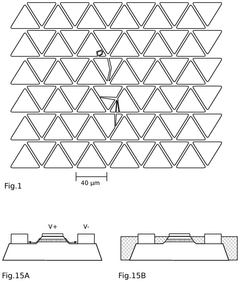
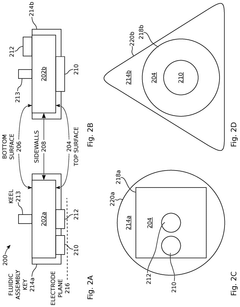
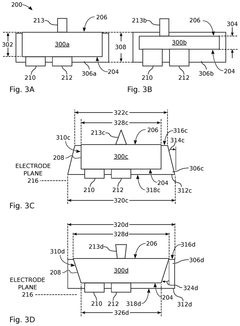
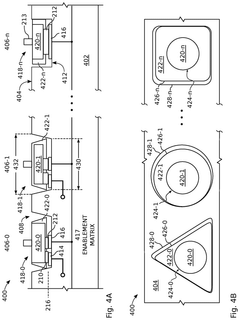
Encapsulated light emitting diodes for selective fluidic assembly
PatentActiveUS12119432B2
Innovation
- The use of partially encapsulated semiconductor-based inorganic micro-LEDs with a patternable polymer encapsulant that protects the LEDs from collisions and optimizes their shape for efficient assembly, allowing for higher speed and yield while preventing defects, and enabling precise alignment of LED colors on a display substrate.
LED display and electronic device having same
PatentWO2019208919A1
Innovation
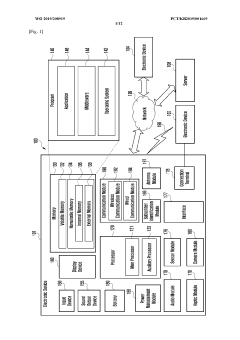
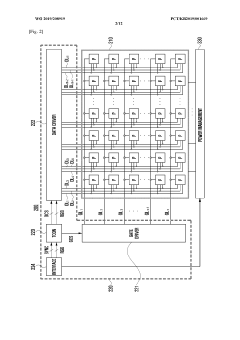
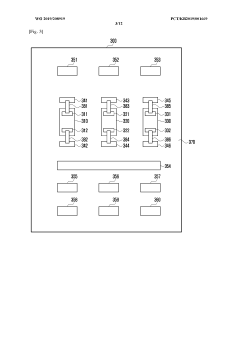
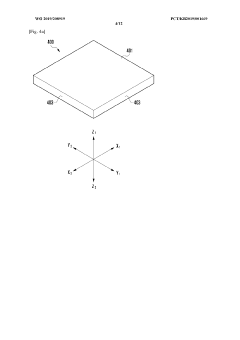
- The development of a micro-LED display with a bezel-less design and segmentation capabilities, allowing for flexible displays of various sizes, achieved through direct mounting of micro-LEDs on a substrate and innovative electrical connections using conductive patterns and wiring lines, enabling robust electrical connections and flexible display configurations.
Energy Efficiency and Sustainability Considerations
Energy efficiency has become a critical factor in display technology selection, particularly when comparing OLED and MicroLED technologies. OLED displays demonstrate significant energy advantages in dark-themed content scenarios due to their self-emissive pixel structure, where black pixels consume virtually no power. This characteristic makes OLEDs particularly efficient for mobile devices and applications with predominantly dark interfaces, potentially extending battery life by 20-40% compared to traditional LCD displays.
MicroLED technology, while still evolving, promises even greater energy efficiency at scale. Research indicates that MicroLEDs can achieve up to 30% higher efficiency than OLEDs at equivalent brightness levels, primarily due to their superior quantum efficiency and reduced heat generation. This efficiency advantage becomes particularly pronounced in high-brightness applications such as automotive displays and outdoor signage.
From a manufacturing sustainability perspective, OLED production currently faces challenges related to material waste and low yield rates, with industry reports suggesting yield losses between 15-30% depending on display size and complexity. The organic materials in OLEDs also present end-of-life recycling challenges due to their sensitivity to oxygen and moisture.
MicroLED manufacturing, while theoretically more sustainable due to inorganic materials, currently suffers from intensive energy requirements during production and complex mass transfer processes. However, recent innovations in pick-and-place technologies have improved transfer efficiency by approximately 40%, suggesting a pathway toward more sustainable manufacturing.
Lifecycle assessment studies indicate that display technologies contribute significantly to electronic devices' overall environmental footprint. OLED displays typically contain fewer toxic substances than traditional LCD technologies but may have shorter operational lifespans due to organic material degradation. MicroLED displays potentially offer longer operational lifetimes—projected at 100,000+ hours versus 30,000-50,000 for premium OLEDs—reducing replacement frequency and associated environmental impacts.
Water consumption represents another critical sustainability metric, with OLED manufacturing requiring approximately 30-45 liters per square meter of display, while preliminary data suggests MicroLED production may require 15-25% more water during fabrication stages. However, this disadvantage may be offset by MicroLED's longer operational lifespan and reduced replacement frequency.
As regulatory frameworks increasingly emphasize energy efficiency and circular economy principles, both technologies face pressure to improve their sustainability profiles. Industry consortiums are developing standardized sustainability metrics specifically for display technologies, which will likely influence future technology adoption decisions across consumer electronics, automotive, and commercial display markets.
MicroLED technology, while still evolving, promises even greater energy efficiency at scale. Research indicates that MicroLEDs can achieve up to 30% higher efficiency than OLEDs at equivalent brightness levels, primarily due to their superior quantum efficiency and reduced heat generation. This efficiency advantage becomes particularly pronounced in high-brightness applications such as automotive displays and outdoor signage.
From a manufacturing sustainability perspective, OLED production currently faces challenges related to material waste and low yield rates, with industry reports suggesting yield losses between 15-30% depending on display size and complexity. The organic materials in OLEDs also present end-of-life recycling challenges due to their sensitivity to oxygen and moisture.
MicroLED manufacturing, while theoretically more sustainable due to inorganic materials, currently suffers from intensive energy requirements during production and complex mass transfer processes. However, recent innovations in pick-and-place technologies have improved transfer efficiency by approximately 40%, suggesting a pathway toward more sustainable manufacturing.
Lifecycle assessment studies indicate that display technologies contribute significantly to electronic devices' overall environmental footprint. OLED displays typically contain fewer toxic substances than traditional LCD technologies but may have shorter operational lifespans due to organic material degradation. MicroLED displays potentially offer longer operational lifetimes—projected at 100,000+ hours versus 30,000-50,000 for premium OLEDs—reducing replacement frequency and associated environmental impacts.
Water consumption represents another critical sustainability metric, with OLED manufacturing requiring approximately 30-45 liters per square meter of display, while preliminary data suggests MicroLED production may require 15-25% more water during fabrication stages. However, this disadvantage may be offset by MicroLED's longer operational lifespan and reduced replacement frequency.
As regulatory frameworks increasingly emphasize energy efficiency and circular economy principles, both technologies face pressure to improve their sustainability profiles. Industry consortiums are developing standardized sustainability metrics specifically for display technologies, which will likely influence future technology adoption decisions across consumer electronics, automotive, and commercial display markets.
Manufacturing Scalability and Cost Analysis
The manufacturing processes for OLED and MicroLED display technologies represent a critical differentiator in their market viability and adoption rates. OLED manufacturing has matured significantly over the past decade, with established production lines and improving yields. Major manufacturers like Samsung and LG Display have invested billions in OLED fabrication facilities, achieving economies of scale that have gradually reduced production costs. However, OLED manufacturing still faces challenges with larger display sizes, where yield rates decline and costs increase disproportionately.
MicroLED manufacturing, by contrast, remains in its nascent stages with substantial hurdles to overcome. The primary challenge lies in the mass transfer process - placing millions of microscopic LED chips precisely onto display substrates. Current techniques include pick-and-place methods, laser transfer, and fluid assembly, each with significant limitations in throughput and precision. These technical barriers translate directly into prohibitive production costs, with current MicroLED displays costing up to 10 times more than comparable OLED panels.
Scale-up potential differs markedly between these technologies. OLED manufacturing benefits from established infrastructure and continuous process improvements, with incremental cost reductions expected through optimization rather than revolutionary breakthroughs. The industry has already achieved production capacities exceeding 30 million square meters annually, though high-end displays still command premium prices due to complex manufacturing requirements.
MicroLED's path to scalability depends on solving fundamental engineering challenges. Recent innovations in mass transfer techniques show promise, with companies like Apple, Samsung, and several startups developing proprietary methods to increase throughput and precision. Industry analysts project that MicroLED manufacturing costs could decrease by 90% within the next five years if these technical barriers are overcome, potentially reaching cost parity with OLED for certain applications by 2028-2030.
Material costs also factor significantly into the manufacturing equation. OLED production relies on organic materials with limited lifespans and complex deposition requirements, while MicroLED utilizes more durable inorganic materials but requires substantially more precise handling. The supply chain for MicroLED components remains underdeveloped compared to OLED's established ecosystem, creating additional cost pressures and potential bottlenecks as production scales.
Environmental considerations increasingly influence manufacturing decisions, with OLED production currently consuming more energy and utilizing more environmentally sensitive materials than potential optimized MicroLED processes. However, the environmental impact of MicroLED manufacturing at scale remains largely theoretical until high-volume production facilities become operational.
MicroLED manufacturing, by contrast, remains in its nascent stages with substantial hurdles to overcome. The primary challenge lies in the mass transfer process - placing millions of microscopic LED chips precisely onto display substrates. Current techniques include pick-and-place methods, laser transfer, and fluid assembly, each with significant limitations in throughput and precision. These technical barriers translate directly into prohibitive production costs, with current MicroLED displays costing up to 10 times more than comparable OLED panels.
Scale-up potential differs markedly between these technologies. OLED manufacturing benefits from established infrastructure and continuous process improvements, with incremental cost reductions expected through optimization rather than revolutionary breakthroughs. The industry has already achieved production capacities exceeding 30 million square meters annually, though high-end displays still command premium prices due to complex manufacturing requirements.
MicroLED's path to scalability depends on solving fundamental engineering challenges. Recent innovations in mass transfer techniques show promise, with companies like Apple, Samsung, and several startups developing proprietary methods to increase throughput and precision. Industry analysts project that MicroLED manufacturing costs could decrease by 90% within the next five years if these technical barriers are overcome, potentially reaching cost parity with OLED for certain applications by 2028-2030.
Material costs also factor significantly into the manufacturing equation. OLED production relies on organic materials with limited lifespans and complex deposition requirements, while MicroLED utilizes more durable inorganic materials but requires substantially more precise handling. The supply chain for MicroLED components remains underdeveloped compared to OLED's established ecosystem, creating additional cost pressures and potential bottlenecks as production scales.
Environmental considerations increasingly influence manufacturing decisions, with OLED production currently consuming more energy and utilizing more environmentally sensitive materials than potential optimized MicroLED processes. However, the environmental impact of MicroLED manufacturing at scale remains largely theoretical until high-volume production facilities become operational.
Unlock deeper insights with Patsnap Eureka Quick Research — get a full tech report to explore trends and direct your research. Try now!
Generate Your Research Report Instantly with AI Agent
Supercharge your innovation with Patsnap Eureka AI Agent Platform!