Method for changing existing roadbed to tunnel without interrupting operation of railway

A subgrade and tunnel technology, applied in the direction of road, track, track maintenance, etc., can solve the problems of reducing the value of land along the railway, destroying the landscape along the surrounding railway, and inconvenient traffic on both sides of the railway, so as to alleviate the impact, eliminate noise pollution, value-enhancing effect

CN102691242BActive Publication Date: 2015-02-04CHINA RAILWAY SIYUAN SURVEY & DESIGN GRP
7 Cites 0 Cited by

Patent Information

Authority / Receiving Office
CN · China
Patent Type
Patents(China)
Current Assignee / Owner
Publication Date
2015-02-04

Smart Images

  • Figure 1
    Figure 1
  • Figure 2
    Figure 2
Patent Text Reader

Abstract

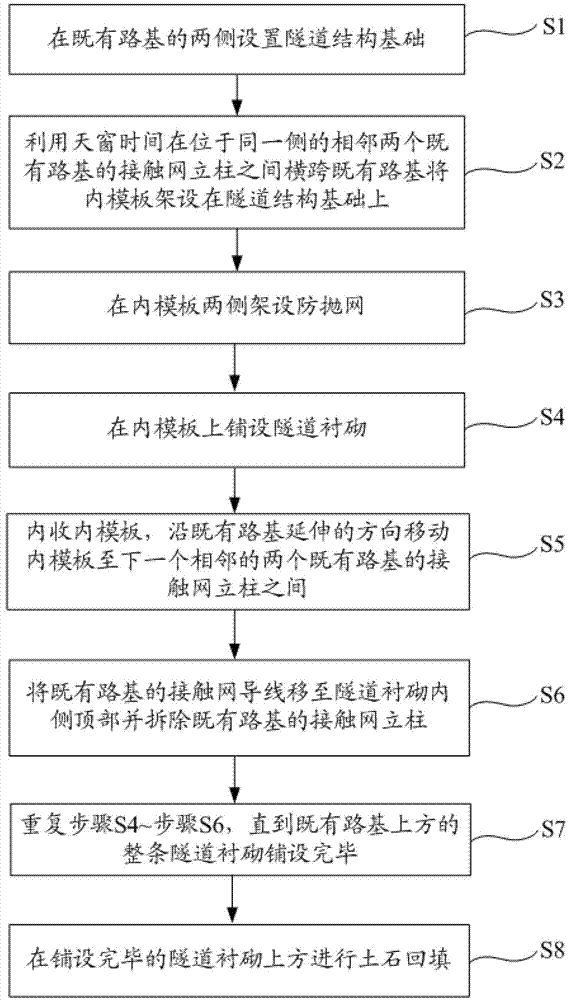
The invention discloses a method for changing an existing roadbed to a tunnel without interrupting the operation of a railway. The method comprises the following steps of: (1) arranging tunnel structure foundations on the two sides of the existing roadbed; (2) erecting an inner formwork on the tunnel structure foundations across the existing roadbed between two adjacent contact net upright posts of the existing roadbed, which are positioned on the same side, by utilizing skylight time; (3) laying a tunnel liner on the inner formwork; (4) adducting the inner formwork, and moving the inner formwork to the position between the next two adjacent contact net upright posts of the existing roadbed along the extension direction of the existing roadbed; (5) moving a contact net conducting wire of the existing roadbed to the top on the inner side of the tunnel liner, and dismantling the contact net upright posts of the existing roadbed; and (6) repeating the step (3) to step (5) till the completion of the laying of the whole tunnel liner above the existing roadbed. According to the method disclosed by the invention, the traffic along the railway can be improved, noise pollution can be eliminated, and the value of the area surrounding the railway can be upgraded.
Need to check novelty before this filing date? Find Prior Art

Description

technical field

[0001] The invention relates to the field of reconstruction of existing railway routes, in particular to a method for converting an existing roadbed into a tunnel without interrupting railway operation. Background technique

[0002] As the pace of urbanization is getting faster and faster, many railway lines pass through the main urban area of ​​the city. Although these historically built railways have made indelible contributions to the prosperity of the city, with the development of the times, the railways in the main urban area, especially the railways in the form of road cuttings, divided the city into multiple plots, resulting in tension on both sides of the railway. The traffic is inconvenient, and the noise brought by the running of the train has affected the lives of residents along the railway. In addition, there is usually a lot of garbage piled up along the railway line. If the garbage is not disposed of in time, it will damage the landscape along...

Examples

Embodiment Construction

[0020] Embodiments of the present invention will now be described with reference to the drawings, in which like reference numerals represent like elements.

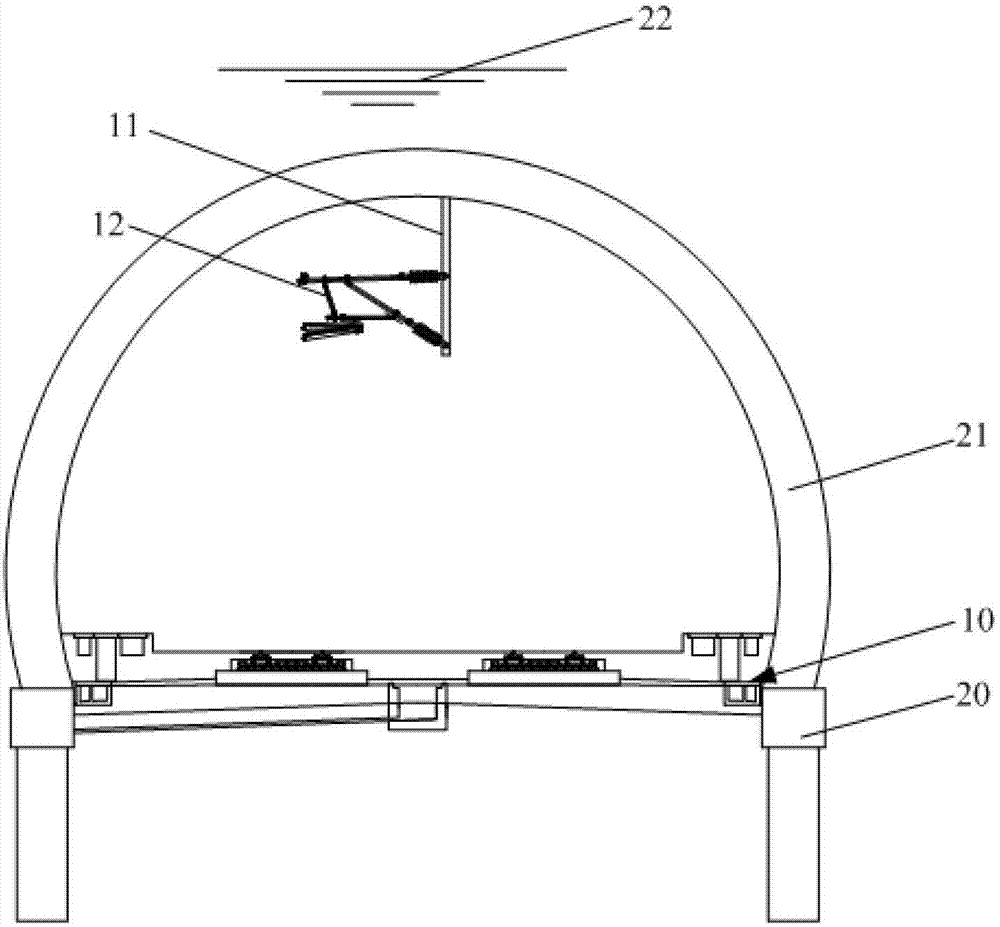
[0021] Such as Figure 1-2 As shown, the method for changing the existing roadbed of the present embodiment into a tunnel without interrupting railway operation includes the following steps:

[0022] Step S1: setting the tunnel structure foundation 20 on both sides of the existing subgrade 10;

[0023] Step S2: Lay guide rails on one side of the existing road 10, and the mobile formwork trolley moves on the guide rails between the catenary columns 11 of two adjacent existing roadbeds 10 on the same side and across the existing Subgrade 10, the inner formwork is erected on the tunnel structure foundation 20;

[0024] Step S3: erecting anti-throwing nets on both sides of the inner template;

[0025] Step S4: erecting the outer formwork above the inner formwork, erecting structural reinforcement between the inner formwork...