
A Multi-Description Video Coding Method Based on Human Visual System
A technology of human visual system and video coding, applied in the field of multi-description video coding based on human visual system, it can solve the problems of relying on source coding structure, ignoring, not taking into account the characteristics of human visual system, etc.
- Summary
- Abstract
- Description
- Claims
- Application Information
AI Technical Summary
Problems solved by technology
Method used
Image

Examples
Embodiment Construction
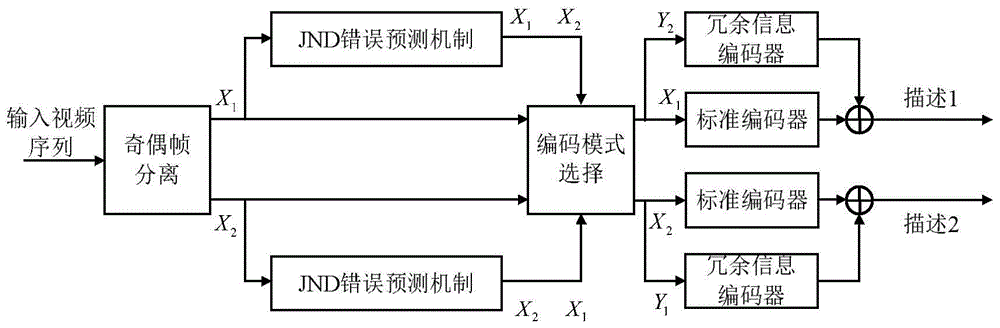
[0068] The present invention will be described in detail below in conjunction with the accompanying drawings, so that the advantages and features of the present invention can be more easily understood by those skilled in the art, so as to define the protection scope of the present invention more clearly.
[0069] In order to verify the effectiveness and advancement of the method of the present invention, we use four standard video sequences with different spatial resolutions as shown in Table 1 to test the performance of the system. The method of the present invention and the method proposed in the literature (traditional method) are compared in terms of subjective video reconstruction quality (average value of PSPNR of Y component) under different conditions. For the sake of fairness, in the process of processing, both methods select the first 100 frames of each video sequence, the block size is taken as 16×16, and the redundant information takes about 10% of the main informat...
PUM
 Login to View More
 Abstract
Description
Claims
Application Information
 Login to View More