A Dual-Wave Transmission System Based on Implicit Conjugation

A transmission system and conjugate technology, applied in the field of nonlinear optical signal transmission and processing, can solve the problems of decreased spectrum utilization, reduced transmission capacity, low effective transmission efficiency, etc., and achieves suppression of first-order nonlinear effects and high tolerance , the effect of improving spectrum utilization

CN107317629BActive Publication Date: 2019-11-05UNIV OF ELECTRONICS SCI & TECH OF CHINA
7 Cites 0 Cited by

Patent Information

Authority / Receiving Office
CN · China
Patent Type
Patents(China)
Current Assignee / Owner
Publication Date
2019-11-05

Smart Images

  • Figure 1
    Figure 1
  • Figure 2
    Figure 2
  • Figure 3
    Figure 3
Patent Text Reader

Abstract

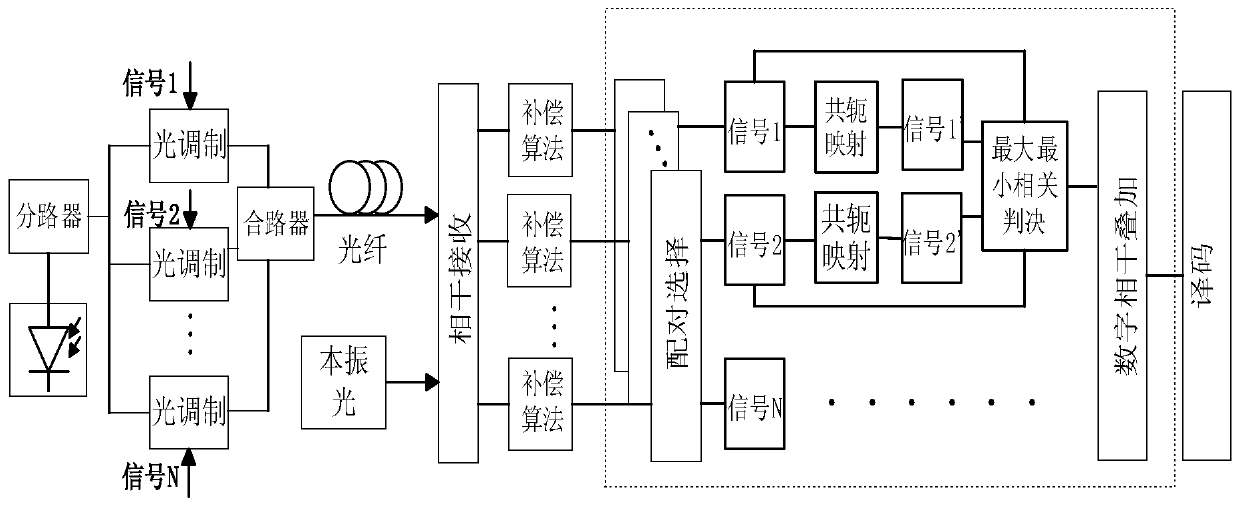
The present invention provides a dual-wave transmission system based on implicit conjugation, which hardly changes the hardware structure and digital signal processing process of commonly used optical transmitters, because it is no longer necessary to generate and transmit conjugated dual-wave according to the traditional scheme, It only requires that there are at least two pairs of separable independent signals that meet the orthogonal condition with each other, including orthogonal channels for polarization multiplexing, or multiple subcarriers through multi-carrier modulation (OFDM), or using wavelength division multiplexing technology Different channels of different channels and different time slices of time division multiplexing can be regarded as at least two parallel transmissions, which meet the generalized orthogonality and can meet the requirements of orthogonality in any dimension, such as polarization multiplexing, time division multiplexing, frequency division multiplexing or mode division multiplexing, etc. In the optical receiver, for each independent signal, determine its corresponding one or more orthogonal channels, and restore the conjugated double-wave on this channel, and then perform the coherent addition of the conjugated double-wave to eliminate the first-order Fiber nonlinear effects.
Need to check novelty before this filing date? Find Prior Art

Description

technical field

[0001] The technology of the present invention relates to nonlinear optical signal transmission and processing technology. Background technique

[0002] Over the past two decades, the transmission capacity of fiber-optic communication systems has experienced three orders of magnitude tremendous growth. In the current high-speed optical fiber communication system, with the completion of the commercial layout of the 100Gb / s system, the next-generation optical fiber transmission single channel begins to develop to 400Gb / s or even 1Tb / s, and the total capacity of a single fiber develops to 100Tb / s to meet the rapid development of data traffic. growing demand. From the perspective of the development of the existing long-distance optical fiber transmission technology, the transmission capacity and the transmission distance are mutually restricted, and there is a theoretical limit to ensuring a sufficient transmission distance while increasing the transmission capa...

Examples

Embodiment

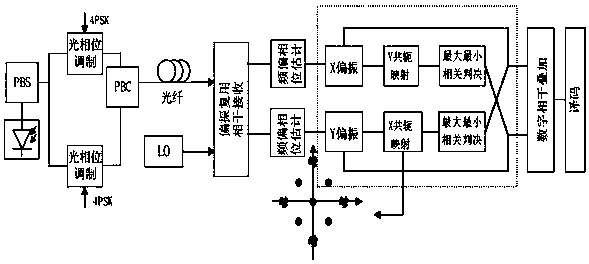
[0023] by figure 2 The transmission of the dual polarization state 4psk modulated signal is taken as an example for detailed description.

[0024] The transmitting end divides the optical carrier generated by the laser into two orthogonal paths through the polarization beam splitter. After the bit stream is modulated and mapped, two modulated signals are generated. The lights in the two polarization directions are respectively input to the optical phase modulator, which adopts the 4PSK modulation sequence, and is synthesized by a polarization light combiner and input to the optical fiber.

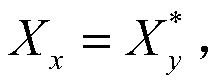
[0025] The dual-polarized signal light is transmitted through the optical fiber, and the receiver adopts the polarization multiplexing coherent receiving technology to separate the X and Y polarization signals, and uses dispersion compensation, clock recovery, frequency offset compensation, polarization demultiplexing, phase noise compensation and Traditional digital coherent demodulation...