
A short-term wind power prediction method and system based on DWT and LSTM
A power forecasting and power technology, applied in forecasting, information technology support systems, instruments, etc., can solve the uncertainty, instability and volatility of wind energy, can not provide reliable data reference for grid scheduling and planning, can not ensure Safe and stable operation of power grids, etc., to avoid gradient disappearance and gradient explosion, improve prediction accuracy, and avoid obstacles
- Summary
- Abstract
- Description
- Claims
- Application Information
AI Technical Summary
Problems solved by technology
Method used
Image

Examples
Embodiment
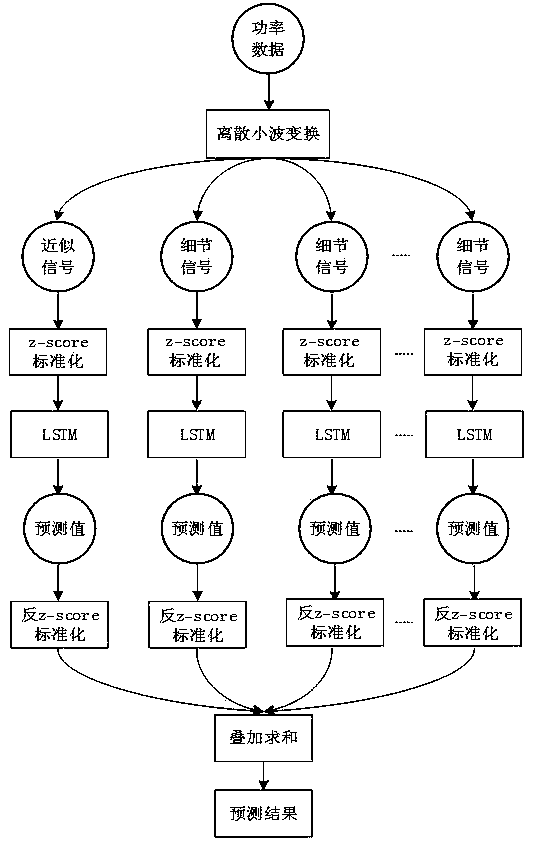
[0035] like figure 1 Shown is the embodiment of the short-term wind power generation power prediction method based on DWT and LSTM of the present invention, comprises the following steps:
[0036] S10. Collecting raw wind power generation data, and using DWT to decompose the raw wind power generation data into low-frequency signals and high-frequency signals;
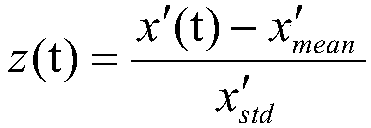
[0037] S20. Standardize the low-frequency signal and high-frequency signal in step S10 by using the z-score standardization method, and make the normalized data obey the normal distribution;
[0038] S30. Dividing the standardized low-frequency signal and high-frequency signal in step S20 into a training set, a verification set, and a test set according to time order;
[0039] S40. Using an independent LSTM to train the training set and verification set of each signal, and predicting the test set of each signal to obtain the predicted value of each component, and summing the predicted values of each component to obta...
PUM
 Login to View More
 Abstract
Description
Claims
Application Information
 Login to View More