
Systems and processes for fast encoding of hamming codes
- Summary
- Abstract
- Description
- Claims
- Application Information
AI Technical Summary
Problems solved by technology
Method used
Image

Examples
Embodiment Construction
The Extended Hamming Code
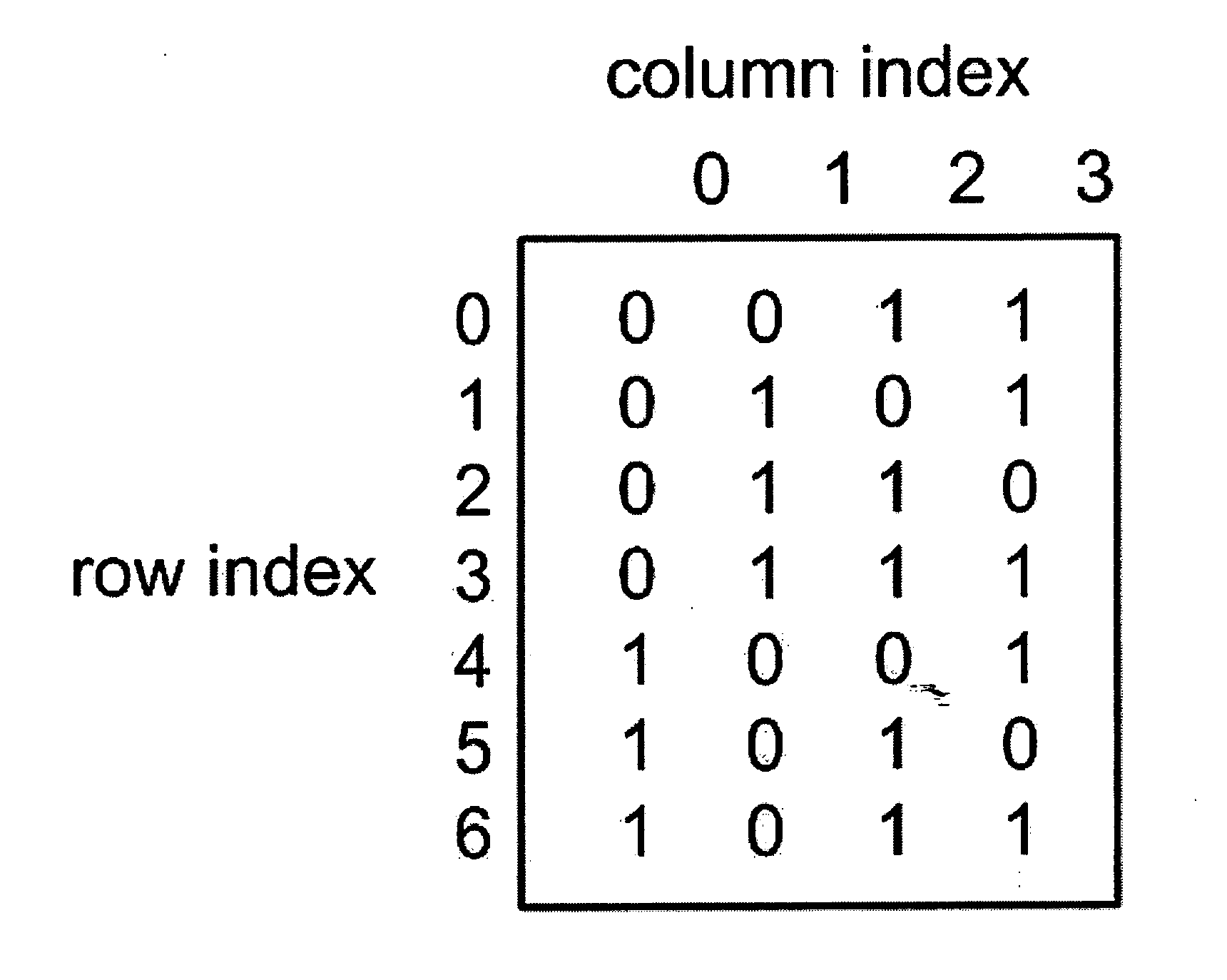
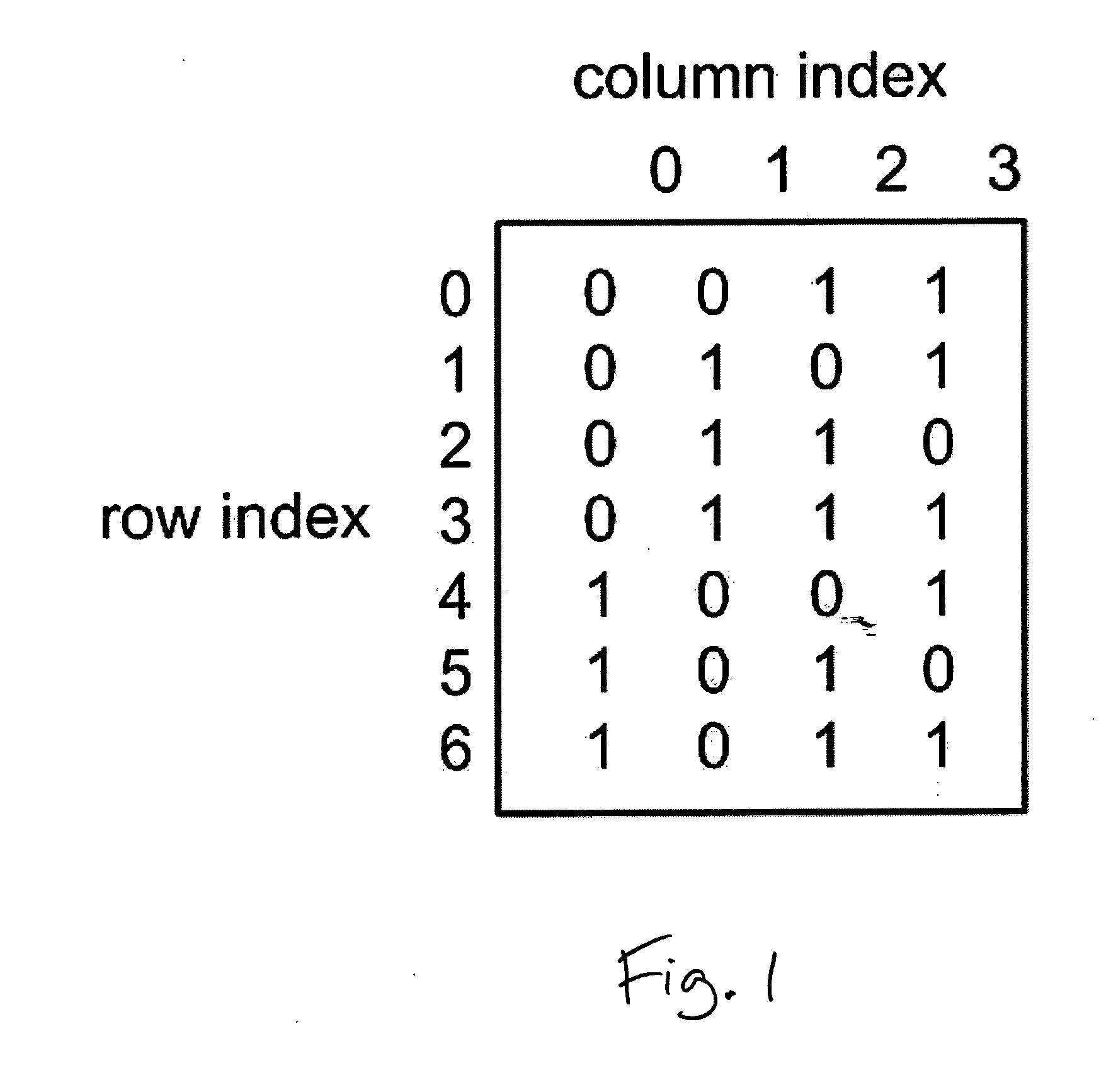
An extended Hamming code computes for a sequence of k input symbols a plurality of r+1 Hamming redundant symbols. Each of these Hamming redundant symbols is the XOR of some of the input symbols, where generally the lengths of all the symbols are the same. We use matrix notation to describe exactly which input symbols are XORed to yield a given Hamming redundant symbol. Let (x0, x1, . . . , xk−1) denote the sequence of k input symbols, and let (y0, y1, . . . , yr) denote the sequence of Hamming redundant symbols, where r satisfies Equation 1. The relationship between the input symbols and the first r Hamming redundant symbols can be represented as shown in FIG. 1 by a matrix H with k rows and r columns with each entry being 0 or 1 such that the Hamming redundant symbols can be calculated from the input symbols using Equation 2.
(x0, x1, . . . , xk−1)·H=(y0, y1, . . . , yr−1) (Equ. 2)
The r+1 Hamming redundant symbol is yr=x0⊕x1⊕ . . . ⊕xk−1⊕y0⊕y1⊕ . . ....
PUM
 Login to View More
 Abstract
Description
Claims
Application Information
 Login to View More