Lacrosse head having a wide catching area and channeled thongs

US20060019778A1Active Publication Date: 2006-01-26WM T BURNETT IP
6 Cites 6 Cited by

Patent Information

Authority / Receiving Office
US · United States
Current Assignee / Owner
Publication Date
2006-01-26

Smart Images

  • Figure 1
    Figure 1
  • Figure 2
    Figure 2
  • Figure 3
    Figure 3
Patent Text Reader

Abstract

A lacrosse head having a wide catching area and channeled thongs. One embodiment includes a stop member, a left sidewall connected to the stop member, a right sidewall connected to the stop member, and a scoop connecting the left sidewall to the right sidewall opposite the stop member. The scoop is disposed about 25.5 cm from the stop member. The widest point of lacrosse head is in a catching section disposed from about 6 cm to about 17 cm from the stop member. The left sidewall is convex with respect to the interior area of the head at a portion of the left sidewall between the widest point and the scoop. The right sidewall is convex at a portion of the right sidewall between the widest point and the scoop. In another embodiment, the sidewalls rise from the plane of the scoop and include thong holes to provide channeled thongs.
Need to check novelty before this filing date? Find Prior Art

Description

[0001] This application claims the benefit of U.S. Provisional Application No. 60 / 590,333, filed Jul. 23, 2004, which is herein incorporated by reference in its entirety.BACKGROUND

[0002] 1. Field of the Invention

[0003] The present invention relates generally to lacrosse sticks, and more particularly, to a lacrosse stick head having a wide catching area and channeled thongs.

[0004] 2. Background of the Invention

[0005] In 1970, the introduction of double-wall, synthetic lacrosse heads revolutionized the game of lacrosse. In comparison to the traditional wooden single-wall heads, the synthetic heads imparted a balance, lightness, maneuverability, and flexibility never-before experienced by lacrosse players. These performance advantages greatly enhanced players' skills such as throwing, catching, cradling, and scooping, and brought the sport of lacrosse to new levels of speed and excitement.

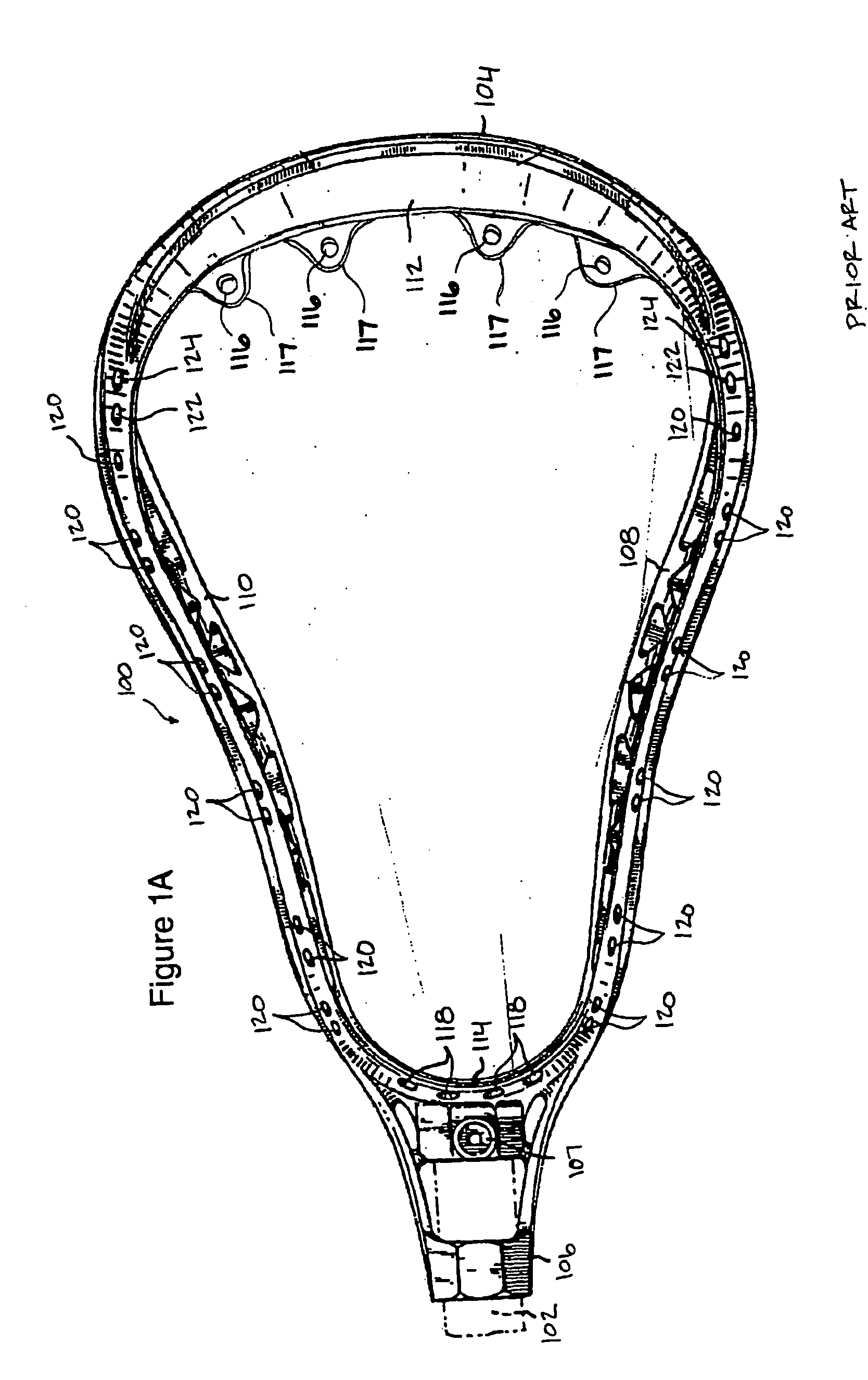
[0006] FIG. 1A illustrates a conventional lacrosse stick 100 having a handle 102 shown in dott...

Examples

Embodiment Construction

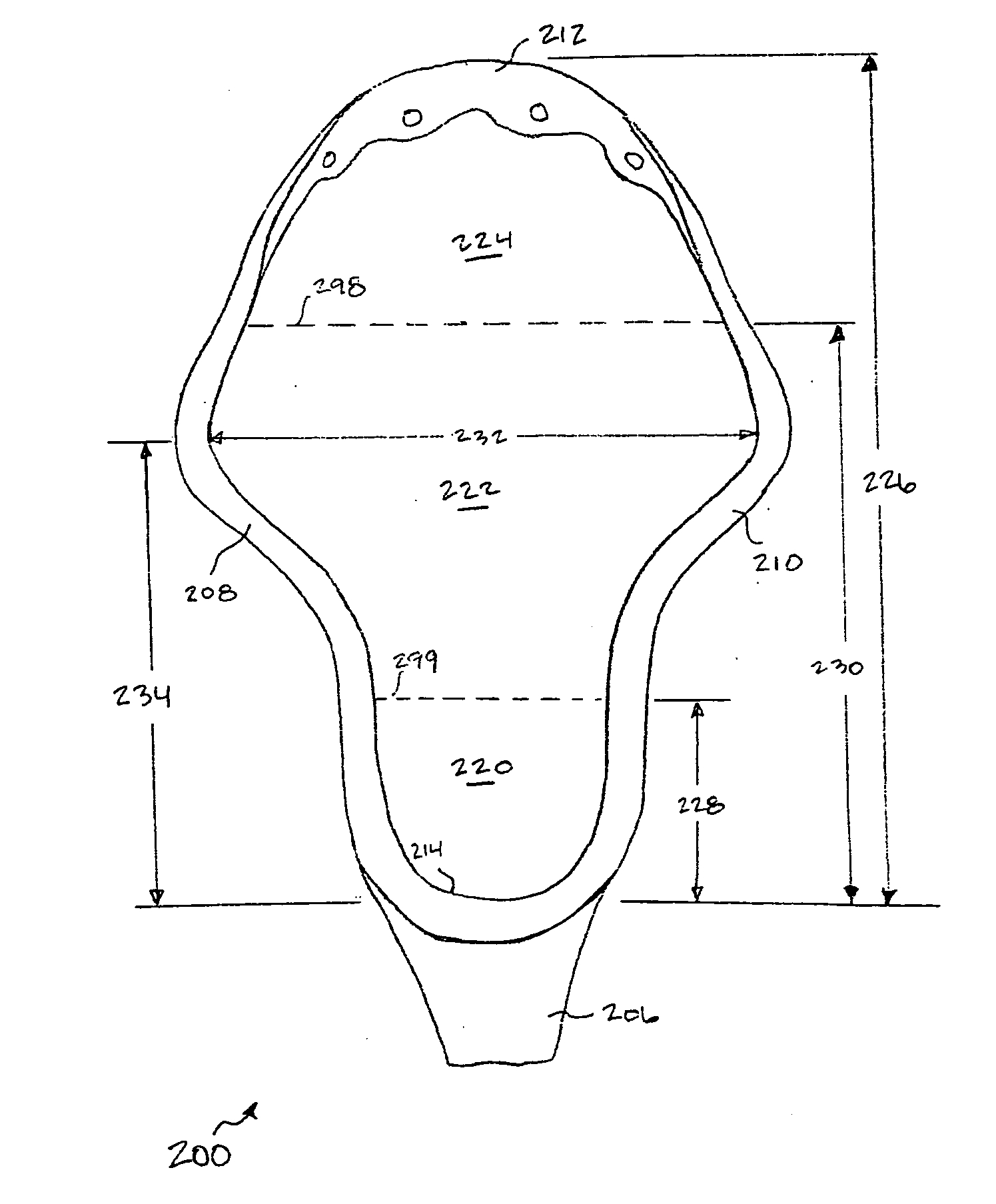
[0032]FIG. 2 illustrates an exemplary lacrosse head 200 according to an embodiment of the present invention. As shown, lacrosse head 200 includes a juncture 206, sidewalls 208 and 210, a scoop 212 joining the sidewalls at their ends opposite juncture 206, and a stop member 214 joining sidewalls 208 and 210 at their ends nearest juncture 206. A handle (not shown) fits into and through juncture 206, and abuts stop member 214.

[0033] As shown by the dotted lines 298 and 299 in FIG. 2, lacrosse head 200 is generally described herein with reference to three sections of the head: a rearward section 220, a catching section 222, and a forward section 224. As shown, rearward section 220 is nearest the ball stop 214 and forward section 224 is nearest the scoop 212. Catching section 222 is disposed in between rearward section 220 and forward section 224.

[0034] In a particular implementation of this embodiment of the present invention, the distance 226 from the middle of ball stop 214 to the e...