Probe, probe set, probe-immobilized carrier, and genetic testing method
Inactive Publication Date: 2009-10-01
CANON KK
View PDF55 Cites 26 Cited by
Summary
Abstract
Description
Claims
Application Information
AI Technical Summary
This helps you quickly interpret patents by identifying the three key elements:
Problems solved by technology
Method used
Benefits of technology
Benefits of technology
[0029]According to the present invention, when an analyte is infected with the above-mentioned causative bacterium, the bacterium can be more quickly and precisely identified from the analyte even if the analyte is simultaneously and co
Problems solved by technology
However, it is no easy task to establish a probe for specifically detecting a gene of an infectious disease pathogenic bacterium in a sample.
Thus, it is no easy task to establish the probe that specifi
Method used
the structure of the environmentally friendly knitted fabric provided by the present invention; figure 2 Flow chart of the yarn wrapping machine for environmentally friendly knitted fabrics and storage devices; image 3 Is the parameter map of the yarn covering machine
View more
Image
Smart Image Click on the blue labels to locate them in the text.
Viewing Examples
Smart Image
Click on the blue label to locate the original text in one second.
Reading with bidirectional positioning of images and text.
Smart Image
Examples
Experimental program
Comparison scheme
Effect test
Example
Example 1
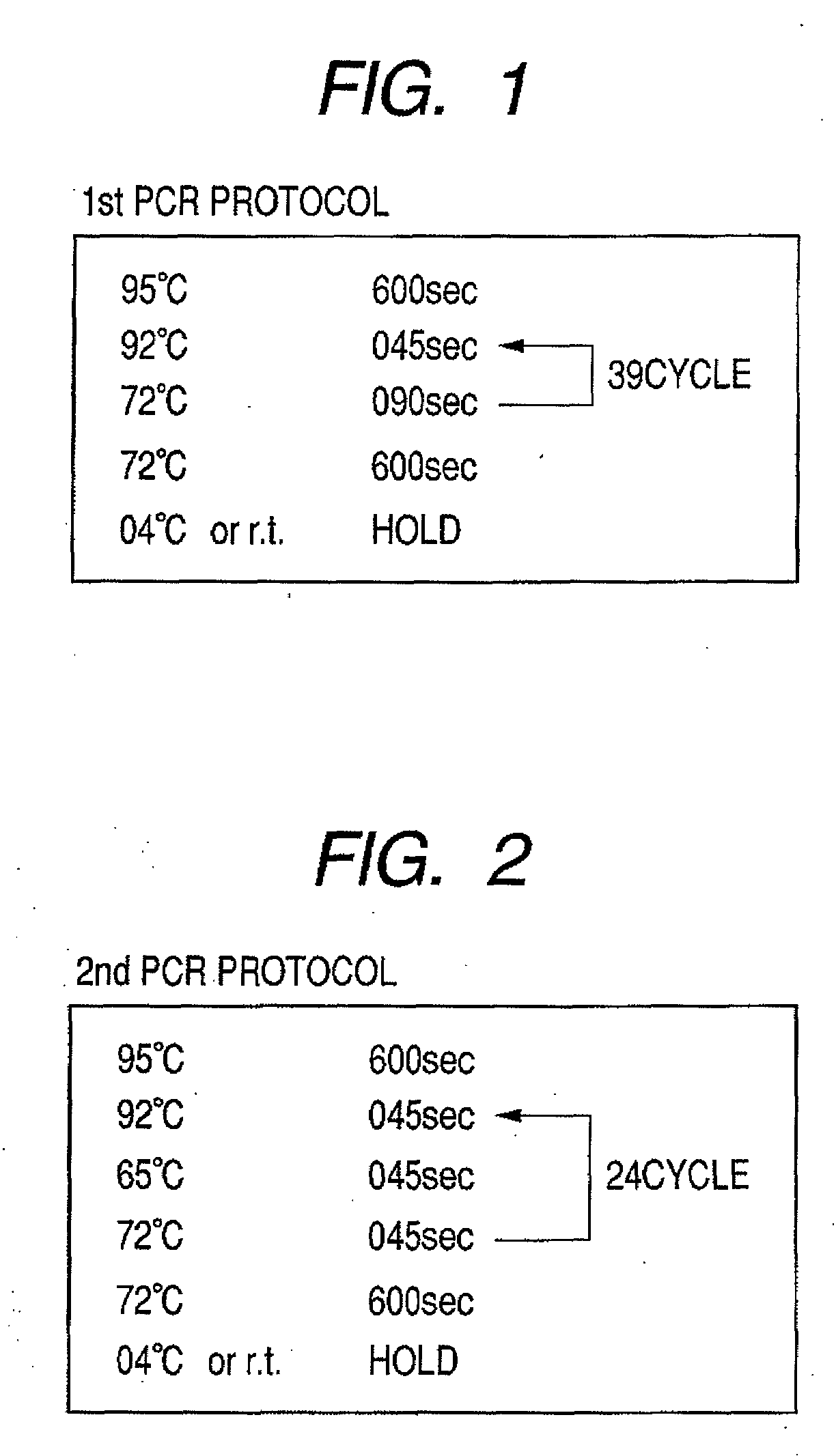
[0111]In this example, microorganism detection using 2-step PCR will be described.
1. Preparation of Probe DNA
[0112]Nucleic acid sequences shown in Table 1 were designed as probes to be used for detection of Providencia rettgeri. Specifically, the following probe base sequences were selected from the genome part coding for the 16s rRNA gene of Providencia rettgeri. These probe base sequences were designed such that they could have an extremely high specificity to the bacterium, and a sufficient hybridization sensitivity
could be expected without variance for the respective probe base sequences. The probe base sequences need not always completely match with those shown in Table 1. Probe base sequences having base lengths of 20 to 30, including the probe base sequences shown in Table 1, are also included in the probe base sequence shown in Table 1.
[0213]Using the DNA chip prepared in Example 2, detection was attempted when a plurality of bacterial species was present in an analyte.
[0214]A culture medium in which Providencia rettgeri and Clostridium difficile were cultured was prepared and subjected to the same treatment as that of Example 1 to react with the DNA chip.
[0215]As a result, only the spots of the probes having SEQ ID NOS. 43, 44, 45, 65, 66, and 67 showed high fluorescence intensity, so the coexistence of those bacteria was able to be simultaneously confirmed.
[0216]The present invention is not limited to the above-mentioned embodiments and various changes and modifications can be made within the spirit and scope of the present invention. Therefore to apprise the public of the scope of the present invention, the following claims are made.
[0217]This application claims the benefit of Japanese Patent Application No. 2006-099497, filed Mar. 31, 2006, which is hereby incorporated by reference herein in its entirety.
NUMB...
the structure of the environmentally friendly knitted fabric provided by the present invention; figure 2 Flow chart of the yarn wrapping machine for environmentally friendly knitted fabrics and storage devices; image 3 Is the parameter map of the yarn covering machine
Login to View More
PUM
Login to View More
Abstract
A nucleic acid probe for classification of pathogenic bacterial species is capable of collectively detecting bacterial strains of the same species and differentially detecting them from other bacterial species. Any one of the base sequences of SEQ ID NOS. 65 to 67 or a combination of at least two of them is used for detecting the gene of an infectious disease pathogenic bacterium.
Description
TECHNICAL FIELD[0001]The present invention relates to a probe and a probe set for detecting a gene of infectious disease pathogenic bacterium, Providencia rettgeri, which are useful for detection and identification of the causative organism of an infectious disease, a probe-immobilized carrier on which the probe or the probe set is immobilized, a genetic testing method using the probe-immobilized carrier, and a genetic testing kit to be used for the method.BACKGROUND ART[0002]Heretofore, reagents for and methods of quickly and accurately detecting the causative organisms of infectious diseases in analytes have been proposed. For instance, Japanese Patent Application Laid-Open No. H08-89254 discloses oligonucleotides having specific base sequences, which can be respectively used as probes and primers for detecting pathogenic bacteria of candidiasis and aspergillosis, and a method of detecting target bacteria using such oligonucleotides. In addition, the same patent document also disc...
Claims
the structure of the environmentally friendly knitted fabric provided by the present invention; figure 2 Flow chart of the yarn wrapping machine for environmentally friendly knitted fabrics and storage devices; image 3 Is the parameter map of the yarn covering machine
Login to View More
Application Information
Patent Timeline
Application Date:The date an application was filed.
Publication Date:The date a patent or application was officially published.
First Publication Date:The earliest publication date of a patent with the same application number.
Issue Date:Publication date of the patent grant document.
PCT Entry Date:The Entry date of PCT National Phase.
Estimated Expiry Date:The statutory expiry date of a patent right according to the Patent Law, and it is the longest term of protection that the patent right can achieve without the termination of the patent right due to other reasons(Term extension factor has been taken into account ).
Invalid Date:Actual expiry date is based on effective date or publication date of legal transaction data of invalid patent.


 Login to View More
  Login to View More