
Determining Textual Content that is Responsible for Causing a Viewing Spike Within a Video in a Digital Medium Environment
- Summary
- Abstract
- Description
- Claims
- Application Information
AI Technical Summary
Benefits of technology
Problems solved by technology
Method used
Image

Examples
example environment
[0026
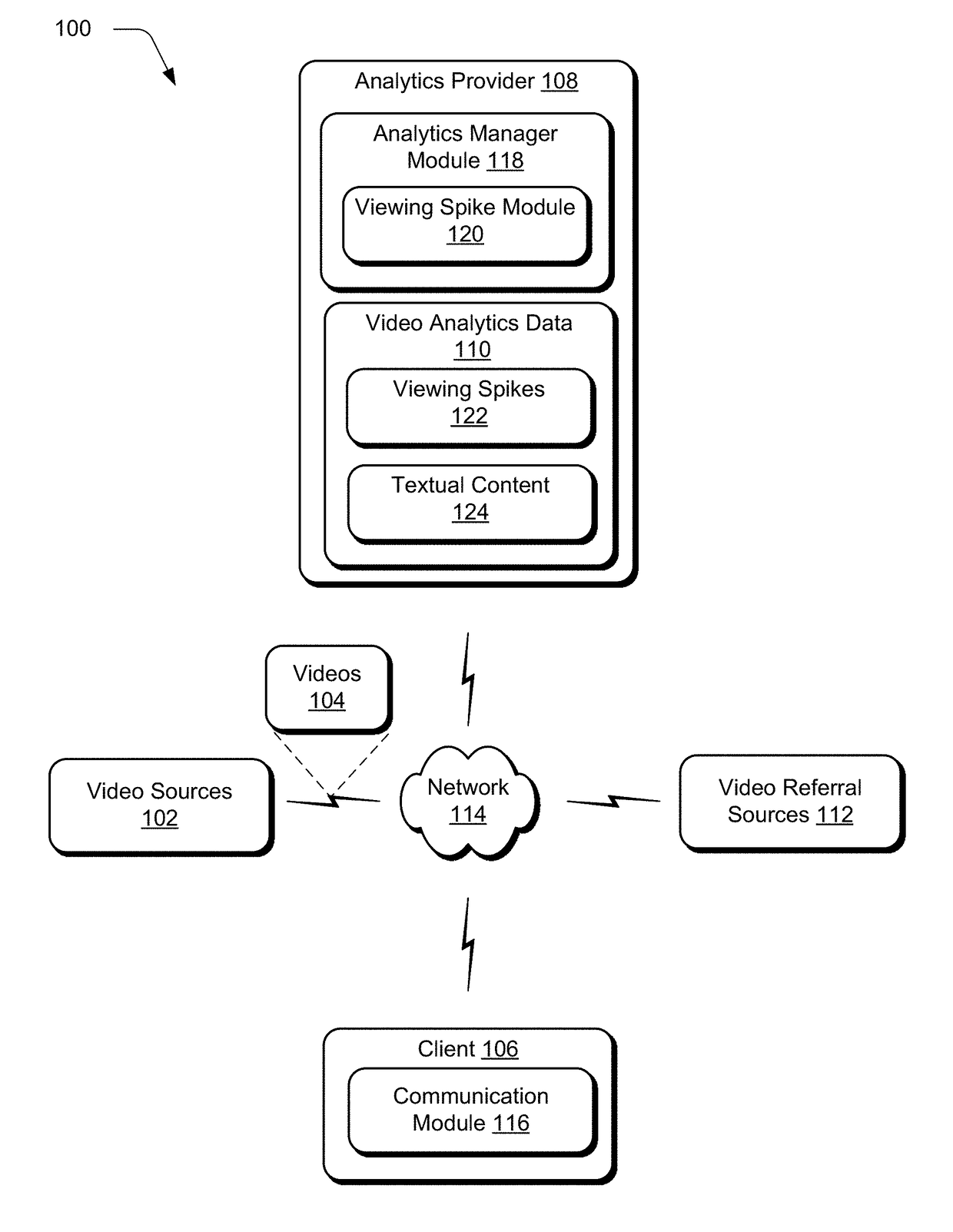
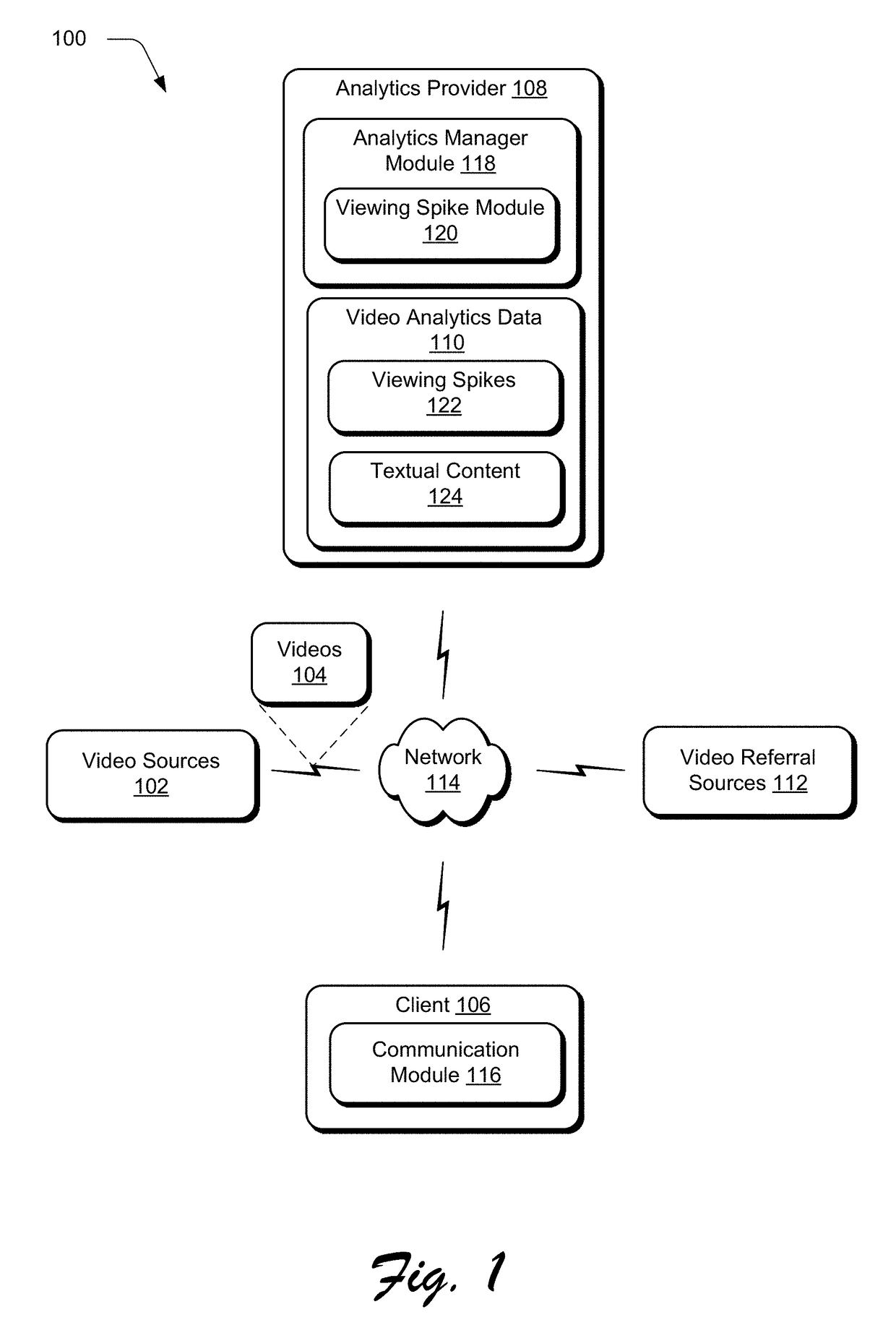
[0027]FIG. 1 is an illustration of a digital medium environment 100 in an example implementation that is operable to employ techniques described herein. The digital medium environment 100 includes video sources 102 at which videos 104 may be viewed by clients 106. An analytics provider 108 is configured to monitor user viewings of videos 104 by clients 106, and provide video analytics data 110 based on the user viewings. The video analytics data 110, for example, may include metrics, statistics, or other information that describes user interactions with the video 104, such as the number of users that viewed the video at particular locations throughout the video. In some cases, user viewings of a video 104 may occur in response to the user navigating to the video source 102 from a video referral source 112. As described herein, video sources 102 correspond to web pages or applications at which the video 104 can be viewed, such as YouTube®, Vimeo®, and so forth. In contrast, vide...
example procedures
[0065
[0066]The following discussion describes techniques that may be implemented utilizing the previously described systems and devices. Aspects of each of the procedures may be implemented in hardware, firmware, or software, or a combination thereof. The procedures are shown as a set of blocks that specify operations performed by one or more devices and are not necessarily limited to the orders shown for performing the operations by the respective blocks. In portions of the following discussion, reference will be made to FIGS. 1-7.
[0067]FIG. 8 depicts a procedure 800 in an example implementation in which textual content that is at least partially responsible for causing a viewing spike within a video is determined.
[0068]At 802, video analytics data associated with a video that identifies a number of previous user viewings at various locations within the video is queried. For example, viewing spike module 120 queries video analytics data 110 that identifies a number of previous user...
PUM
 Login to View More
 Abstract
Description
Claims
Application Information
 Login to View More