
Process for recycling fiber composite materials
a fiber composite material and composite material technology, applied in the field of fiber composite material recycling, can solve the problems of inability to produce a different type of fiber composite material, separation between fibers and matrix, etc., and achieve the effect of facilitating the cleaving of polymer chains and higher dielectric loss factor
Inactive Publication Date: 2003-03-25
DAIMLER AG
View PDF6 Cites 10 Cited by
- Summary
- Abstract
- Description
- Claims
- Application Information
AI Technical Summary
Benefits of technology
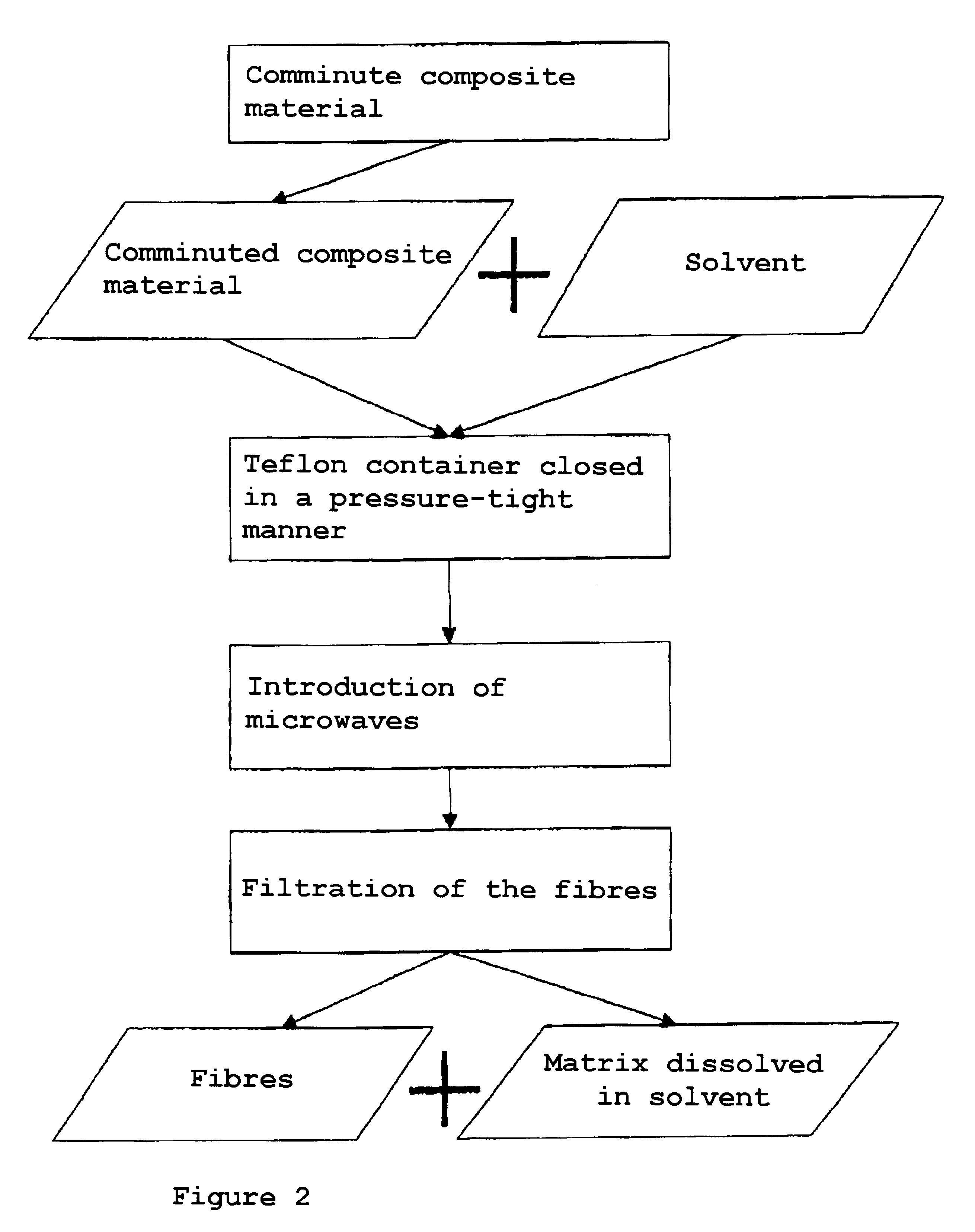
It is particularly advantageous to place the composite material in a solvent during the introduction of energy. This applies particularly to composite materials with organic matrices. As a result of the selective heating of the matrix, the polymer chains of the matrix are broken up, comminuted and directly dissolved in the solvent. Furthermore, the solvent assists with cleaving of the polymer chains. The fibers are not attacked by the solvent and are virtually completely separated from the matrix.
The container can be closed in a pressure-tight manner. An excess pressure is built up in the container as a result of the heating of the solvent, with the result that the action of the solvent is reinforced.
Problems solved by technology
A drawback of this process is that it is very protracted and is only suitable for recycling carbon fiber-containing composite materials.
Furthermore, the fibers are not separated from the matrix and consequently cannot be used to produce a different type of fiber composite material.
The result is selective heating of the matrix, which causes the matrix to breakdown and leads to separation between the fibers and the matrix.
Method used
the structure of the environmentally friendly knitted fabric provided by the present invention; figure 2 Flow chart of the yarn wrapping machine for environmentally friendly knitted fabrics and storage devices; image 3 Is the parameter map of the yarn covering machine
View moreImage
Smart Image Click on the blue labels to locate them in the text.
Smart ImageViewing Examples

Examples
Experimental program
Comparison scheme
Effect test
example 2
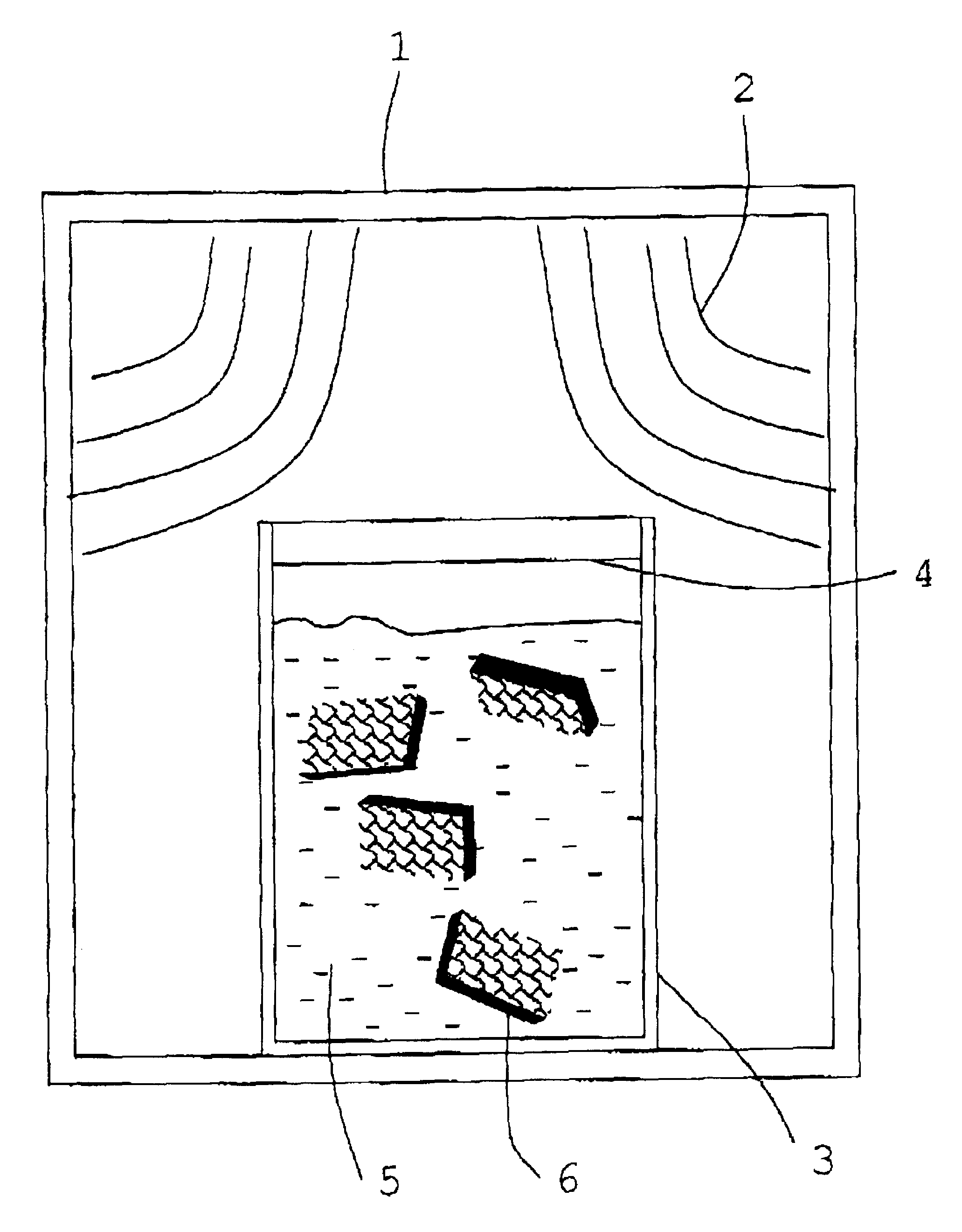
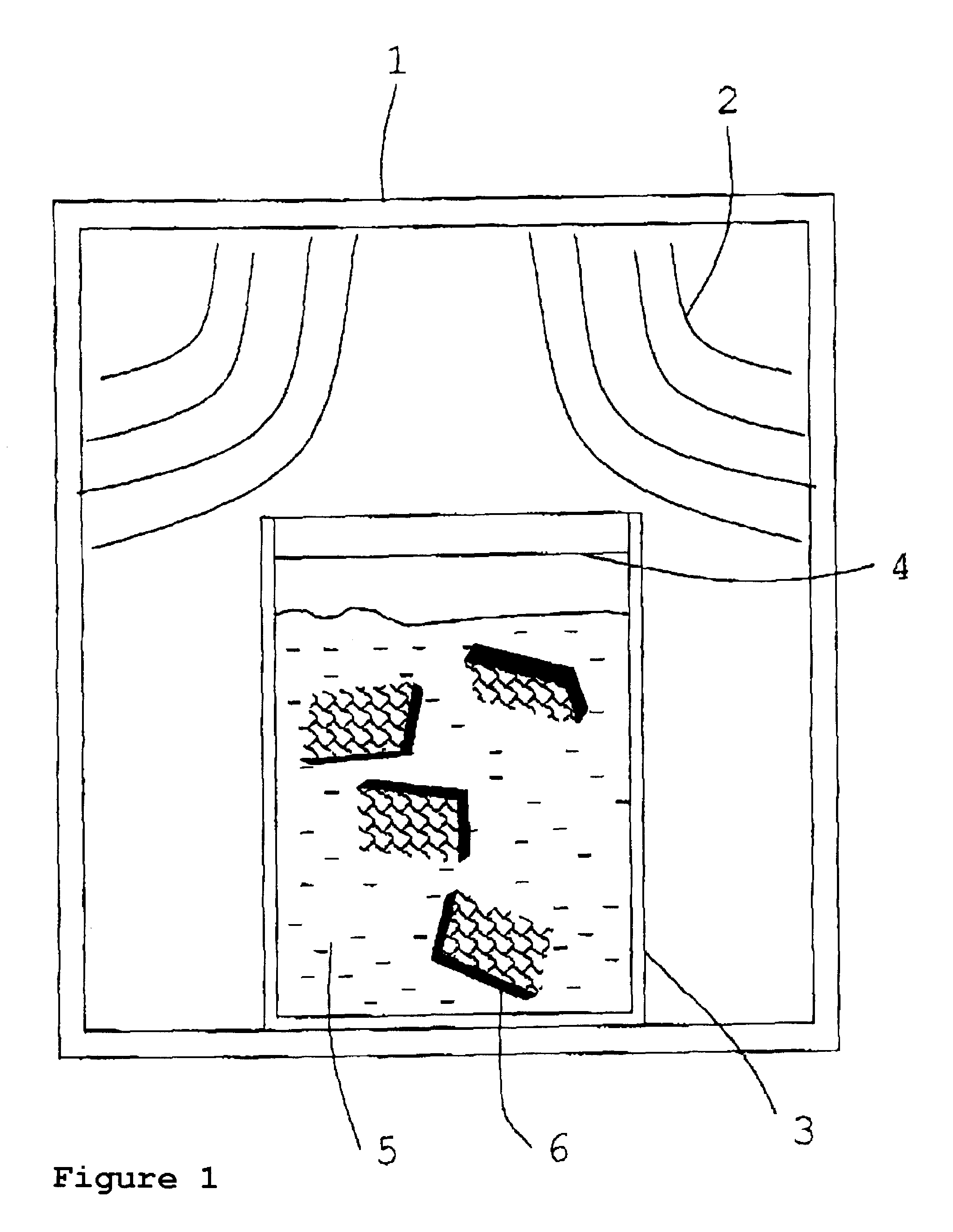
The test material used was a commercially available carbon fiber-reinforced plastic woven fabric. Cured epoxy was the plastic matrix, as used in the aircraft construction sector. A square specimen piece with an edge length of 1 cm, together with 20 ml of N-methylpyrrolidone, in a TEFLON.RTM. container 3, was introduced into the microwave oven 1 shown in FIG. 1. A microwave program (FIG. 3), which allows an energy introduction of 0.196 Wh, was started. After the program time had ended, the content of the pressure vessel was filtered, and what remained was the carbon fibers from which the plastic matrix had been completely removed. These fibers were rinsed using distilled water and were then dried in air.
the structure of the environmentally friendly knitted fabric provided by the present invention; figure 2 Flow chart of the yarn wrapping machine for environmentally friendly knitted fabrics and storage devices; image 3 Is the parameter map of the yarn covering machine
Login to View More PUM
| Property | Measurement | Unit |
|---|---|---|
| frequency | aaaaa | aaaaa |
| length | aaaaa | aaaaa |
| energy | aaaaa | aaaaa |
Login to View More
Abstract
A process for recycling composite materials that comprise fibers and a matrix includes exposing the composite material to electromagnetic waves in the form of microwaves. The electromagnetic waves induce an introduction of energy into the composite material, leading to a separation of fibers and matrix. The separation operation can be assisted by a suitable solvent.
Description
BACKGROUND AND SUMMARY OF INVENTIONThis application claims the priority of German patent document No. 100 26 761.0, filed May 30, 2000, the disclosure of which is expressly incorporated by reference herein.The present invention relates to a process for recycling composite materials that comprise fibers and a matrix.A process of the generic type is known from EP 636 428. In this process, fiber composite materials with a reinforcement of carbon fibers are coked for one week in a four-stage process initially with the exclusion of oxygen, (i.e., the organic matrix is reduced to form carbon). In a subsequent step, a binder is admixed with the coking product, which comprises carbon and carbon fibers. This mixture is subjected to shaping and finally, once again, is coked to form a final carbon fiber-reinforced carbon (C / C). This process is used in particular for recycling prepreg waste materials which are formed during the production of C / C materials.A drawback of this process is that it i...
Claims
the structure of the environmentally friendly knitted fabric provided by the present invention; figure 2 Flow chart of the yarn wrapping machine for environmentally friendly knitted fabrics and storage devices; image 3 Is the parameter map of the yarn covering machine
Login to View More Application Information
Patent Timeline
 Login to View More
 Patent Type & AuthorityPatents(United States)
IPC IPC(8): B29B17/02C08J11/08C08J11/00
CPCB29B17/021C08J11/08B29B2017/0293B29K2105/06B29K2709/02B29K2709/08B29K2707/04Y02W30/62
InventorDANNENHAUER, FRITZGRUNDIG, PETRASAILER, MARIA-THERESIA
OwnerDAIMLER AG