
Superconducting fault current limiter
a fault current limiter and superconductor technology, applied in the direction of superconducting magnets/coils, superconductor devices, magnetic bodies, etc., can solve the problem of adding significantly to the overall device cos
- Summary
- Abstract
- Description
- Claims
- Application Information
AI Technical Summary
Problems solved by technology
Method used
Image

Examples
Embodiment Construction
[0027]In the preferred embodiment, there are disclosed methods for the construction of a compact HTS FCL. Both single phase and three phase arrangements are disclosed.
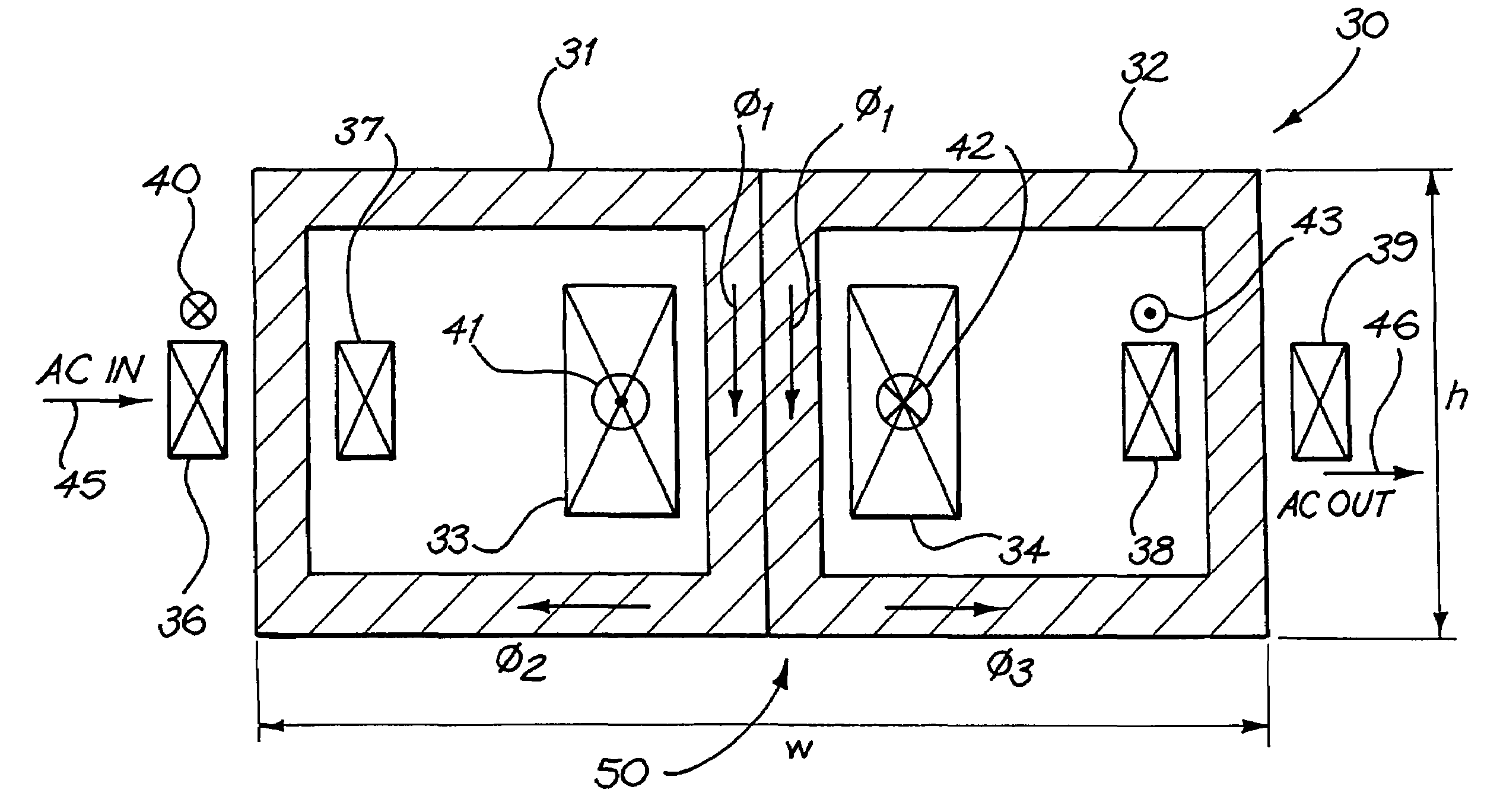
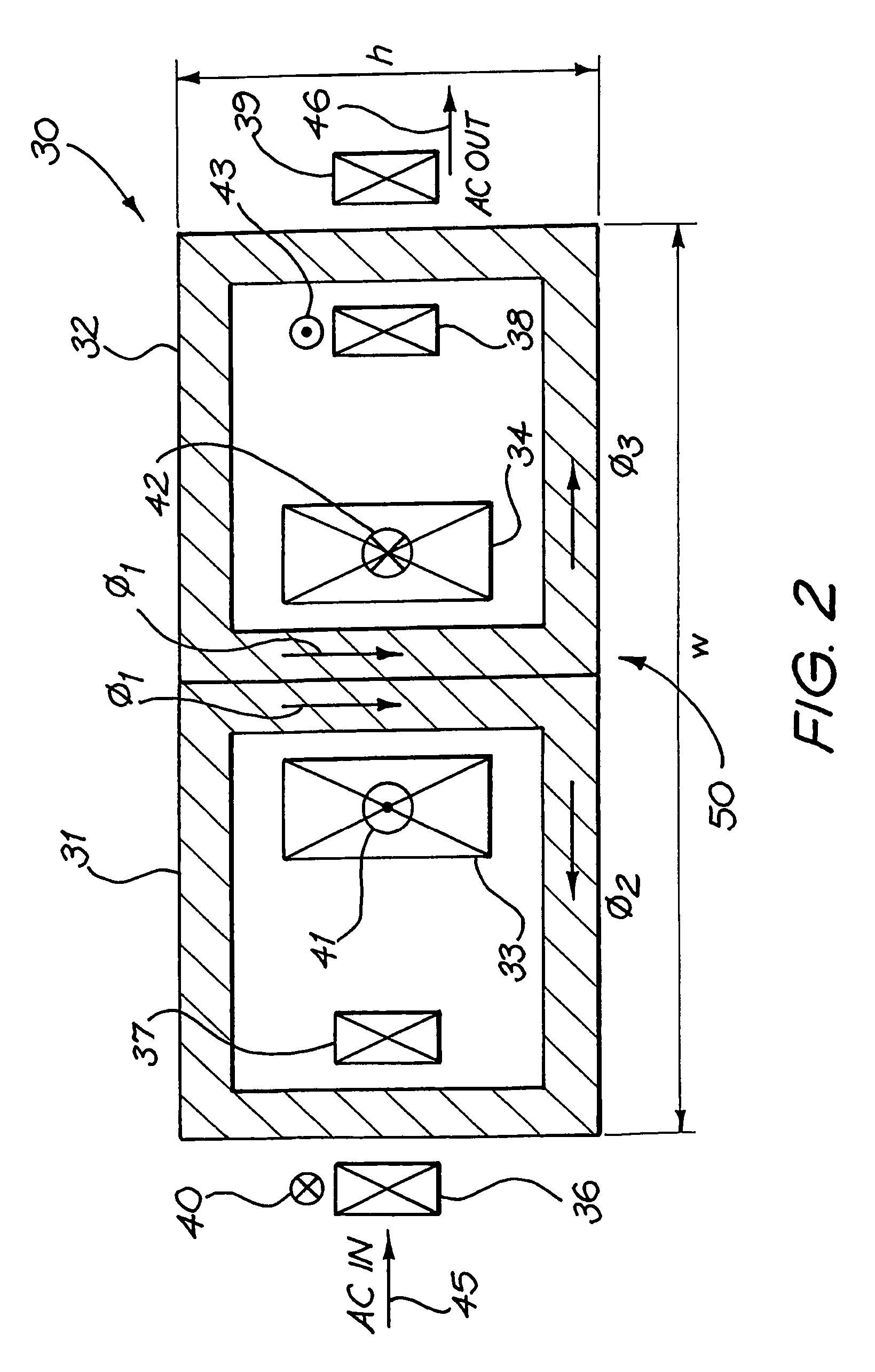
[0028]Turning initially to FIG. 2, there is illustrated schematically a sectional view of an initial design arrangement 30 for a split core single phase HTS FCL. The unit 30 includes a split core having components 31, 32 so as to allow for a substantial reduction in foot print size. In the arrangement 30, the DC saturated core windings are internally located 33. The AC linkage windings are also provided in pairs 36 and 38. The current carrying directions are as indicated via standard dot notation 40, 41, 42, and 43. The AC in port is assumed to occur at port 45 and the AC out port at port 46.
[0029]The design of the arrangement 30 and, in particular, the dimensions of the core 50 are in accordance with certain rules. The design is a compromise between the DC current and the level of saturation required. In an example ca...
PUM
| Property | Measurement | Unit |
|---|---|---|
| frequency | aaaaa | aaaaa |
| critical temperature | aaaaa | aaaaa |
| magnetic permeability | aaaaa | aaaaa |
Abstract
Description
Claims
Application Information
 Login to View More