Drug/drug delivery systems for the prevention and treatment of vascular disease
What is AI technical title?
AI technical title is built by Patsnap AI team. It summarizes the technical point description of the patent document.
a technology of vascular disease and drug delivery system, which is applied in the direction of drugs, cardiovascular disorders, prosthesis, etc., can solve the problems of ischemic injury, stroke or myocardial infarction, and sudden closure of the vessel, so as to reduce the systemic toxicity, reduce the dose, and facilitate administration
Inactive Publication Date: 2007-11-27
WYETH LLC
View PDF521 Cites 29 Cited by
Summary
Abstract
Description
Claims
Application Information
AI Technical Summary
This helps you quickly interpret patents by identifying the three key elements:
Problems solved by technology
Method used
Benefits of technology
Benefits of technology
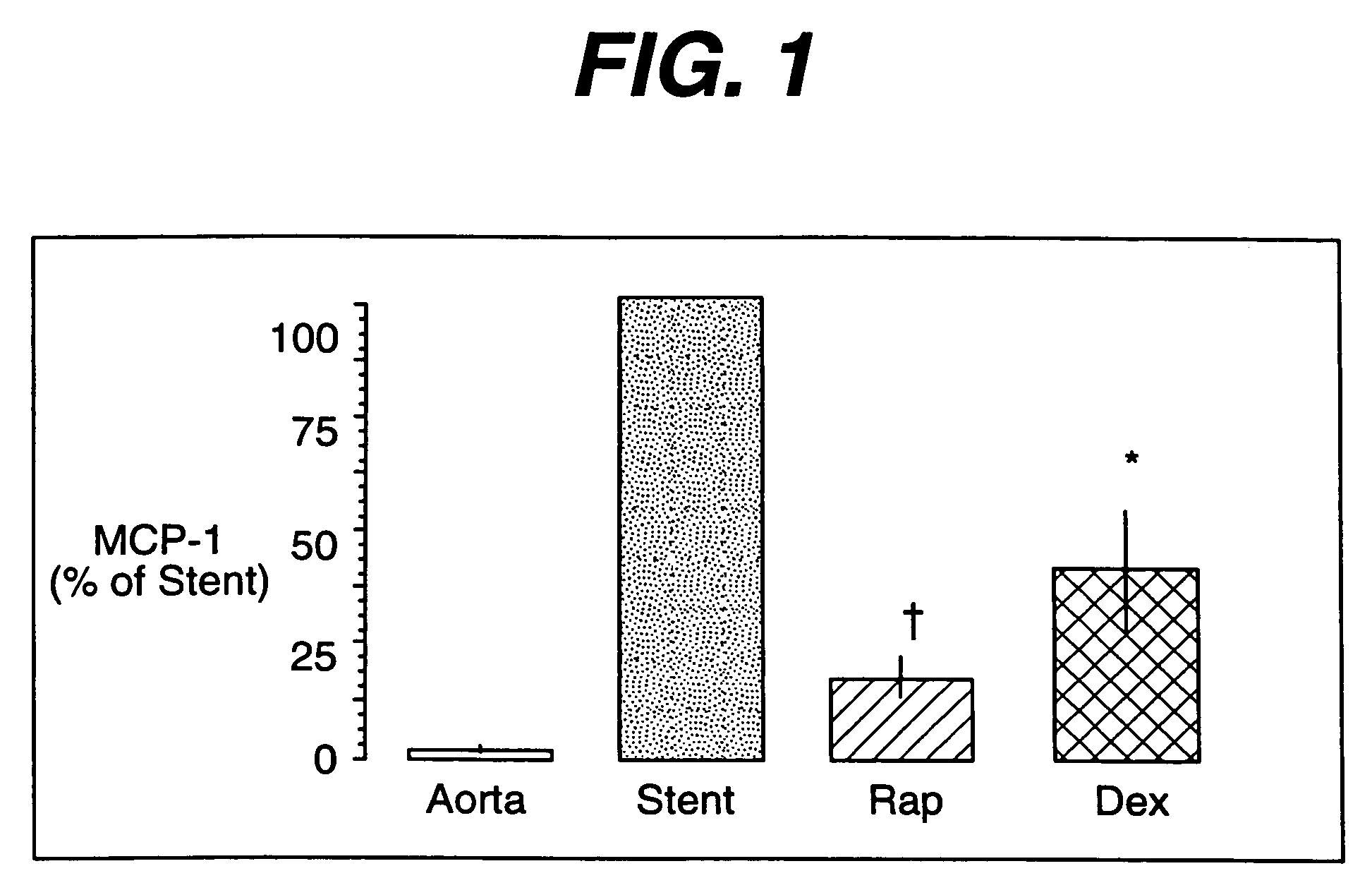
[0020]The drugs and drug delivery systems of the present invention utilize a stent or graft in combination with rapamycin or other drugs / agents / compounds to prevent and treat neointimal hyperplasia, i.e. restenosis, following percutaneous transluminal coronary angioplasty and stent implantation. It has been determined that rapamycin functions to inhibit smooth muscle cell proliferation through a number of mechanisms. It has also been determined that rapamycin eluting stent coatings produce superior effects in humans, when compared to animals, with respect to the magnitude and duration of the reduction in neointimal hyperplasia. Rapamycin administration from a local delivery platform also produces an anti-inflammatory effect in the vessel wall that is distinct from and complimentary to its smooth muscle cell anti-proliferative effect. In addition, it has also been demonstrated that rapamycin inhibits constrictive vascular remodeling in humans.
[0022]The local administration of drugs, agents or compounds to stented vessels have the additional therapeutic benefit of higher tissue concentration than that which would be achievable through the systemic administration of the same drugs, agents or compounds. Other benefits include reduced systemic toxicity, single treatment, and ease of administration. An additional benefit of a local delivery device and drug, agent or compound therapy may be to reduce the dose of the therapeutic drugs, agents or compounds and thus limit their toxicity, while still achieving a reduction in restenosis.
Problems solved by technology
More severe blockage of blood vessels in such individuals often leads to hypertension, ischemic injury, stroke, or myocardial infarction.
A limitation associated with percutaneous transluminal coronary angioplasty is the abrupt closure of the vessel which may occur immediately after the procedure and restenosis which occurs gradually following the procedure.
Additionally, restenosis is a chronic problem in patients who have undergone saphenous vein bypass grafting.
Upon pressure expansion of an intracoronary balloon catheter during angioplasty, smooth muscle cells within the vessel wall become injured, initiating a thrombotic and inflammatory response.
However, in contrast to animal models, attempts in human angioplasty patients to prevent restenosis by systemic pharmacologic means have thus far been unsuccessful.
The platelet GP IIb / IIIa receptor, antagonist, Reopro is still under study but has not shown promising results for the reduction in restenosis following angioplasty and stenting.
These agents must be given systemically, however, and attainment of a therapeutically effective dose may not be possible; anti-proliferative (or anti-restenosis) concentrations may exceed the known toxic concentrations of these agents so that levels sufficient to produce smooth muscle inhibition may not be reached (Mak and Topol, 1997; Lang et al., 1991; Popma et al., 1991).
Currently, however, the most effective treatments for restenosis are repeat angioplasty, atherectomy or coronary artery bypass grafting, because no therapeutic agents currently have Food and Drug Administration approval for use for the prevention of post-angioplasty restenosis.
Method used
the structure of the environmentally friendly knitted fabric provided by the present invention; figure 2 Flow chart of the yarn wrapping machine for environmentally friendly knitted fabrics and storage devices; image 3 Is the parameter map of the yarn covering machine
View more
Image
Smart Image Click on the blue labels to locate them in the text.
Viewing Examples
Smart Image
Click on the blue label to locate the original text in one second.
Reading with bidirectional positioning of images and text.
Smart Image
Examples
Experimental program
Comparison scheme
Effect test
Embodiment Construction
[0027]As stated above, the proliferation of vascular smooth muscle cells in response to mitogenic stimuli that are released during balloon angioplasty and stent implantation is the primary cause of neointimal hyperplasia. Excessive neointimal hyperplasia can often lead to impairment of blood flow, cardiac ischemia and the need for a repeat intervention in selected patients in high risk treatment groups. Yet repeat revascularization incurs risk of patient morbidity and mortality while adding significantly to the cost of health care. Given the widespread use of stents in interventional practice, there is a clear need for safe and effective inhibitors of neointimal hyperplasia.
[0028]Rapamycin is a macroyclic triene antibiotic produced by streptomyces hygroscopicus as disclosed in U.S. Pat. No. 3,929,992. It has been found that rapamycin inhibits the proliferation of vascular smooth muscle cells in vivo. Accordingly, rapamycin may be utilized in treating intimal smooth muscle cell hyper...
the structure of the environmentally friendly knitted fabric provided by the present invention; figure 2 Flow chart of the yarn wrapping machine for environmentally friendly knitted fabrics and storage devices; image 3 Is the parameter map of the yarn covering machine
Login to View More
PUM
Property
Measurement
Unit
diameter
aaaaa
aaaaa
diameter
aaaaa
aaaaa
time
aaaaa
aaaaa
Login to View More
Abstract
A drug and drug delivery system may be utilized in the treatment of vascular disease. A local delivery system is coated with rapamycin or other suitable drug, agent or compound and delivered intraluminally for the treatment and prevention of neointimal hyperplasia following percutaneous transluminal coronary angiography. The local delivery of the drugs or agents provides for increased effectiveness and lower systemic toxicity.
Description
CROSS REFERENCE TO RELATED APPLICATIONS[0001]This application is a continuation-in-part of U.S. application Ser. No. 09 / 850,293, filed May 7, 2001, now abandoned, which in turn claims priority of U.S. Provisional Application No. 60 / 263,979, filed Jan. 25, 2001, U.S. Provisional Application No. 60 / 263,806, filed January 24, 2001, U.S. Provisional Application No. 60 / 262,614, filed Jan. 18, 2001, U.S. Provisional Application No. 60 / 262,461, filed Jan. 18, 2001, and is a continuation-in-part of U.S. Application No. 09,575,480, filed May 19, 2000, now pending, which in turn claims priority of U.S. Provisional Application No. 60 / 204,4 17, filed May 12, 2000.BACKGROUND OF THE INVENTION[0002]1. Field of the Invention[0003]The present invention relates to drugs and drug delivery systems for the prevention and treatment of vascular disease, and more particularly to drugs and drug delivery systems for the prevention and treatment of neointimal hyperplasia.[0004]2. Discussion of the Related Art...
Claims
the structure of the environmentally friendly knitted fabric provided by the present invention; figure 2 Flow chart of the yarn wrapping machine for environmentally friendly knitted fabrics and storage devices; image 3 Is the parameter map of the yarn covering machine
Login to View More
Application Information
Patent Timeline
Application Date:The date an application was filed.
Publication Date:The date a patent or application was officially published.
First Publication Date:The earliest publication date of a patent with the same application number.
Issue Date:Publication date of the patent grant document.
PCT Entry Date:The Entry date of PCT National Phase.
Estimated Expiry Date:The statutory expiry date of a patent right according to the Patent Law, and it is the longest term of protection that the patent right can achieve without the termination of the patent right due to other reasons(Term extension factor has been taken into account ).
Invalid Date:Actual expiry date is based on effective date or publication date of legal transaction data of invalid patent.


 Login to View More