
Camera phone using multiple lenses and image sensors to provide an extended zoom range
a camera phone and image sensor technology, applied in the field of digital cameras, can solve the problems of increased size of digital cameras, increased cost of large zoom range lenses, user inconvenience, etc., and achieve the effects of compromising optical quality, large size, and high cos
- Summary
- Abstract
- Description
- Claims
- Application Information
AI Technical Summary
Benefits of technology
Problems solved by technology
Method used
Image

Examples
first embodiment
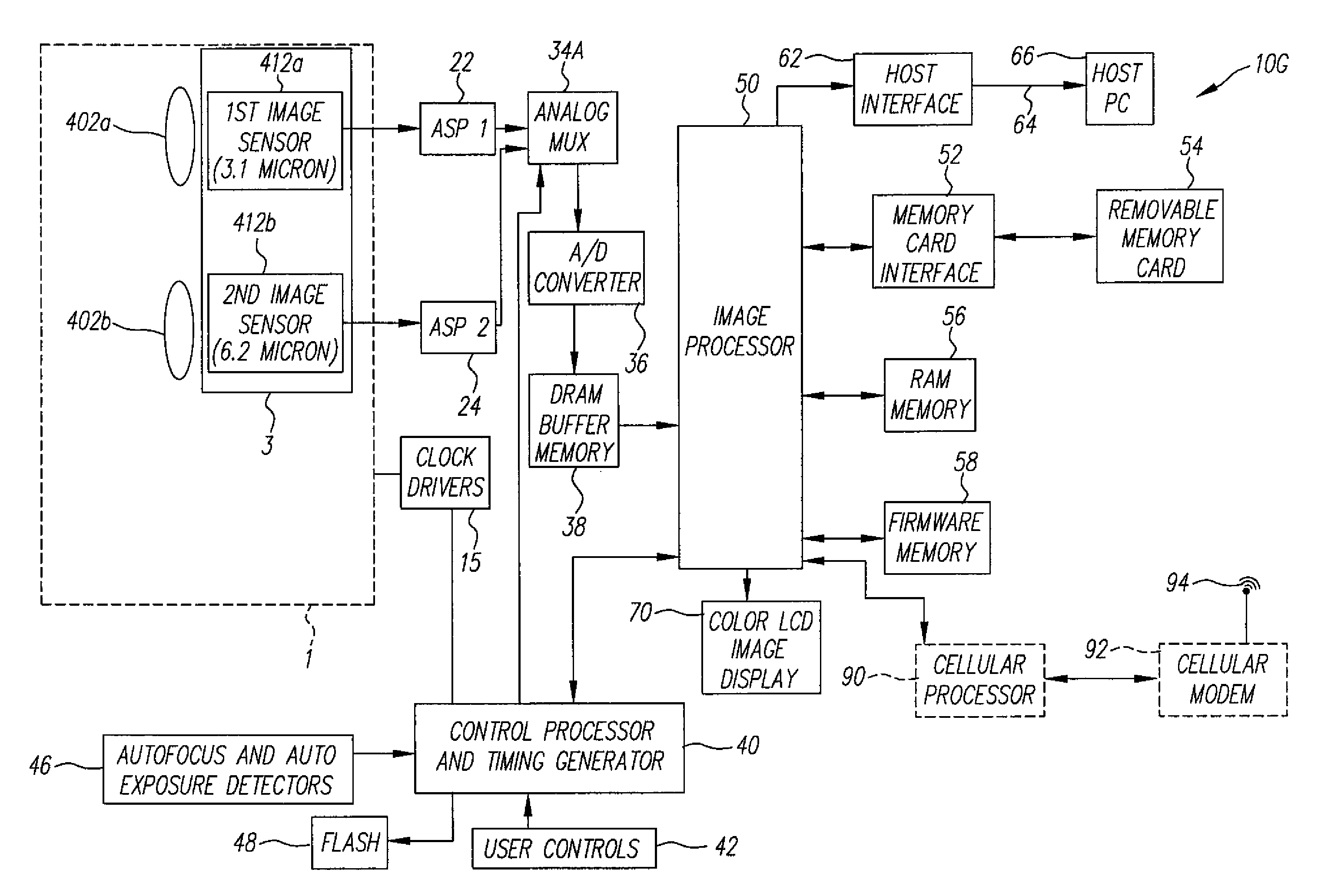
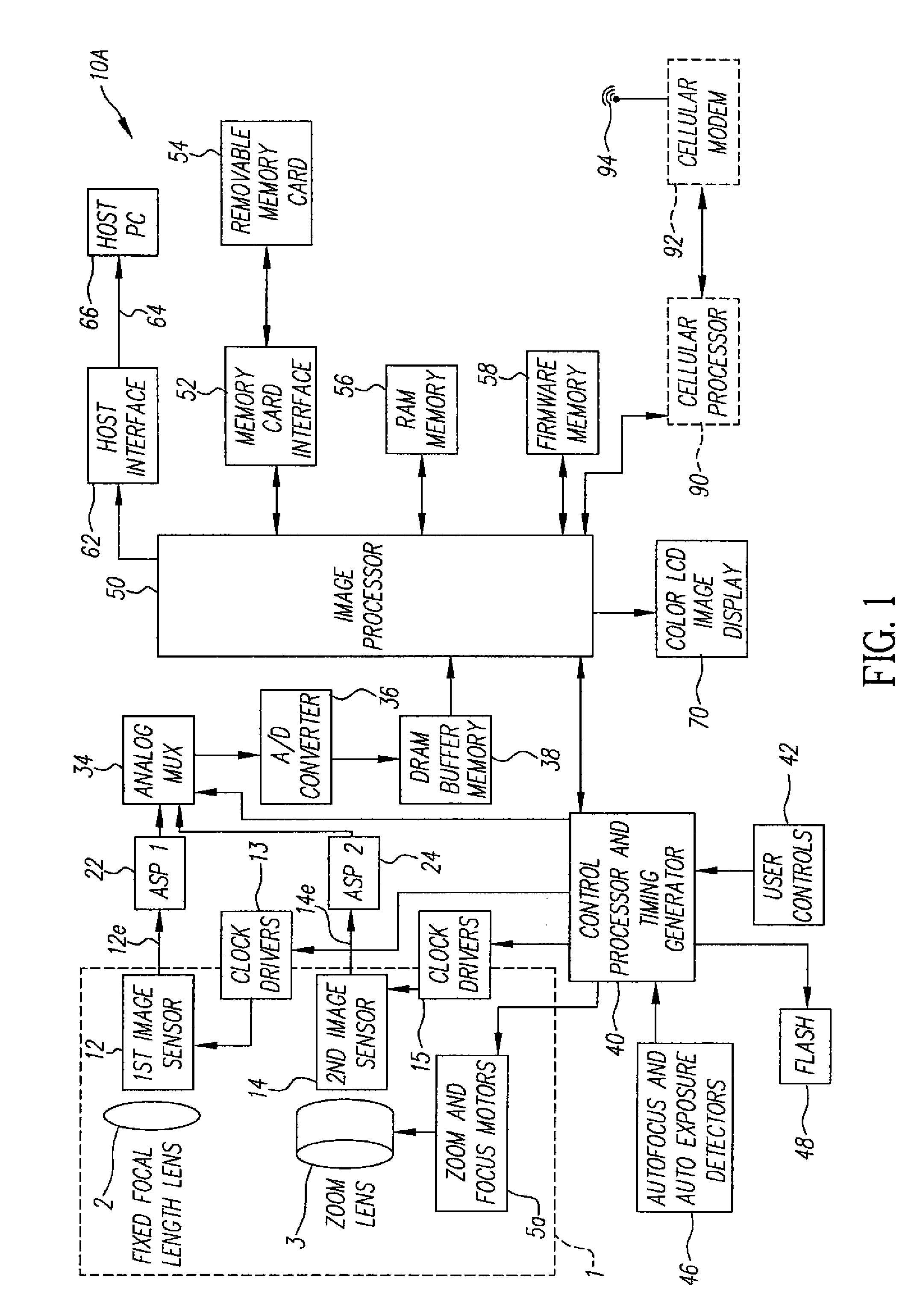
[0056]FIG. 11 provides a spatial layout of a digital camera, showing how the various components described in FIG. 10A fits within the confined space of the digital camera 10A. For example, FIGS. 11 and 12 show how the image capture assembly 1 is arranged within the width-wise dimension 201 of a digital camera 10A for the first embodiment shown in FIG. 10A. FIG. 11 is a frontal view of the digital camera 10A showing how the fixed focal length lens subassembly 1a and the zoom lens subassembly 1b are positioned to one side of the lenses 2 and 3 beneath an electronic flash 48. A battery compartment 204 is located on the other side of the lenses 2 and 3. FIG. 12 is a top view of the digital camera 10A taken along lines 12-12 in FIG. 11, and further shows the location of a removable memory card 54 and a color LCD image display 70. FIG. 13 is a side view of the digital camera 10A taken along the lines 13-13 in FIG. 12, and further shows the vertical spacing of the fixed focal length lens s...
third embodiment
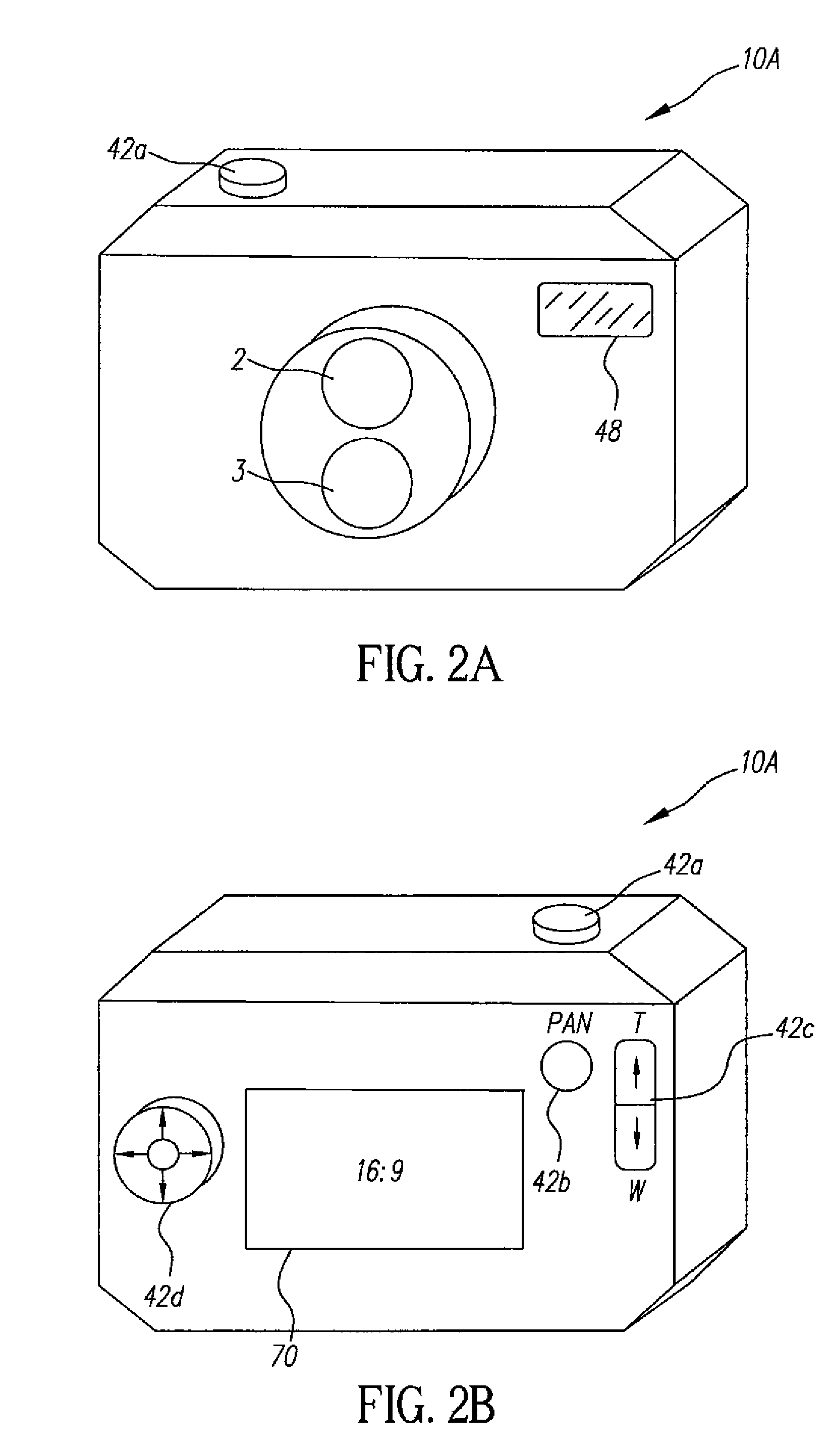
[0089]FIG. 8B is a rear view of the camera 10C, and similar in all respects to FIG. 2B. In a further (optional) variation of the third embodiment, the aspect ratio (e.g., 16:9) of the image provided by the fixed focal length lens 2 may be different than the aspect ratio of the image provided by the zoom lenses 3 or 4. In this case, as was shown in FIG. 2B, the user control 42 (e.g., the zoom button 42c) may input user commands for changing the aspect ratio of the image sensor 2 in order to obtain a variable panoramic effect that transitions from the wide angle of the lens 2 toward a narrower angle approaching the effect of the 4:3 aspect ratio of the zoom lens 3.
[0090]FIG. 9 depicts a flow diagram showing a method for capturing digital images using the digital camera of FIG. 7. This figure is mostly a composite of the blocks in FIGS. 3 and 6, and most of the blocks retain the same reference characters for the same block functions and steps. In lens setting block 100, when the camera...
PUM
 Login to View More
 Abstract
Description
Claims
Application Information
 Login to View More