

System and method for synthesizing crossing ADC distributions via reassembly of multiple k-spaces
a technology of apparent diffusion coefficient and system, applied in the field of medical imaging, can solve the problems of systematic bias, inability to synthesize cross-dti distributions, and inability to accurately predict the effect of noise on dti data, and achieve the effect of increasing the direct clinical relevan
- Summary
- Abstract
- Description
- Claims
- Application Information
AI Technical Summary
Benefits of technology
Problems solved by technology
Method used
Image



Examples
example application
OF THE INVENTION
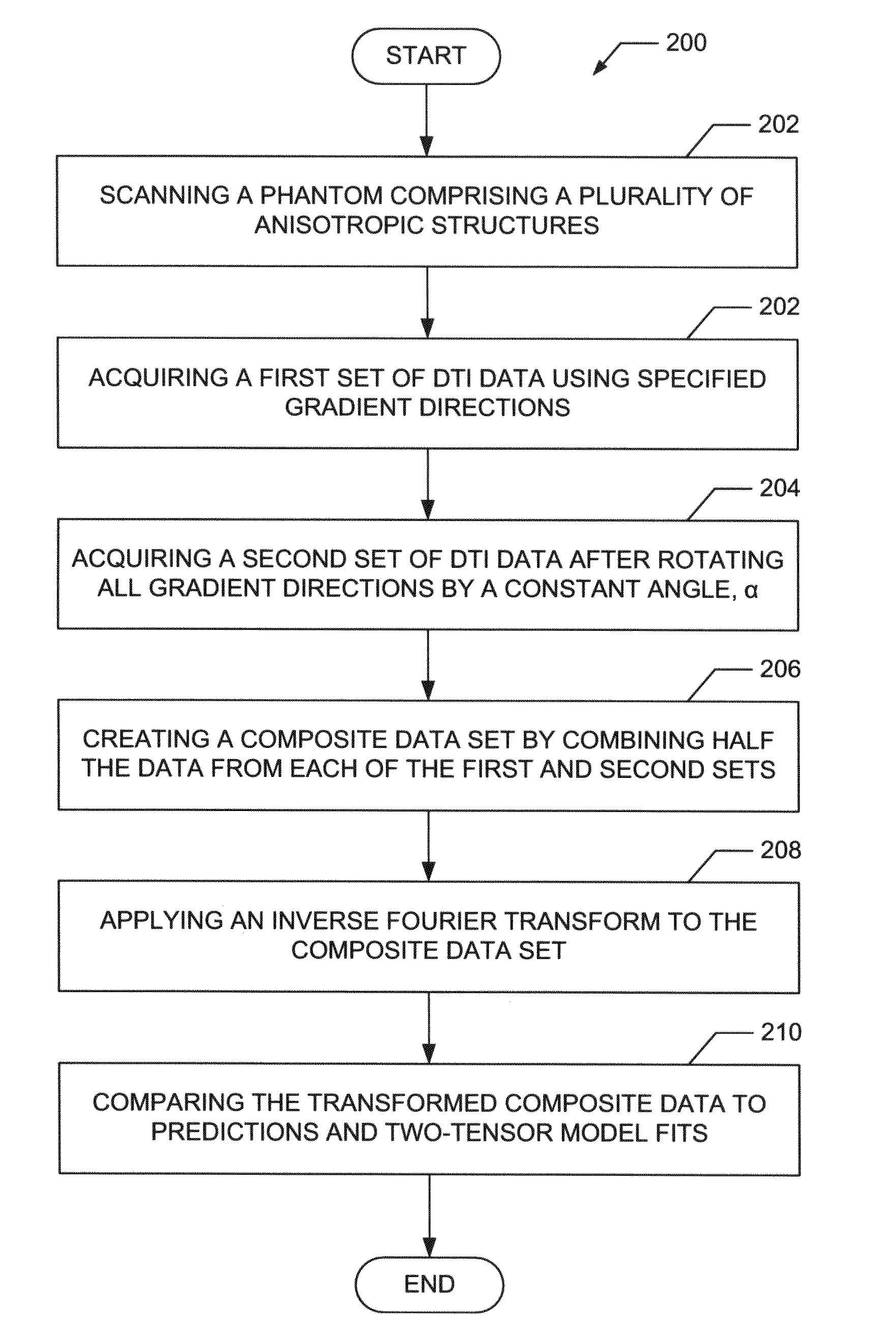
[0042]A phantom 100 (approximately 125 in3 in volume) comprising arrays of water-filled 20 μm i.d. capillaries was used as the test object. The phantom 100 was scanned with a GE Excite HDx 3.0T MRI scanner (GE Medical Systems, Milwaukee, Wis.), using an eight-channel head coil. DTI data were acquired during two sessions on different days, using a 1- or 2-slice axially-oblique DTI sequence (3 b=0 images collected, with the first image disregarded during processing; two sets of 36 gradient directions per series, or 72 directions total; ASSET factor=1; b=1000 sec mm-2). Before rotation, the set of 36 gradient directions employed were specified by the standard GE MR system file (tensor.dat).
[0043]In the first session, data were acquired to demonstrate the proper synthesis of five different distributions: two identical prolates crossing at 90° (hereafter, “90×”); two identical prolates crossing at 60° (hereafter, “60×”); and three other distributions involving 1:1 mixture...
PUM
 Login to View More
 Abstract
Description
Claims
Application Information
 Login to View More