
System and method for safely automating the generation of multiple data definition language statements
a data definition language and automatic generation technology, applied in the field of data management, can solve the problems of not being able to understand and maintain, and not being able to guarantee the success of alterations and data definition language (ddl) derived from such an effort, and achieve the effect of ensuring the success of db2 table objects and db2 table objects
- Summary
- Abstract
- Description
- Claims
- Application Information
AI Technical Summary
Benefits of technology
Problems solved by technology
Method used
Image

Examples
example # 4.1
EXAMPLE #4.1
[0081]
TABLE 4.1Transaction ALTER NodesP_PARTSIZEL_PARTENDINGOLDA0021 T2BNEWA002—1BOLDA003100 M3CNEWA003—2COLDA001100 M1ANEWA001—3D
[0082]Refer to FIG. 4 for an illustration of altering the TCP using a DB2 rotate. A DB2 ROTATE request is accomplished by keying in the ‘ROTATE’ primary command. The DDL generated will be the single statement:
[0083]ALTER TABLE ROTATE PARTITION FIRST TO LAST ENDING AT (‘D’) RESET
[0084]When inspecting the Transaction ALTER Nodes, differentiating between an authentic DB2-ROTATE and other kinds of alterations that mimic such a rotate may be facilitated by inspecting the NEW and OLD fields. On authentic DB2-ROTATE:
[0085]1. The transaction node for the first partition is physically (or may be made to appear to have been physically moved) so that it is the last partition.
[0086]2. The NEW physical partition number fields in all nodes are not re-sequenced and remain unchanged after the move.
[0087]3. The NEW logical partition number fields are re-seque...
example # 5.1
EXAMPLE #5.1
[0109]
TABLE 5.1Transaction ALTER NodesP_PARTSIZEL_PARTENDINGOLDA001100 M1ANEWA001—1BOLDA0021 T2BNEWA002—2COLDA003100 M3CNEWA003—3D
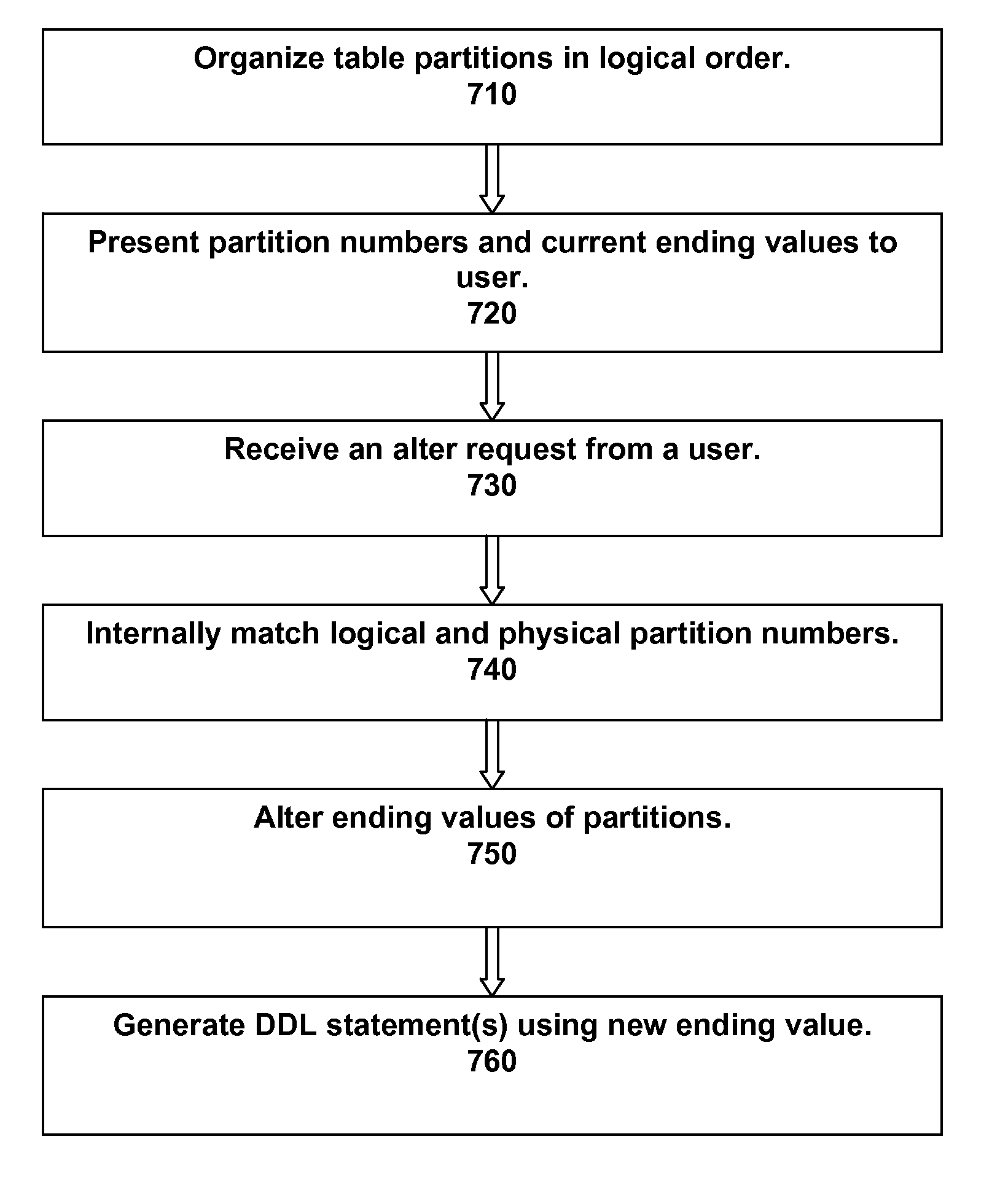
[0110]Refer to FIG. 5 for an illustration of the pseudo-logical rotate. This kind of alteration is accomplished with the ‘M / A’ (Move / After) line command pair, and then altering the moved ending value, as is shown in the above sequence of tiles, 1 through 3. The same may also be accomplished by first altering the ending value for partition 1 and then moving it; or by directly entering new ending values for all three partitions. Warning: Although this kind of alteration causes alterations to the table alter nodes that seem identical to the alterations induced by a DB2 ROTATE, these two kinds of alterations are not the same and must not be treated as such because: the DB2 ROTATE causes all data in the rotated partition to be discarded (RESET), while this alternate (pseudo-logical) rotate does not. Differentiating between a DB2-ROTATE and this kin...
example # 5.2
EXAMPLE #5.2
[0124]
TABLE 5.2Transaction ALTER NodesP_PARTSIZEL_PARTENDINGOLDA0021 T1BNEWA002—1COLDA003100 M2CNEWA003—2DOLDA001100 M3DNEWA001—3E
[0125]In this second example, the same as in the first example is accomplished, however being done on a partitioning table that had been previously rotated by DB2 once before. This demonstrates what the expected OLD and NEW values in the transaction table should be when such an alteration is made against a previously DB2-rotated partitioning table—and, better demonstrates the altering of the physical partitions in their reverse-logical-order. As in the first example, the alteration is accomplished by logically moving the first partition to the end of the list (by moving its ending value, only,) and then altering the appropriate ‘ENDING AT’ values of all impacted partitions. The DDL generated will be the three statements:
[0126]ALTER TABLE ALTER PARTITION 1 ENDING AT (‘E’)
[0127]ALTER TABLE ALTER PARTITION 3 ENDING AT (‘D’)
[0128]ALTER TABLE AL...
PUM
 Login to View More
 Abstract
Description
Claims
Application Information
 Login to View More