
Speech recognition system and speech recognizing method
a speech recognition and speech recognition technology, applied in speech recognition, speech analysis, instruments, etc., can solve the problems of undeveloped speech recognition system, and achieve the effect of improving the performance of speech recognition
- Summary
- Abstract
- Description
- Claims
- Application Information
AI Technical Summary
Benefits of technology
Problems solved by technology
Method used
Image

Examples
Embodiment Construction
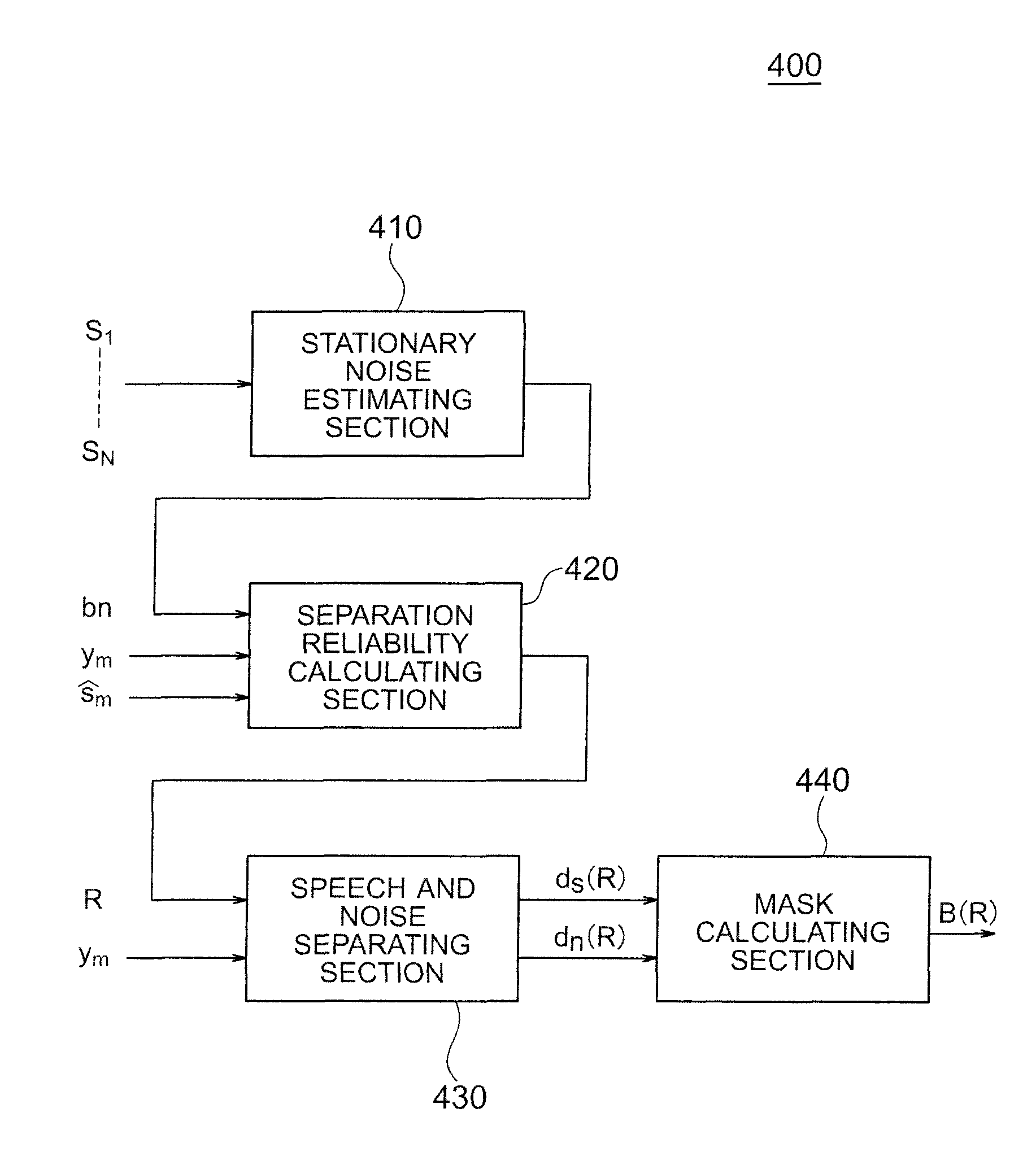
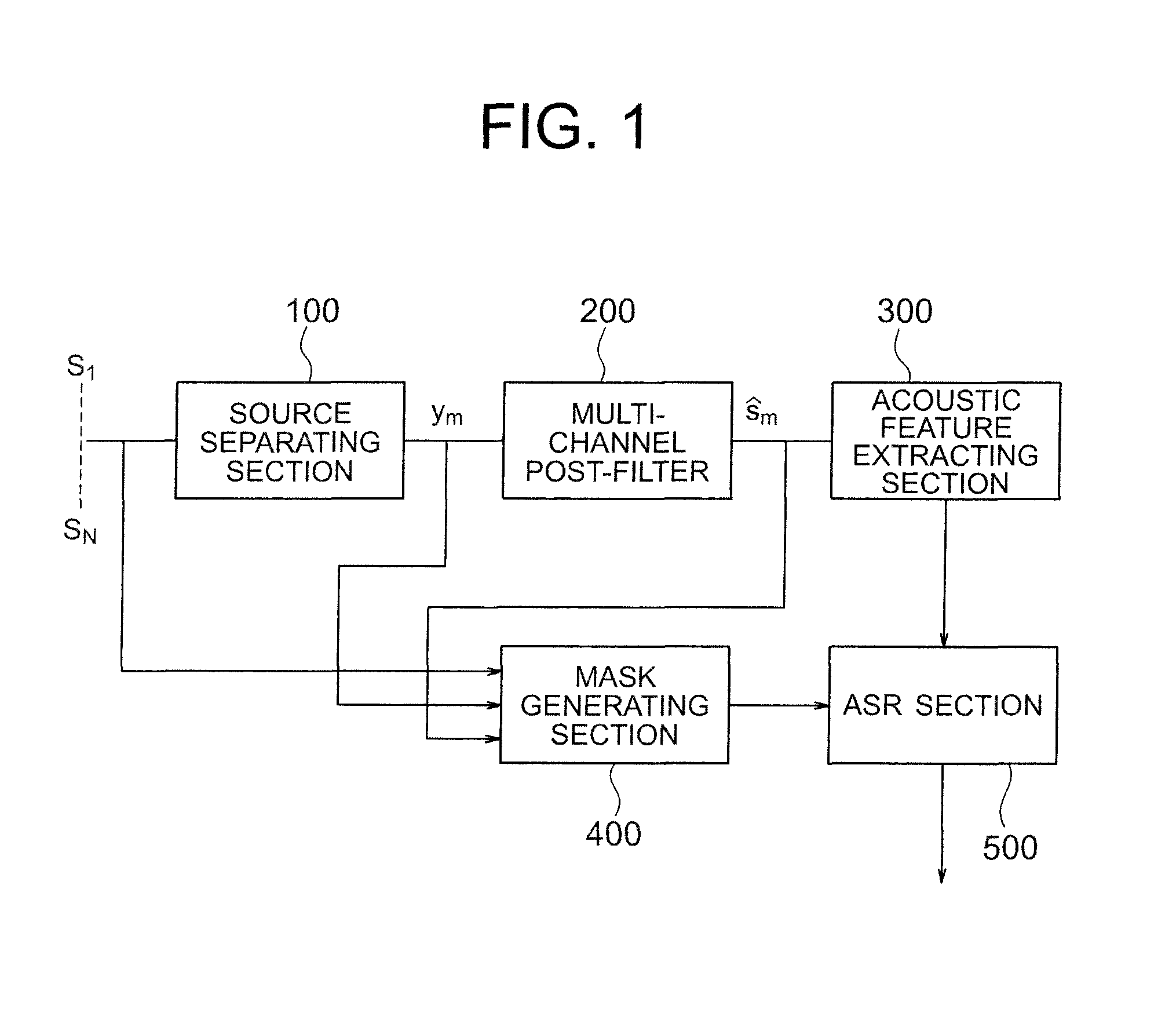
[0029]FIG. 1 illustrates a configuration of a speech recognition system according to an embodiment of the present invention. The speech recognition system performs simultaneous recognition of speeches from multiple sound sources such as multiple speakers. The speech recognition system includes a source separating section 100, a multi-channel post-filter 200, an acoustic feature extracting section 300, a mask generating section 400 and a speech recognizing section 500.
[0030]The sound source separating section 100 will be described below. Suppose that there are M sources and N(≧M microphones. A spectrum vector of M sources at frequency ω,s(ω), is denoted as
[s1(ω)s2(ω) . . . sM(ω)]T,
and a spectrum vector of signals captured by the N microphones at frequency ω,x(ω), is denoted as
[x1(ω)x2(ω) . . . xN(ω)]T,
where T represents a transpose operator. x(ω) is, then, calculated as
x(ω)=H(ω)s(ω)
where H(ω) is a transfer function matrix. Each component Hnm of the transfer function matrix represents...
PUM
 Login to View More
 Abstract
Description
Claims
Application Information
 Login to View More