
Stack for fuel cell, and fuel cell
A fuel cell and battery technology, which is applied to fuel cells, fuel cell groups, fuel cell components, etc., can solve problems such as impeding liquid flooding resistance, unable to reduce pressure loss deviation, etc., to reduce pressure loss, reduce deviation, The effect of high flooding resistance
Patent Information
- Authority / Receiving Office
- CN · China
- Patent Type
- Applications(China)
- Current Assignee / Owner
- Publication Date
- 2008-01-09
- Estimated Expiration
- Not applicable · inactive patent
Smart Images
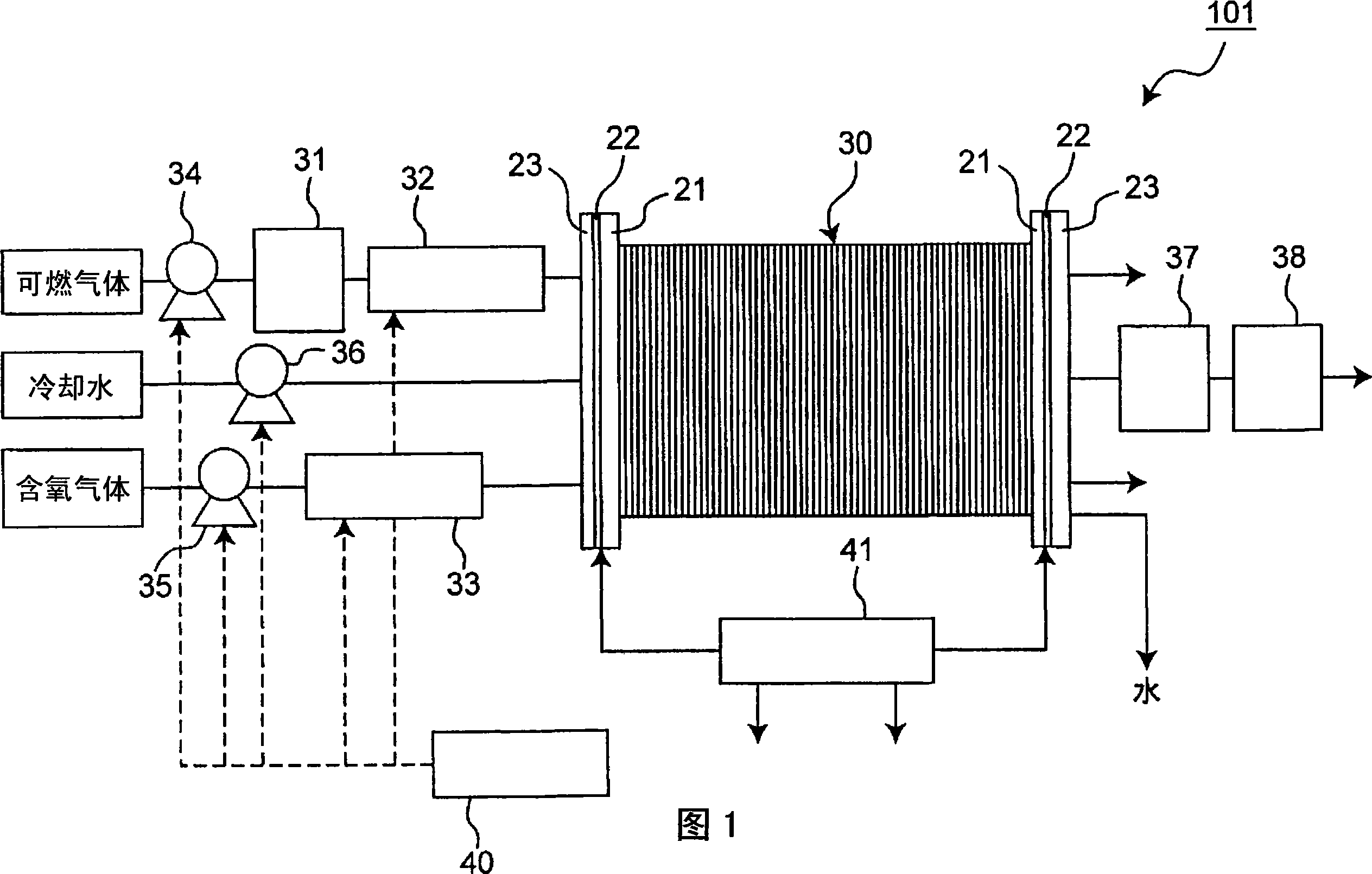
Figure 1 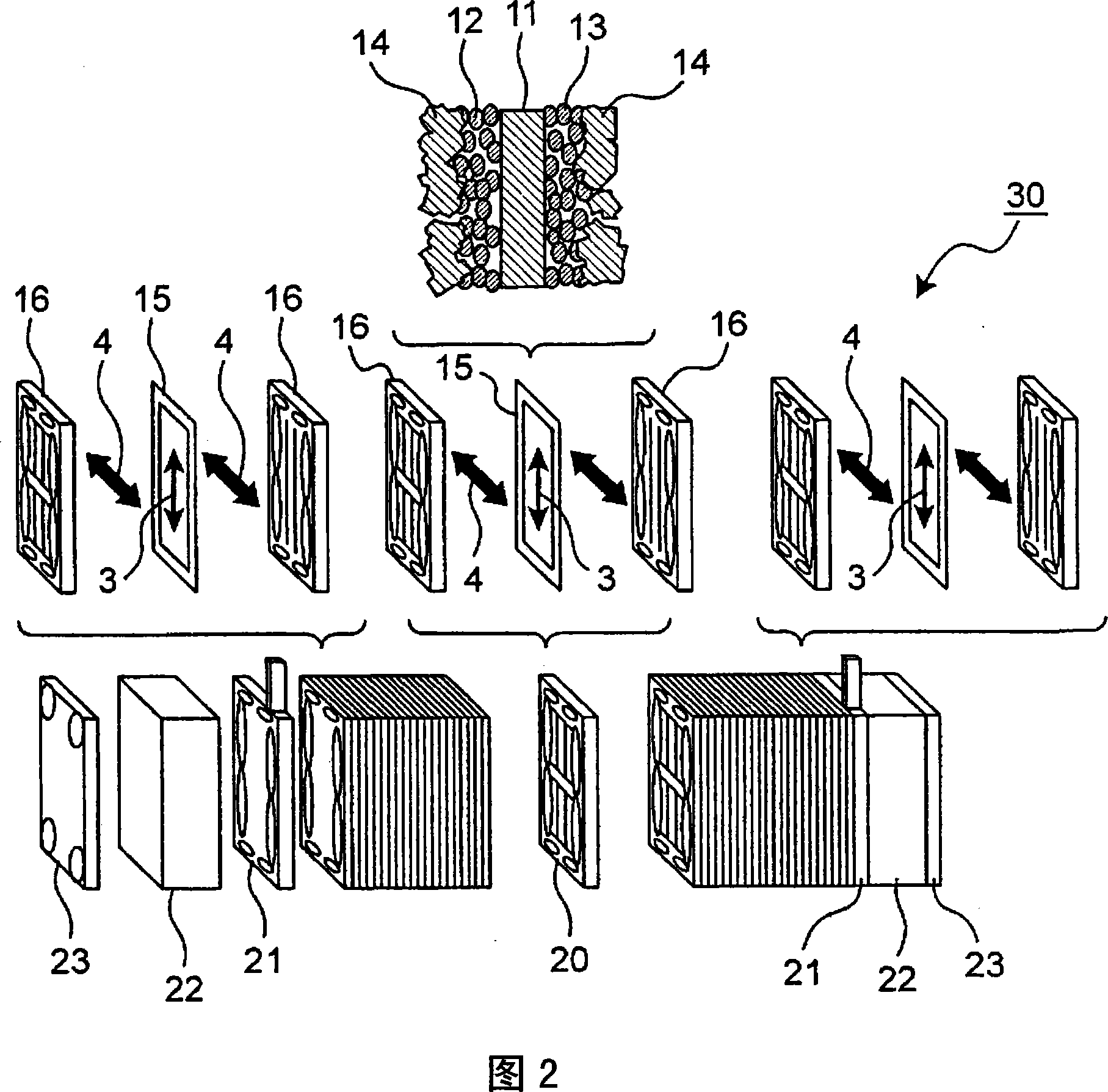
Figure 2 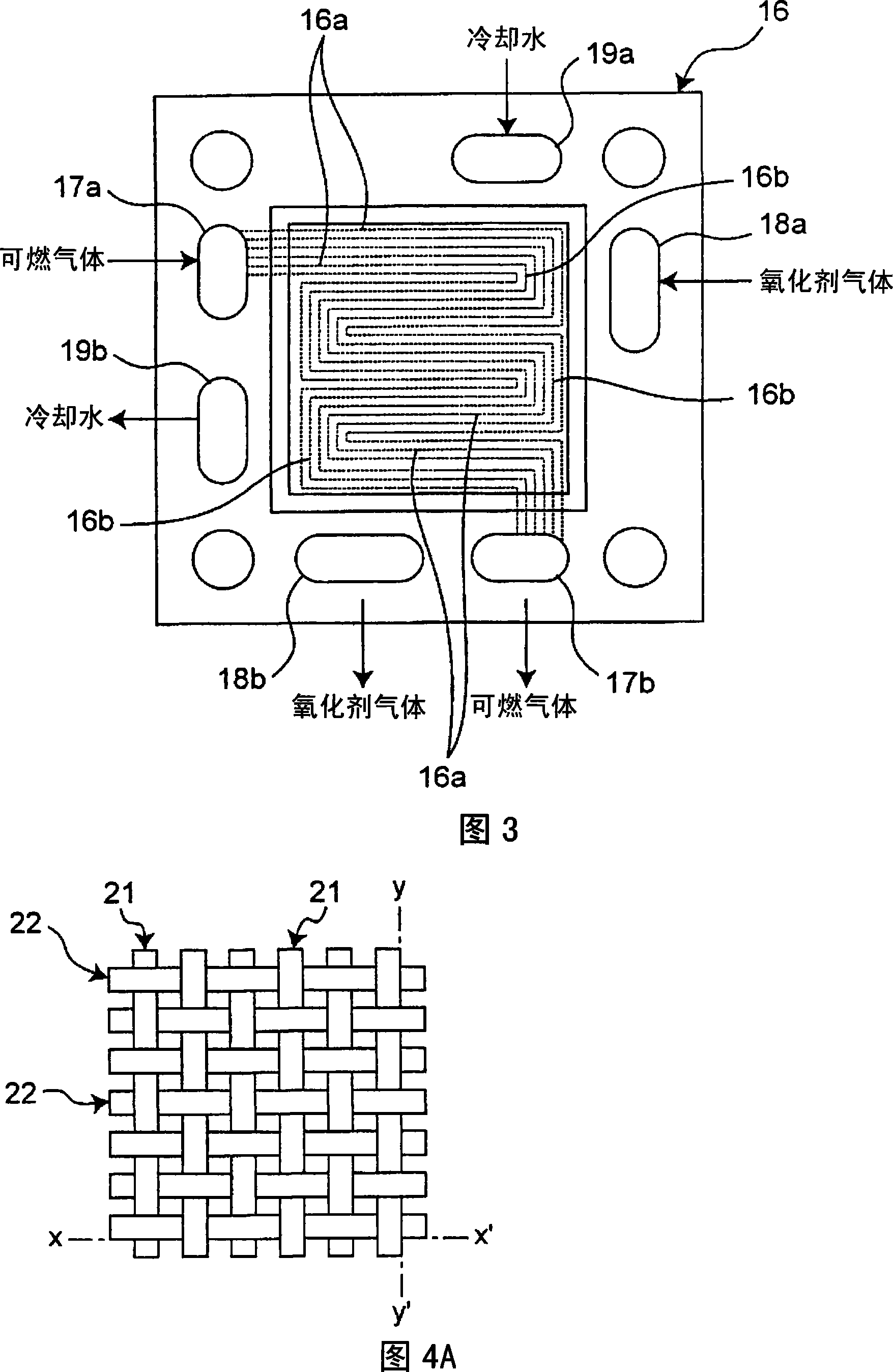
Figure 3
Abstract
Description
technical field
[0001] The present invention relates to directly using pure hydrogen or modified hydrogen from fossil fuels, or liquid fuels such as methanol and ethanol as fuels, and fuel cells and stacks for fuel cells using air or oxygen as oxidants, in particular to solid polymer fuel cells (PEFC). Background technique
[0002] A fuel cell, such as a solid polymer fuel cell, is a device that simultaneously generates electricity and heat by electrochemically reacting a hydrogen-containing combustible gas with an oxygen-containing oxidant gas such as air. Its structure is that, first, catalyst reaction layers mainly composed of carbon powder carrying a platinum-group metal catalyst are formed on both surfaces of a polymer electrolyte membrane that selectively transports hydrogen ions. Next, a gas diffusion layer having both gas permeability and electron conductivity is formed on the outer surface of the catalyst reaction layer, and the diffusion layer and the catalyst rea...
Examples
Embodiment 1
[0089] First, a method of manufacturing the MEA included in the fuel cell stack according to Example 1 of the present invention will be described. On both sides of a polymer electrolyte membrane (Nafion 112 manufactured by Dupont), a catalyst in which platinum is supported in acetylene black powder is coated to form a catalyst layer, and a gas diffusion layer with a carbon fiber woven fabric as a base material is arranged on the outside. The carbon fiber fabric has a plain weave structure, and GDL-1 (Gas Diffusion Layer Base Material-1) shown in Table 2 was used.
[0090]In addition, the characteristic data related to the elongation of two kinds of gas diffusion layer base materials GDL-1 and GDL-2 having different characteristics are shown in Table 2. The value obtained by dividing the displacement of the fabric under the condition of a load of 10 N when a tensile load is applied to a carbon fiber fabric with a width of 25 mm at a distance between chucks of 100 mm by the init...
Embodiment 2
[0100] Next, the fuel cell stack of Example 2 will be described. In the same manner as in Example 1, an MEA and a separator were produced, and the warp arrangement direction of the carbon fiber woven fabric of GDL-1 shown in Table 2 was arranged perpendicular to the main direction of the gas flow path of the separator to produce a single cell. In the same manner as in Example 1, 50 of these single cells were stacked, stainless steel current collector plates and insulating plates of electrically insulating materials were arranged at both ends, and end plates were arranged and fixed with fastening rods to manufacture a stack for fuel cells. That is, in Example 2, as shown in Table 2, the gas diffusion layer base material (GDL -1) the stack.
[0101] For the solid polymer fuel cell equipped with the fuel cell stack of Example 2 prepared in this way, the conditions of Example 1 were used to measure the flooding resistance, the average pressure loss and standard deviation in the s...
Embodiment 3
[0103] Next, the fuel cell stack of Example 3 will be described. In the same manner as in Example 1, an MEA and a separator were produced, and the warp arrangement direction of the GDL-2 carbon fiber woven fabric shown in Table 2 was arranged parallel to the main direction of the gas flow path of the separator to produce a single cell.
[0104] In the same manner as in Example 1, 50 of these single cells were stacked, stainless steel current collector plates and insulating plates of electrically insulating materials were arranged at both ends, and end plates were arranged and fixed with fastening rods to manufacture a stack for fuel cells. That is, in Example 2, as shown in Table 2, the gas diffusion layer base material (GDL -2) the stack.
[0105] For the solid polymer fuel cell equipped with the fuel cell stack of Example 3 prepared in this way, the conditions of Example 1 were used to measure the flooding resistance, the average pressure loss and standard deviation in the ...