

A glycan feed additive
A technology for feed additives and polysaccharides, applied in the field of polysaccharide feed additives, can solve problems such as antibiotic residues, and achieve the effects of improving survival rate, improving disease resistance, and avoiding drug toxic and side residues.
Patent Information
- Authority / Receiving Office
- CN · China
- Patent Type
- Applications(China)
- Current Assignee / Owner
- Publication Date
- 2009-08-26
- Estimated Expiration
- Not applicable · inactive patent
Smart Images

Figure 1 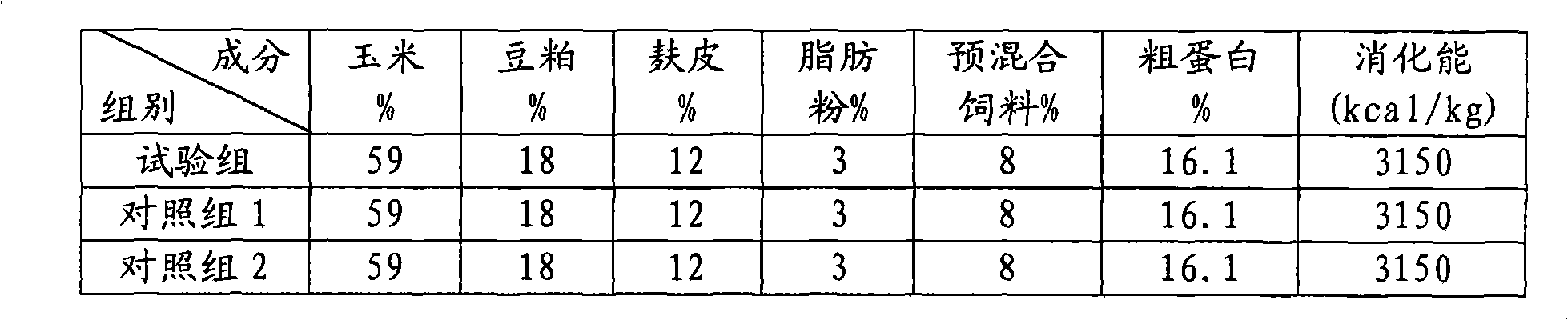
Figure 2 
Figure 3
Abstract
Description
technical field
[0001] The invention belongs to the application of modern biochemical technology, in particular to a feed additive used for breeding animals to improve the immunity of the animal body, specifically to a polysaccharide feed additive. Background technique
[0002] Antibiotic drugs have been used in large quantities as feed drug additives for a long time in the existing farmed animal feed, and the long-term use of conventional feed for farmed animals may cause antibiotic residues in meat products.
[0003] Since the 1960s, polysaccharides have been considered as a broad-spectrum, non-specific promoter. In human immunity, they can enhance the cellular and humoral immune functions of host cells, such as activating macrophages, T cells, B cells, and NK cells. Cells, activating complement and inducing the production of interferon, etc., its function will be to activate the non-specific defense function of the human body, and it has good curative effect in anti-virus...
Examples
Embodiment 1
[0017] Example 1: Validation test of the effect of polysaccharide feed additive in suckling pig feeding
[0018] The effect verification test of the polysaccharide feed additive disclosed by the present invention was carried out in the pig farm of Xiamen Dawang Huaqiao Breeding Pig Co., Ltd. The basic formula composition of the polysaccharide feed additive used in the test: bacterial exopolysaccharide 0.5%; β-cyclodextrin 50.0%, corn cob 45.5%.
[0019] The suckling pigs were divided into 4 groups for the test. The amount of polysaccharide added in the suckling pig compound feed was as follows: the addition amount of polysaccharide feed additive in the suckling pig compound feed of the test group 1 was 0.1%, and the suckling pig compound feed of the test group 2 was 0.1%. The addition amount of the polysaccharide feed additive was 0.15%, the addition amount of the polysaccharide feed additive in the suckling pig compound feed of the test group 3 was 0.2%, and the test group 4 ...
Embodiment 2
[0021] Embodiment 2: Effect verification test of polysaccharide feed additive in sow feeding
[0022] experiment method
[0023] 1. Animal selection and grouping: Select 60 sows from a self-propagation farm with the third and fourth parities in estrus at the same time, and divide them into 3 groups randomly, with 20 pigs in each group, and record the numbers. The experiment started one week after mating, and the test periods were as follows: the compound feed for pregnant sows with polysaccharide feed additive was used for 80 days; the compound feed for lactating sows with polysaccharide feed additive was used for 60 days.
[0024] 2. Test treatment and diet composition: The test was divided into three treatment groups: control group 1, control group 2 and test group. The formulas of the compound feeds of the three groups are the same, and they are formulated with reference to the nutritional requirements of the pregnancy and lactation stages of the "Lean Meat Sow Feeding Sta...
Embodiment 3
[0042] Example 3: Validation test on the effect of polysaccharide feed additive in broiler feeding
[0043] Materials and Methods
[0044] 1. Selection of test animals: 20,500 Beijing white chicken AA broilers of the same batch of weight 30 grams with the same breed, similar age, consistent sex ratio, and equivalent body condition were selected and divided into 2 groups, and one group was 8,500 as the test group. A group of 12,000 chickens was the control group (allocated according to the size of the chicken pens).
[0045] 2. The test start time: from July 5, 2006 to August 20, 2006, a total of 47 days.
[0046] 3. Test feed variety: the test used the broiler special series compound feed originally used by the chicken farm, and the test group and the control group used the same feed.
[0047] 4. Feeding management: According to the normal feeding and management method of the chicken farm, the same kind of vaccination is carried out during the period, and the disease is foun...