
Cationic surfactant and preparation method thereof
A surfactant and cation technology, applied in the field of cationic surfactant and its preparation, achieves the effects of high yield, mild reaction conditions and simple operation
Patent Information
- Authority / Receiving Office
- CN · China
- Patent Type
- Applications(China)
- Current Assignee / Owner
- Publication Date
- 2010-04-21
- Estimated Expiration
- Not applicable · inactive patent
Smart Images
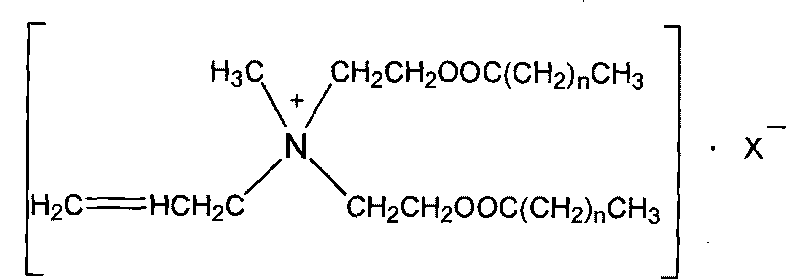
Figure 1 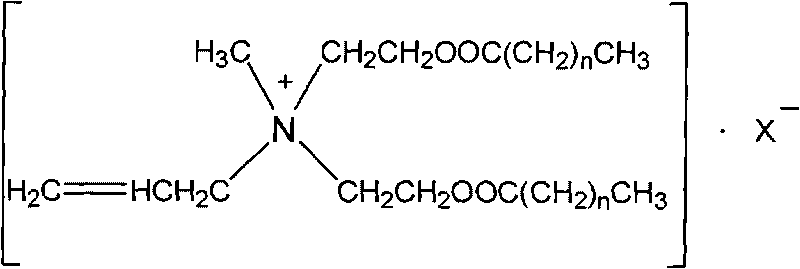
Figure 2 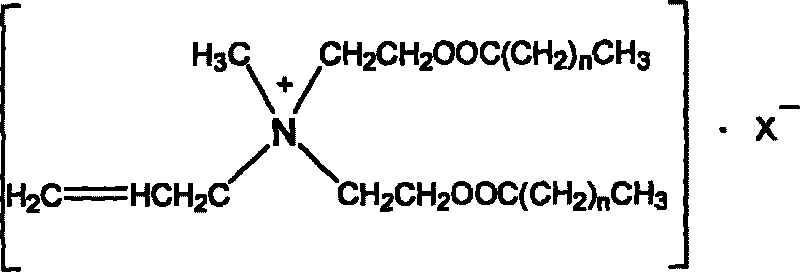
Figure 3
Abstract
Description
technical field
[0001] The invention relates to the field of fine chemicals, in particular to a cationic surfactant and a preparation method thereof. Background technique
[0002] Surfactants are a class of fine chemicals that have been widely used in industrial production, washing cosmetics, pesticides, medicine, printing and dyeing, tertiary oil recovery, sterilization, sewage treatment and other fields. Agents have received much attention in fabric softening. The structural characteristics of general fabric softener cationic surfactants are: quaternary ammonium salt products containing two long-chain alkyl groups in the molecular structure. A typical representative compound is distearyldimethylammonium chloride (D1821). With the enhancement of people's environmental awareness, quaternary ammonium salts with high biodegradation rate and convenient production and operation have appeared one after another. Among them, the most representative is ester quaternary ammonium sa...
Examples
Embodiment 1
[0029] The first step: the synthesis of fatty acid methyl diethanolamine ester
[0030] In a reaction flask equipped with a rectifying column, 35.7 g (0.30 mol) of methyldiethanolamine, 132 g (0.66 mol) of n-dodecanoic acid and 0.5 g of p-toluenesulfonic acid as a catalyst were added, and the mixture was heated at 120°C to 150°C. After melting at ℃, the reaction was stirred, and the progress of the reaction was monitored by the content of separated water in the water separator. After about 8 to 10 hours, the reaction was stopped when the amount of water separated reached 95% of the theoretical water separation. The resulting reactants were dissolved in CHCl 3 , after washing with water, the organic phase was evaporated, and dried over anhydrous sodium sulfate to obtain the product, methyl diethanolamine laurate, as a pale yellow liquid with a weight of 122 g. The gas chromatography normalized detection purity was 97%, and the yield was 81%.
[0031] The second step: the synt...
Embodiment 2
[0036] According to the same operation as Example 1, only the n-dodecanoic acid 132g (0.66 mol) used therein was changed to n-dodecanoic acid 144 g (0.72 mol), and the others were unchanged to obtain the product, methyl diethanolamine laurate, pale yellow The liquid, with a weight of 126 g, has a purity of 97% as detected by gas chromatography, and a yield of 83.6%.
[0037] Based on methyldiethanolamine, the total yield was 71.69%.
Embodiment 3
[0039] According to the same operation as in Example 1, only the 3-chloropropene 3.67g (0.048mol) used in the synthesis method of the second step was changed to 3-chloropropene 4.59g (0.06mol), and the other remained unchanged to obtain the quaternary ammonium salt The product has a weight of 21.8 g, a gas chromatographic normalization detection purity of 97%, and a synthesis yield of 91.6% in the second step.
[0040] Based on methyldiethanolamine, the total yield was 74.2%.