
Method for repairing cadmium-arsenic polluted soil by utilizing bidens pilosa
A cloverleaf and compound pollution technology, applied in the field of phytoremediation of polluted environments, can solve problems such as slow research progress and limited rejection plants, and achieve the effects of strong operability, repairing cadmium pollution, and not causing secondary pollution
Patent Information
- Authority / Receiving Office
- CN · China
- Patent Type
- Applications(China)
- Current Assignee / Owner
- Publication Date
- 2010-06-23
- Estimated Expiration
- Not applicable · inactive patent
Smart Images
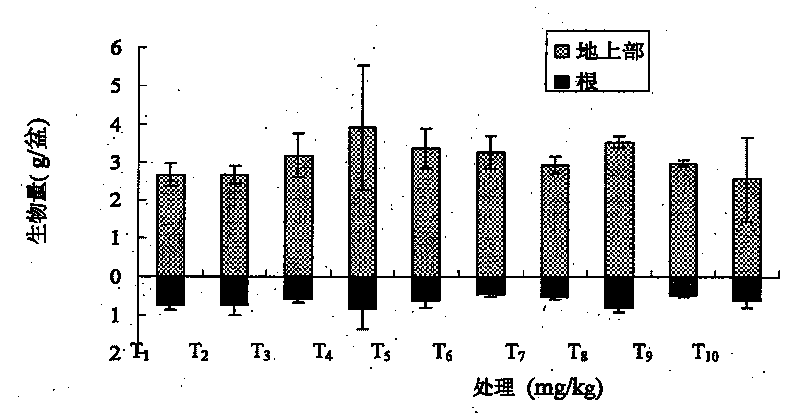
Figure 1 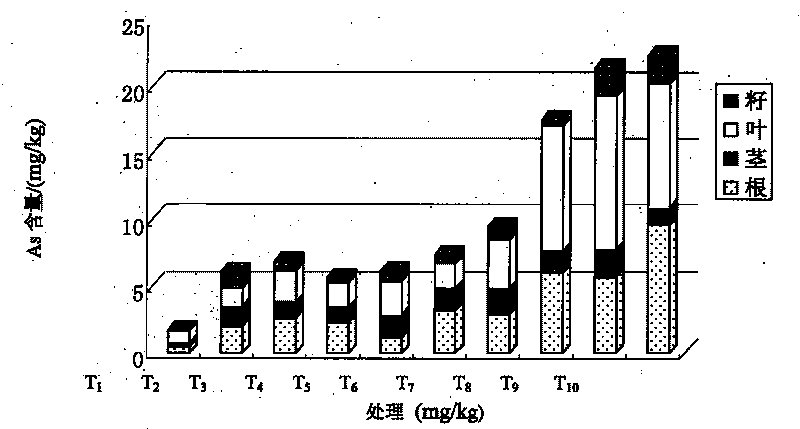
Figure 2 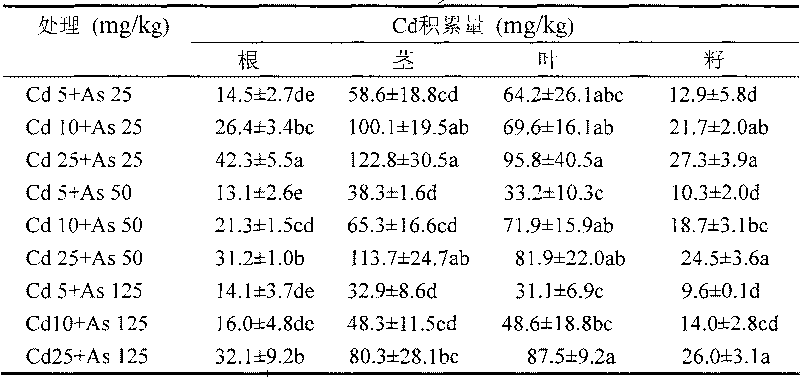
Figure 3
Abstract
Description
technical field
[0001] The invention belongs to the technical field of phytoremediation of polluted environment, and in particular relates to a method for remediating cadmium-arsenic compound polluted soil by using ghost needle grass. Background technique
[0002] Cadmium (Cd) and arsenic (As) are toxic pollutants widely distributed in the environment. Due to the discharge of industrial waste and unreasonable agricultural management measures, the Cd-As compound pollution in farmland soil is becoming more and more serious. Cd and As in soil environmental pollution come from a wide range of sources. In addition to natural factors, they mainly come from pesticides, pesticides, urban domestic sludge, and wastewater, waste gas, and waste residues discharged from mining, smelting, chemical, and leather industries (Document 1 : McGrath S P, Zhao F J, Lombi E.Plant andrhizosphere processes involved in phytoremediation of metal-contaminated soils[J].Plant Soil, 2001, 232:207-214. Li...
Examples
Embodiment Construction
[0013] The growth response of P. trifoliate under pollution conditions and the characteristics of arsenic absorption and accumulation are further explained in the following figure as a cadmium hyperaccumulator and arsenic rejection plant, which has certain utilization value for the control of arsenic pollution.
[0014]The test site is located in the Shenyang Ecological Experiment Station of the Chinese Academy of Sciences. The geographical location is 123°41′ east longitude, 41°31′ north latitude, and the altitude is about 50m. -164d, the annual precipitation is 650-700mm. The potting test soil was collected from the top soil (0-20cm) of the station. The soil type was meadow brown soil. Its physical and chemical properties were pH 6.56, organic matter 12.26g / kg, total N 0.91g / kg, total P 0.4g / kg, Total K 183g / kg, total Cd 0.17mg / kg, total Cu 32.9mg / kg, total Zn 28.1mg / kg, total Pb 11.1mg / kg, total As 2.1mg / kg.
[0015] After the test soil is air-dried and passed through a 4m...