
Preparation method of octahydrocyclopenta[C]pyrrole derivatives and salts thereof
A technology of pyrrole derivatives and octahydrocyclopentane, applied in the direction of organic chemistry and the like, can solve the problems of difficulty in realizing large-scale production, harsh control conditions, difficult source of raw materials, etc., and achieves the effects of low cost, easy availability of raw materials and high yield
Patent Information
- Authority / Receiving Office
- CN · China
- Current Assignee / Owner
- Publication Date
- 2013-09-04
Smart Images
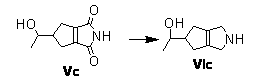
Figure 1 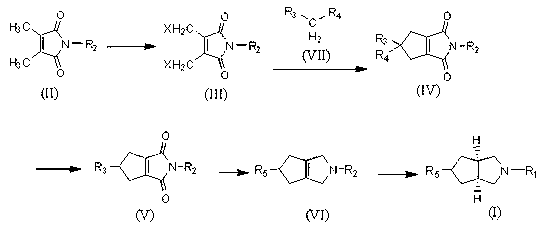
Figure 2 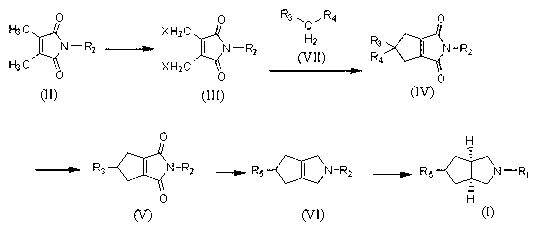
Figure 3
Abstract
Description
technical field
[0001] The invention relates to a preparation method of octahydrocyclopenta[C]pyrrole and its derivatives as a pharmaceutical intermediate and a drug synergistic structural fragment. Background technique
[0002] 5-Substituted octahydrocyclopenta[c]pyrrole and its derivatives can be used as pharmaceutical intermediates and drug synergistic structural fragments, which can significantly enhance the selectivity of the drug to the target, optimize the metabolic kinetics of the drug, especially in the Viral drugs and anti-tumor drugs based on multi-target tyrosine kinase inhibitors are increasingly widely used. At present, the literature synthesis methods of 5-substituted octahydrocyclopenta[c]pyrroles and their derivatives mainly include the following methods.
[0003] 1. In 1990, Daniel L Flynn et al. in Journal of Organic Chemistry, 55 , In 3673-3674, it was reported that dimethyl iodoallyl malonate was used as raw material, and M1 was obtained by free radic...
Examples
Embodiment 1
[0048] Example 1 The preparation of raw material formula II compound
[0049] The compound of formula II can be obtained by three methods, and is also named as formula IIa, formula II b. A compound of formula IIc.
[0050] 1. Synthesis of N-tert-butoxyacyl-3,4-dimethyl-1H-pyrrole-2,5-dione (structural formula IIa)
[0051]
[0052] 2,3-Dimethylmaleic anhydride (100g, 0.8mol) was dissolved in 900mL of toluene, ammonium acetate (70g, 0.9mol) was added under stirring, and the reaction was refluxed for 24h. After the reaction solution was cooled to room temperature, 500mL of water was added to stir evenly, and the layers were allowed to stand. The organic layer was taken, dried over anhydrous sodium sulfate, and the solvent was recovered under reduced pressure to obtain a white solid 2,3-dimethylmaleimide (formula A1) 90g, yield 90%.
[0053] 2,3-Dimethylmaleimide A1 (45g, 0.36mol) was dissolved in 250mL of anhydrous acetonitrile, and di-tert-butyl dicarbonate (87.3g, 0....
Embodiment 2
[0060] Example 2 Synthesis of 5-Hydroxymethyl-(3aR,6aS)-octahydrocyclopenta[C]pyrrole (Formula Ia)
[0061] 1. Synthesis of N-tert-butoxyacyl-3,4-dibromomethyl-1H-pyrrole-2,5-dione (structural formula IIIa)
[0062]
[0063] The compound of formula IIa (78g, 0.35mol), N-bromosuccinimide (249g, 1.4mol) and a catalytic amount of benzoyl peroxide were added to 3000mL of dichloromethane, and heated under reflux for 24h while stirring. After the reaction was completed, it was lowered to room temperature, filtered with suction, and the filter cake was washed with dichloromethane. The filtrates were combined, washed successively with water, saturated aqueous sodium chloride solution, anhydrous Na 2 SO 4 After drying, the solvent was reclaimed under reduced pressure to dryness to obtain 133g of the compound of formula IIIa. This step does not need to be purified and can be directly used in the next step reaction.
[0064] 2. Synthesis of 2-tert-butoxyacyl-5,5-diethoxyacyl-1,3-...
Embodiment 3
[0077] Example 3Synthesis of 5-aminomethyl-(3aR,6aS)-octahydrocyclopenta[C]pyrrole dihydrochloride (structural formula Ib)
[0078] 1. Synthesis of N-benzyloxyacyl-3,4-dichloromethyl-1H-pyrrole-2,5-dione (IIIb)
[0079]
[0080] Formula IIb (30g, 0.11mol), dichlorohydantoin (35.5g, 0.18mol) and a catalytic amount of azobisisobutyronitrile were added to 500mL of dichloromethane, and heated to reflux for 24h while stirring. After the reaction was completed, it was lowered to room temperature, filtered with suction, and the filter cake was washed with dichloromethane. The filtrates were combined, washed successively with water, saturated aqueous sodium chloride solution, anhydrous Na 2 SO 4 After drying, the solvent was recovered under reduced pressure to dryness to obtain 29 g of a syrupy compound of formula IIIb. This step does not need to be purified and can be directly used in the next step reaction.
[0081] 2. Synthesis of 2-benzyloxyacyl-5-cyano-1,3-dioxo-4,6-dihyd...