
Monofluorocyclopropane compounds as well as preparation method and application for same
A compound and alkyl technology, which is applied in the field of monofluorocyclopropane compounds and their preparation, can solve the problems of poor substrate universality, low conversion rate, poor enantioselectivity and diastereoselectivity, etc.
Patent Information
- Authority / Receiving Office
- CN · China
- Current Assignee / Owner
- Publication Date
- 2013-10-30
Smart Images
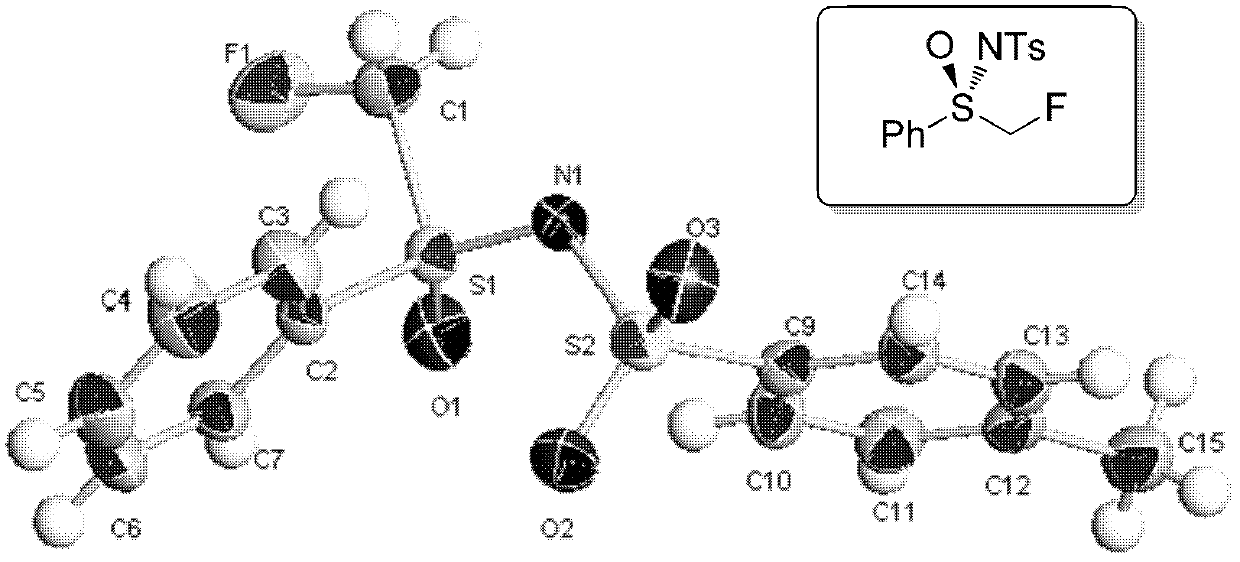
Figure 1 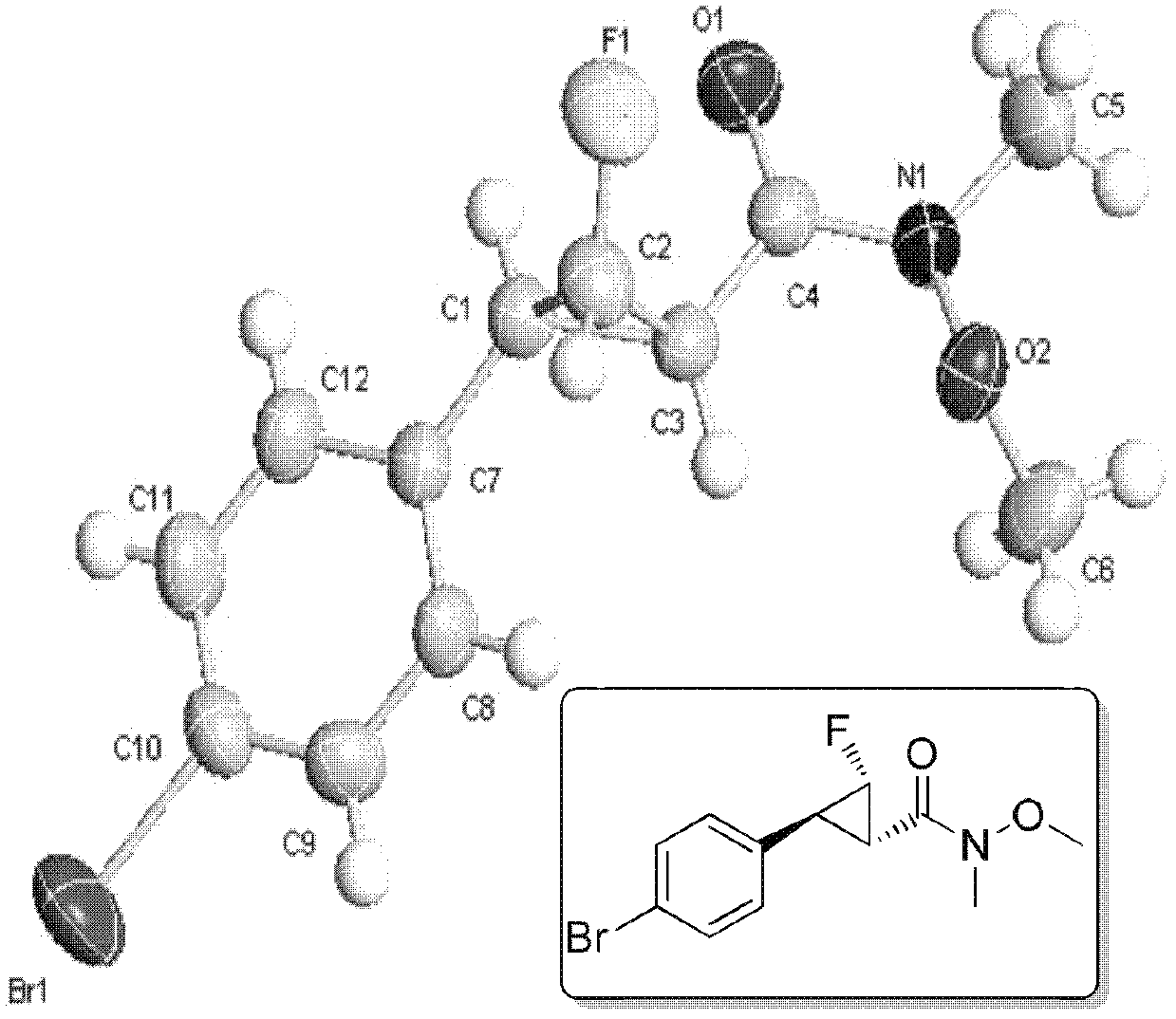
Figure 2 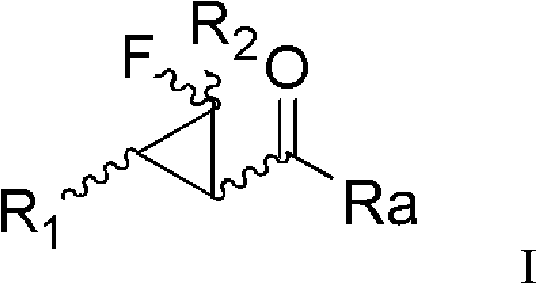
Figure 3
Abstract
Description
Technical field
[0001] The present invention relates to cyclopropane compounds, in particular to a monofluorocyclopropane compound, and a preparation method and application thereof. Background technique
[0002] Due to its special bonding, the cyclopropane structure is an important structural unit for many biologically active molecules. Many marketed drug molecules have cyclopropane structure, such as Odanacatib (cathepsin K inhibitor), Singulair (anti-asthma drug) and Ciprofloxacin (broad-spectrum antibiotic) (HWLiu, CTWalsh, Biochemistry of the Cyclopropyl Group. In The Chemistry of the Cyclopropyl Group; Rappoport, Z., Ed.; Wiley: New York, 1987, p 959; J. Salaün, Top. Curr. Chem. 2000, 207, 1. etc.). As the most electronegative element, fluorine atom has a small atomic radius (close to that of hydrogen atom). For example, the introduction of fluorine atoms into drug molecules can improve their metabolic stability and membrane permeability under the conditions of minimal cha...
Examples
preparation example Construction
[0134] Method for preparing compound of formula I
[0135] The method for preparing the compound of formula I provided by the present invention includes the steps:
[0136] (a1) The compound of formula IV is reacted with a fluorinating reagent to obtain a compound of formula II;
[0137] Or (a2) the compound of formula VI is reacted with an alkylating reagent to obtain a compound of formula II;
[0138]
[0139] (b) In an organic solvent and in the presence of a base, the compound of formula III reacts with the compound of formula II to form the compound of formula I,
[0140]
[0141] In each formula, R 1 , R 2 , Ra, Rb, R 4 The definition of is as before;
[0142] In another preferred embodiment, the fluorinating reagent may be a fluorinating reagent commonly used in the art. For example, the fluorinating reagent includes but not limited to: NFSI fluorinating agent, Selectfluor fluorine reagent, NFTh fluorinating agent, and NFOBS fluorine reagent. Chemical agent, nitrogen-fluoropyrid...
Embodiment 1
[0184] Synthesis of [(R)-N-p-toluenesulfonyl]monofluoromethyl phenyl sulfoximine ((R)-N-Tosyl-S-monofluoromethyl-S-phenylsulfoximine)
[0185]
[0186] Under the protection of nitrogen, 9.3 g (30 mmol) of [(S)-N-p-toluenesulfonyl]methylphenylsulfoximine and 150 ml of dry THF were added to a 250 ml three-necked flask, cooled to -78°C, and then NBuLi (1.6M, 33mmol, 1.1 equiv) was added dropwise, and after reacting at -78°C for half an hour, NFSI (12g, 1.2 equiv) was added. Spontaneously heat up to 25℃ and stir overnight, then add H 2 The reaction was quenched by O, and the organic layer was obtained by extraction with ether. The organic layer was washed with saturated brine, and MgSO was added 4 After drying, the solvent was evaporated and the product was obtained by column chromatography (6.4 g, yield 65%).
[0187] White solid. Melting point: 89-91°C. Optical rotation: [α] D 24 =+49.8°(c=1.00, CHCl 3 ). The enantiomeric excess was determined by a chiral column Lux 5u Amylose-2 (...
Embodiment 2
[0190] Synthesis of [(R)-N-p-toluenesulfonyl]-1-fluoroethylphenylsulfoximine ((R)-N-Tosyl-S-1-fluoroethy-S-phenylsulfoximine)
[0191]
[0192] Under the protection of nitrogen, add 1.96 g (6 mmol) of [(R)-N-p-toluenesulfonyl]fluoromethylphenylsulfoximine and 30 ml of dry THF into a 50 ml three-necked flask, and cool to -78°C. Then nBuLi (1.6M, 6.6mmol, 1.1equiv) was added dropwise, and after reacting at -78°C for half an hour, MeI (2.13g, 2.5equiv) was added. After reacting at -78℃ for 1 hour, the temperature was raised to 25℃ and stirred overnight, then H was added 2 The reaction was quenched by O, and the organic layer was obtained by extraction with ether. The organic layer was washed with saturated brine, and MgSO was added 4 After drying, the solvent was evaporated, and the product was obtained by column chromatography (1.54 g, yield 75%). One of the diastereoisomer data:
[0193] White solid. Melting point: 117-118°C. Optical rotation: [α] D 28 = +141.7° (c = 0.52, CHCl 3...