
A method for producing ethanol, butanol and acetone by segmenting mixed sugar containing pentose and hexose and mixed bacteria fermentation
A technology of mixed bacteria fermentation and mixed sugar, which is applied in the field of fermentation to produce ethanol, butanol and acetone, to reduce environmental pollution, ensure safety and promote diversification
Patent Information
- Authority / Receiving Office
- CN · China
- Patent Type
- Patents(China)
- Current Assignee / Owner
- Publication Date
- 2017-10-17
Smart Images
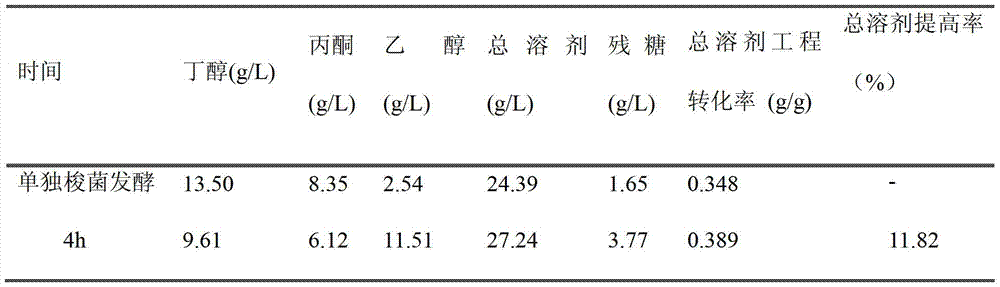
Figure 1 
Figure 2 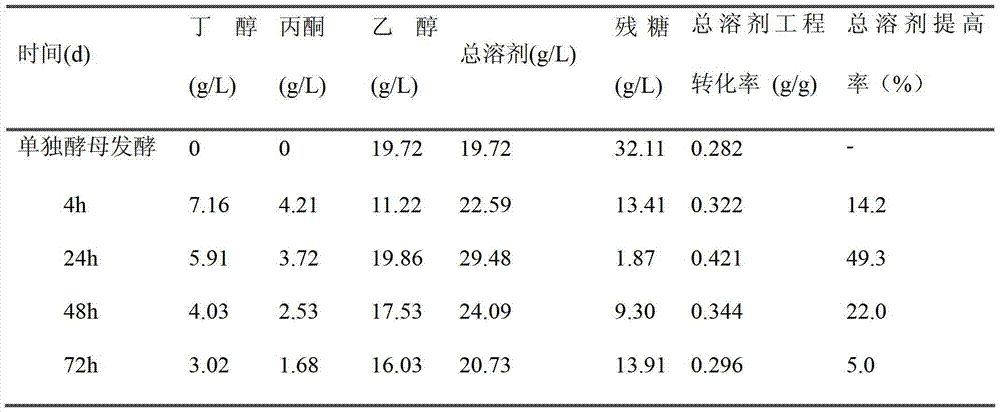
Figure 3
Abstract
Description
Technical field:
[0001] The invention relates to a method for producing ethanol, butanol and acetone by fermentation, in particular to a method for producing ethanol, butanol and acetone by segmenting mixed sugars containing pentose and hexose and fermenting mixed bacteria. Background technique:
[0002] With the rapid development of the global society and economy, the consumption of energy is increasing day by day. The total energy consumption will increase from the current 10 billion tons of oil to 16.2 billion tons of oil in 2025, with a growth rate of more than 50%. 2 emissions will also increase rapidly. On the other hand, according to the latest data, the proven reserves of oil, coal and natural gas in the world are 177 billion tons, 982.7 billion tons and 118×106 billion m3 respectively. 3 . Based on current mining and consumption rates, oil can only last for 40 years, while natural gas and coal can last for 65 and 162 years, respectively. Therefore, the pressure o...
Examples
Embodiment 1
[0020] Example 1: Production of ethanol, butanol and acetone by segmenting corn stalk hydrolyzate and mixed bacteria fermentation
[0021] The fermentation medium is: total sugar is 70g / l, of which pentose is 30g / l (accounting for 42.8% of total sugar), adding organic additives (mixed preparation of various agricultural and sideline products, rich in phosphorus and nitrogen, including bran, rice bran , bean cake powder and bean cake, etc.) 7g / l (the quality of the nitrogen source and phosphorus source is 10% of the total sugar mass in the hydrolyzate). Mix well, dispense into 250ml Erlenmeyer flasks, each Erlenmeyer flask is filled with 150ml. Sterilize at 135°C for 20 minutes in a sterilizer. After sterilization, cool to 37°C, insert Clostridium acetobutylicum, and anaerobically ferment at 37°C for 4 hours, 24 hours, 48 hours, and 72 hours, then respectively insert Saccharomyces cerevisiae at 28°C to continue anaerobic fermentation until the total fermentation time 144 ho...
Embodiment 2
[0025] Example 2: Select corn stalk hydrolyzate to segment and mix bacteria to ferment to produce ethanol, butanol and acetone
[0026] The fermentation medium is: total sugar is 70g / l, wherein pentose is 35g / l (accounting for 50% of total sugar), bran 35g / l is added (the quality of the nitrogen source and phosphorus source is the total sugar mass in the hydrolyzate 50% of Mix well, dispense into 250ml Erlenmeyer flasks, each Erlenmeyer flask is filled with 150ml. Sterilize at 115°C for 60 minutes in a sterilizer. After sterilization, cool to 28°C, insert Saccharomyces cerevisiae, and carry out anaerobic fermentation at 28°C for 4 hours, 24 hours, 48 hours, and 72 hours, respectively insert Clostridium acetobutylicum and continue anaerobic fermentation at 37°C until the total fermentation time 168 hours. After the fermentation is complete, get 1ml of fermented liquid and place it in a centrifuge tube, centrifuge for 7 minutes at a speed of 11000 rpm, and measure the conte...
Embodiment 3
[0029] Example 3: Production of ethanol, butanol and acetone by segmenting corn stalk hydrolyzate and mixed bacteria fermentation
[0030]The fermentation medium is: total sugar is 70g / l, of which pentose is 30g / l (accounting for 42.8% of total sugar), bean cake powder is added 14g / l (the quality of the nitrogen source and phosphorus source is the total sugar mass in the hydrolyzate 20% of Mix well, dispense into 250ml Erlenmeyer flasks, each Erlenmeyer flask is filled with 150ml. Sterilize at 115°C for 60 minutes in a sterilizer. After sterilization, cool to 37°C, insert Clostridium acetobutylicum, insert Saccharomyces cerevisiae after anaerobic fermentation at 37°C for 18 hours, and continue anaerobic fermentation at 28°C for 30 hours, 48 hours, 72 hours, 96 hours, 120 hours , 144 hours, 168 hours. After the fermentation is complete, get 1ml of fermented liquid and place it in a centrifuge tube, centrifuge for 7 minutes at a speed of 11000 rpm, and measure the contents ...