
Method for producing kojic acid by using immobilized Aspergillus oryzae to ferment molasses
A technology of Aspergillus oryzae and fermented sugar, which is applied in the field of producing kojic acid by using immobilized Aspergillus oryzae to ferment molasses, and can solve the problems of large environmental threat, increased alcohol production cost and the like
Patent Information
- Authority / Receiving Office
- CN · China
- Patent Type
- Patents(China)
- Current Assignee / Owner
- Publication Date
- 2016-08-17
Smart Images
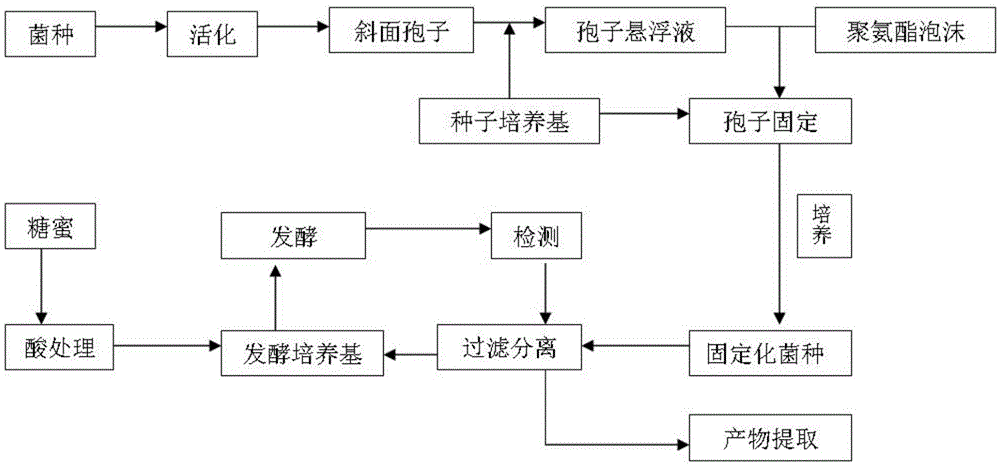
Figure 1
Abstract
Description
technical field
[0001] The invention belongs to the technical field of organic acid production, in particular to a method for producing kojic acid by using immobilized aspergillus oryzae to ferment molasses. Background technique
[0002] Molasses is a by-product of the production process of the sugar industry. It is a dark brown viscous liquid left after repeated cooking and crystallization of massecuite. It is rich in sugars, proteins, vitamins, biotin, amines, pigments, and phenols. Classes and other soluble substances. Molasses contains 30% to 40% of sucrose, 12% to 24% of invert sugar, 9% to 11% of colloid, and 10% to 20% of ash. It is rich in nutrients and is a renewable resource with great application potential. my country is the third largest sugarcane planting country in the world after Brazil and India, and the South Sugar Factory has very rich sugarcane molasses resources. According to the statistics of the National Bureau of Statistics, in 2011, the planting are...
Examples
Embodiment 1
[0033] (1) Preparation of Aspergillus oryzae spores
[0034] Streak-inoculate the frozen-preserved Aspergillus oryzae spores on the slant medium of the PDA test tube, culture at a temperature of 30°C for 4 days, then streak-inoculate the Aspergillus oryzae spores on the slant medium of the PDA test tube, and repeat the passage in the same way 3 to 4 generations of activated strains, until the spores completely cover the mycelium surface.
[0035] (2) Preparation of Aspergillus oryzae spore suspension
[0036] The mature Aspergillus oryzae spores obtained in step (1) were eluted with sterile physiological saline, and the spore eluate was treated in an ultrasonic cleaner for 10 seconds to fully break up the spores, and then filtered through 4 layers of gauze to remove the mycelium. Slowly add the seed medium to the filtered spore suspension to a final spore concentration of 10 7 ~10 6 individual / mL.
[0037](3) Fix Aspergillus oryzae spores on a polyurethane foam (low-densit...
Embodiment 2
[0048] Others are the same as in Example 1, the side length of the polyurethane foam (low-density sponge) carrier is changed to 4 mm, the acid-treated molasses is diluted with water to reduce the total sugar concentration of the molasses to 80 g / L, the pH is adjusted to 5.0, and sterilized under high temperature and high pressure. The liquid volume of the fermentation broth is 50mL / 250mL Erlenmeyer flask, the inoculum volume of immobilized bacteria is 10% (V / V), the temperature is 30°C, the shaker speed is 200 rpm, and the fermentation is for 10 days.
[0049] As determined by the ferric chloride colorimetric method, the concentration of kojic acid in the fermentation broth was 8.387g / L.
Embodiment 3
[0051] Others are the same as in Example 1, the side length of the polyurethane foam (low-density sponge) carrier is changed to 6mm, the acid-treated molasses is diluted with water to reduce the total sugar concentration of the molasses to 100g / L, the pH is adjusted to 6.0, and it is sterilized under high temperature and high pressure. The liquid volume of the fermentation broth is 60mL / 250mL Erlenmeyer flask, the inoculum volume of immobilized bacteria is 15% (V / V), the temperature is 32°C, the shaker speed is 220rpm, and the fermentation is for 10 days.
[0052] As determined by the ferric chloride colorimetric method, the concentration of kojic acid in the fermentation broth was 7.795g / L.