
Dark colored reactive dye with high fixation rate
A reactive dye and deep black technology, applied in organic dyes, dyeing methods, textiles and papermaking, etc., can solve problems affecting economic benefits, dye residues, and high chroma of dyeing residues
Patent Information
- Authority / Receiving Office
- CN · China
- Current Assignee / Owner
- Publication Date
- 2014-02-12
- Estimated Expiration
- Not applicable · inactive patent
Smart Images

Figure 1 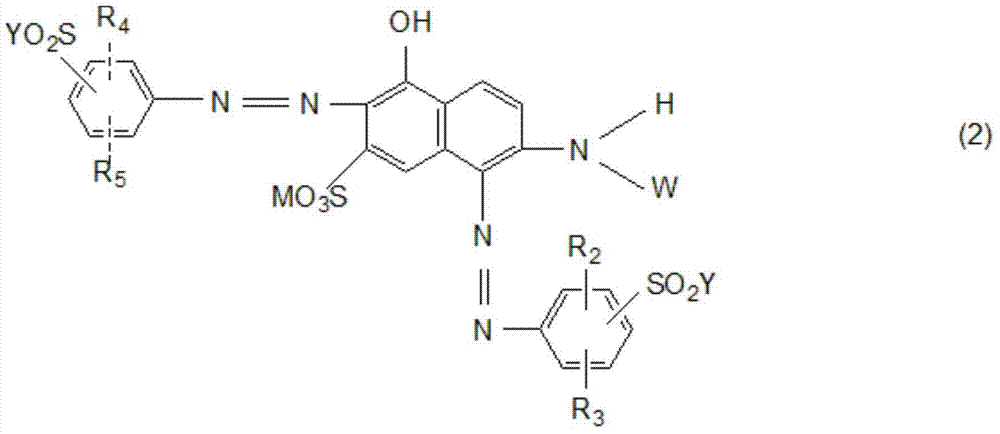
Figure 2 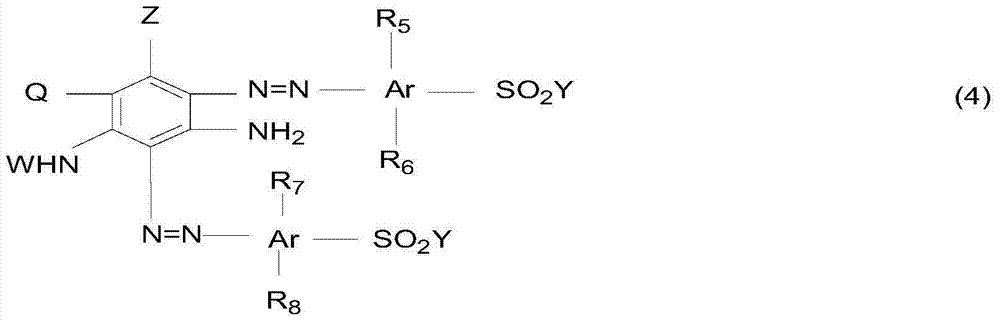
Figure 3
Abstract
Description
technical field
[0001] The invention relates to the technical field of chemical dyes, in particular to a reactive dye in the fine chemical industry. Background technique
[0002] Black reactive dyes are the most widely used and produced varieties of dyes. Since the 21st century, a large number of reactive black patents have come out, but so far, the vast majority of commercial reactive dyes still use C.I. reactive black. Such as Cibacron Black WNN, Cibacron Supra Black G, Supra Black R, etc. The advantages of these dyes are not only the better blackness of the dyed fabrics, but also the dyeing curves of the three primary colors have the same trend, and the compatibility is better. Related patents include CN200510047135.4, CN200510047136.9, WO2004069937, US6537332, USP5849887 and so on.
[0003] However, the main deficiency of the above-mentioned dyes is that the fixation rate of the dyes is only 60% to 65%, the chroma of the dyeing residue is high, and a large amount of ...
Examples
Embodiment 1
[0051] Mix 0.1mol of para-ester (compound 01) and 0.15mol of hydrochloric acid, add 350g of ice-water mixture, beat for 30min, add 30% NaNO dropwise from the liquid surface at 0~5℃ 2 Solution 0.1mol, keep NaNO during dropwise addition and reaction 2 excess. After diazotization to the end point, excess NaNO 2 Destroy with sulfamic acid.
[0052] Add 0.1mol-amino-8-naphthol-3,6-disulfonic acid (H acid) solution to the above diazonium salt, and carry out acidic coupling at 5-8°C. After the reaction is completed, add 0.1 mol of 2.4-bis(β-hydroxyethylsulfonyl sulfate) aniline diazonium salt dropwise to the above-mentioned acidic coupling monoazo dye reaction solution, and maintain 10°C and PH6~6.5 to react to the end . The navy blue component dye 101 was obtained after membrane separation to remove salt and spray drying.
Embodiment 2
[0054] Add 15g of sodium methanesulfonate to 10% J acid solution (0.1mol), and react at below 50°C for 4 hours to obtain 2-sulfomethylamino-5-naphthol-7-sulfonic acid solution. Add 0.1 mol para-ester diazonium hydrochloric acid solution to the above coupling components, control pH ≤ 2, and couple at 0-5°C until the reaction is complete. Add 0.2mol para-ester diazonium salt solution dropwise to the above-mentioned primary coupling solution, and gradually increase the pH to 6-6.2 at room temperature until the reaction is complete. Salt out, dry and pulverize to get the yellow component dye 301.
Embodiment 4
[0056] 45 parts of dye (101), 15 parts of dye (202), 12 parts of dye (301) and 10 parts of naphthalenesulfonic acid formaldehyde condensate are mixed in a mixing tank as dry powder, or dissolved together and then spray-dried to obtain black dyed cotton as dark black. It has good dyeing performance and satisfactory color fastness.